Research Procurement Information
Buy NAD+ for Research | RUO COA & Documentation Guide
For laboratory teams evaluating where to buy NAD+ for research, the priority is documentation, compound identity, and research-use-only (RUO) alignment. NAD+ (β-nicotinamide adenine dinucleotide) is a pyridine dinucleotide coenzyme catalogued by PubChem with the molecular formula C21H27N7O14P2 and a molecular weight of approximately 663.4 g/mol (PubChem CID 5893)[1] (CAS 53-84-9). It is a small-molecule cofactor rather than a peptide, so identity review focuses on the dinucleotide structure and purity.
Fast AnswerResearchers evaluating where to buy NAD+ for research should review RUO labeling, a batch-specific certificate of analysis (COA), HPLC purity data, LC-MS/UV or comparable identity support, structure/mass consistency, and lot traceability before procurement. Material discussed here is intended for laboratory research use only and is not for human or veterinary use.
What Does “Buy NAD+ for Research” Mean?
The phrase is addressed as laboratory research-procurement intent — how qualified researchers, institutions, and technical buyers evaluate an NAD+ reference material through documentation, analytical support, and labeling clarity, not personal, clinical, or consumer decision-making.
Compound Identity & Classification
| Compound name | NAD+ (β-nicotinamide adenine dinucleotide) |
| PubChem CID | 5893[1] |
| CAS number | 53-84-9 |
| Molecular formula | C21H27N7O14P2[1] |
| Molecular weight | ≈ 663.4 g/mol[1] |
| Classification | Pyridine dinucleotide coenzyme (small molecule) |
| Reported role | Redox cofactor in cellular-energy research[2] |
| Product form | Lyophilized powder |
| Purity target | ≥ 99% (see batch-specific COA) |
| Regulatory status | Research use only — not for human or veterinary use |
Pathway Context (NAD+ Metabolism & Cellular-Energy Research)
Published literature describes NAD+ within cellular-energy metabolism and NAD+-dependent enzyme research (for example, sirtuin and redox-pathway research) in cell and preclinical models[2][3]. On a research product page this pathway context should remain academic literature interpretation used to define the research lane — it is not converted into product-performance language.
COA, Purity & Identity Documentation
An NAD+ COA should be reviewed as a batch-specific record, not a marketing statement. Look for compound name, lot number, test date, stated purity, analytical method, identity confirmation, and structure/mass information. Purity, identity, method, and lot number should be evaluated together.
| Evaluation area | What to review | Why it matters |
|---|
| RUO labeling | Clear research-use-only language | Separates research procurement from human-use positioning |
| COA availability | Batch-specific certificate for the received lot | Supports lot-level documentation |
| Purity data | HPLC area-percent support for stated purity | Helps evaluate material consistency |
| Identity testing | LC-MS / UV / mass-spec confirmation vs expected structure | Confirms the material matches the listed compound |
| Lot traceability | Lot number matching across records | Supports research recordkeeping |
HPLC, LC-MS & Analytical Review
HPLC documentation supports purity assessment; LC-MS, UV, or mass-spectrometry documentation supports identity confirmation and molecular-mass review[10][11]. For a small-molecule dinucleotide, chromatographic purity and mass confirmation against the expected value are especially useful. ICH Q2(R2) describes validation characteristics used to interpret assay, purity, and identity results[7].
Lot Traceability & Batch Documentation
Lot traceability connects the product listing, COA, label, and receiving record. ISO/IEC 17025 addresses the competence of testing laboratories, and NIST resources describe how certificates and lot identifiers support traceability[8][9].
Claim Boundary for RUO Positioning
| Research-safe statement | Non-compliant version to avoid |
|---|
| “NAD+ is discussed in published literature on cellular-energy metabolism research.” | “NAD+ boosts energy or reverses aging.” |
| “Researchers should review COA and identity data before procurement.” | “Buy NAD+ for longevity.” |
| “Greatest Peptides supplies NAD+ as a research-use-only material.” | “Greatest Peptides supplies NAD+ for treatment.” |
Research Procurement Checklist
- Confirm the material is labeled for research use only.
- Review the batch-specific certificate of analysis for the received lot.
- Confirm purity is supported by HPLC analytical data.
- Confirm identity is supported by LC-MS, UV, or mass spectrometry.
- Compare compound name, formula, and mass across the page, label, and COA.
- Verify the lot number matches across all documentation.
- Document storage and handling conditions in the laboratory record.
How Greatest Peptides Presents NAD+
Greatest Peptides supplies NAD+ as a research-use-only laboratory material in lyophilized powder form, positioned around a stated ≥99% purity target, batch-specific COA availability, HPLC/LC-MS documentation, lot-level traceability, and transparent RUO labeling. Products are not intended for human or animal consumption, diagnostic, therapeutic, clinical, or veterinary use.
Published Literature Context
Published NAD+ literature spans coenzyme biochemistry and preclinical NAD+-metabolism research models[2][3]. Model-specific findings should not be generalized or interpreted as use guidance for research-use-only materials.
Contributing Researchers
Recognized for published work that shaped the scientific context discussed above
Shin-ichiro Imai, MD, PhD — authored foundational research on NAD+ biosynthesis and NAD+-dependent enzyme (sirtuin) biology[2].
Leonard Guarente, PhD — authored foundational research on NAD+-dependent sirtuins and cellular-energy research[3].
FAQs About Buying NAD+ for Research
What should researchers check before buying NAD+ for research?
Review RUO labeling, the batch-specific COA, stated purity with HPLC support, LC-MS/UV identity data, structure/mass consistency, and lot traceability.
What is NAD+ in research documentation?
NAD+ (β-nicotinamide adenine dinucleotide) is a pyridine dinucleotide coenzyme with molecular formula C21H27N7O14P2 and a molecular weight near 663.4 g/mol.
Why does a COA matter when buying NAD+?
It connects the listing to batch-specific documentation: compound name, lot number, test date, purity, and identity method for the received lot.
Is NAD+ intended for human or animal use?
No. Material discussed here is intended strictly for laboratory research use only.
How should published literature be interpreted?
As scientific context only. Model-specific findings should not be generalized or read as use guidance for research-use-only materials.
This page addresses NAD+ only as research-use-only laboratory procurement. Boundary-sensitive terms such as energy, aging, metabolism, and longevity are referenced here only as research-language examples that must stay separate from RUO product positioning. All product information is for informational and educational purposes only. Products are not intended for human or animal consumption and have not been evaluated by the FDA to diagnose, treat, cure, or prevent any disease.
References
- National Center for Biotechnology Information. NAD+, CID 5893. PubChem Compound record. Accessed 2026.
- Imai S, Guarente L. NAD+ and sirtuins in aging and disease. Trends in Cell Biology. 2014. PMID 24838415.
- Rajman L, Chwalek K, Sinclair DA. Therapeutic potential of NAD-boosting molecules: the in vivo evidence. Cell Metabolism. 2018. PMID 29514064.
- Registry record for NAD+, CAS 53-84-9. Accessed 2026.
- IUPAC nomenclature for nucleotides and coenzymes. Recommendations.
- U.S. FDA. Analytical procedures and methods validation for drugs and biologics. 2015.
- U.S. FDA. Q2(R2) Validation of Analytical Procedures. 2024.
- International Organization for Standardization. ISO/IEC 17025:2017. 2017.
- National Institute of Standards and Technology. Reference materials and certificates of analysis. Accessed 2026.
- General HPLC methodology for small-molecule purity analysis. Analytical chemistry literature.
- General LC-MS methodology for small-molecule identity confirmation. Analytical chemistry literature.
Compound profile
NAD+: compound profile, literature landscape and handling notes
NAD+ in one paragraph
NAD+ is nicotinamide adenine dinucleotide, and it is the odd item in this catalog: it is not a peptide, it is not a receptor ligand, and it is not an experimental molecule. It is a coenzyme that was first detected in yeast extracts in 1906 and has been under continuous study ever since, which makes it one of the most thoroughly characterized small molecules in all of biochemistry. That inverts the usual problem. For most listings here the difficulty is that too little is known; for this one the core biochemistry is settled to textbook standard and the contested part is entirely downstream, in the literature on whether adding NAD+ or its precursors to a system meaningfully changes what that system does. The sections below separate the two, because conflating them is the single most common error in secondary writing about this compound. Everything here describes the published research record and the behavior of the material on a bench. Nothing here is a claim about what this vial does, and nothing here is applicable to use in humans or animals.
Where NAD+ came from
The story of NAD+ begins as a story about fermentation. In 1906 Arthur Harden and William Young were working out why cell-free yeast juice loses its ability to ferment sugar over time, and they showed that the activity could be restored by adding back a boiled, dialyzed fraction of the same juice. Boiling ruled out a protein; passage through a dialysis membrane established that the active material was small. They had separated an enzyme from its required small-molecule partner, and the name they gave that partner, cozymase, records exactly that relationship. Harden shared the 1929 Nobel Prize in Chemistry with Hans von Euler-Chelpin, whose laboratory did much of the work of establishing that cozymase was a nucleotide.
The functional half of the story belongs to Otto Warburg and Walter Christian in the 1930s. They identified the nicotinamide portion as the business end of the molecule and established that the coenzyme works by accepting and donating hydrogen, which is the hydride-transfer chemistry described in the next section. Warburg's group also characterized the phosphorylated relative now called NADP+. The older names for the two, diphosphopyridine nucleotide and triphosphopyridine nucleotide, abbreviated DPN and TPN, appear throughout the mid-century literature and are worth recognizing when reading it.
The third thread is nutritional. Pellagra had been shown by Joseph Goldberger to be a dietary disorder rather than an infection, and in 1937 Conrad Elvehjem's group showed that nicotinamide corrected the canine equivalent, black tongue. That closed a loop that few other molecules can claim: a deficiency disease, a dietary factor, and a coenzyme structure were connected to each other within roughly three decades. Nicotinamide and nicotinic acid became vitamin B3, and NAD+ became the reason a vitamin was required at all.
The practical consequence for a research buyer is that the identity, structure, spectroscopy and enzymology of this molecule are not in dispute anywhere. Any uncertainty in the modern literature is about flux, compartments and intervention, not about what the compound is.
Reading the structure of NAD+
NAD+ is a dinucleotide, and reading the name backwards is the fastest way to see it. Two nucleotide halves are joined tail to tail through a pyrophosphate bridge. One half is nicotinamide mononucleotide: nicotinamide attached through a beta-N-glycosidic bond to the C1 position of a ribose, with a phosphate on the ribose C5. The other half is adenosine monophosphate: adenine on its own ribose, again phosphorylated at C5. Joining the two phosphates gives the diphosphate linkage that holds the molecule together. The formula, mass and salt form for this listing are printed in the specification table further down this page and are not restated here; note only that material of this kind is supplied either as the free acid or as a sodium salt, often hydrated, and that the three forms differ in formula weight, so the number on the table is the number to weigh against rather than any generic value from a textbook.
The redox chemistry lives entirely in the nicotinamide ring. That ring is a pyridine derivative, and in NAD+ the ring nitrogen is quaternized by the glycosidic bond to ribose, which makes it a pyridinium cation. That fixed positive charge is what the plus sign in NAD+ denotes. It is not a statement about the net charge of the whole molecule, which also carries the ionized phosphates, and misreading it as net charge is a common error.
Reduction happens at the carbon opposite the ring nitrogen, position 4. A hydride, meaning two electrons and a proton traveling together, adds to C4. The ring loses its aromatic pyridinium character and becomes a 1,4-dihydronicotinamide, the positive charge is gone, and the molecule is now NADH. Because the substrate being oxidized usually gives up two hydrogens while only one is transferred as hydride, the balanced reaction is conventionally written as NADH plus a free proton, which is why the term appears in so many equations. The transfer is also stereospecific: C4 becomes a prochiral center, and individual dehydrogenases add and remove hydride from one defined face, a fact established with deuterium labeling and still used to classify enzymes.
NADP+ differs by a single phosphate group esterified to the 2 position of the adenosine ribose, far from the reactive ring. Chemically the hydride transfer is the same. Biologically the phosphate acts as a recognition tag that lets enzymes distinguish the two pools, and cells hold those pools at very different oxidation states. The NAD+ to NADH ratio is kept high, favoring the oxidized form, so that catabolic dehydrogenases have oxidant available; the NADPH to NADP+ ratio is kept high in the opposite direction, so that reductive biosynthesis and antioxidant systems have a reservoir of reducing equivalents. One phosphate, two economies.
The target and the pathway in more detail
NAD+ has no receptor, and any description written in receptor language is wrong from the first sentence. It has two distinct classes of partner, and the difference between them is the conceptual center of the modern literature.
The first class is the dehydrogenases and oxidoreductases, several hundred of them, which use NAD+ as a redox cofactor. Glyceraldehyde-3-phosphate dehydrogenase in glycolysis, lactate dehydrogenase, alcohol dehydrogenase, malate and isocitrate dehydrogenases in the citric acid cycle, and on the other side of the ledger complex I of the respiratory chain, which re-oxidizes NADH and feeds the electrons into ubiquinone. The defining feature of this class is that NAD+ is not consumed. It cycles between oxidized and reduced forms, potentially thousands of times, and what matters physiologically is the ratio between the two forms rather than the total amount. A cell can be limited by its NAD+ to NADH ratio while its total nicotinamide adenine dinucleotide content is unchanged, and much of the classical literature on redox state is about exactly that distinction.
The second class consumes the molecule. Several enzyme families cleave the glycosidic bond between nicotinamide and its ribose, releasing free nicotinamide and using the ADP-ribose portion for chemistry. Sirtuins are NAD+-dependent deacylases: they strip acetyl and other acyl groups from lysine residues on histones and hundreds of other proteins, transferring the acyl group onto ADP-ribose rather than releasing it as a free acid, which is why they need NAD+ stoichiometrically and why the released nicotinamide acts as a product inhibitor of their own reaction. The PARP family builds poly(ADP-ribose) chains, most prominently in response to DNA strand breaks, and extensive PARP activation is a large and rapid NAD+ sink. CD38 is an ectoenzyme that hydrolyzes NAD+ and cyclizes part of it to cyclic ADP-ribose, a calcium signaling metabolite. SARM1, a more recent addition, is a TIR-domain NADase implicated in the published work on regulated axon degeneration.
That second class is why NAD+ has a turnover problem at all. A cofactor that is recycled needs to be made once; a substrate that is cleaved has to be replaced continuously. Because both roles draw on the same pool, anything that raises consumption, from DNA damage signaling to elevated ectoenzyme activity, competes with redox metabolism for the same molecules. The entire body of work on NAD+ availability, including the reported age-associated declines discussed below, is built on that competition rather than on anything resembling receptor pharmacology.
What the published literature on NAD+ actually measures
The published NAD+ literature separates cleanly into settled biochemistry and contested intervention work, and a citation is only useful once you know which of the two it belongs to.
Biosynthesis is settled. Mammalian cells make NAD+ by three routes. The de novo route starts from tryptophan and runs through the kynurenine pathway to quinolinic acid; the Preiss-Handler route starts from nicotinic acid; and the salvage route, which carries most of the flux in most tissues, recaptures the nicotinamide released by sirtuins, PARPs and CD38. In salvage, nicotinamide phosphoribosyltransferase, NAMPT, converts nicotinamide to nicotinamide mononucleotide, and this step is the reported rate-limiting one. Nicotinamide mononucleotide adenylyltransferases, NMNAT1 through NMNAT3, then complete the molecule, and they are compartment-specific, with the isoforms distributed between nucleus, cytosol and mitochondria. That compartmentalization matters more than it looks: pools are not freely interchangeable, and a whole-cell measurement averages over compartments that may be moving in opposite directions. Identification of SLC25A51 as a mammalian mitochondrial NAD+ transporter is comparatively recent and sharpened this picture considerably.
Pharmacological tools exist for the pathway. FK866, also called daporinad, is a well-established NAMPT inhibitor used throughout the bench literature to lower cellular NAD+ deliberately, and it is a far more common experimental manipulation than NAD+ addition.
The intervention literature is where care is needed. Most of it uses precursors rather than NAD+ itself, principally nicotinamide riboside and nicotinamide mononucleotide, because these are the forms with a plausible uptake route. The published trials in humans are generally small, short, and measure blood or peripheral blood mononuclear cell concentrations of NAD+ and related metabolites by mass spectrometry. That is worth stating plainly: the primary endpoint in most of these reports is a pharmacokinetic one. It establishes that an orally supplied precursor raises measurable metabolite concentrations in an accessible compartment. It does not establish a functional consequence, and it says nothing directly about the tissues that are usually the reason anyone was interested.
Alongside this sits a body of work reporting that tissue NAD+ concentrations decline with age in rodent models and, in a smaller set of reports, in human tissue. CD38 has been proposed as a driver of that decline, with much of the supporting work coming from a relatively small number of groups. The observation is repeated far more often than it is independently reproduced, and the magnitude reported varies substantially with tissue and with extraction method.
Where the NAD+ literature is thin or frequently misread
The central and most consequential gap is a physical one. Intact NAD+ is a large, highly polar molecule carrying ionized phosphates and a permanent pyridinium charge, and molecules of that description do not cross intact plasma membranes to any useful extent. What happens instead, on the prevailing reading of the published work, is that extracellular NAD+ is degraded at the cell surface. CD73, an ecto-5-nucleotidase, and CD38 progressively strip the molecule down to nicotinamide mononucleotide, then to nicotinamide riboside and nicotinamide, and it is those smaller species that enter the cell and are rebuilt inside. Direct transport of intact NAD+ through connexin 43 hemichannels has been proposed and remains contested rather than established.
The consequence is blunt and worth writing on the wall of any laboratory working with this material. Adding NAD+ to a system and raising the intracellular NAD+ concentration of that system are not the same experiment, and a study that performs the first and reports the second has assumed the step it was supposed to demonstrate. Any in vitro experiment in which NAD+ is added to culture medium and an effect is observed has an obligation to distinguish the intact molecule from its degradation products, ideally by running the candidate breakdown products as separate arms and by inhibiting or removing the relevant ectoenzymes. A large fraction of published NAD+ addition experiments does not do this.
The second gap is species extrapolation. Rodent salvage flux, CD38 expression and baseline tissue NAD+ concentrations are not human values, and the age-associated decline literature is heavily weighted toward mice. Transferring an effect size across that gap is not supported by the data.
The third is the endpoint problem already noted: precursor trials predominantly demonstrate that a metabolite concentration moved. Reading a metabolite increase as a functional finding is the most common misuse of that literature in secondary sources.
The fourth is measurement itself. NAD+ turns over rapidly and is chemically labile under exactly the conditions used to extract it, so reported tissue concentrations depend strongly on how quickly the sample was frozen and how it was extracted. Numbers from different methods are frequently not comparable, and disagreements in the literature that look biological are sometimes analytical.
How NAD+ behaves in solution
The single most useful bench fact about NAD+ is that it and its reduced form are labile under opposite conditions, and the pairing is a classic. NAD+ is alkali-labile. In alkaline solution the electron-poor C4 of the pyridinium ring is attacked by hydroxide and other nucleophiles, and the molecule degrades quickly, with the rate climbing steeply as pH rises above neutrality. NADH is the reverse: it is acid-labile, decomposing readily in mildly acidic solution, while being comparatively stable in alkali. Working solutions of NAD+ are therefore prepared at neutral to slightly acidic pH, and NADH solutions at neutral to slightly alkaline pH, and the two should not be stored under the same conditions out of convenience. This inverse behavior is not merely a nuisance; it is exploited deliberately in analysis, as described in the next section.
The reactivity at C4 is general, not specific to hydroxide. Cyanide, bisulfite and various carbonyl compounds all add at that position to give adducts, which is why buffer composition matters more here than for an inert reagent, and why an unexplained loss of activity should prompt a look at what else is in the solution.
As a solid, the material is hygroscopic. A vial that has been opened at cold temperature and allowed to draw in condensation will gain water, which corrupts any subsequent weighing and accelerates degradation of the remaining solid. Allowing a container to reach room temperature before opening is a small habit that avoids a large error.
Freeze-thaw cycling degrades solutions measurably, so single-use aliquots are the right pattern rather than repeated returns to a stock. Prepared solutions are not indefinitely stable even when frozen, and the sensible assumption is that a solution is a short-lived working reagent rather than a stored one.
Degradation has a visible signature that is genuinely useful. Alkaline degradation products of NAD+ are yellow and fluorescent, so a solution that was colorless when prepared and is now visibly yellow has told you something before you have run a single measurement. Discard it rather than correcting for it. A solution that fails to dissolve cleanly, or that develops any haze or particulate, is likewise not a candidate for careful work.
Analytical notes specific to NAD+
The defining analytical feature of this compound is that the oxidized and reduced forms have different ultraviolet spectra, and almost the whole of enzymology rests on that fact. Both NAD+ and NADH absorb strongly near 260 nanometers, which is the adenine chromophore and is essentially unaffected by the redox state of the nicotinamide ring. Only NADH absorbs at 340 nanometers. NAD+ has no meaningful absorbance there at all. Reduction therefore creates a new band where there was none, and the classical molar absorptivity of NADH at 340 nanometers, 6220 per molar per centimeter, is one of the most heavily used constants in the field. Every dehydrogenase assay that follows a reaction at 340 nanometers is reading exactly this transition.
The same relationship serves as a purity check running in the opposite direction. A preparation of NAD+ should show its 260 nanometer band and effectively nothing at 340 nanometers; measurable absorbance at 340 indicates reduced material is present. Suppliers of NADH quote the ratio of the two absorbances as a specification for the same reason, with the ratio reporting on oxidized contamination. A spectrum cannot distinguish NAD+ from NADP+, since the extra phosphate is nowhere near either chromophore.
Chromatography here does not resemble peptide chromatography, and methods do not transfer. NAD+ is a small polar anionic species, and on a conventional reversed-phase column with an acidic aqueous-acetonitrile gradient it is poorly retained and elutes close to the void volume, unresolved from related nucleotides. The methods that work are ion-pairing reversed-phase, using an alkylamine or tetraalkylammonium additive to give the anion something to retain against, or hydrophilic interaction chromatography, which retains polar analytes on a polar stationary phase with a high-organic mobile phase. Either will separate NAD+ from NADP+, from nicotinamide mononucleotide and from free nicotinamide, which a spectrum will not.
For mass spectrometry, the permanent pyridinium charge makes positive-mode ionization straightforward, which is slightly unusual for a nucleotide-like analyte.
The orthogonal confirmation a chromatogram cannot provide is an enzymatic one. Supplying the material to a well-characterized dehydrogenase, traditionally alcohol dehydrogenase, and watching the 340 nanometer band appear demonstrates that the molecule is a functional coenzyme and not merely something with the right retention time and mass. Enzymatic cycling assays, in which the coenzyme is shuttled repeatedly between oxidized and reduced forms while a colorimetric indicator accumulates, extend the same principle to very low concentrations and are the standard approach for quantifying the coenzyme in biological extracts. Combining a cycling assay with the acid and alkali differential extraction implied by the stability behavior above, in which one extract preserves the oxidized form and destroys the reduced form and the other does the opposite, is how the two pools are measured separately.
Compounds researchers confuse with NAD+
| Often mistaken for | How it actually differs from NAD+ |
|---|
| NADH | The two-electron-reduced form of the same molecule, not a different compound. It carries a hydride at C4 of the nicotinamide ring, has lost the pyridinium positive charge, absorbs at 340 nanometers where NAD+ does not, and is acid-labile where NAD+ is alkali-labile. Anything written about one applies to the other only after checking which form the assay or the storage condition requires. |
|---|
| NADP+ and NADPH | Identical chemistry at the reactive ring, differing only by a phosphate on the 2 position of the adenosine ribose. That phosphate is a recognition tag: enzymes select one pool or the other, and cells hold the NADP pool strongly reduced for biosynthesis and antioxidant defense while holding the NAD pool strongly oxidized for catabolism. Ultraviolet spectra cannot tell them apart, so identity here rests on chromatography or mass. |
|---|
| Nicotinamide mononucleotide (NMN) | One half of NAD+, the nicotinamide-ribose-phosphate portion without the adenosine. It is the immediate biosynthetic precursor, made by NAMPT and converted to NAD+ by the NMNAT enzymes. It is also one of the species that extracellular NAD+ is degraded into at the cell surface, which is precisely why experiments adding NAD+ and experiments adding NMN can be harder to distinguish than they look. |
|---|
| Nicotinamide riboside (NR) | Nicotinamide attached to ribose with no phosphate at all. It enters the pathway through the nicotinamide riboside kinases, which phosphorylate it to NMN, so it sits one step further back than NMN does. It is the precursor with the largest number of published human trials, and those trials predominantly report blood metabolite concentrations rather than functional endpoints. |
|---|
| Nicotinamide and nicotinic acid (niacin) | The two vitamin B3 forms, and neither is NAD+. Nicotinamide is the fragment released whenever a sirtuin, PARP or CD38 cleaves NAD+, and it re-enters through salvage; it is also a product inhibitor of sirtuins, which complicates any experiment that generates a lot of it. Nicotinic acid enters by the separate Preiss-Handler route. Different entry points, different pathway enzymes. |
|---|
| MOTS-c | The other item in this catalog associated with mitochondrial metabolism, and a useful contrast rather than a relative. MOTS-c is a short peptide encoded in mitochondrial DNA whose reported mechanism runs through AMPK-linked signaling, which is a signaling hypothesis about a peptide. NAD+ is a coenzyme participating directly in enzyme chemistry. Shared vocabulary, entirely different level of description. |
|---|
Questions specific to NAD+
Is NAD+ a peptide, and does peptide methodology apply to it?
No on both counts. NAD+ is a dinucleotide coenzyme with no amino acids and no sequence, built from nicotinamide, adenine, two riboses and a pyrophosphate bridge. It is not made by solid-phase synthesis, so the impurity classes that dominate peptide work, such as deletion sequences and incomplete couplings, have no analog here. The relevant impurities are hydrolysis and degradation products, the reduced form, and the phosphorylated relative NADP+. Analytical methods differ accordingly: the reversed-phase gradients used for peptides barely retain this molecule, and the 214 nanometer peptide-bond detection that underlies peptide purity figures is not the right handle for a nucleotide chromophore.
If NAD+ does not readily cross the plasma membrane, what is a cell in NAD+-supplemented medium actually exposed to?
On the prevailing reading of the published work, a mixture. Ectoenzymes at the cell surface, including CD38 and the ecto-5-nucleotidase CD73, progressively degrade extracellular NAD+ to nicotinamide mononucleotide, then nicotinamide riboside and nicotinamide, and those smaller species are what the cell takes up and reassembles internally. The practical implication is that an effect observed after adding NAD+ to medium has several candidate causes, only one of which is intact NAD+. Distinguishing them requires running the degradation products as separate arms and, where possible, inhibiting or removing the ectoenzymes. Experiments that skip this cannot attribute the effect to the molecule they added.
Why is NAD+ described as both a cofactor and a substrate?
Because it genuinely is both, in different reactions, and the distinction drives most of the modern literature. In dehydrogenase chemistry it is a cofactor: it accepts a hydride, becomes NADH, is re-oxidized elsewhere, and returns to the pool intact. Nothing is consumed and the meaningful quantity is the ratio between the oxidized and reduced forms. In sirtuin, PARP and CD38 chemistry it is a substrate: the bond between nicotinamide and its ribose is cleaved, nicotinamide is released, and the ADP-ribose portion is used for something else. That reaction consumes the molecule, so the pool has to be continuously rebuilt by the salvage pathway. Total content and redox ratio are therefore two different measurements answering two different questions.
Why do NAD+ and NADH need opposite pH conditions on the bench?
It comes from the ring chemistry. In NAD+ the nicotinamide ring is an electron-poor pyridinium cation, and position 4 is open to attack by nucleophiles, hydroxide among them, so the oxidized form degrades quickly as pH rises above neutral. In NADH that position already carries a hydride and the ring is no longer a pyridinium, but the dihydro ring is instead susceptible to acid-catalyzed reactions, so the reduced form degrades in mildly acidic conditions and is comparatively stable in alkali. Keep NAD+ solutions neutral to slightly acidic and NADH solutions neutral to slightly alkaline. The same inverse behavior is what allows the two pools to be extracted separately from a biological sample.
What does an absorbance reading at 340 nanometers tell me about a NAD+ preparation?
It reports on reduced material. NAD+ has no meaningful absorbance at 340 nanometers, while NADH has a strong band there, so a preparation intended to be the oxidized form should show its 260 nanometer adenine band and effectively nothing at 340. Measurable 340 nanometer absorbance means reduced material is present, whether from the manufacturing route or from subsequent handling. Note the limits of the check: the spectrum is blind to the difference between NAD+ and NADP+, since the extra phosphate sits away from both chromophores, and it will not resolve nicotinamide mononucleotide or free nicotinamide either. For those, chromatography or mass measurement is required.
Should a reported age-associated decline in NAD+ be read the same way in every tissue?
No, and treating it as a single uniform finding is one of the more common misreadings. The reports vary by tissue, by species, and by extraction and quantification method, and the compound is labile under exactly the conditions used to extract it, so how fast a sample was frozen and how it was processed influence the number obtained. Much of the work is in rodents, and the proposed role of CD38 in the decline rests on a comparatively small number of groups. The honest description is that a decline has been reported in specific tissues under specific methods, that reproduction across methods is uneven, and that magnitude figures should not be transferred across species or across assays.
This listing sits near vitamin and cofactor products in the catalog. Are those related compounds?
Commercially adjacent, chemically unrelated. The vitamin B12 solution in this catalog is cobalamin, a cobalt-centered corrinoid coenzyme whose chemistry is organometallic and involves carbon-cobalt bond homolysis, which has nothing in common with hydride transfer at a pyridinium ring. The lipotropic blend listed nearby contains B-vitamin components and is a formulated mixture rather than a single characterized coenzyme. The only genuine relative of NAD+ among the vitamins is B3 itself, nicotinamide and nicotinic acid, which are pathway precursors rather than substitutes. Grouping by shelf position is not grouping by chemistry, and records should reflect the latter.
NAD+: Documentation, Handling and Quality Record for This SKU
The section above covers what NAD+ is and what the published literature has looked at. This section is the operational half: what physically arrives when you order this listing, what paperwork comes with it, which fields on that paperwork are worth reading closely, and how to log the material once it is on your bench. It is written for the person who has already decided the compound is relevant and now has to justify the purchase to a supervisor, a grant line or an internal quality process.
Everything below is scoped to this exact listing rather than to research peptides in general. If you want the general version — how to read a certificate of analysis from scratch, what HPLC and mass spectrometry each prove, how to compare two suppliers who both claim 99% — that is on the home page guide, and there is no reason to read it twice.
What ships when you order NAD+
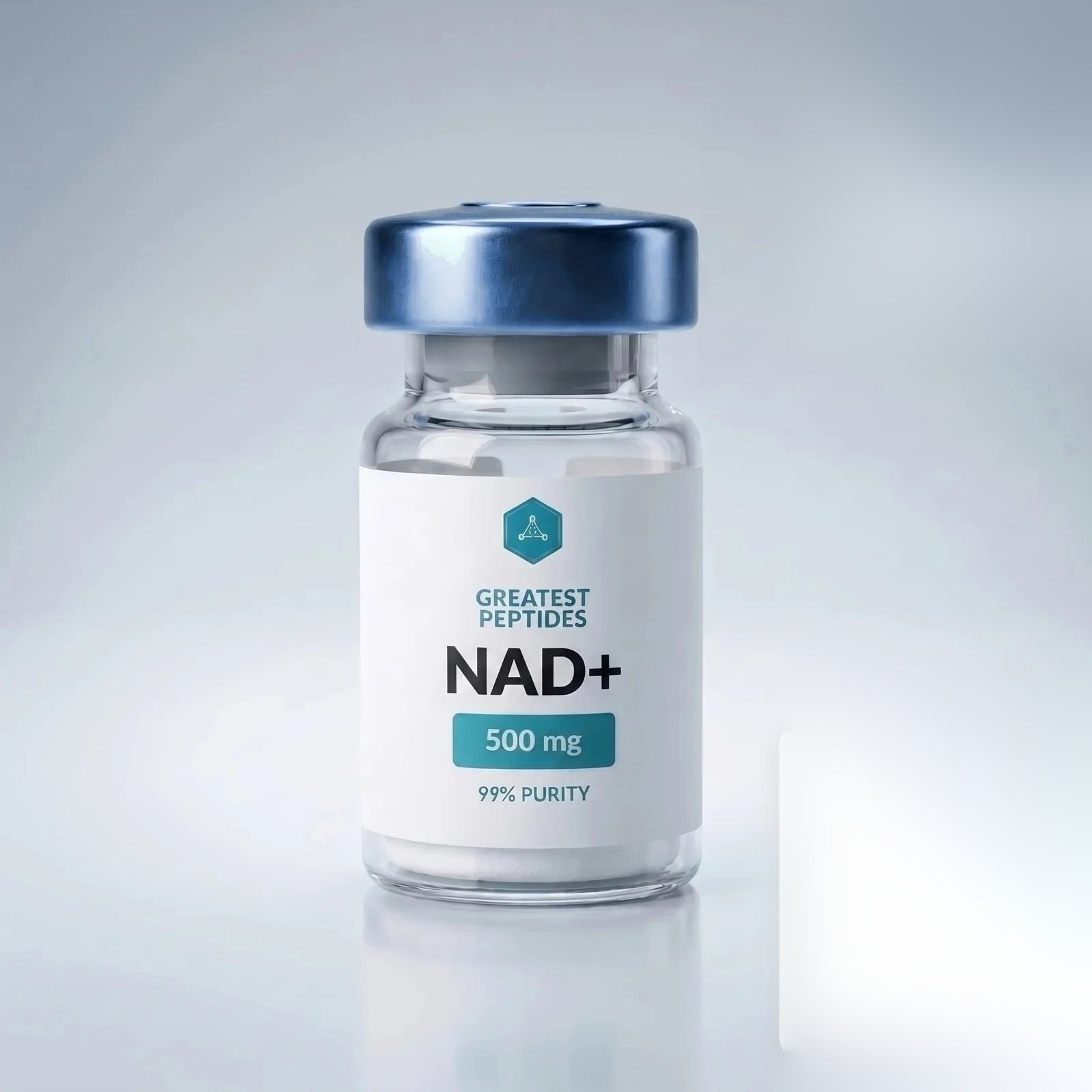
At a glanceOne sealed vial of lyophilized material at the listed 500 mg fill, labeled for research use only, dispatched within 24 hours of the order clearing. Batch documentation is available for the lot you receive. Free shipping applies at $150 and above.
This listing is a single fixed presentation, not a size selector. That is deliberate: each presentation gets its own page, its own documentation trail and its own URL, so a citation or a purchase-order line that points at NAD+ at 500 mg points at exactly one thing. If you need a different fill of the same compound and it is not listed, it is not currently in stock rather than hidden behind a dropdown.
| Field | This listing |
|---|
| Listing | NAD+ |
| Labeled fill mass | 500 mg |
| Physical form | Lyophilized powder in a sealed vial |
| Catalog category | Metabolic & Mitochondrial Compounds |
| Compound class | Mitochondrial and cofactor research compound |
| Intended use | Research use only. Not for human or veterinary use, not for diagnostic use, not a drug or supplement. |
| Dispatch | Within 24 hours of the order clearing |
| Documentation | Batch analytical documentation available for the lot supplied |
| Free shipping threshold | Orders of $150 and above |
Specification summary for NAD+
The table below is the specification the store publishes for this listing. It is reproduced here from the product record itself rather than retyped, which means it cannot drift away from what the attribute table further up the page says. Where a field is absent it is absent because we do not publish it for this SKU, not because it was left out of this summary.
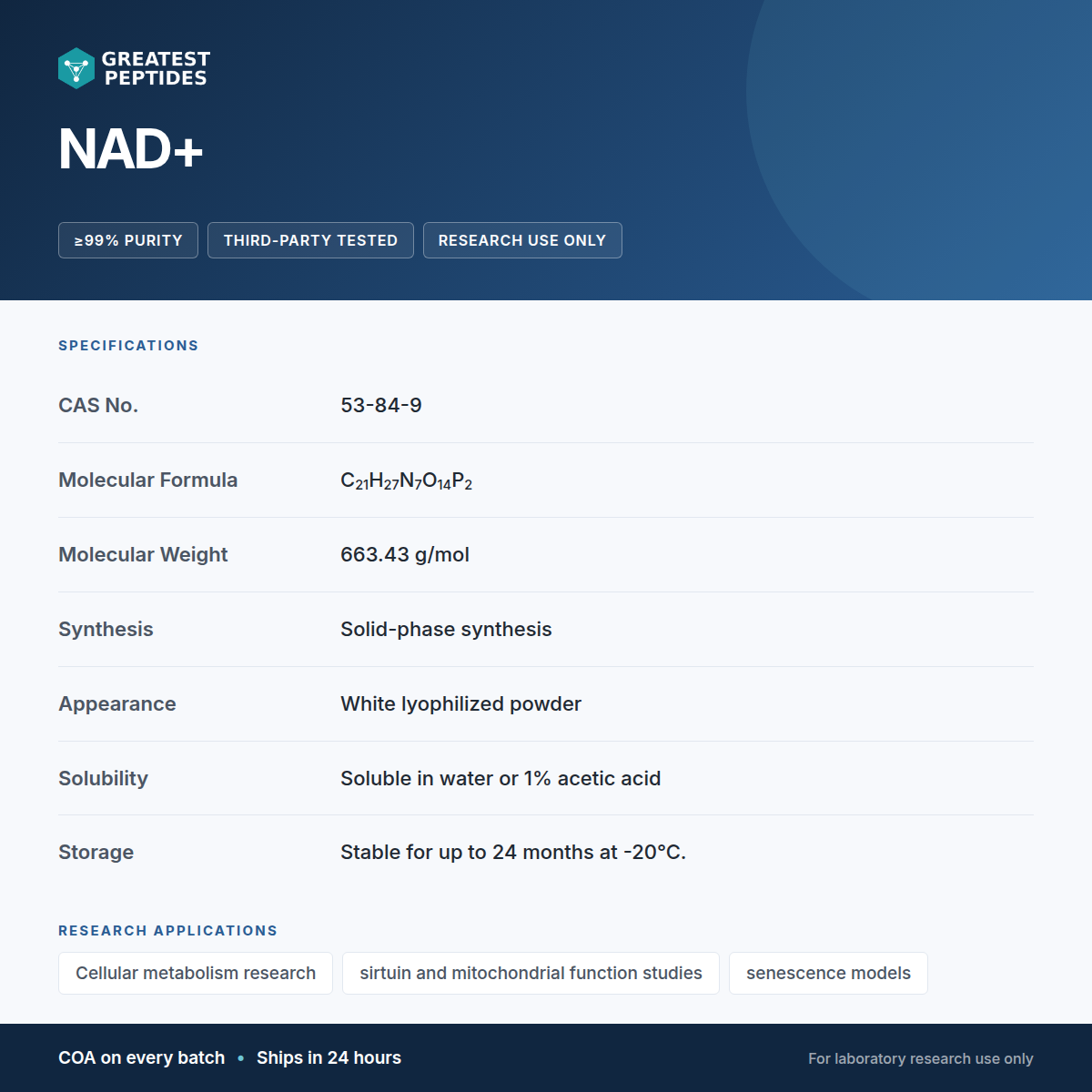
| Size | 500 mg, 1000 mg |
| CAS No. | 53-84-9 |
| Purity | ≥99% |
| Sequence | N/A (NAD+ is not a peptide) |
| Molecular Formula | C21H27N7O14P2 |
| Molecular Weight | 663.43 g/mol |
| Synthesis | Solid-phase synthesis |
| Solubility | Soluble in water or 1% acetic acid |
| Stability & Storage | Stable for up to 24 months at -20°C. After reconstitution, may be stored at 4°C for up to 4 weeks or at -20°C for up to 6 months. |
| Applications | Cellular metabolism research, sirtuin and mitochondrial function studies, senescence models |
| Appearance | White lyophilized powder |
| Shipping Conditions | Shipped at ambient temperature; once received, store at -20°C |
| Regulatory/Compliance | Manufactured in a facility that adheres to cGMP guidelines |
| Safety Information | Refer to provided MSDS |
A specification table is a claim, and a claim is only worth the record behind it. Every field above is one you can ask us to substantiate against the batch documentation for the lot you were sent. If a field ever fails to match the paperwork, that is a defect on our side and we would rather hear about it than not.
Cofactor and mitochondrially encoded material in this group is often assayed by methods borrowed from small-molecule chemistry rather than peptide chemistry, so the certificate may reference a different analytical convention than a standard peptide COA.
The analytical record behind this lot
A certificate of analysis is not a quality badge. It is a measurement report about one specific batch, produced on a specific date by a specific method, and its value to you is entirely a function of how much of that context it discloses. For NAD+ the fields worth checking first are the ones that tie the document to the container in your hand.
| Field on the certificate | Why it matters for this SKU |
|---|
| Lot or batch identifier | Ties the document to the vial. A certificate with no lot reference describes some batch, not necessarily yours. |
| Compound name and, where applicable, sequence | This is the identity claim. For a mitochondrial and cofactor research compound it is the field that distinguishes the material from its close relatives. |
| Analytical method and conditions | A purity figure without a method is a number without units. Column, gradient and detection wavelength change what the figure means. |
| Date of analysis | Establishes how old the measurement is relative to the material. A recent vial with a two-year-old certificate is a documentation gap. |
| Who performed the analysis | In-house and independent third-party results are both legitimate; they are not the same claim, and the document should say which it is. |
| The chromatogram or spectrum itself | A summary table can be typed by anyone. A trace can be read, and a reader who knows the compound class can tell whether it is plausible. |
What our documentation for NAD+ does assert is what the analysis measured on the batch that was tested. What it does not assert — and no certificate from any supplier can assert — is that the material is safe, that it is suitable for any use in humans or animals, or that it will reproduce a result reported in a published paper. Those are different questions and a purity figure is not evidence for any of them.
Our batch documentation policy, including how to request the record for a lot you already have, is on the certificate of analysis page. If you need the record before ordering rather than after, ask us through the contact page and reference this listing by name.
How NAD+ is checked before it reaches this catalog
Three questions have to be answered separately before a compound gets a page here, and collapsing them into one percentage is the most common way a supplier listing becomes misleading.
| Question | What answers it | What it does not tell you |
|---|
| Identity — is this the right molecule? | Mass determination, and sequence confirmation where the material is a defined chain | Nothing about how much of the vial is that molecule |
| Purity — what proportion of the detected material is the target? | Chromatographic separation with a stated method | Nothing about what the other fraction actually is, unless the impurities are themselves identified |
| Content — how much target material is actually in the container? | Quantitative determination against the labeled fill | Nothing about identity or purity; a vial can be accurately filled with the wrong thing |
For NAD+, respirometry, mitochondrial membrane potential assays and metabolite quantification are the assay formats the published work in this area tends to use, which matters when you are deciding whether the material as supplied is fit for the experiment you have in mind. A compound that is clean enough for a binding assay is not automatically clean enough for a quantitative cell-based readout where a co-eluting impurity could carry activity of its own.
Content is the field most often missing from a supplier listing, and it is the one that changes your arithmetic. A vial labeled 500 mg contains that much total solid, and total solid includes counter-ion, residual water and whatever else survived the process. If you need the peptide mass rather than the vial mass to be exact, that is a specific request to make in advance, not an assumption to carry into a calculation.
Receiving, inspecting and storing NAD+
The most useful five minutes you will spend on this material are the five minutes immediately after the package is opened, because that is the only moment at which you can still distinguish a transit problem from a handling problem of your own.
- Confirm the label on the container matches this listing, including the fill mass, and record the lot identifier in your notebook before anything else happens.
- Inspect the closure and seal. A compromised closure is a reason to stop, not a reason to proceed carefully.
- Look at the cake. Note its appearance and position; a cake that has collapsed, shifted or gone glassy is telling you something about the vial's history in transit.
- Let a cold vial reach room temperature before opening it, so that atmospheric moisture condenses outside the vial rather than into the material.
- Photograph the label and the container on arrival. It costs nothing and it settles later questions instantly.
- Store it in the dark, at the temperature stated for this listing, and write down the date it entered storage.
- Decide your aliquot plan before the first opening, not after it.
Cofactor material in this group is more prone to oxidative change than a plain peptide chain, and headspace air in a partly used vial is part of that exposure.
The general rule for lyophilized material is that the dry state is the stable state and every transition away from it costs you something. Freeze-thaw cycling is the specific mechanism most likely to degrade NAD+ after it reaches you, and it is entirely under your control: a single reconstitution split into pre-planned aliquots exposes the material once, while repeatedly warming and refreezing one container exposes it as many times as you open it. There is a fuller treatment of the mechanism in our guide on freeze-thaw cycles in peptide research materials and on storage and handling.
Preparing aliquots from a 500 mg vial: the measurement arithmetic
This is arithmetic, not guidance. The only thing the table below does is tell you what concentration you are holding after you have added a known volume of diluent to a vial labeled 500 mg, so that the figure in your notebook and the figure in the container are the same figure. It says nothing about how much material any experiment should use, and it is not applicable to any use in humans or animals.
| Diluent added | Resulting concentration | Amount in 0.1 mL | Amount in 0.05 mL | Aliquots of 0.25 mL |
|---|
| 1 mL | 500 mg/mL | 50,000 µg | 25,000 µg | 4 |
| 2 mL | 250 mg/mL | 25,000 µg | 12,500 µg | 8 |
| 3 mL | 166.67 mg/mL | 16,666.7 µg | 8,333.3 µg | 12 |
| 5 mL | 100 mg/mL | 10,000 µg | 5,000 µg | 20 |
Every figure above is the same division: the labeled mass of NAD+ divided by the volume of diluent added. Nothing in the table is a recommendation about how much material to use in an experiment — it is the arithmetic that tells you what concentration you are holding once you have added a known volume, so that the number you write in the notebook matches what is in the container.
Two things routinely go wrong at this step. The first is treating the labeled mass as the peptide mass; as noted above, the labeled figure is total solid unless the documentation says otherwise, so a concentration derived from it is a nominal concentration. Say so in your methods rather than implying a precision the specification does not support. The second is ignoring the volume the solid itself occupies — small at these masses, but not zero, and it means the final volume is very slightly greater than the volume you added.
If you want to work backwards from a target concentration to a diluent volume, or to check a figure against a different vial size, our peptide reconstitution calculator does the same division in both directions and shows its working.
What to record for NAD+ so the work is reproducible
Reproducibility in this area fails at the material-provenance step far more often than at the analysis step. The fields below are the ones that let somebody else — a reviewer, a collaborator, or you in eighteen months — work out whether two sets of results were generated with comparable material.
- Supplier and the exact listing name, including the fill size, rather than just the compound name
- Lot identifier, and the date the batch documentation was issued
- Date received, and the storage conditions and location it went into
- Date of reconstitution, the diluent used and its lot, and the volume actually added
- Nominal concentration obtained, stated as nominal rather than as measured
- Aliquot scheme: how many, what volume, stored where
- Freeze-thaw count for each aliquot at the point of use
- Any deviation from plan, including deviations that seemed unimportant at the time
- Whether the material was research-use-only labeled, which for this listing it is
Comparing suppliers on this exact SKU
Comparing NAD+ across suppliers on price alone is comparing two numbers that may not describe the same thing. These are the questions that make the comparison meaningful, with our answers next to them so you can hold us to the same standard you would hold anyone else.
| Question to ask any supplier | Our answer for this listing |
|---|
| Is batch documentation available for the specific lot I will receive, not a representative lot? | Yes — the record is tied to the lot supplied. Policy on the certificate of analysis page. |
| Does the analytical method appear on the document, or only the result? | The method context belongs on the document; a bare percentage is not a complete record. |
| Is the labeled figure total solid or target-compound mass? | Labeled as the fill for this presentation. If you need the distinction resolved for a calculation, ask before ordering. |
| Is the listing labeled research use only throughout, without use claims? | Yes, and deliberately so. No use, benefit or outcome is claimed anywhere on this page. |
| How quickly does it dispatch, and is that a promise or an average? | Within 24 hours of the order clearing. |
| Can I reach a person about the paperwork rather than only about the order? | Yes — the contact page reaches us directly. |
| Is there a published position on what the documentation does not prove? | Yes. It is stated on this page and on every product page. |
A supplier who answers all seven honestly is a better bet than a supplier who is ten percent cheaper and answers four. A supplier who cannot answer the first one at all is not selling you documented material; they are selling you a container.
Compliance boundary for NAD+
NAD+ is supplied for laboratory research use only. It is not a drug, not a supplement, not a cosmetic and not a medical device. It is not for human or veterinary administration, not for diagnostic use, and not for use in food. That is not a disclaimer bolted onto a sales page — it is the actual scope of what is being sold, and it constrains what can honestly be written about it.
| Language that stays inside the boundary | Language that does not |
|---|
| "Supplied for research use only" | Any phrasing that implies a personal or clinical use |
| "Published work in this area has examined mitochondrial function markers, oxidative-stress endpoints and cellular energetics" | "NAD+ does X" stated as an established effect |
| "Purity determined by the stated method on the tested batch" | "Pharmaceutical grade", "medical grade", "safe" |
| "Concentration arithmetic for preparing laboratory aliquots" | Anything framed as a dose, a protocol or a schedule |
| "Not for human or veterinary use" | Silence on the point, which readers correctly interpret as evasion |
| Naming the model system a finding came from | Reporting an animal or in-vitro finding as though it were a human finding |
The reason to be precise about this is not only regulatory. Research literature on this class of material is genuinely interesting and genuinely incomplete, and overstating it makes the real findings harder to see. Where published work is referenced on this site it is referenced as what was measured, in what system, at what scale — not as a property of the vial.
Other Metabolic & Mitochondrial Compounds listings
These share a catalog category with NAD+, which means the documentation and handling considerations above largely transfer to them. Their compound-specific sections do not — each has its own identity, its own literature and its own analytical profile.
| Listing | Price |
|---|
| AOD9604 10 mg | $42.99 Original price was: $42.99.$37.99Current price is: $37.99. |
| MOTS-c (Human) 10 mg | $44.99 Original price was: $44.99.$39.99Current price is: $39.99. |
The full catalog is on the shop page, and the longer written material is in our research guides.
Questions about ordering NAD+
Is NAD+ documentation available before I order?
Yes. Ask through the contact page and reference this listing by name. Our general position on batch documentation is on the certificate of analysis page. If a supplier will not show you the record until after payment has cleared, that is worth noticing.
What does the 500 mg figure on the label actually refer to?
It is the labeled fill for this presentation. For lyophilized material the labeled mass is total solid unless the documentation states otherwise, and total solid includes counter-ion and residual moisture as well as target compound. If your calculation depends on the distinction, resolve it against the batch record rather than assuming.
How fast does NAD+ ship?
Within 24 hours of the order clearing. Orders of $150 and above ship free. Transit time after dispatch depends on the service selected at checkout.
Can I buy NAD+ for personal use?
No. This material is supplied for laboratory research use only. It is not a drug, supplement or cosmetic, it is not for human or veterinary administration, and nothing on this page should be read as guidance for any such use.
How should NAD+ be stored before and after reconstitution?
Store the sealed vial dry, dark and at the temperature stated for this listing, and record the date it entered storage. Once material is in solution the useful discipline is to minimize repeated warming: plan the aliquot scheme before the first reconstitution so the material is exposed once rather than once per experiment. Cofactor material in this group is more prone to oxidative change than a plain peptide chain, and headspace air in a partly used vial is part of that exposure.
How much diluent should I add to a 500 mg vial?
That depends entirely on the concentration your protocol calls for, which is your decision and not something a product page can answer. What the table above provides is the arithmetic: labeled mass divided by added volume gives concentration. The reconstitution calculator runs the same division in either direction.
Does a high purity figure mean NAD+ is safe?
No, and this is the single most common misreading of a certificate of analysis. Purity describes what proportion of the detected material was the target compound in the batch that was tested, by the method stated. It is not a safety assessment, it says nothing about suitability for any use in humans or animals, and it does not become a safety claim by being a large number.
What is NAD+ classified as in your catalog?
It is listed as a cofactor or mitochondrially encoded sequence, in the Metabolic & Mitochondrial Compounds category. Published work in this area has looked at mitochondrial function markers, oxidative-stress endpoints and cellular energetics. That is a description of where the literature sits, not a claim about what the material does.
Do you have more general written material on evaluating research peptides?
Yes. The home page guide covers reading a certificate of analysis, what chromatographic and mass-spectrometric methods each prove, and how to compare suppliers. The research guides go deeper on individual topics, and the FAQ covers ordering, shipping and post-shipping questions.
NAD+ is supplied strictly for laboratory research use. It is not a drug, supplement, cosmetic or medical device; it is not for human or veterinary use, not for diagnostic use and not for use in food. No statement on this page is intended to describe a therapeutic use, benefit or outcome, and references to published work describe what was measured in the reported model system rather than a property of the material supplied. Purchasers are responsible for handling the material in accordance with the requirements applicable to their institution and jurisdiction.