

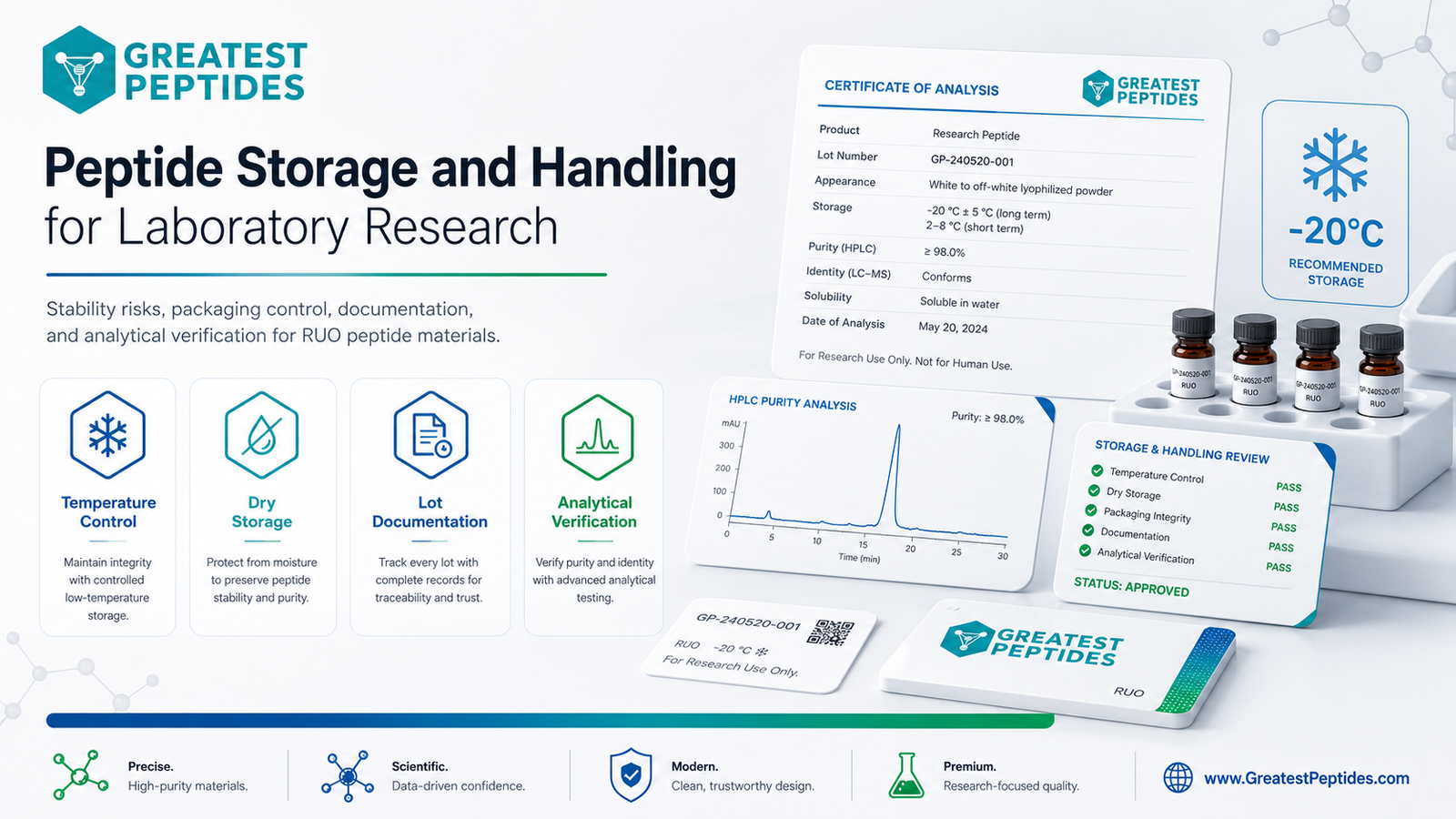
Proper storage preserves the integrity of research peptides and keeps analytical documentation meaningful. This guide summarizes the storage and handling practices RUO laboratories use to maintain lyophilized and reconstituted research materials, and how those practices connect to the Certificate of Analysis (COA).
Why storage matters for RUO materials
Peptides are sensitive to temperature, moisture, and repeated handling. A batch that ships at documented purity can degrade if stored improperly, which undermines the value of the COA and any downstream measurements. Storage is therefore part of documentation discipline, not an afterthought.
Lyophilized powder
Lyophilized (freeze-dried) peptides are generally the most stable form. Common laboratory practice is to keep sealed vials desiccated and frozen (for example at -20°C), protected from light, until reconstitution. Allowing a vial to reach room temperature before opening helps limit condensation inside the vial.
Reconstituted solutions
Once reconstituted, stability is typically shorter and depends on the diluent and peptide. Solutions are usually refrigerated and used within a documented window. Bacteriostatic water (sterile water with 0.9% benzyl alcohol) is a common reconstitution diluent because the preservative supports multi-draw workflows in a research setting.
Handling and documentation
Record the lot number, storage temperature, reconstitution date, and diluent in the laboratory record. Confirm that the compound name, purity, and lot on the label match the COA. This chain of records is what makes a result traceable.
Research use only. Products discussed are intended strictly for in-vitro laboratory research and are not for human or veterinary use.
The short version
The article above sets out the storage temperatures and the record-keeping habit. This expansion covers the layer underneath: the equipment, the physical handling, and the paperwork system that decide whether those temperatures mean anything. Most material that degrades in a well-run lab does not degrade because someone chose the wrong setpoint. It degrades because a frost-free freezer heats its own evaporator twice a day, because a vial was opened while still cold enough to pull water out of the room air, because a stopper was cored on the fourth entry, because a dilute solution bound to the walls of an untreated tube, or because a label fell off in the frost and nobody could prove which lot was in the box. What follows is a set of comparison tables for freezer classes, moisture failure modes, vial access methods, adsorption losses, preservative scope, and label and inventory fields.
Freezer hardware, defrost cycles and shelf position
The number on the front panel is the least interesting thing about a freezer. What matters is how stable that number is, how far the cabinet strays between cycles, and where in it a given vial actually sits.
Frost-free units are built around a heating element that periodically warms the evaporator coil to clear ice, then lets the compressor pull the cabinet back down, typically every few hours to half a day. The cabinet air, and everything with low thermal mass sitting in it, rides that ramp upward and back. For a small sealed vial of lyophilized powder each cycle is a moisture-mobility and headspace event rather than a melt, but the cycles accumulate over months. For anything already in solution, the excursion can carry material through its freezing point and back repeatedly without anyone opening the door. That is the hidden hazard in an otherwise reasonable setup: the freezer is doing exactly what it was designed to do, and its design goal is a dry cabinet, not stable contents.
Manual-defrost units, chest or upright, hold a much flatter curve because nothing deliberately heats the cabinet. The trade is that frost builds until somebody schedules a defrost, which means having a validated place to put the contents and a record showing where they went.
Position inside the cabinet matters as much as the class of unit. The door shelf is the worst location available: it takes a slug of ambient room air every time the door opens, it is farthest from the evaporator, and in an upright unit it is where the warmest air collects. Interior positions toward the rear are consistently the most stable. The only way to know for a specific unit is to map it: loggers at several positions, a week of normal door traffic, and read the spread rather than assume it.
Logging turns assumption into evidence. A minimum and maximum thermometer gives the extremes but not their shape or frequency. A data logger at a defined interval shows the defrost sawtooth, the door-opening spikes, and the drift that precedes a compressor failure, and it produces a file you can attach to the lot record when a result later looks wrong.
How each class of cold storage behaves, and what that means for a sealed vial.
| Storage option | Temperature behavior | Practical consequence |
|---|---|---|
| Frost-free domestic freezer | Deliberate warming cycles every few hours to clear coil ice | Contents ride repeated ramps; poor for anything in solution |
| Manual-defrost domestic freezer | Flat between compressor cycles; frost builds until defrosted | Better stability, but you must plan and document the defrost |
| Laboratory -20 degrees C, alarmed | Tight band, alarm on excursion, usually manual defrost | The normal working choice for sealed lyophilized material |
| Ultra-low -80 degrees C | Very stable, large thermal mass, slow to recover after a long opening | Margin for long holds and frozen solutions; longer equilibration |
| Refrigerator, 2 to 8 degrees C | Stable but above freezing; frost-free models still cycle | Short in-use windows for reconstituted material, not long holds |
| Door shelf of any unit | Largest swings in the cabinet, driven by door traffic | Never for material you care about; use it for empty racks |
Power loss is the contingency most labs have not written down. A full cabinet holds cold far longer than an empty one, so filling dead space with sealed water bottles is cheap insurance. The most useful rule during an outage is to keep the door shut, because every opening trades hours of hold time for seconds of curiosity. Decide in advance what the trigger points are, who gets called, where material moves to, and how the excursion is recorded, then keep that page at the freezer rather than in a drive nobody can reach with the power out.
Condensation, desiccants and the cost of opening cold
A vial pulled from a freezer is far below the dew point of ordinary room air. The moment its seal is broken, water condenses on the glass, on the exposed face of the stopper, and then on the material itself. The governing variable is the room dew point, not the relative humidity figure people usually quote: at a comfortable bench temperature and middling humidity the dew point sits well above freezing, so every surface at freezer temperature condenses. Air conditioning does not remove this, and a humid day makes it worse.
Equilibration is therefore not a courtesy step, it is the step that decides whether water enters the vial. How long it takes depends on mass, glass thickness, packaging, and air movement: a small vial in still air needs a meaningful stretch, while a rack or a vial inside a foam shipper needs far longer, because the thermal mass around it is what you are actually warming. The reliable field test is not a timer but the absence of any cold feel on the glass and of any visible film. If frost is still present outside, the inside is still cold.
The trick that removes most of the risk is to warm the vial inside a sealed bag or a small desiccator, which holds a fixed pocket of air so the condensation lands on the bag rather than the vial. Open it only once the contents are at room temperature.
Why this matters comes down to what a lyophilized cake is. Freeze drying produces a porous solid with enormous internal surface area, and the common counter ions from synthesis and purification are themselves water attracting. Absorbed water plasticizes the cake, lowers the temperature at which it loses its glassy structure, and turns a fluffy plug into a collapsed or sticky mass. It also mobilizes the chemistry, since hydrolysis and deamidation both depend on water availability. A tacky cake is not automatically ruined, but it says the moisture barrier failed.
Desiccant belongs in the storage box, not loose in the cabinet, and indicating silica gel earns its premium by telling you when it is spent. Fresh from a bag it is often already partly loaded, so drying it before first use and regenerating on a schedule is what separates a desiccant from a decoration.
Moisture-related observations and what each one is telling you.
| What you observe | Most likely cause | Reasonable next step |
|---|---|---|
| Cake collapsed, shrunken or glassy | Water uptake plasticized the solid, or a warm excursion | Treat as a stability flag; re-analyze before quantitative use |
| Powder tacky or stuck to the stopper | Repeated condensation events on opening | Review the equilibration habit; check for opening cold |
| Droplets inside on first opening | Vial opened below the room dew point | Reclose; warm in a sealed bag next time |
| Exterior frost still present at opening | Equilibration cut short | Not ready; frost outside means cold inside |
| Balance reading climbing while weighing | Condensate accumulating on a cold vial | Never weigh cold; the drift is water and is not reproducible |
| Desiccant indicator changed color | Desiccant saturated and no longer protecting | Regenerate or replace; check whether the box seal is failing |
The habit that covers all six rows is to treat every cold-to-warm transition as a documented step rather than a pause. Log when the vial came out, log when it was opened, and if the two are closer together than your own rule allows, write that down too. A stability question six months later is far easier to answer when the record shows how the material was actually handled than when it shows only the setpoint it was stored at.
Closures, coring and working under reduced light
An elastomeric stopper held by an aluminum crimp is a good seal and a poor target. Pushing a needle through it can punch out a small disk of the closure and drop it into the vial, a failure known as coring. The odds rise with a larger outside diameter, with a blunt or reused point, with entering off the perpendicular and then forcing, and with repeatedly entering one spot until the material there is chewed. The countermeasures are unglamorous: a fresh sharp point, the smallest practical gauge, an entry started at a slight angle with the bevel up and brought upright, and entry points moved around the septum instead of one reused crater.
A cored fragment is visible if you look for it, and it is a problem twice over: it is particulate matter in the preparation, and the hole it left is a leak path. That second consequence is the one people miss. Every closure has a finite number of entries before it stops resealing, and past that point the vial is losing solvent to evaporation and gaining whatever is in the room. Deciding in advance how many entries a vial gets, and writing that number on the record, beats inspecting the stopper afterward and guessing.
Decapping removes the septum problem and replaces it with a different one. Once the crimp is off, that vial has no resealable closure, so it becomes a single-session container unless the contents move to a screw-cap vial with an inert liner. That is legitimate for material aliquoted once and never revisited, and a bad choice for anything needing repeated access. The article above already covers making aliquots at first opening, so it is enough to say that aliquoting and closure wear are one problem seen from two directions.
Surface preparation matters more than its two-second reputation suggests. An alcohol swab on the septum face has to dry before the needle goes through, because a point dragged through a wet film carries that liquid inside.
Light exposure is the quieter variable. Aromatic and sulfur-containing residues absorb in the ultraviolet and are subject to photo-oxidation, well documented for specific residues under defined exposure. Much less well characterized is the magnitude for a particular sequence over the few minutes a vial spends on an open bench, and vendors almost never publish it. The defensible position is that brief bench exposure is a small risk while long-term storage under fluorescent or germicidal lamps is a real one, so amber glass, a foil overwrap and a bench away from windows remove the question.
Ways into a sealed vial, and what each one costs.
| Access method | Main hazard | When it is the right choice |
|---|---|---|
| Needle through septum, rotating entry points | Gradual closure wear; small coring risk per entry | The default for a planned, small number of entries |
| Needle through the same point repeatedly | High coring risk and early loss of reseal | Never; it concentrates all the wear into one spot |
| Large-gauge or reused point | Markedly higher coring and a larger leak path | Avoid; smallest gauge the viscosity allows, fresh point |
| Decap and transfer to a screw-cap vial | No reseal on the original; transfer adds adsorption loss | Good when the whole contents are aliquoted in one session |
| Vent needle left in during withdrawal | Open path to room air for the duration | Only in a clean enclosure, and only if pressure requires it |
| Screw-cap vial with an inert liner | Liner can be chewed if it is pierced repeatedly | Best for aliquots that need many opening cycles |
None of this is exotic technique, but it is the part of handling that leaves no trace unless somebody chooses to record it. A line in the lot file reading that the vial was entered three times, with a fresh point each time and rotated entry sites, is what makes a later discrepancy tractable. Without it, a strange result and an intact-looking stopper give you nothing to reason from. The entry count is also the cheapest warning that a vial is nearing the end of its useful closure life.
Where material disappears into labware surfaces
Peptides stick to things. They stick through hydrophobic interaction with plastics, through electrostatic interaction with charged surfaces such as glass, and through combinations of both, and the amount that sticks is governed by the ratio of exposed surface area to solution volume rather than by the absolute quantity present. That relationship explains why the problem is invisible at working concentrations and severe at low ones. A concentrated stock in a small vial loses a fraction of a percent to the walls and nobody notices. The same material diluted far down in a large tube can lose a large share of what was put in, and the assay reports a low number with no indication why.
Untreated polypropylene is the usual workhorse and it binds. Low-retention consumables use a modified surface to reduce that binding, and for dilute work they are worth the cost difference. Borosilicate glass binds basic sequences particularly well through interaction with surface silanols, which is why silanized glass exists. Polystyrene plates bind readily too, which matters wherever material sits in a well through a long incubation.
Two additives are commonly used to occupy binding sites before the analyte can reach them: a carrier protein such as serum albumin at low concentration, or a small percentage of a nonionic surfactant. Both work, and both are decisions rather than defaults, because carrier protein is incompatible with mass spectrometry and interferes with several classes of assay, and surfactants can suppress ionization or perturb a binding measurement. Choosing without checking downstream compatibility trades an adsorption problem for an interference problem.
Transfer steps are their own quiet loss. Every pipette tip a solution passes through presents fresh surface, so a workflow with many transfers loses to each one. Pre-rinsing a tip with the solution saturates those sites before the measured volume is drawn, which costs one aspirate and recovers real material. Filtration is the same idea at larger scale: a syringe filter membrane can retain a meaningful fraction of a dilute peptide, and pre-wetting or discarding the first volume reduces it.
The honest caveat is that none of these losses come with a number you can look up. The magnitude depends on the sequence, the pH, the ionic strength, the organic modifier, and the specific plastic, and it will not appear on any certificate of analysis. Knowing this is diagnostic: when a low-concentration workflow gives results that are low and inconsistent, adsorption belongs on the suspect list well before the material itself does.
Relative adsorption risk by surface, and the mitigation usually available.
| Surface | Binding tendency | What reduces it |
|---|---|---|
| Untreated polypropylene tube | Moderate to high, especially for hydrophobic sequences | Low-bind tubes; keep volume large relative to tube size |
| Low-retention polypropylene | Reduced by surface treatment | Already the mitigation; verify it at your working concentration |
| Borosilicate glass vial | High for basic sequences via surface silanols | Silanized glass; avoid long dilute holds in plain glass |
| Polystyrene plate well | High, and exposure time is long | Blocking with carrier protein or surfactant, if chemistry allows |
| Pipette tip | Small per tip, large across many transfers | Pre-rinse the tip; reduce the number of transfer steps |
| Syringe filter membrane | Can be substantial for dilute solutions | Pre-wet the membrane and discard the first small volume |
The compounding case is the one that catches people. A dilute preparation made in an untreated tube, moved through four tips, and passed through an unwetted filter has had four independent chances to lose material, and the losses multiply rather than add. When a recovery figure comes out badly and the material has a clean certificate, walking the transfer chain backward and counting surfaces beats repeating the analysis on the same setup. Recording which consumables a preparation touched makes that walk possible months later.
Contamination control and the limits of a preservative
Bacteriostatic water is sterile water containing benzyl alcohol at a low percentage, and the word doing the work is bacteriostatic. It inhibits the growth of bacteria introduced during handling. It does not sterilize, it is not a disinfectant for the preparation, and it does not undo a contamination event that has already happened. What it buys is tolerance for a preparation entered more than once across a working window, which is exactly the use case the article above describes and exactly the limit of the claim.
The gaps are specific rather than vague. Bacterial spores are not reliably addressed by a bacteriostatic agent, which is why spore formers are the classic failure in preserved multi-entry preparations. Molds and yeasts sit in an in-between category and should not be assumed covered. Viruses are outside the scope entirely. And endotoxin, the lipopolysaccharide fragment shed by gram-negative bacteria, is heat stable, outlives the organism that produced it, and is untouched by any preservative. If a downstream workflow is cell-based, endotoxin is often the contaminant that matters most, and it will not appear on a certificate unless it was explicitly tested for.
Benzyl alcohol is also not chemically inert with respect to every peptide. It is a small organic solvent, and there are materials for which vendor documentation specifies sterile water, or an acidified diluent, on solubility grounds. Where solubility drives the choice of diluent, preservative content is not the deciding variable.
Physical contamination sits outside the preservative question altogether. A solution that goes hazy, throws a visible fiber, or shows a settled particle has a problem no antimicrobial addresses. Haze can be microbial growth, but it can equally be precipitation at a solubility limit, a salt effect, or aggregation, and those carry different implications. The useful discipline is to inspect against both a dark and a light background at every access, and to record what was seen rather than only the anomalies, so a change has a baseline to be a change from.
Aseptic handling is what actually determines bioburden: swabbing the closure and letting it dry, not touching the septum face with anything that has touched anything else, keeping the working area clear of airflow from an open window, capping points immediately, and never returning withdrawn liquid to the vial. The preservative is the backstop for the small failures those practices miss. The diluent container also has its own in-use window once opened.
Scope of a low-percentage benzyl alcohol preservative, concern by concern.
| Concern | Addressed by the preservative? | What actually addresses it |
|---|---|---|
| Vegetative bacteria introduced at entry | Growth inhibited, within a working window | Aseptic technique plus a defined in-use period |
| Bacterial spores | Not reliably | Prevent introduction; sterile filtration where possible |
| Molds and yeasts | Not dependably; do not assume coverage | Inspection at every access and a short in-use window |
| Viruses | No | Source control and handling practice; outside the scope |
| Endotoxin already present | No; it is heat stable and outlives the organism | Explicit endotoxin testing when downstream work is cell-based |
| Particulates, fibers, cored fragments | No | Inspection, filtration, and better closure technique |
| Chemical degradation over time | No; unrelated mechanism | Temperature control, light control, a documented use-by |
Read the table as a scope statement rather than a criticism. A preservative does the one job it claims, and doing that job well is genuinely useful for a multi-entry preparation. The failure mode is treating its presence as evidence that the preparation is clean, which then licenses skipping the swab, extending the in-use window past anything defensible, and ignoring a haze. Every row that says no is a row that has to be covered by something else in the workflow.
Labels, inventory records and transfers between sites
Adhesive is the first thing that fails in a freezer. Standard paper labels with general-purpose acrylic adhesive lose tack as they cool, and frost and thaw cycling works moisture under the edge until the label curls off into the bottom of the box. Labels rated for cryogenic service use a modified adhesive and a facestock that tolerates the cycling, but they still have to go onto a clean, dry, room-temperature vial with dwell time before the vial goes cold. A label pressed onto a frosted vial has no chance regardless of what it cost.
Ink is the second failure. Many pens and most consumer inkjet output smear or lift when a vial is wiped with isopropanol, which is exactly what happens before every access. Solvent-resistant markers, laser-printed labels, and thermal transfer printing with a resin ribbon all survive that wipe. The cheap test is to write a sample label, let it cure, and scrub it before committing a whole inventory to it.
What the label carries is a design problem, because vial surface area is small and the information set is not. The resolution is to put the identifying minimum on the vial and a unique identifier pointing at the full record elsewhere. The compound name exactly as it appears on the certificate, the lot, the physical form, the concentration and diluent if reconstituted, the preparation date, preparer initials, an internal use-by, and a research-use-only marking are the fields worth the space. The inventory system, not the label, is the source of truth for everything else.
An inventory record that works is positional and current: unit, rack, box and cell, so somebody can find a vial without opening five boxes and warming the cabinet. Quantity on hand and a check-out habit make it reconcilable, and reconciliation catches the vial that was used and never written down.
The expiry question deserves a distinction that gets blurred constantly. An expiration date is a claim about stability that should be backed by stability data. A retest or internal use-by is an administrative decision about when material gets looked at again. When a vendor states no expiration, no stability claim is being made, and no internal policy manufactures one. What a lab can legitimately do is set a conservative internal review date based on physical form and demonstrable storage condition, write down the reasoning so it is auditable, and requalify by re-analysis at that date rather than quietly extending it. A date with a recorded basis is defensible even when conservative; a date with no basis is decoration.
Label and record fields, and the specific failure each one prevents.
| Field | Where it belongs | What goes wrong without it |
|---|---|---|
| Compound name as written on the certificate | Vial and record | Paraphrased names break the match back to the certificate |
| Lot or batch identifier | Vial and record | No traceability from a result to the analytical documents |
| Form, and concentration and diluent if in solution | Vial and record | Later arithmetic is guesswork; aliquots cannot be compared |
| Preparation date and preparer initials | Vial and record | No way to age the material or ask the person who made it |
| Internal use-by and its recorded basis | Record, summarized on the vial | Material drifts past any defensible window unreviewed |
| Position: unit, rack, box, cell | Record only | Long searches with the door open, warming the whole cabinet |
| Unique short identifier linking vial to record | Vial and record | The label runs out of space and the detail lives nowhere |
Moving material between sites is a cold chain in miniature. Ship as lyophilized powder wherever there is a choice, because a powder tolerates a transit excursion far better than a frozen solution. Use an insulated container sized to the payload, choose the refrigerant to the transit time rather than to habit, and never seal dry ice in an airtight container, since it sublimes and the pressure has to go somewhere. Put a logger inside the payload, not taped to the outside, and read it on arrival. Whatever it shows, including a clean trace, goes into the lot record at the receiving end.
Questions this guide gets asked
Our only freezer is frost-free and we cannot replace it. What is the least bad arrangement?
Work with the physics rather than against it. Put the material in the coldest, most stable interior position you can find, usually low and toward the back, never the door shelf. Give it thermal mass: a closed insulated box with the vials in the middle buffers the defrost ramps, because the box warms and cools more slowly than cabinet air. Add indicating desiccant inside that box. Then map the unit with a logger for a week so you know the amplitude of the cycling, and shorten your internal review interval to match. That converts an unquantified risk into a measured one.
How long does a vial really need to sit before it is safe to open?
There is no single number, because the answer scales with thermal mass and packaging rather than with the vial alone. A lone small vial in still room air needs a good stretch; the same vial inside a foam shipper, or a whole rack pulled out together, needs far longer. Use a physical endpoint instead of a timer: no cold sensation when you close your hand around the glass, and no frost or condensate film outside. The version that removes the judgment call is to seal the vial in a bag before it leaves the freezer and open the bag only once the assembly is at room temperature.
We found a small rubber fragment in a vial. Is the material still usable?
Treat it as a particulate contamination event and reason from the workflow. The fragment is a coring failure, and the consequences are foreign material in the preparation and an enlarged, poorly sealing hole in the closure. Whether the contents remain usable depends on what they are for: a workflow that filters before use and tolerates trace elastomer extractables may be fine, anything sensitive is not. Either way, record the event against the lot and fix the technique behind it, because coring is almost always a symptom of a blunt or reused point, too large a gauge, or repeated entry at one spot.
Does a bacteriostatic diluent make a preparation sterile?
No, and the distinction is worth being precise about. Bacteriostatic means growth of bacteria is inhibited, not that organisms present are killed and not that the preparation is sterile. Spores are not reliably covered, fungi should not be assumed covered, viruses are outside the scope, and endotoxin already present is unaffected because it is a heat-stable fragment rather than a living thing. What the preservative provides is tolerance for a preparation entered several times across a defined window. It is a backstop for small technique failures, not a replacement for swabbing the closure and keeping the in-use period short.
The vendor states no expiration date. What should go on our internal record?
Read the absence correctly: no stated expiration means no stability claim is being made, and your internal policy cannot create data that does not exist. What you can do is set an internal review date rather than an expiry, choose it conservatively from the physical form and the storage condition you can demonstrate, and write the reasoning next to the date so it is auditable. At that date the material is requalified by re-analysis or retired, and the outcome goes in the record. The failure mode to avoid is a date with no basis that slides whenever it is convenient.
Can we hand-carry material between two of our own sites without dry ice?
Often yes, if the material is lyophilized powder, the transit is short, and you can show what the temperature actually did. Powder in a sealed, desiccated vial tolerates a bounded excursion far better than a frozen solution, which is why the first choice is to move it dry. Use an insulated container with a conditioned phase-change pack matched to the transit time, put a logger inside the payload rather than on the outside of the box, and keep the container out of a hot vehicle. On arrival, read the logger, write the trace into the lot record, and return the material to storage. Long transits and solutions change that calculus.
Where to read next
- How to store research peptides properly the temperature-by-form walkthrough this guide assumes
- Freeze-thaw cycles in peptide research materials what repeated cycling actually costs, in detail
- Lot traceability: matching label, COA and records the record side of the labeling system above
- Bacteriostatic water for research peptides
- Third-party lab testing and documentation
Research use only. Everything above describes laboratory handling of reagents and the record systems around them. Nothing here is guidance for use in humans or animals, and none of it should be read as such. Materials discussed are intended strictly for in-vitro laboratory research by qualified personnel, and storage, handling, and disposal remain the responsibility of the receiving laboratory under its own institutional procedures.