

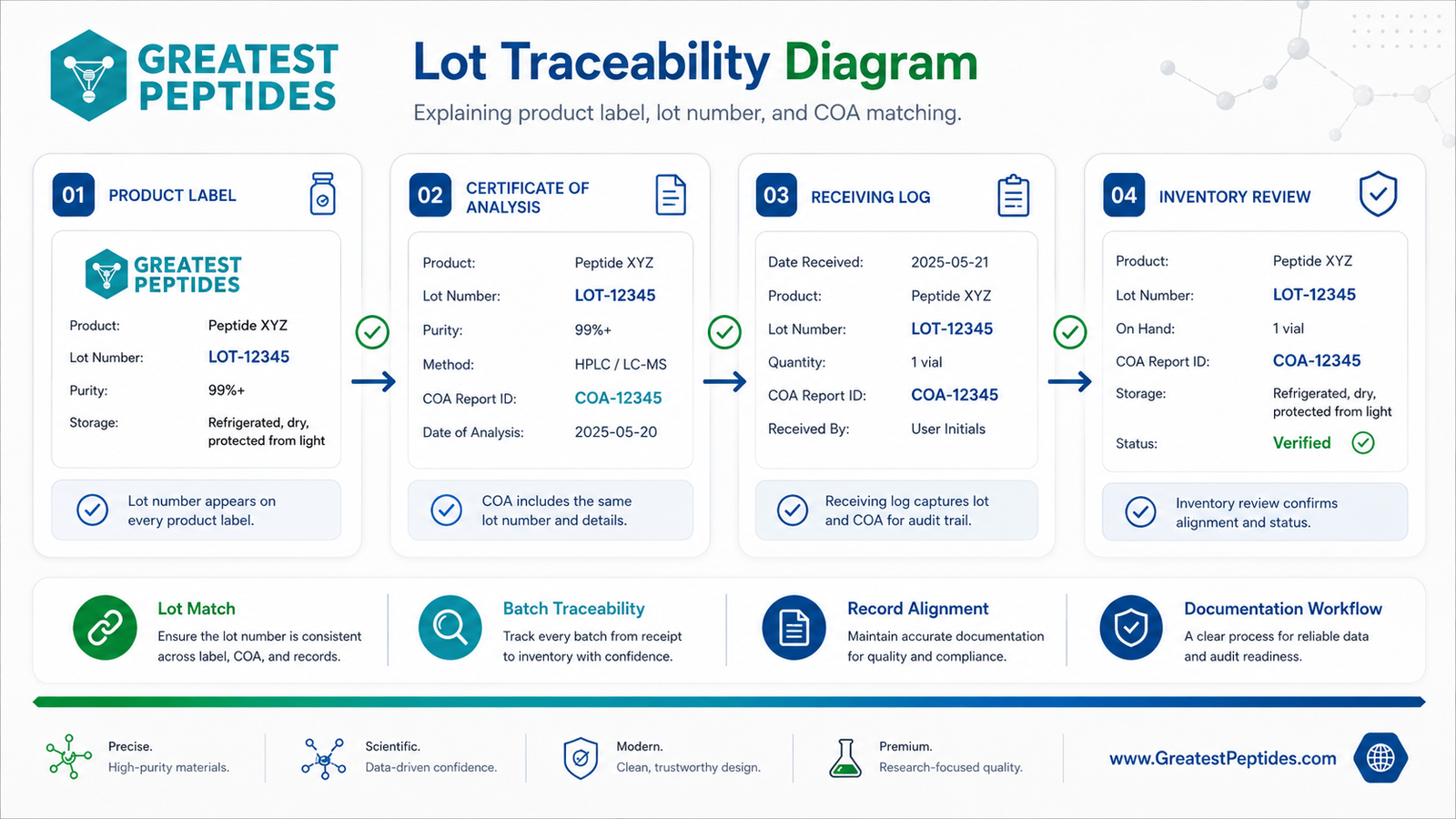
Lot traceability connects the product label, the certificate of analysis, the receiving log, and the inventory record through a shared lot number. That chain is what makes a research result auditable.
The traceability chain
Product label — the lot number appears on every label. Certificate of Analysis — the COA includes the same lot number and analytical details. Receiving log — captures the lot and COA for the audit trail on arrival. Inventory review — confirms alignment and status. When the lot number is consistent across all four, batch traceability is established.
Why researchers rely on it
Accurate, aligned documentation supports quality, compliance, and audit readiness — a clear process for reliable data.
Research use only. Products discussed are intended strictly for in-vitro laboratory research and are not for human or veterinary use.
The short version
A lot number is an index key, not a fact. It points at a batch record held by someone else, and everything a receiving lab can say about a vial depends on whether that pointer still resolves. The article above sets out the four links in the chain; this guide takes the cases where a link is bent rather than missing, which is how the failure usually presents. A suffix appears on one document and not the other. Two vials from a single order carry different strings. A revised certificate arrives three weeks after the material was logged and shelved. None of those are automatically wrong, and none of them are automatically fine. What follows is what a lot string can and cannot tell you, the mismatch patterns and what each typically means, a receiving log built to be read by someone who was not there, custody once the vial is opened, how long to keep what, and what is salvageable when the chain is already broken.
What a lot number encodes and what it cannot prove
There is no cross-industry standard for how a lot string is constructed. Two suppliers can use identical-looking formats that mean entirely different things, and the same supplier can change its format between years without announcing it. That matters because the most common traceability error in a small lab is not a mismatch at all; it is reading meaning into the string itself.
A block of six digits that looks like a date very often is one, and very often is not. It may be a synthesis start date, a fill date, a packaging date, a release date, or a sequential counter that happens to fall in a plausible range. Treating it as a manufacturing date and writing that inferred date into a receiving log converts a guess into a record, and the record will be read later as though it were observed. The only defensible entry is the string as printed, with any date recorded separately and only if it is printed separately.
The distinction that causes the most trouble is between a synthesis lot and a fill lot. A single bulk synthesis can be split across several filling runs, each producing its own vial-level identifier, sometimes as a suffix on the bulk number and sometimes as an unrelated string. Analytical work is frequently performed on the bulk, which means the certificate legitimately carries the bulk identifier while the vial in hand carries a fill identifier. Both documents are honest. They simply describe different levels of the same hierarchy, and a receiving procedure that demands character-for-character equality will flag a perfectly sound consignment while missing genuinely unrelated numbers.
Catalog numbers add a third layer of confusion. A catalog or item number identifies a product line and is identical across every unit ever sold under that name; it carries no batch information whatever. A certificate that shows only a catalog number, however precise its analytical figures look, is a product specification rather than a batch record.
The practical stance is that a lot string is a lookup key whose only guaranteed property is uniqueness within one supplier's system. Everything else about it is a hypothesis until the supplier confirms the structure in writing.
Elements commonly seen in lot strings, and what each one settles
| Element | What it may indicate | What it does not establish |
|---|---|---|
| Six- or eight-digit date-like block | A date somewhere in the production sequence | Which date, or that it is a date at all |
| Alphabetic prefix | Compound family, site, or product line code | Anything about the specific batch |
| Trailing suffix such as -A, -2, or /R | A fill split, re-work, or document revision | Whether the parent material is the same |
| Sequential counter | Order within one internal series | Volume produced, or gaps in the series |
| Catalog or item number only | Which product line the vial belongs to | That any batch-level testing was done |
| No identifier on the vial at all | Nothing | That the container can be linked to any record |
The useful test when a format is unfamiliar is to ask the supplier one narrow question in writing: does the string on this label identify the material that was analyzed on this certificate, and if not, what is the relationship between them. The answer becomes part of the record and closes the question permanently for that supplier's format, which is worth far more than any inference drawn from the digits. Filed against the first consignment, it also saves the next person from re-deriving the same conclusion from scratch, and it converts an ongoing ambiguity into a one-time cost.
The mismatch patterns and what each one usually means
Disagreement between a label and a certificate is rarely a clean binary. It arrives in a handful of recognizable shapes, and the shape is diagnostic enough to determine the next action without any laboratory work.
The label lot appears nowhere on the certificate. This is the most serious pattern and also the most likely to be a clerical accident. The document may have been generated for a different consignment, attached to the wrong order line, or issued against a bulk identifier the supplier never printed on the vial. Until the relationship is stated by the supplier, the certificate describes some material, but not demonstrably this one.
The certificate lot matches except for a suffix. Sometimes this is the bulk versus fill relationship described above, in which case it is expected and benign. Sometimes it marks re-worked material, a second lyophilization, or a re-filled batch, in which case the analytical data may predate the re-work and no longer describe the container. The suffix has no universal meaning, so the only way to distinguish the two is to ask what that character denotes.
Two vials in one order carry different lots. Entirely normal when an order spans stock replenishment, and it becomes a problem only if the paperwork treats the shipment as one unit. If the packing list and the receiving log record a single lot for the order, then half the material is now undocumented while appearing fully documented, which is worse than an obvious gap. Each distinct lot needs its own log row and its own certificate.
A revised certificate arrives after receipt. Revisions happen for benign reasons, including typographical corrections and the addition of a test that was pending at first issue. The failure mode is silent replacement: the new file overwrites the old one, and the record no longer shows that anything changed. Both versions should be retained, with the revision date and the stated reason for revision.
A certificate generic to the compound. If no lot appears anywhere on the document, or the same file is served for every unit of that product, it is a specification sheet. It may be accurate about what the product is meant to be and still say nothing measured about the vial received.
Mismatch patterns, likely cause, and the request that resolves each
| Pattern | Most likely cause | What to request |
|---|---|---|
| Label lot absent from the certificate | Wrong document attached to the order | The certificate carrying this exact lot |
| Certificate lot differs only by suffix | Bulk versus fill, or re-worked material | Written statement of what the suffix denotes |
| Two lots in one shipment | Order filled from more than one batch | A separate certificate per lot, and a corrected packing list |
| Revised certificate for a logged lot | Correction or a late-added test | The revision reason, plus retention of both versions |
| Certificate names the compound but no lot | Product specification, not a batch record | A lot-specific, dated document |
| Analysis date precedes the stated fill date | Testing on bulk, or a transcription error | Clarification of which material was tested and when |
Every row resolves into a document request rather than a judgment about the material, and most close within a day or two. The discipline worth keeping is that the material stays in quarantine while the question is open. Moving a vial into general stock and intending to sort the paperwork out later is how an unresolved question becomes a permanent gap, because the vial is indistinguishable from its neighbors once it is on the shelf. Quarantine here means no more than a marked box and a line in the log; it does not need to be elaborate to work, it needs to be visible to whoever reaches for the material next.
Building a receiving log that reads well to a stranger
The value of a receiving record is that it was written at the moment of receipt by someone who had the container in hand. That is a kind of evidence no later reconstruction can produce, and it is destroyed by two habits: normalizing what was printed, and editing rows after the fact.
Transcribe the identifier exactly as it appears. Preserve case, separators, leading zeros, and spacing. A lab that silently converts LOT-0248B to 248b has made the record unsearchable against the supplier's own system and has removed the only evidence of what the label actually said. If the printing is ambiguous, record the ambiguity in words rather than resolving it, and photograph the label at receipt. A photograph costs nothing and settles almost every later dispute about what was on the vial, which is otherwise unanswerable once the label is peeled, frosted, or discarded with the container.
Assign an internal receipt identifier that is independent of the supplier's lot. This is the single highest-value field in the log. It gives every downstream aliquot, freezer entry, and notebook reference a stable key that still works when the supplier's lot turns out to be duplicated, mistyped, or unreadable, and it means a broken external link does not orphan the internal record as well.
Make the log append-only. Corrections are added as new dated lines that reference the original entry, never as overwrites. An audit reads a corrected entry as evidence of a working process; it reads an unexplained clean record that contradicts an attached photograph as something else entirely.
Record condition on arrival even when nothing is wrong. Whether cold packs were still cold, whether seals were intact, whether the cake looked normal or had collapsed or shifted. A blank field is ambiguous forever, while an explicit note that the material arrived at ambient temperature with intact seals is a usable data point months later when a stability question surfaces.
Separate the two judgments that usually get compressed into one. Whether a certificate arrived is a fact; whether it matches the label is a conclusion. Logging them in a single yes-or-no column means a consignment where nobody looked is recorded identically to one that was checked and passed. Two fields, one for receipt of the document and one for the result of the comparison, cost nothing and make the difference legible. Where the comparison was not clean, name the pattern rather than the verdict, since a note reading suffix difference, unresolved carries information that a bare fail does not.
Fields a receiving row needs, and what breaks when each is missing
| Field | Why it is there | Failure when omitted |
|---|---|---|
| Internal receipt ID | Stable internal key, independent of the supplier | Every downstream reference depends on an external string |
| Lot exactly as printed | The only contemporaneous evidence of the label | Cannot be matched against the supplier system |
| Compound name and nominal amount as printed | Confirms the label agrees with the order | Wrong-item errors surface only at the bench |
| Certificate received, with file name and date | Distinguishes missing from unchecked | A gap looks identical to an oversight |
| Match result, with the mismatch pattern named | Records the judgment, not just the outcome | The reasoning is unrecoverable later |
| Condition on arrival | Baseline for any later stability question | Cannot separate transit damage from storage damage |
| Receiver initials and date | Attributes the observation to a person | No one can be asked what they saw |
A row built this way takes a couple of minutes and is legible to someone who has never met the person who wrote it. That is the actual test, and it is worth running deliberately once a year on a randomly chosen tube. If a colleague joining next year cannot take that tube from the freezer and walk it back to a supplier, a lot, a certificate, and a date without asking anyone, the log is decorative rather than functional, and the gap is far cheaper to find on a quiet afternoon than in the middle of a question about a result.
Custody after the vial is opened and split
Traceability up to the shelf is the easy half. The chain most often breaks in the hour after a vial is first opened, because that is where one labeled container becomes several small tubes with no room to write on them.
The minimum an aliquot label must carry is a pointer back to the internal receipt ID, an aliquot index, and a preparation date. Everything else can live in the log. Cryogenic tube labels are small and freezer-frosted handwriting is unreliable, so a short internal code is more robust than an attempt to write the full supplier lot on the cap. What is fatal is a tube labeled only with the compound name, which is exactly what happens under time pressure and is functionally an unlabeled tube for traceability purposes.
The link most often forgotten is the diluent. Reconstitution introduces a second material with its own lot number, its own certificate, and its own expiry, and it is fully capable of being the cause of a later problem. If the solvent lot is not recorded against the aliquot, a contamination or stability question cannot be answered even when the peptide side of the chain is immaculate. The same applies to buffers and to any carrier prepared in house, which needs an internal preparation record and its own identifier.
Freeze-thaw history belongs with the aliquot record rather than in memory. A simple thaw counter incremented at each retrieval turns an unanswerable question into a number, and it is the field most likely to explain an anomalous result months afterward.
Custody transfers deserve a line each. Material moving to another operator, another freezer, or another site should generate a dated entry naming both parties. The point is not formality; it is that a gap in the record is indistinguishable from a gap in control, and only one of those is actually a problem.
Relabeling is the quiet destroyer. Tubes get consolidated, boxes get reorganized, and a label written in a hurry replaces one that had a pointer on it. Any relabeling should be treated as a custody event with its own dated entry recording the old identifier and the new one, because a tube whose label has changed with no record is indistinguishable from a tube of unknown origin. The same applies to material inherited from a departing colleague: it enters the system as a new receipt with whatever provenance is documented, and no more than that.
Custody events and the record each one has to produce
| Event | What the record must capture | Link preserved |
|---|---|---|
| First opening of the vial | Date, operator, receipt ID, condition of contents | Ties observed condition to the sealed unit |
| Reconstitution | Diluent identity, its lot, volume added, date | Makes the solvent a traceable input, not an assumption |
| Aliquot preparation | Number of tubes, volume each, aliquot indices | Every tube resolves back to one parent vial |
| Storage placement | Freezer, shelf, box, position | A tube can be located without opening every box |
| Thaw for use | Date and running thaw count | Explains degradation patterns after the fact |
| Transfer or disposal | Date, both parties, remaining volume | Closes the chain instead of leaving it open |
Read the table from the bottom upward and the design becomes obvious: from any tube in any box, there should be an unbroken path back to a receipt row, a lot string, and a certificate, with no step requiring anyone to remember anything. Systems that depend on recall work fine until the person who remembers is on leave, which is reliably the week the question gets asked. The design goal is not completeness for its own sake but the removal of every step where the answer lives only in someone's head.
Retention: what to keep, in what form, and for how long
Retention is a policy decision rather than a per-lot one, and the most common mistake is leaving it undefined so that each record survives by accident. Institutions with formal requirements will set a window in years; groups without one still benefit from writing down a rule and applying it uniformly, because a uniform rule explains an absence, whereas an ad hoc practice makes every absence look selective.
Keep original files unmodified. A certificate should be retained as the file the supplier sent, not as a screenshot, a re-export, or a printed copy scanned back in. A stored checksum for each original costs nothing and later distinguishes an untouched file from one that has been through an editor. Keep the transmission itself as well, because the message carrying the file establishes when it arrived and from whom, and that timing is frequently the disputed point.
Keep superseded versions. When a revised certificate arrives, both versions stay, with the revision date recorded. A record showing an old version, a new version, and a note explaining the change is stronger evidence of a functioning process than a single clean file that appeared from nowhere.
Keep the things that are usually thrown away. Label photographs, packing lists, the shipping record showing transit duration, and any correspondence resolving a mismatch. These are the documents nobody thinks to file and everybody wants later, precisely because they are the ones that describe circumstances rather than specifications.
The sensible horizon is the longest of a few competing clocks: how long the material itself remains in storage, how long derived data will be relied on, and how long the institution requires primary records to persist. Since a single aliquot can outlive several projects in a freezer, retention tied to the last use of the material rather than to the receipt date is the version that does not strand records early.
One structural point is easy to miss. Retention only means anything if the records can still be found, which makes the naming scheme part of the policy rather than a detail beneath it. Files named for the internal receipt identifier and the lot, in that order, remain findable when the supplier changes its own file naming or the original message has been archived. Files named for whatever the download produced are technically retained and practically lost, which is the outcome the policy exists to prevent.
What to retain, in what form, and what sets the clock
| Record | Preferred form | What drives the retention period |
|---|---|---|
| Supplier certificate | Original file as received, plus checksum | Last use of any aliquot from the lot |
| Transmission of the certificate | The message itself, with headers intact | Same as the certificate it delivered |
| Superseded certificate versions | Retained alongside, never replaced | Same as the current version |
| Receiving log | Append-only, with corrections as new lines | Institutional records policy, typically the longest clock |
| Label photographs | Dated image linked to the receipt ID | Until the material and its derived data are retired |
| Discrepancy and resolution notes | Written record with dates and both parties | As long as any affected lot or its data persists |
One caution about storage medium. Records that live only in a single spreadsheet on a single machine have a failure mode that is not about traceability at all, and losing them costs the chain just as completely as a peeled label does. Whatever the retention window is, it needs a copy somewhere the original author cannot accidentally delete, and it needs to survive the departure of the person who set it up. A retention rule that depends on one laptop and one memory is a plan for the years in which nothing goes wrong.
Re-testing, disputed material, and a chain already broken
Independent analysis is often treated as a way to repair traceability. It is not. A re-test produces a new document with its own report number, describing the material as submitted, and it can confirm what a sample is while remaining silent about where it came from. That is still valuable, but it is a parallel record rather than a replacement, and it should be filed alongside the supplier certificate with an explicit reference to the receipt ID and the sample that was sent.
When material is disputed, the instinct to return or discard the container is the wrong one. The vial, the label, the closure, and any remaining contents are the evidence. Physically segregate them, record the quarantine with a date, and stop drawing aliquots. Aliquots already prepared are quarantined too, because they inherit the parent's status; leaving them in circulation while the parent is disputed defeats the purpose of having a chain. If material must be returned, photograph everything first and retain a small retained sample where the situation and the material permit.
A chain that is already broken calls for honesty rather than reconstruction. If a label is unreadable, a tube was relabeled without a pointer, or a certificate cannot be located, the correct entry is that the link is unverifiable, with a note explaining how it was lost. What is emphatically wrong is back-filling the log from a supplier invoice or a memory of which order it probably came from. That converts an obvious, contained gap into an invisible false record, and invisible false records propagate into every downstream conclusion.
Orphaned material still has uses. It can be re-tested for identity and purity, and it can support method development, column conditioning, or instrument familiarization where the provenance of the material does not affect the conclusion. What it cannot do is underwrite a comparative result or anything a reader would expect to be traceable to a batch.
Mark the downgrade physically as well as on paper. A distinct label or a separate box keeps orphaned material from drifting back into work where its provenance matters, which is the usual outcome when the only evidence of its status is a line in a file nobody opens at the bench. Deciding the acceptable uses at the moment the break is discovered, and writing them down, is easier than relitigating the question every time someone reaches for the tube.
Kinds of break, what recovers, and what does not
| Break in the chain | What can be recovered | What is permanently lost |
|---|---|---|
| Certificate missing, label intact | Usually the document, on request by lot | Nothing, if the supplier still holds the record |
| Label unreadable, vial sealed | Identity and purity, by independent analysis | The link to a specific supplier batch |
| Aliquot labeled only with a compound name | Nothing beyond what the compound is | Parent vial, lot, preparation date, thaw history |
| Receiving row never written | Approximate date, from order records | Arrival condition and who observed it |
| Certificate overwritten by a revision | The current version only | What changed, and when the change occurred |
| Diluent lot not recorded | The peptide side of the chain | Ability to attribute a problem to the solvent |
The pattern across the table is that breaks involving a document are usually recoverable, and breaks involving a physical label usually are not. That is a useful ranking for deciding where to spend effort. Photographing labels and writing an internal identifier onto every container are cheap, take seconds, and protect against exactly the failures that no amount of later correspondence can undo. Document-side breaks are worth preventing too, but they can almost always be repaired by asking, and that asymmetry is what should drive which habits get enforced first.
Questions this guide gets asked
The certificate lot has an extra letter on the end. Is that a match?
It is unresolved rather than matched or mismatched. A trailing character can mark a fill split from a common bulk, in which case the analytical data legitimately applies, or it can mark re-worked or re-filled material whose testing predates the re-work. Suffix conventions are supplier-specific and undocumented, so the character cannot be interpreted from the outside. Ask the supplier in writing what it denotes for that product, record the answer against the receipt, and keep it as a reference for future consignments in the same format. Until then, log the pattern as a suffix difference rather than recording a clean match.
Should the log record the lot as printed or in a normalized format?
Exactly as printed, including case, separators, and leading zeros. Normalizing feels tidy and quietly destroys the only contemporaneous evidence of what the label said. It also breaks lookups against the supplier's own system, which does not normalize. If a searchable form is genuinely useful for internal filtering, add it as a second column beside the verbatim one rather than replacing it. The same rule applies to ambiguous characters: record the ambiguity in words, photograph the label, and resolve it with the supplier rather than deciding at the keyboard which character it probably was.
Two vials in one shipment have different lot numbers. Is that wrong?
Not in itself. Orders are routinely filled across more than one batch, especially around a stock replenishment. It becomes a problem only when the paperwork collapses the shipment into a single unit, because then half the material is undocumented while appearing documented. Each distinct lot needs its own row in the receiving log and its own certificate, and the vials should be stored so the two are not interchangeable on the shelf. If only one certificate arrived, the second lot is unsupported and should sit in quarantine until the matching document is supplied.
A revised certificate arrived for a lot we logged weeks ago. Now what?
Keep both versions and add a dated line to the log recording that a revision arrived, when, and what the supplier states changed. Then compare the two documents field by field rather than assuming the change is cosmetic; a correction to a purity figure or an analysis date has different implications than a fixed typographical error. If any aliquots were prepared from the lot in the interim, note the revision against those records too. What should never happen is a silent replacement of the file, because that erases the fact that the supplier's own account of the material changed after receipt.
If we ran our own analysis, do we still need the supplier certificate?
Yes, because the two documents answer different questions. Independent analysis describes the sample that was submitted. The supplier certificate is what connects that sample to a manufacturing batch, an analysis date, and a chain of custody before it reached the lab. Discard the certificate and the material becomes well-characterized but unprovenanced, which is a real limitation if anyone later asks about batch-to-batch consistency or wants to obtain the same lot again. File the independent report alongside the certificate with an explicit reference to the receipt identifier and the sample submitted.
How much of this is reasonable for a small lab with no formal requirement?
The high-value subset is short: a verbatim lot entry, an internal receipt identifier, a photograph of the label, the original certificate file, and an aliquot label that points back to the receipt. That is a few minutes per consignment and covers most of the failure modes described above. Retention policy, checksums, and formal custody transfer records matter more as a group scales or as data becomes externally reviewed. The ordering principle is to spend effort first on the breaks that cannot be repaired later, which are almost always the physical ones rather than the documentary ones.
Where to read next
- How to review a peptide certificate of analysis the field-by-field walkthrough of the document itself
- Spotting real versus fabricated COA documentation what a generic or reused certificate looks like up close
- Peptide storage and handling for laboratory research the storage side of what the receiving log records
- Freeze-thaw cycles in peptide research materials why the thaw count belongs on the aliquot record
- Third-party lab testing and COAs
All materials described here are supplied strictly for laboratory research use. They are not drugs, foods, cosmetics, or medical devices, and they are not for human or veterinary use, diagnostic use, or any form of consumption. Nothing in this guide is a recommendation to acquire, prepare, or handle any compound outside a controlled research setting. Record-keeping practices described here are general laboratory guidance and do not substitute for the documentation requirements set by an institution or a regulator.