

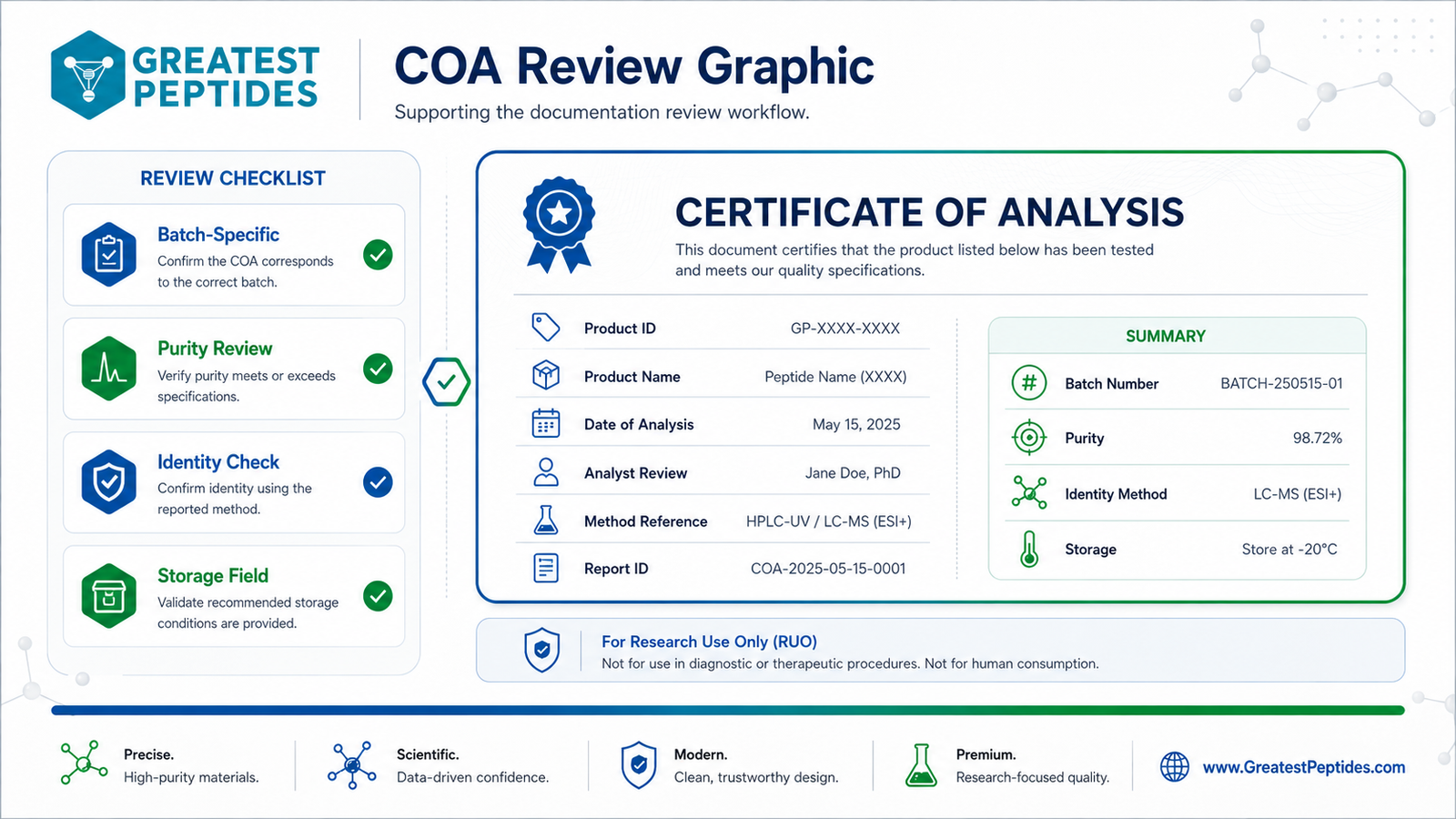
A peptide COA should be reviewed as a batch-specific record, not a general marketing statement. It ties analytical data to a specific production lot.
The review checklist
Confirm the COA is batch-specific and corresponds to the correct lot; verify the reported purity meets specification; confirm identity was established by an approved analytical method (HPLC and/or LC-MS); and check that recommended storage conditions are stated. Product identifier, lot number, test date, analytical method, molecular weight and sequence where relevant, and product form all belong on a complete document.
Why it matters
A purity percentage alone does not establish complete compound identity. Purity, identity, method, lot number, and documentation should be evaluated together so a research result is fully traceable.
Research use only. Products discussed are intended strictly for in-vitro laboratory research and are not for human or veterinary use.
The short version
A certificate of analysis is a structured document, and almost every complaint about certificates comes down to a field that is missing, a field present but unlabeled, or a number being read as something it is not. This expansion walks the document field by field: the masthead that says who tested what and when, the identity block that names the molecule and its sequence, the results table where specification and measured result are different columns, and the secondary fields covering water, counter-ion, appearance and storage. It then works through the arithmetic that surprises most receiving labs, which is that a lot reported at 98 percent purity can still be well under 80 percent peptide by mass once salt and water are counted. The article above gives the review sequence; what follows is what each line actually means once you stop to read it.
Who issued the document, for which lot, and when
Every certificate is a statement made by a specific party about a specific quantity of material at a specific moment. The masthead establishes all three, and it is the part of the document most often skimmed.
The issuing party matters because certificates come from three sources that carry different weight. A manufacturer's own quality control group tests material it produced, which is normal practice and not a weakness in itself, but the figures are self-reported. An independent contract laboratory tests material submitted to it, which introduces an outside party and also a question about what was submitted. A distributor may reissue or summarize either of those on its own letterhead, at which point the reader is two steps from the instrument. A complete document names the facility that performed the testing, with an address, rather than leaving the reader to infer it from a logo.
Sample provenance is the field most often absent. Wording such as "results apply to the sample as received" is standard contract-laboratory language and it is honest, but it means the laboratory characterized what arrived in its sample vial rather than the lot in your freezer. What links those two things is the lot identifier and the chain of custody, not the certificate itself.
The lot or batch identifier converts a general product description into a record about material you can hold. It must be a specific alphanumeric string, and the same string must appear on the vial label. A document with no lot identifier is not a certificate of analysis; it is a product datasheet describing what the compound is supposed to be, and it supports no claim about any particular container.
Dates come in at least three flavors and a good document separates them. The manufacture or fill date is when the lot came into existence, the test date is when the reported measurements were taken, and the report date is when somebody signed off. Those can be months apart, and the gaps are informative. The signature block should name an individual and a role rather than carry an unattributed company stamp, because that line says who is accountable for the figures above it.
Masthead fields and what their absence leaves unresolved
| Header field | What a complete document states | What its absence leaves open |
|---|---|---|
| Issuing party | Name and address of the facility that ran the tests | Whether figures are self-reported or externally checked |
| Relationship to maker | In-house QC or independent contract laboratory, stated | Whether anyone outside the supply chain saw the material |
| Sample provenance | Who drew the sample and when the lab received it | Whether the tested sample came from the shipped lot |
| Lot or batch identifier | An alphanumeric string that also appears on the label | Any link between the document and your container |
| Manufacture or fill date | The date the lot was produced or filled | The start point for any storage or retest interval |
| Test date and report date | Both, as separate fields | How long the lot sat between testing and release |
| Signature block | A named individual, a role, and an authorization date | Who stands behind the numbers |
Together these fields answer one question: does this paper describe the object in front of me, and can I tell who says so. If the lot string is missing or the signature is an unattributed logo, nothing further down the page can be attributed to your vial, however strong the numbers look.
The identity block: name, sequence, formula and theoretical mass
Below the masthead sits the block defining what the material is supposed to be. A competent reader can check this section independently, because three of its fields are arithmetically related to one another.
The compound name should be the established name for the sequence, not a category. A certificate naming a mechanism class rather than a molecule has described a family, and families contain compounds with very different sequences and masses. Where a compound is widely known by a code number or trade shorthand, both should appear with one designated as primary. Synonyms are not decoration; they are how a receiving lab reconciles a purchase order, a label and a certificate that each use a different name for the same thing.
The sequence should be printed in full, in one-letter or three-letter code, with terminal and side-chain modifications shown explicitly. Acetylation at the N-terminus, amidation at the C-terminus, a disulfide bridge or a fatty-acid conjugation each change the molecular formula and therefore the theoretical mass. A certificate that names a modified compound but prints the parent sequence has printed a formula that will not reconcile.
The molecular formula and theoretical mass are where the cross-check happens. Given a printed sequence the formula is determined, and given the formula so is the mass, which means a reader can recalculate both. That is the most useful property of the identity block, and it explains why a missing sequence matters more than it first appears: without it the theoretical mass cannot be verified, and the identity result later in the document is compared against a number nobody outside the issuing lab can reproduce.
One distinction is quietly important. The formula and mass for the free peptide and for the salt form are different, and most certificates report the free peptide while shipping the salt. That is conventional and correct, but the document should say which basis it uses, because the difference propagates into every mass calculation downstream.
Identity fields, correct form, and the defect each usually shows
| Field | Correctly stated as | Common defect |
|---|---|---|
| Compound name | The established name for the specific sequence | A class or mechanism label standing in for a molecule |
| Synonyms and codes | Shorthand and code numbers beside a primary name | Only the shorthand, leaving the entity ambiguous |
| Sequence | Printed in full on the document itself | Omitted, so no mass or formula can be recalculated |
| Modifications | Acetyl, amide, bridges and conjugations named | Implied by the trade name and stated nowhere |
| Molecular formula | Reconcilable with the printed sequence | A formula that does not match that sequence |
| Theoretical mass | Labeled monoisotopic or average, matched to the formula | An unlabeled number with no stated basis |
| Salt or free-base basis | Stated once and applied consistently | Never stated, so mass arithmetic is ambiguous |
A useful habit is to recalculate the theoretical mass from the printed sequence before reading any result. It takes a minute with a sequence calculator, it catches transcription errors in the identity block, and it means the observed mass further down is compared against a figure you derived rather than one you were handed.
Specification, result and method belong in the same row
The results table is the part everybody reads and the part most often misconstrued, because a row can be printed several ways and only one of them carries full information. A complete row has four parts: the attribute tested, the method used, the specification it is judged against, and the measured result.
Drop the method and the result becomes uncomparable. Purity by reversed-phase HPLC at one wavelength and gradient is not the same measurement as purity by another, and two lots cannot be compared unless both rows name the conditions. Drop the result and the row collapses into a restatement of the product definition: a line reading "purity: not less than 98 percent" tells you what the supplier intends to sell, not what this lot measured. That is a specification masquerading as a finding, and it is the most common weakness in circulating certificates.
Conforms and complies are the same problem in different clothing. They record that somebody made a pass-or-fail judgment, which is worth something, but they discard the value. Two lots both reading conforms against a 98 percent specification might have measured 98.1 and 99.6, materially different materials with identical paperwork.
Not detected needs a limit attached. A negative result is only as strong as the sensitivity behind it, so a residual-solvent or impurity row reading none detected with no limit of detection or quantitation stated is not a result. The same applies to identity rows reading conforms to reference spectrum without printing an observed mass: something was compared to something, and the reader is asked to accept the conclusion without the data.
The counterintuitive case is a row reporting a result outside its specification, annotated and signed. That is a stronger document than one with no out-of-specification results anywhere, because it shows results are transcribed from instruments rather than assembled to match the specification column.
How a results row is printed and what it is worth
| How the row is printed | What you actually learn | Strength |
|---|---|---|
| Attribute, method, specification and result | The measured value and the yardstick behind it | Strong |
| Numeric result, no method named | A number that cannot be compared across lots | Moderate |
| Specification only, no measured value | The product definition, restated as if it were data | Weak |
| Result given as conforms or complies | That a pass-or-fail call was made, value discarded | Weak |
| Not detected, no limit stated | Nothing, until the detection limit is given | Weak |
| Out-of-specification result, annotated and signed | An acknowledged deviation, implying honest transcription | Strong in context |
When comparing two certificates for the same compound, compare row structure before comparing numbers. A document printing methods, specifications and results for six attributes is a different class of record from one printing two percentages and a signature, and that gap is larger than any difference between the percentages.
What a purity figure leaves out of the mass balance
Purity is the number everyone quotes and the one most often misread, because at least three quantities travel under that word and they answer different questions about the same vial.
Chromatographic purity is an area ratio within the ultraviolet-absorbing material that came off the column. If the figure is 98 percent, then 98 percent of the integrated peak area belongs to the target and the rest belongs to other peptide-related species: truncations, deletions, oxidized forms, diastereomers. That calculation is confined to the peptide fraction. Anything in the vial that does not absorb meaningfully at the detection wavelength never enters the arithmetic.
Net peptide content, sometimes called peptide content or peptide assay, is a mass ratio. It reports what fraction of the weighed powder is peptide rather than water, counter-ion and residual salt, and it is normally determined by amino acid analysis or a nitrogen determination rather than by chromatography. For a lyophilized research peptide it is routinely in the seventies or eighties, which is expected rather than alarming.
Two things fill the gap between those figures. The first is the counter-ion. Peptides purified by reversed-phase chromatography with trifluoroacetic acid as the ion-pairing agent are typically isolated as TFA salts, and TFA associates with basic residues, so a sequence carrying several arginines or lysines takes on proportionally more. The second is water: lyophilized peptide is hygroscopic and retains bound water, which is why a Karl Fischer or loss-on-drying figure appears on thorough certificates.
The practical consequence is that a vial labeled with a nominal amount of powder does not contain that amount of peptide unless the fill basis says so. A competent certificate or label states whether the figure is gross powder mass or net peptide mass. Where measurement arithmetic for preparing laboratory aliquots starts from the label figure, that convention is the difference between the concentration you calculate and the one you have.
Illustrative mass balance on a 100 mg powder basis; arithmetic only, not a specification
| Component | Share of 100 mg powder | How it is determined |
|---|---|---|
| All peptide-related material | 80 mg | Net peptide content by amino acid or nitrogen analysis |
| Target sequence within that | 78 mg | Net peptide content times 98 percent chromatographic purity |
| Non-target peptide species | 2 mg | The complement of the chromatographic purity figure |
| Counter-ion, typically TFA | 12 mg | Ion chromatography or fluorine-19 NMR, where reported |
| Bound and residual water | 6 mg | Karl Fischer titration or loss on drying |
| Inorganic salts and solvents | 2 mg | Headspace GC for solvents, ash or conductivity for salts |
Those numbers are illustrative and should not be used as a correction factor for a real lot, because counter-ion load scales with the number of basic residues and water content depends on lyophilization and handling. The point is the shape of the arithmetic: a high chromatographic purity figure and a much lower peptide-by-mass figure are entirely consistent, and a certificate reporting the first without the second has left the mass question unanswered.
Appearance, water, counter-ion and the storage statement
The fields around the edges of a certificate get treated as boilerplate, and they are the ones most often carrying recoverable information.
Appearance is the cheapest test on the document and the only one a receiving lab can repeat without instruments. A stated appearance such as a white to off-white lyophilized powder or cake gives a technician something to compare against, and a discrepancy is a real finding: a collapsed or discolored cake in a vial whose certificate describes a white cake is evidence of something that happened between test and receipt. An appearance row reading conforms or as described forfeits that check.
Water content matters twice. It is mass, so it displaces peptide in the vial, and it is a reactant, so residual moisture drives hydrolysis and other degradation during storage. A water figure with no method is weak, since loss on drying and Karl Fischer titration do not measure quite the same thing, and a certificate with no water figure has left one of the two largest non-peptide fractions unquantified.
Residual solvents are carryover from cleavage, purification, precipitation and drying. A row saying the lot meets requirements without naming which analytes were screened is uninformative; the analytes actually looked for are the content of that test.
The counter-ion or salt form should be named. It changes the mass per vial, and TFA in particular is documented as affecting some cell-based assays, so a lab running that work needs to know whether it holds a TFA salt or an acetate salt.
The storage statement is where certificates get vague. A usable statement gives a temperature, says whether the container should be protected from light and kept desiccated, and separates conditions for the sealed lyophilized powder from conditions after reconstitution. Store in a cool, dry place is not a storage statement. Any retest or re-evaluation interval only means something read against the test date, because elapsed months since testing come out of that interval before the material reaches you.
Secondary fields, what each constrains, and wording too weak to rely on
| Field | What it constrains | Wording too weak to use |
|---|---|---|
| Appearance | The only check a receiving lab can repeat unaided | Conforms, or as described |
| Water content | Vial mass and the rate of downstream degradation | Absent, or a figure with no method named |
| Residual solvents | Carryover from cleavage, purification and drying | Meets requirements, with no analytes listed |
| Counter-ion and salt form | Mass per vial and behavior in some cell-based assays | Salt form named nowhere on the document |
| Storage statement | Conditions under which the figures should hold | Store in a cool, dry place |
| Retest interval | How long the reported figures are treated as current | An expiry date with no stated basis |
| Elapsed time since test | How much of that interval is spent on arrival | Test date absent, so no interval can be applied |
The last two rows interact in a way worth stating plainly. A certificate with a generous storage claim and a test date well in the past describes the material as it was on the test date, not as it is on your bench. That is not a defect, but the reported purity is a historical measurement, and the further back that date sits, the more of the claim rests on storage and shipping rather than on the assay.
Filing a certificate so it still means something later
A certificate that cannot be retrieved and tied back to a specific container is functionally the same as no certificate, and that is usually where the process fails: not at review, but months later when somebody asks which lot produced a given experiment.
The cross-check at receipt runs across four artifacts, not one. The vial label, the packing list or invoice, the certificate, and the receiving log entry carry overlapping fields, and the useful exercise is confirming they agree rather than reading any one closely. Compound name, lot string and stated amount per vial should be identical across all four. Where a shipment contains vials from more than one lot, each lot needs its own certificate and its own log line; a single certificate filed against a mixed shipment quietly breaks the link for every vial it does not describe.
This is also where the difference between a certificate and a datasheet gets enforced. A generic datasheet carries a compound name, a sequence, a specification range and often a nominal purity figure, and it looks convincing enough to get filed as though it were lot-specific evidence. The test is mechanical: no lot string and no test date means no lot-specific claim. Filing one in place of the other is the hardest documentation failure to detect afterward, because everything else about the file looks right.
Filing itself should be boring and consistent. Name the stored file with the compound and the lot string so it sorts predictably. Record in the receiving log the file name, who reviewed it, on what date, and any discrepancy found and how it was resolved. Retain it at least as long as data derived from that lot remains in use.
Where a certificate is requested before purchase, it should be for the lot that will actually ship, and it is reasonable to ask for exactly that. A certificate for a previous lot shows the supplier tests material, which is genuinely useful, but says nothing about the container that will arrive.
Cross-checking a certificate against the receiving record
| Field | Where else it must appear | What a mismatch means |
|---|---|---|
| Compound name and synonym | Vial label, packing list, receiving log | The document may belong to a different product line |
| Lot or batch string | Vial label and receiving log entry | The certificate does not describe the container in hand |
| Stated amount per vial | Vial label and the invoice line | Fill basis or product size differs from what was ordered |
| Number of vials and lots | Packing list and receiving log | A split shipment, so each lot link needs rechecking |
| Date received | Receiving log, read against the test date | The interval the storage claim must cover on your side |
| Stored file name | The receiving log line for that lot | Nobody can retrieve the document behind a result |
None of this requires software. A dated spreadsheet row per received lot, with a file name in one column and reviewer initials in another, closes the loop well enough that a question raised months later is answered from the record rather than from memory.
Questions this walkthrough gets asked
How do I work out how many milligrams of peptide a vial actually holds?
Find the net peptide content figure and the fill basis. If the label states a gross powder mass and the certificate reports net peptide content, multiply the two: a vial filled with 10 mg of powder at 80 percent net peptide content holds roughly 8 mg of peptide-related material, of which the chromatographic purity figure describes the target fraction. If the label states net peptide mass instead, the powder weighs more than the label figure and no correction is needed. If neither the fill basis nor the net peptide content appears anywhere, the contents cannot be converted to a peptide mass from the paperwork alone, and that gap is worth raising with the supplier.
Is a certificate signed by the manufacturer worth less than an independent one?
Not automatically. In-house quality control is standard across chemical manufacturing, and a well-constructed in-house document naming methods, printing numeric results and showing chromatograms is more informative than a thin one-page summary from an outside laboratory. What an independent certificate adds is that a party with no commercial interest in the result handled the sample. The stronger position is both: the manufacturer's full analytical package for the lot, plus periodic independent verification on selected lots. What should carry no weight is a certificate whose issuing party is not identified, since the question of who is making the claim has been left blank.
Which missing fields actually matter and which are just nice to have?
Three absences break the document outright: no lot string, no test date, and no identity data. Without the first two the record is not lot-specific; without the third the material has not been shown to be the named compound. Two more degrade it seriously: no method statement for the purity figure, which makes the number uncomparable, and no net peptide or water figure, which leaves the mass question open. The rest is a matter of degree. A missing CAS number, appearance row or residual-solvent screen reduces what the document covers without undermining what it does say, provided the core fields are intact.
Why does the counter-ion appear on some certificates and not others?
Because measuring it is a separate test that many suppliers do not commission. Peptides purified by reversed-phase chromatography with trifluoroacetic acid as the ion-pairing agent are generally isolated as TFA salts, and the amount carried depends on how many basic sites the sequence has, so the load varies by compound and cannot be assumed from a rule of thumb. Quantifying it needs ion chromatography or fluorine-19 NMR. The salt form should still be named even when the amount is not quantified, because it tells a reader whether the material is a TFA salt, an acetate salt after exchange, or a hydrochloride.
The test date is many months before the material shipped. Does that matter?
It changes what the figures describe. Every number on the certificate measures the material on the test date, and the assumption that it still holds rests on the storage statement and on the conditions the lot actually experienced since. A long gap is not evidence of a problem, particularly for a lyophilized powder held at low temperature, but it shifts weight from the assay onto the storage and shipping record. The proportionate response is to note the elapsed interval in the receiving log, confirm the appearance matches what the certificate describes, and ask whether any re-evaluation was performed if the gap is long relative to the stated retest interval.
What does a result of conforms tell me that a number would not?
Less, in almost every case. A conforms entry records that someone compared a measured value against a specification and judged it acceptable, preserving the pass-or-fail conclusion and discarding the value. Two lots reading conforms against the same specification can sit far apart, and neither the receiving lab nor anyone reviewing the work later can tell them apart from the paperwork. Conforms is defensible for genuinely qualitative attributes, such as an appearance check against a written description, where there is no number to print. For anything an instrument produced a value for, it should prompt a request for the underlying result.
Where to read next
- Lot traceability: matching label, COA and records the receiving-log side of the cross-check in more detail
- Reading an HPLC chromatogram: purity by area where the chromatographic purity figure comes from
- Mass spectrometry for peptide identity confirmation how the observed mass is produced and judged
- Peptide purity versus peptide identity why the two figures cannot substitute for each other
- Third-party lab testing and certificates
All materials referenced here are supplied strictly for laboratory research use. They are not drugs, foods, cosmetics or medical devices, and they are not for human or veterinary use, diagnostic use, or any form of consumption. This guide describes how analytical documents are structured and read; it is a records and chemistry discussion, not safety qualification, and it is not a substitute for a qualified analyst reviewing a specific certificate.