Research Procurement Information
Buy Bacteriostatic Water for Research | RUO COA & Documentation Guide
For laboratory teams evaluating where to buy bacteriostatic water for research, the priority is documentation, composition, and research-use-only (RUO) alignment. Bacteriostatic water is sterile water containing 0.9% benzyl alcohol (C7H8O, ≈108.14 Da, CAS 100-51-6) as a bacteriostatic preservative, commonly used in laboratories as a reconstitution diluent for lyophilized research peptides[1]. The benzyl alcohol content is what distinguishes it from plain sterile water and should be confirmed against the batch-specific COA. It is offered in multiple fill volumes (including standard and 10 mL vials).
Fast AnswerResearchers evaluating where to buy bacteriostatic water for research should review RUO labeling, a batch-specific certificate of analysis (COA), the stated benzyl alcohol concentration (0.9%), sterility/appearance documentation, fill volume, and lot traceability before procurement. Material discussed here is intended for laboratory research use only and is not for human or veterinary use.
What Does “Buy Bacteriostatic Water for Research” Mean?
The phrase is addressed as laboratory research-procurement intent — how qualified researchers evaluate a bacteriostatic-water diluent through documentation, composition, and labeling clarity, not personal, clinical, or consumer decision-making.
Product Identity & Classification
| Product name | Bacteriostatic Water (research diluent) |
| Composition | Sterile water + 0.9% benzyl alcohol[1] |
| Benzyl alcohol | C7H8O, ≈108.14 Da (CAS 100-51-6) |
| Classification | Preserved sterile diluent / reconstitution solvent |
| Product form | Solution (multiple fill volumes, incl. 10 mL) |
| Typical laboratory role | Reconstitution of lyophilized research peptides |
| Documentation | Per batch-specific COA (composition, sterility, appearance) |
| Regulatory status | Research use only — not for human or veterinary use |
Why Benzyl Alcohol (Bacteriostatic Context)
Benzyl alcohol at 0.9% acts as a bacteriostatic agent, and this is why the diluent is described as suitable for multi-draw reconstitution workflows in a research setting relative to plain sterile water[2][3]. On a research product page this context should remain composition-and-handling information used to define the research lane — it is not converted into human-use guidance.
COA, Composition & Sterility Documentation
A bacteriostatic-water COA should be reviewed as a batch-specific record, not a marketing statement. Look for composition (water + 0.9% benzyl alcohol), fill volume, lot number, test date, sterility/appearance, and method information. Composition, sterility, fill volume, and lot number should be evaluated together.
| Evaluation area | What to review | Why it matters |
|---|
| RUO labeling | Clear research-use-only language | Separates research procurement from human-use positioning |
| COA availability | Batch-specific certificate for the received lot | Supports lot-level documentation |
| Composition | Water with stated 0.9% benzyl alcohol | Defines the diluent and distinguishes it from plain water |
| Sterility / appearance | Clarity and sterility documentation | Supports diluent suitability in research |
| Fill volume | Stated vial volume (e.g., 10 mL) | Supports accurate reconstitution planning |
Analytical & Quality Review
For a preserved diluent, composition verification (benzyl alcohol content), sterility, and appearance are the primary review points; analytical methods may include chromatographic confirmation of benzyl alcohol concentration[10][11]. ICH Q2(R2) describes validation characteristics used to interpret assay and identity results[7].
Lot Traceability & Batch Documentation
Lot traceability connects the product listing, COA, label, and receiving record. ISO/IEC 17025 addresses the competence of testing laboratories, and NIST resources describe how certificates and lot identifiers support traceability[8][9].
Claim Boundary for RUO Positioning
| Research-safe statement | Non-compliant version to avoid |
|---|
| “Bacteriostatic water is a preserved sterile diluent used to reconstitute lyophilized research peptides.” | “Bacteriostatic water is for injecting medications.” |
| “Researchers should confirm the 0.9% benzyl alcohol composition on the COA.” | “Buy bacteriostatic water for injections.” |
| “Greatest Peptides supplies bacteriostatic water as a research-use-only material.” | “Greatest Peptides supplies bacteriostatic water for medical use.” |
Research Procurement Checklist
- Confirm the material is labeled for research use only.
- Confirm composition: sterile water with 0.9% benzyl alcohol.
- Review the batch-specific certificate of analysis for the received lot.
- Confirm sterility/appearance documentation.
- Confirm the fill volume (e.g., 10 mL) matches the listing.
- Verify the lot number matches across all documentation.
- Document storage and handling conditions in the laboratory record.
How Greatest Peptides Presents Bacteriostatic Water
Greatest Peptides supplies bacteriostatic water as a research-use-only laboratory diluent, characterized by a batch-specific COA (composition, sterility, appearance), a stated 0.9% benzyl alcohol content, defined fill volumes, lot-level traceability, and transparent RUO labeling. Products are not intended for human or animal consumption, diagnostic, therapeutic, clinical, or veterinary use.
Documentation Context
Published references for benzyl alcohol and preserved diluents describe composition and handling in laboratory contexts[2][3]. Reference information should not be generalized or interpreted as use guidance for research-use-only materials.
Reference Basis
Documentation drawn from established analytical and quality references
United States Pharmacopeia (USP) monograph references — describe bacteriostatic water composition and benzyl alcohol content used as documentation context[2].
Analytical chemistry literature — describes chromatographic confirmation of benzyl alcohol concentration[3].
FAQs About Buying Bacteriostatic Water for Research
What should researchers check before buying bacteriostatic water for research?
Confirm the 0.9% benzyl alcohol composition, RUO labeling, the batch-specific COA, sterility/appearance, fill volume, and lot traceability.
What is bacteriostatic water in research documentation?
Sterile water containing 0.9% benzyl alcohol (C7H8O), used in laboratories as a reconstitution diluent for lyophilized research peptides.
How is it different from sterile water?
The added 0.9% benzyl alcohol acts as a bacteriostatic preservative, which is why it is described for multi-draw reconstitution workflows in research settings.
Is bacteriostatic water intended for human or animal use?
No. Material discussed here is intended strictly for laboratory research use only.
What fill volumes are available?
Multiple fill volumes are offered, including a 10 mL vial; confirm the volume against the specific listing and COA.
This page addresses bacteriostatic water only as research-use-only laboratory procurement. Boundary-sensitive terms such as injection and medical use are referenced here only as research-language examples that must stay separate from RUO product positioning. All product information is for informational and educational purposes only. Products are not intended for human or animal consumption and have not been evaluated by the FDA to diagnose, treat, cure, or prevent any disease.
References
- Reference record for benzyl alcohol (CAS 100-51-6, C7H8O, ≈108.14 Da) and bacteriostatic water composition (0.9% benzyl alcohol). Accessed 2026.
- United States Pharmacopeia. Bacteriostatic Water and Benzyl Alcohol monograph references. Composition documentation.
- Analytical chemistry literature on chromatographic determination of benzyl alcohol in preserved solutions. 2000s.
- Meyer BK, et al. Antimicrobial preservative use in parenteral formulations. Journal of Pharmaceutical Sciences. 2007.
- General laboratory guidance on peptide reconstitution diluents. Reference literature.
- U.S. FDA. Analytical procedures and methods validation for drugs and biologics. 2015.
- U.S. FDA. Q2(R2) Validation of Analytical Procedures. 2024.
- International Organization for Standardization. ISO/IEC 17025:2017. 2017.
- National Institute of Standards and Technology. Reference materials and certificates of analysis. Accessed 2026.
- General HPLC/GC methodology for benzyl alcohol quantitation. Analytical chemistry literature.
- General sterility and appearance testing references for diluents. Quality-control literature.
Compound profile
Bacteriostatic Water: compound profile, literature landscape and handling notes
Bacteriostatic Water in one paragraph
Bacteriostatic Water for Injection is the one listing in this catalog with no target, no receptor and no pharmacology of its own. It is a diluent: Water for Injection carrying a single added excipient, benzyl alcohol, at the concentration given on this listing and in the specification table further down this page. That makes almost everything worth saying about it a statement about specification rather than about mechanism, which is why the sections below are arranged differently from the compound profiles elsewhere in this catalog. There are several distinct pharmacopeial waters that are routinely spoken about as though they were one thing, and collapsing them is the most common error in this whole product category. There is also a real and frequently ignored published literature on what benzyl alcohol does to proteins and peptides in solution, which matters directly to anyone reaching for this vial as a diluent. Everything below describes published specification and published research. Nothing here is guidance for use in humans or animals.
Where Bacteriostatic Water came from
The history worth telling here is not the history of a molecule but the history of a specification. Water is the most heavily used ingredient in pharmaceutical manufacturing, and the compendia respond to that fact by refusing to treat water as a single article at all. The United States Pharmacopeia carries several separate water monographs, and the differences between them are the entire subject of this section. They are also the only reason this product exists as a separate category.
Purified Water is the base article. It is defined by chemical purity, judged principally by electrical conductivity and by total organic carbon. It carries no requirement for sterility and no limit on bacterial endotoxin. It is water that is chemically clean, and that is all the monograph claims.
Water for Injection sits above it, and the important point is that it is not defined merely by being cleaner. The monograph has historically been anchored to a production method, distillation, on the reasoning that a phase change is an inherently robust barrier to endotoxin and to nonvolatile contamination. The modern monograph allows distillation or a purification process demonstrated to be equivalent or superior, which in practice brought reverse osmosis and related membrane technologies into scope. What the monograph adds on top of the Purified Water attributes is a bacterial endotoxin limit, stated as not more than 0.25 USP endotoxin units per milliliter. Water for Injection as a bulk article is not required to be sterile, because it is a manufacturing ingredient held and distributed under controlled conditions rather than a packaged finished article.
Sterile Water for Injection is the packaged, sterilized, single-entry form. It contains no antimicrobial agent and no added substance whatsoever. Once the closure is entered, the container has no defense against anything introduced.
Bacteriostatic Water for Injection is the fourth article, and it is exactly what happens when one thing is added to the third: an antimicrobial preservative. That single addition is what creates the multiple-entry category, because the entire rationale for repeated entry into a container rests on the preservative's capacity to suppress organisms introduced at each entry. Two further monographs, Sterile Water for Irrigation and Sterile Water for Inhalation, exist for other container formats and other specifications again.
The practical consequence is that the words on the label are load-bearing. Four articles, four specifications, four intended contexts, and they are not substitutes for one another.
What is actually in the vial
There are two components. The first is Water for Injection, covered in the section above. The second is benzyl alcohol, present at the level stated on this listing. The exact figure, the fill volume and the container format are printed in the specification table further down this page and are not restated here.
Benzyl alcohol is the simplest aromatic alcohol: a benzene ring carrying a single hydroxymethyl group. That structure explains almost everything about its behavior. The ring is flat, hydrophobic and carries no ionizable group; the hydroxyl is small, polar, hydrogen-bonding, and not acidic to any degree that matters in an aqueous formulation. The molecule is therefore amphiphilic in a very lopsided way, mostly greasy with one small polar handle, and only sparingly soluble in water. A preservative level of the order used here is not a trace addition; it is a meaningful fraction of what water will hold, which is part of why the concentration is conventional across the whole class of multiple-entry parenteral containers rather than being tuned product by product. At room temperature benzyl alcohol is a colorless liquid with a faint aromatic odor of its own.
Benzyl alcohol belongs to a small set of antimicrobial preservatives accepted in parenteral formulation. The others encountered most often are phenol, m-cresol, the parabens, chlorobutanol, and in some product classes 2-phenoxyethanol or benzalkonium chloride. The set is small because the requirements pull against each other. A preservative has to be broadly active against bacteria and fungi at a concentration low enough to be acceptable as an excipient; it has to remain chemically stable in an aqueous container across the shelf life of the product; it must not react with the active ingredient or with the elastomeric closure; it must not interfere with the analytical methods used to release the product; and it has to carry a large body of prior regulatory experience. Very few molecules satisfy all of that simultaneously, and the ones that do are almost all phenolic or benzylic. That is not a coincidence: the mechanism described in the next section depends on partitioning out of water and into a lipid membrane, and small aromatics do that efficiently.
What is absent from the vial defines the article as much as what is present. There is no buffer, no tonicity-adjusting solute, no chelating agent and no antioxidant. The solution is essentially unbuffered, so its pH has very little capacity to resist change, and it is hypotonic relative to a physiological saline solution because nothing has been added to raise its osmolality. Both of those are specification facts with direct consequences for how a prepared solution behaves, and both are frequently overlooked because the label reads like the word water with an adjective in front of it.
What the benzyl alcohol is actually doing
The mechanism of a preservative is worth understanding properly, because the word bacteriostatic is doing precise technical work and is almost always read as though it meant something stronger.
Benzyl alcohol acts on microbial membranes. Being a small, largely hydrophobic molecule with a single polar group, it partitions readily out of the aqueous phase and into the lipid bilayer of a microbial cell. Once inside the bilayer it acts as a membrane perturbant: it increases fluidity, disorders lipid packing, and compromises the integrity of the membrane as a permeability barrier. The downstream consequences follow from that single physical event, including leakage of small solutes, collapse of the transmembrane gradients that respiration and transport depend on, and disruption of the function of membrane-embedded proteins. Benzyl alcohol is in fact used in membrane biophysics precisely as a fluidizing agent, which is a useful thing to know because it means the mechanism is not inferred from antimicrobial testing alone; it is directly measured in model membrane systems.
This is a physicochemical mechanism rather than a receptor-mediated or enzyme-inhibitory one. There is no binding site, no structure-activity relationship of the usual kind, and no selectivity in the pharmacological sense. Activity scales with how much of the compound partitions into the membrane, which is why preservative performance is concentration-dependent in a steep and unforgiving way, and why diluting a preserved solution also dilutes its preservative capacity.
Now the distinction that matters most on this page. Bacteriostatic means growth-inhibiting. The claim attaching to this article is that the preservative inhibits the multiplication of organisms introduced into the container during repeated entry, holding a small incidental contamination in check rather than allowing it to grow into a large one. That is a different and much weaker claim than bactericidal, which means killing an established population, and it is a completely different claim from sterilizing, which means the validated reduction of all viable organisms including spores to a defined probability of survival.
Stated plainly, because this is the single most important sentence in this profile: this diluent does not sterilize anything, and it does not rescue a preparation that has already been contaminated. It is not a disinfectant, it is not a decontamination step, and it cannot be used to make a compromised solution acceptable. Benzyl alcohol has no useful activity against bacterial spores, its antifungal activity is weaker and slower than its antibacterial activity, and organisms differ substantially in how readily they are held in check by it. A preservative is a margin of safety against small introductions, not a substitute for aseptic technique.
What the literature on benzyl alcohol as a preservative establishes
The evidence base for a preservative claim is not a pharmacology literature at all, and researchers arriving from compound work often look for the wrong kind of paper.
The formal basis is antimicrobial effectiveness testing, the concept codified in USP chapter 51 and its counterparts in other pharmacopeias. The design is deliberately blunt. A defined panel of organisms is inoculated directly into the finished product in its container, and viable counts are measured at fixed intervals over a period of weeks. The panel conventionally spans a Gram-positive bacterium, Gram-negative bacteria including a pseudomonad, a yeast and a mold, because the four classes respond to preservatives differently and a preparation can pass against one while failing badly against another. Acceptance is expressed as a required log reduction at defined time points, with a larger reduction demanded at the later point and a requirement that counts not increase thereafter. The important conceptual point is that this is a challenge test: organisms are deliberately introduced and the preparation is asked to suppress them. It is not a purity assay and it is not a sterility test, and the number it produces is a log reduction rather than a concentration.
That structure explains why preservative data is not transferable between formulations. The same preservative at the same concentration can pass in one matrix and fail in another, because partitioning into any lipid or surfactant component, binding to a protein, adsorption onto the closure, and pH all change how much free preservative is actually available. Preservative efficacy is a property of a formulation in its container, not a property of the preservative.
The second body of literature is the one most directly relevant to anyone using this vial as a diluent for a peptide or protein, and it is routinely ignored. Benzyl alcohol is a well-documented perturbant of protein conformation. Because it partitions into hydrophobic regions, it can bind to partially exposed nonpolar surfaces and to cavities in the folded state, shifting the conformational equilibrium toward partially unfolded species and lowering thermal stability. Several published studies have reported that benzyl alcohol promotes aggregation in protein formulations, with recombinant interleukin-1 receptor antagonist being the best-known worked example in the pharmaceutical stability literature; related observations exist for other proteins, and the effect has been characterized both spectroscopically and by particle counting. The effect is not universal, and some formulations are entirely unaffected, but it is real, published and reproducible in the systems where it occurs.
The practical reading is not that a preserved diluent is unusable with peptides. It is that the preservative is a formulation variable with documented conformational consequences, and any stability observation made in a preserved diluent belongs in the record as such rather than being attributed to the peptide alone.
Where diluent choice is most often gotten wrong
The errors around this article are unusually consistent, which makes them worth naming precisely.
The first and largest is treating bacteriostatic and sterile water as interchangeable. They are separate pharmacopeial articles with different compositions and different container logic, and substituting one for the other silently changes an experimental variable. Sterile Water for Injection introduces nothing but water; this article introduces an aromatic alcohol at a concentration high enough to be pharmacologically active against membranes. Any comparison between preparations made in the two is confounded unless the difference is recorded and, ideally, controlled for.
The second is the belief that a preservative makes a preparation indefinitely usable. It does not, and the reasoning is straightforward once the mechanism is clear. The preservative suppresses growth of small introductions; it does not sterilize, its capacity is finite and is consumed by successive challenges, it is diluted whenever the solution is diluted, it can partition into or bind to whatever else is in solution, and it does nothing at all about the chemical degradation of the substance dissolved in it. A preserved solution still has a chemical stability limit that is entirely independent of its microbiological one, and the two are routinely conflated.
The third is ignoring the benzyl-alcohol-aggregation literature described above. Secondary sources describing this product as an inert diluent are overstating the case. Inert with respect to microbial growth is exactly what it is not, and inert with respect to protein conformation is exactly what the published record says it sometimes is not either.
The fourth belongs here because it is a documented pharmacological property of the excipient and is often omitted entirely from product pages. Benzyl alcohol is specifically contraindicated in neonatal contexts. In the early 1980s a characteristic toxicity, since referred to as gasping syndrome, was documented in newborn infants exposed to benzyl-alcohol-preserved preparations, and it is attributed to immature capacity to metabolize benzoic acid, the oxidation product of benzyl alcohol, by conjugation with glycine. This is stated here purely as a documented fact about the excipient's pharmacological record. It is not guidance of any kind, and nothing in this catalog is for use in humans or animals. It is included because a page that describes benzyl alcohol as merely a preservative and stops there is leaving out the most-cited fact about it.
How this diluent behaves once a vial is in use
Benzyl alcohol is chemically stable enough to serve as a shelf-life preservative, but it is not inert, and its degradation chemistry is textbook and well worth knowing.
The relevant pathway is oxidation. A primary benzylic alcohol oxidizes to the corresponding aldehyde, so benzyl alcohol oxidizes to benzaldehyde, and benzaldehyde in turn autoxidizes readily in air to benzoic acid. Both steps are accelerated by oxygen, by light, by trace transition-metal ions and by elevated temperature, and benzaldehyde autoxidation is a radical chain process that is notoriously fast for an aldehyde. Two observable consequences follow. The first is odor: benzaldehyde carries the familiar bitter-almond smell, and a distinctly almond-like note where none was expected is a direct sensory indication that oxidation has occurred. The second is pH. Because the solution is unbuffered, the accumulation of even a small amount of benzoic acid can move the pH downward disproportionately, and that pH movement, rather than the benzoic acid itself, is usually what affects whatever is dissolved in the diluent.
Light and oxygen exposure are therefore the two environmental variables that matter, and headspace in a partially emptied container is not negligible in this respect. Nothing in the formulation buffers, chelates or scavenges, so there is no formulation-level protection against any of it.
Repeat entry introduces a mechanical problem alongside the microbiological one. Each penetration of an elastomeric closure can excise a fragment of the stopper, which is coring, and each penetration adds to the cumulative deformation of the septum. Cored fragments are visible particulates; the deformation is a container-closure integrity question. Both scale with the number of entries and with needle geometry, and both are reasons why the number of entries into a container is a recorded quantity in careful work rather than an afterthought.
What a degraded or compromised vial looks like is simple to state. The solution should be clear, colorless and free of visible particulate matter. Cloudiness or haze indicates suspended material, which may be microbial growth, precipitated matter or fragments from the closure, and it is never acceptable. Any color at all is abnormal for an article whose entire composition is water and a colorless liquid. Visible particles, a disturbed or lifted stopper, or an unexpected almond odor all point at something that has happened to the container, and no property of the preservative makes any of those recoverable.
Analytical and quality notes for a diluent
A diluent inverts the usual analytical problem, and this is the single most useful thing to understand about its quality record. Everywhere else in this catalog the analytical question is how much of the labeled substance is present and what else came along with it, so the methods are identity and purity methods and the answer is a percentage of a defined molecule. Here the labeled substance is water. The analytical question is therefore almost entirely about the absence of things, and absence is a fundamentally harder measurement problem than presence, because you cannot detect what you did not think to look for.
The attributes that carry the specification are consequently mostly limit tests. Electrical conductivity is the general inorganic purity test, run as a staged, temperature-referenced procedure rather than a single number, and it is sensitive to ionic contamination at extremely low levels precisely because ultrapure water conducts so poorly. Total organic carbon is the general organic purity test, oxidizing whatever carbon is present and measuring the carbon dioxide produced; it is a bulk indicator that names nothing, which is exactly its virtue and exactly its limitation. Bacterial endotoxin is measured by the limulus amebocyte lysate assay or an equivalent recombinant method, and it is a separate question from sterility, because endotoxin is a heat-stable lipopolysaccharide fragment that survives the death of the organism that produced it. Sterility is its own compendial test, with its own well-understood statistical weakness on small sample counts. Particulate matter is assessed by light obscuration or microscopic count. Container closure integrity is a test of the package rather than the liquid, and for a multiple-entry container it is arguably the most important attribute of all.
Only one attribute is a conventional content assay, and that is the preservative. Benzyl alcohol is straightforward to quantify by reversed-phase HPLC with ultraviolet detection, because the benzene ring is a genuine chromophore with useful absorbance in the region around 257 nanometers, where water and most inorganic contaminants are transparent. The compound is small, neutral and well retained on a C18 column under ordinary aqueous-organic conditions, and the same run can resolve benzaldehyde and benzoic acid from the parent, which makes it stability-indicating rather than merely quantitative. That single chromatogram therefore reports both how much preservative is present and how far the oxidation described in the previous section has proceeded. The reasonable expectation for the record accompanying a diluent, then, is a list of limits met rather than a purity figure.
Diluents and waters this is confused with
| Often mistaken for | How it actually differs from Bacteriostatic Water |
|---|
| Sterile Water for Injection | The same packaged, sterilized water with no preservative and no added substance of any kind. It is a single-entry article precisely because nothing in it suppresses organisms introduced at entry. Substituting it for a preserved diluent, or the reverse, changes the composition of every preparation made from it and is not a neutral swap. |
|---|
| Water for Injection (bulk pharmacopeial article) | The bulk monograph article defined by its production process and by conductivity, total organic carbon and bacterial endotoxin limits. It is a manufacturing ingredient rather than a packaged product, and as a bulk article it is not required to be sterile. It is the starting material for both of the packaged waters above, not an interchangeable name for them. |
|---|
| Sodium Chloride Injection 0.9 percent (normal saline) | An entirely different specification with an entirely different purpose. It contains a dissolved solute at a level chosen to approximate physiological osmolality, so it is isotonic where this article is hypotonic, and its monograph includes assay and identity requirements for that solute. A preserved variant containing benzyl alcohol also exists, which is a further and frequently missed distinction. |
|---|
| Sterile Water for Irrigation | A separate monograph again, packaged in larger containers with different closure and particulate expectations and not specified as a parenteral article. It contains no preservative. The name resembles the others closely enough that it is regularly cited as though it were equivalent, and it is not. |
|---|
| Purified Water | The base compendial article, specified on conductivity and total organic carbon only. It carries no endotoxin limit and no sterility requirement, which is precisely the gap that the Water for Injection monograph exists to close. Laboratory-grade deionized or reverse-osmosis water is closer to this article than to any of the injection-grade ones. |
|---|
| Vitamin B12 solution | Not a diluent at all but a compound already dissolved: an aqueous solution of cyanocobalamin at a stated concentration, with a colored corrinoid chromophore that makes it visibly distinct. Its certificate is a content and identity record for a defined substance, the opposite analytical problem from a diluent. Multiple-entry solutions of this type are themselves commonly preserved, which is a separate point from being a preservative-containing water. |
|---|
Questions specific to Bacteriostatic Water
Why are bacteriostatic water and sterile water not interchangeable?
Because they are two different pharmacopeial articles with different compositions. Sterile Water for Injection contains nothing but water. This article contains benzyl alcohol, an aromatic alcohol that partitions into lipid membranes and is capable of perturbing protein conformation. Swapping one for the other therefore changes the chemical composition of every preparation made from it, and any comparison across the two carries an uncontrolled variable. The container logic differs too: the preserved article is the multiple-entry format specifically because the preservative is what supports repeated entry, while the unpreserved article has no such support. Recording which one was used is not bookkeeping pedantry; it is recording a formulation component.
What does the word bacteriostatic actually promise?
Only that growth is inhibited. The claim is that organisms introduced into the container during entry are held in check rather than allowed to multiply. It is not a claim that organisms are killed, which would be bactericidal, and it is emphatically not a claim of sterilization, which is a validated reduction of all viable organisms including spores to a defined probability of survival. Benzyl alcohol has no meaningful activity against bacterial spores and its antifungal activity is weaker and slower than its antibacterial activity. A preservative provides a margin against small incidental introductions. It cannot rescue a preparation that is already contaminated, and treating it as though it could is the most consequential misreading of this product.
Does the preservative mean a preparation stays usable indefinitely?
No, for several independent reasons. Preservative capacity is finite and is consumed by successive microbial challenges. It is diluted whenever the solution is diluted, and its activity is steeply concentration-dependent, so a diluted preparation is less protected than the stock it came from. The preservative can partition into or bind to other formulation components, reducing the free concentration that is doing the work. And, most importantly, it addresses only the microbiological question. Chemical degradation of whatever is dissolved in the diluent proceeds entirely independently of microbiological status, and for peptides in aqueous solution that chemical clock is usually the limiting one. Microbiological and chemical stability are two separate questions that happen to share a container.
Can benzyl alcohol interact with a peptide or protein in solution?
The published record says it can, and this is not a fringe observation. Benzyl alcohol partitions into hydrophobic environments, which includes exposed nonpolar surfaces and internal cavities of a folded protein. Binding at those sites shifts the conformational equilibrium toward partially unfolded states and can lower thermal stability. Several studies in the pharmaceutical stability literature have reported benzyl-alcohol-promoted aggregation in protein formulations, with recombinant interleukin-1 receptor antagonist the most frequently cited worked example. The effect is formulation-specific rather than universal, and short unstructured peptides with little tertiary structure have far less to be perturbed. The correct conclusion is that the preservative is a formulation variable to be recorded, not that it is automatically disqualifying.
Why does a specification for a diluent read as a list of absences?
Because the labeled substance is water, so there is almost nothing to assay in the usual sense. For a synthetic compound the analytical question is how much of the named molecule is present and what else is with it, and the answer is a percentage. For a diluent the questions are whether ionic contamination is below a conductivity limit, whether organic contamination is below a total organic carbon limit, whether bacterial endotoxin is below its limit, whether the article is sterile, whether particulates are within count limits, and whether the container closure is intact. Every one of those is a limit test for something that should not be there. The only conventional content measurement in the whole set is the preservative assay.
Why does an almond-like odor matter?
Because it points at a specific and well-understood chemical event. Benzyl alcohol is a primary benzylic alcohol and oxidizes to benzaldehyde, which carries the characteristic bitter-almond odor, and benzaldehyde autoxidizes further to benzoic acid. An unexpected almond note is therefore a direct sensory indication that oxidation has progressed further than it should have, which in turn implies exposure to oxygen, light, warmth or trace metal catalysis. The second-order consequence is the one that matters analytically: because the solution is completely unbuffered, accumulated benzoic acid can move the pH downward out of proportion to the small amount of material involved, and pH movement is what actually affects a dissolved peptide.
Is Water for Injection just distilled water from a laboratory still?
No, although the confusion is understandable given the production history. The monograph is not satisfied by the phase change alone. Water for Injection has to meet conductivity and total organic carbon requirements and, critically, a bacterial endotoxin limit, and it has to be produced, held and distributed in a system designed and qualified to keep microbial proliferation and endotoxin from re-entering, which is why storage loops are typically kept hot or continuously circulating. A laboratory still producing distilled water into an open receiver satisfies none of the endotoxin or system-control requirements and corresponds much more closely to the Purified Water article. The distinction is about the qualified system, not about the boiling step.
Bacteriostatic Water: Documentation, Handling and Quality Record for This SKU
The section above covers what Bacteriostatic Water is and what the published literature has looked at. This section is the operational half: what physically arrives when you order this listing, what paperwork comes with it, which fields on that paperwork are worth reading closely, and how to log the material once it is on your bench. It is written for the person who has already decided the compound is relevant and now has to justify the purchase to a supervisor, a grant line or an internal quality process.
Everything below is scoped to this exact listing rather than to research peptides in general. If you want the general version — how to read a certificate of analysis from scratch, what HPLC and mass spectrometry each prove, how to compare two suppliers who both claim 99% — that is on the home page guide, and there is no reason to read it twice.
What ships when you order Bacteriostatic Water
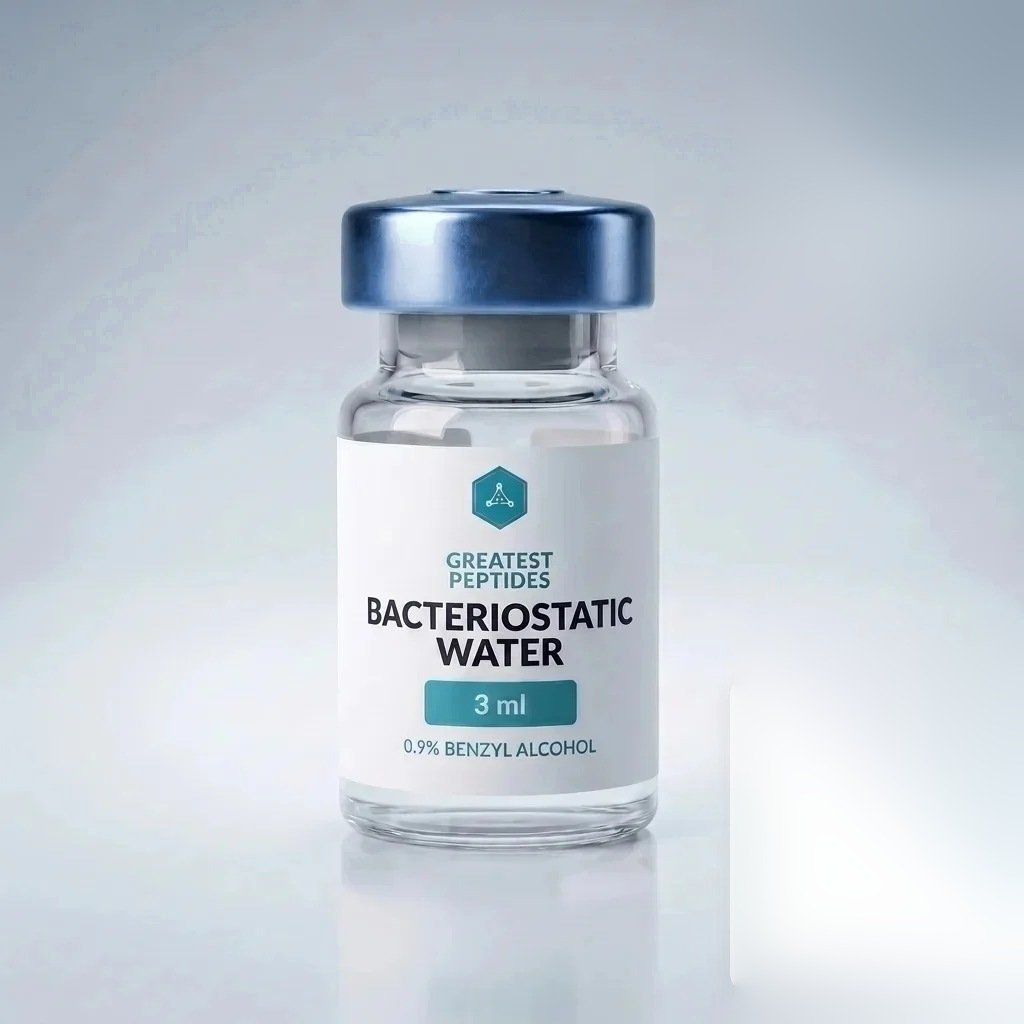
At a glanceOne sealed container of pre-mixed solution at the listed 3 ml fill, labeled for research use only, dispatched within 24 hours of the order clearing. Batch documentation is available for the lot you receive. Free shipping applies at $150 and above.
This listing is a single fixed presentation, not a size selector. That is deliberate: each presentation gets its own page, its own documentation trail and its own URL, so a citation or a purchase-order line that points at Bacteriostatic Water at 3 ml points at exactly one thing. If you need a different fill of the same compound and it is not listed, it is not currently in stock rather than hidden behind a dropdown.
| Field | This listing |
|---|
| Listing | Bacteriostatic Water |
| Labeled fill volume | 3 ml |
| Physical form | Pre-mixed liquid in a sealed container |
| Catalog category | Laboratory Solutions & Consumables |
| Compound class | Laboratory diluent |
| Intended use | Research use only. Not for human or veterinary use, not for diagnostic use, not a drug or supplement. |
| Dispatch | Within 24 hours of the order clearing |
| Documentation | Batch analytical documentation available for the lot supplied |
| Free shipping threshold | Orders of $150 and above |
Specification summary for Bacteriostatic Water
The table below is the specification the store publishes for this listing. It is reproduced here from the product record itself rather than retyped, which means it cannot drift away from what the attribute table further up the page says. Where a field is absent it is absent because we do not publish it for this SKU, not because it was left out of this summary.
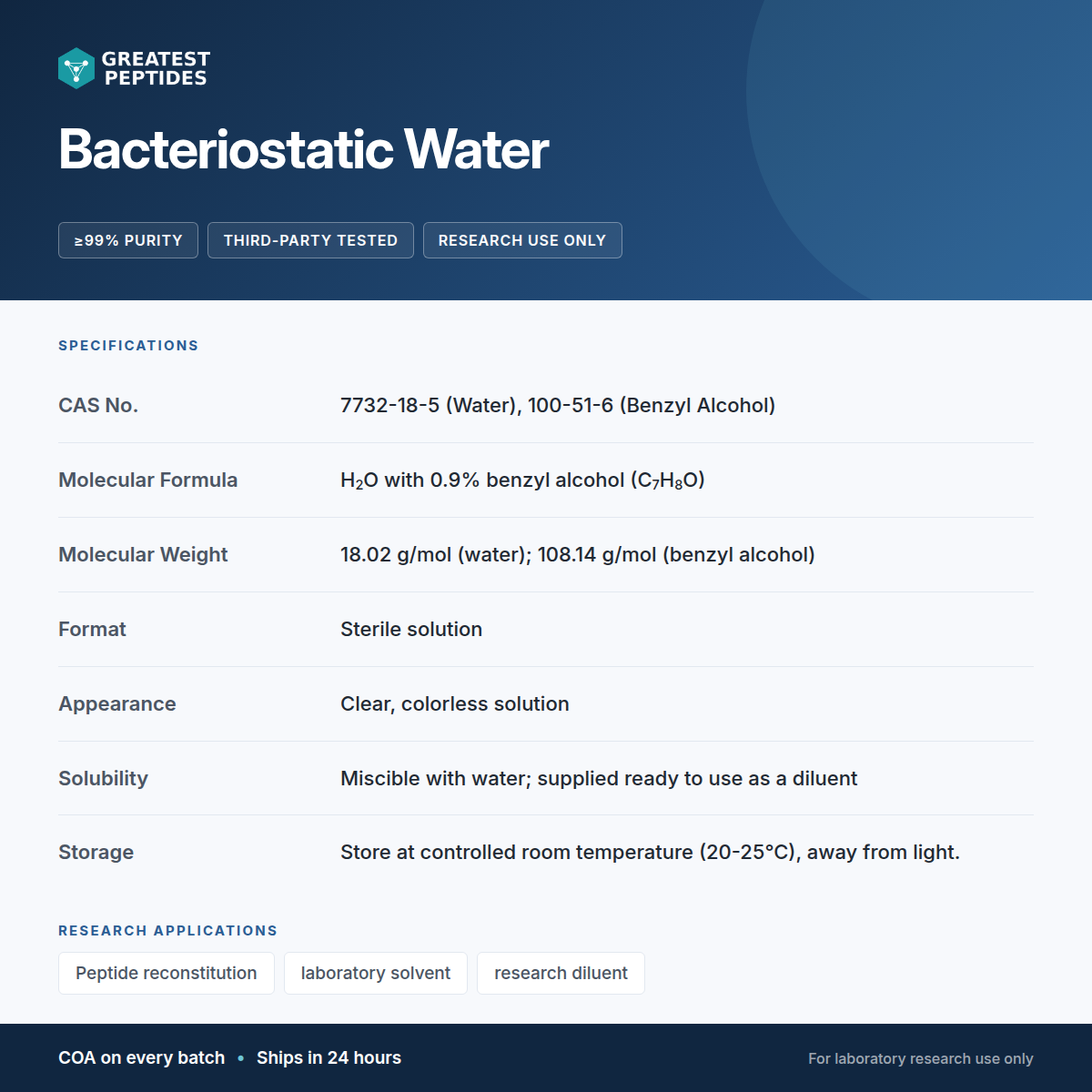
| Size | 3 ml, 10 ml |
| CAS No. | 7732-18-5 (Water), 100-51-6 (Benzyl Alcohol) |
| Purity | ≥99% |
| Molecular Formula | H2O with 0.9% benzyl alcohol (C7H8O) |
| Molecular Weight | 18.02 g/mol (water); 108.14 g/mol (benzyl alcohol) |
| Format | Sterile solution |
| Solubility | Miscible with water; supplied ready to use as a diluent |
| Stability & Storage | Store at controlled room temperature (20-25°C), away from light. Do not freeze. |
| Applications | Peptide reconstitution, laboratory solvent, research diluent |
| Appearance | Clear, colorless solution |
| Regulatory/Compliance | Not for human consumption. For research use only. |
| Safety Information | MSDS available upon request |
A specification table is a claim, and a claim is only worth the record behind it. Every field above is one you can ask us to substantiate against the batch documentation for the lot you were sent. If a field ever fails to match the paperwork, that is a defect on our side and we would rather hear about it than not.
This is a diluent, not a study compound. It has no sequence, no molecular weight to confirm and no peptide purity figure; what matters is that it is what the label says and that its container has not been compromised.
The analytical record behind this lot
A certificate of analysis is not a quality badge. It is a measurement report about one specific batch, produced on a specific date by a specific method, and its value to you is entirely a function of how much of that context it discloses. For Bacteriostatic Water the fields worth checking first are the ones that tie the document to the container in your hand.
| Field on the certificate | Why it matters for this SKU |
|---|
| Lot or batch identifier | Ties the document to the vial. A certificate with no lot reference describes some batch, not necessarily yours. |
| Compound name and, where applicable, sequence | This is the identity claim. For a laboratory diluent it is the field that distinguishes the material from its close relatives. |
| Analytical method and conditions | A purity figure without a method is a number without units. Column, gradient and detection wavelength change what the figure means. |
| Date of analysis | Establishes how old the measurement is relative to the material. A recent vial with a two-year-old certificate is a documentation gap. |
| Who performed the analysis | In-house and independent third-party results are both legitimate; they are not the same claim, and the document should say which it is. |
| The chromatogram or spectrum itself | A summary table can be typed by anyone. A trace can be read, and a reader who knows the compound class can tell whether it is plausible. |
What our documentation for Bacteriostatic Water does assert is what the analysis measured on the batch that was tested. What it does not assert — and no certificate from any supplier can assert — is that the material is safe, that it is suitable for any use in humans or animals, or that it will reproduce a result reported in a published paper. Those are different questions and a purity figure is not evidence for any of them.
Our batch documentation policy, including how to request the record for a lot you already have, is on the certificate of analysis page. If you need the record before ordering rather than after, ask us through the contact page and reference this listing by name.
How Bacteriostatic Water is checked before it reaches this catalog
Three questions have to be answered separately before a compound gets a page here, and collapsing them into one percentage is the most common way a supplier listing becomes misleading.
| Question | What answers it | What it does not tell you |
|---|
| Identity — is this the right molecule? | Mass determination, and sequence confirmation where the material is a defined chain | Nothing about how much of the vial is that molecule |
| Purity — what proportion of the detected material is the target? | Chromatographic separation with a stated method | Nothing about what the other fraction actually is, unless the impurities are themselves identified |
| Content — how much target material is actually in the container? | Quantitative determination against the labeled fill | Nothing about identity or purity; a vial can be accurately filled with the wrong thing |
For Bacteriostatic Water, identity and container-integrity checks appropriate to a laboratory diluent are the assay formats the published work in this area tends to use, which matters when you are deciding whether the material as supplied is fit for the experiment you have in mind. A compound that is clean enough for a binding assay is not automatically clean enough for a quantitative cell-based readout where a co-eluting impurity could carry activity of its own.
Content is the field most often missing from a supplier listing, and it is the one that changes your arithmetic. A vial labeled 3 ml contains that much total solid, and total solid includes counter-ion, residual water and whatever else survived the process. If you need the peptide mass rather than the vial mass to be exact, that is a specific request to make in advance, not an assumption to carry into a calculation.
Receiving, inspecting and storing Bacteriostatic Water
The most useful five minutes you will spend on this material are the five minutes immediately after the package is opened, because that is the only moment at which you can still distinguish a transit problem from a handling problem of your own.
- Confirm the label on the container matches this listing, including the fill volume, and record the lot identifier in your notebook before anything else happens.
- Inspect the closure and seal. A compromised closure is a reason to stop, not a reason to proceed carefully.
- Check the solution for clarity, color and any visible particulate, and record what you see rather than only whether it looked acceptable.
- Note the fill level. A container that arrives visibly short is a documentation issue worth raising immediately.
- Photograph the label and the container on arrival. It costs nothing and it settles later questions instantly.
- Store it in the dark, at the temperature stated for this listing, and write down the date it entered storage.
- Decide your aliquot plan before the first opening, not after it.
A diluent is the one item in the catalog where the container matters more than the contents. A compromised closure invalidates it regardless of how it is stored.
Because this item ships in solution there is no dry state to fall back on. The useful discipline is to treat the container as a stock that is already on the clock: minimize the number of times it is opened, keep it out of light, and record every withdrawal rather than reconstructing the history later from how much is left.
Using this diluent in reconstitution arithmetic
A diluent is the volume term in every reconstitution calculation, which makes the accuracy of the volume you add the limiting factor in the accuracy of every concentration you derive. Add it by measured transfer rather than by eye, record the volume you actually added rather than the volume you intended to add, and note the diluent and its lot alongside the compound in your records — if a preparation later behaves unexpectedly, the diluent is part of the evidence. Our reconstitution calculator covers the arithmetic itself.
What to record for Bacteriostatic Water so the work is reproducible
Reproducibility in this area fails at the material-provenance step far more often than at the analysis step. The fields below are the ones that let somebody else — a reviewer, a collaborator, or you in eighteen months — work out whether two sets of results were generated with comparable material.
- Supplier and the exact listing name, including the fill size, rather than just the compound name
- Lot identifier, and the date the batch documentation was issued
- Date received, and the storage conditions and location it went into
- Stated concentration from the label, and the date the container was first opened
- Every withdrawal: date, volume and what it was used for
- Any dilutions made, with the diluent and its lot
- Any deviation from plan, including deviations that seemed unimportant at the time
- Whether the material was research-use-only labeled, which for this listing it is
Comparing suppliers on this exact SKU
Comparing Bacteriostatic Water across suppliers on price alone is comparing two numbers that may not describe the same thing. These are the questions that make the comparison meaningful, with our answers next to them so you can hold us to the same standard you would hold anyone else.
| Question to ask any supplier | Our answer for this listing |
|---|
| Is batch documentation available for the specific lot I will receive, not a representative lot? | Yes — the record is tied to the lot supplied. Policy on the certificate of analysis page. |
| Does the analytical method appear on the document, or only the result? | The method context belongs on the document; a bare percentage is not a complete record. |
| Is the labeled figure total solid or target-compound mass? | Labeled as the fill for this presentation. If you need the distinction resolved for a calculation, ask before ordering. |
| Is the listing labeled research use only throughout, without use claims? | Yes, and deliberately so. No use, benefit or outcome is claimed anywhere on this page. |
| How quickly does it dispatch, and is that a promise or an average? | Within 24 hours of the order clearing. |
| Can I reach a person about the paperwork rather than only about the order? | Yes — the contact page reaches us directly. |
| Is there a published position on what the documentation does not prove? | Yes. It is stated on this page and on every product page. |
A supplier who answers all seven honestly is a better bet than a supplier who is ten percent cheaper and answers four. A supplier who cannot answer the first one at all is not selling you documented material; they are selling you a container.
Compliance boundary for Bacteriostatic Water
Bacteriostatic Water is supplied for laboratory research use only. It is not a drug, not a supplement, not a cosmetic and not a medical device. It is not for human or veterinary administration, not for diagnostic use, and not for use in food. That is not a disclaimer bolted onto a sales page — it is the actual scope of what is being sold, and it constrains what can honestly be written about it.
| Language that stays inside the boundary | Language that does not |
|---|
| "Supplied for research use only" | Any phrasing that implies a personal or clinical use |
| "Published work in this area has examined not applicable - a diluent is a tool in a protocol, not a subject of one" | "Bacteriostatic Water does X" stated as an established effect |
| "Purity determined by the stated method on the tested batch" | "Pharmaceutical grade", "medical grade", "safe" |
| "Concentration arithmetic for preparing laboratory aliquots" | Anything framed as a dose, a protocol or a schedule |
| "Not for human or veterinary use" | Silence on the point, which readers correctly interpret as evasion |
| Naming the model system a finding came from | Reporting an animal or in-vitro finding as though it were a human finding |
The reason to be precise about this is not only regulatory. Research literature on this class of material is genuinely interesting and genuinely incomplete, and overstating it makes the real findings harder to see. Where published work is referenced on this site it is referenced as what was measured, in what system, at what scale — not as a property of the vial.
Other Laboratory Solutions & Consumables listings
These share a catalog category with Bacteriostatic Water, which means the documentation and handling considerations above largely transfer to them. Their compound-specific sections do not — each has its own identity, its own literature and its own analytical profile.
The full catalog is on the shop page, and the longer written material is in our research guides.
Questions about ordering Bacteriostatic Water
Is Bacteriostatic Water documentation available before I order?
Yes. Ask through the contact page and reference this listing by name. Our general position on batch documentation is on the certificate of analysis page. If a supplier will not show you the record until after payment has cleared, that is worth noticing.
What does the 3 ml figure on the label actually refer to?
It is the labeled fill for this presentation. For lyophilized material the labeled mass is total solid unless the documentation states otherwise, and total solid includes counter-ion and residual moisture as well as target compound. If your calculation depends on the distinction, resolve it against the batch record rather than assuming.
How fast does Bacteriostatic Water ship?
Within 24 hours of the order clearing. Orders of $150 and above ship free. Transit time after dispatch depends on the service selected at checkout.
Can I buy Bacteriostatic Water for personal use?
No. This material is supplied for laboratory research use only. It is not a drug, supplement or cosmetic, it is not for human or veterinary administration, and nothing on this page should be read as guidance for any such use.
How should this preparation be stored once opened?
Keep it dark, at the temperature stated for this listing, and treat the first opening as the start of its useful life rather than the date of first use. Record each withdrawal. A diluent is the one item in the catalog where the container matters more than the contents. A compromised closure invalidates it regardless of how it is stored.
Does a high purity figure mean Bacteriostatic Water is safe?
No, and this is the single most common misreading of a certificate of analysis. Purity describes what proportion of the detected material was the target compound in the batch that was tested, by the method stated. It is not a safety assessment, it says nothing about suitability for any use in humans or animals, and it does not become a safety claim by being a large number.
What is Bacteriostatic Water classified as in your catalog?
It is listed as a laboratory diluent, in the Laboratory Solutions & Consumables category. Published work in this area has looked at not applicable - a diluent is a tool in a protocol, not a subject of one. That is a description of where the literature sits, not a claim about what the material does.
Do you have more general written material on evaluating research peptides?
Yes. The home page guide covers reading a certificate of analysis, what chromatographic and mass-spectrometric methods each prove, and how to compare suppliers. The research guides go deeper on individual topics, and the FAQ covers ordering, shipping and post-shipping questions.
Bacteriostatic Water is supplied strictly for laboratory research use. It is not a drug, supplement, cosmetic or medical device; it is not for human or veterinary use, not for diagnostic use and not for use in food. No statement on this page is intended to describe a therapeutic use, benefit or outcome, and references to published work describe what was measured in the reported model system rather than a property of the material supplied. Purchasers are responsible for handling the material in accordance with the requirements applicable to their institution and jurisdiction.