Research Procurement Information
Buy Vitamin B12 (Methylcobalamin) for Research | RUO COA & Documentation Guide
For laboratory teams evaluating where to buy Vitamin B12 for research, the priority is documentation, compound identity, and research-use-only (RUO) alignment. Vitamin B12 in the methylcobalamin form is a cobalt-containing corrinoid with molecular formula C63H91CoN13O14P and a molecular weight of approximately 1,344.4 Da (cyanocobalamin, a related form, is C63H88CoN14O14P, ≈ 1,355.4 Da)[1]; the exact form should be confirmed against the batch-specific COA (methylcobalamin CAS 13422-55-4; cyanocobalamin CAS 68-19-9). It is described in the literature as a cofactor in one-carbon-metabolism research[2].
Fast AnswerResearchers evaluating where to buy Vitamin B12 for research should review RUO labeling, a batch-specific certificate of analysis (COA), HPLC/UV purity data, identity support, concentration for solution products, and lot traceability before procurement. Confirm which cobalamin form is supplied. Material discussed here is intended for laboratory research use only and is not for human or veterinary use.
What Does “Buy Vitamin B12 for Research” Mean?
The phrase is addressed as laboratory research-procurement intent — how qualified researchers evaluate a Vitamin B12 reference material through documentation, analytical support, and labeling clarity, not personal, clinical, dietary, or consumer decision-making.
Compound Identity & Classification
| Compound name | Vitamin B12 (methylcobalamin / cyanocobalamin form) |
| CAS number | 13422-55-4 (methylcobalamin); 68-19-9 (cyanocobalamin) |
| Molecular formula | C63H91CoN13O14P (methyl); confirm form on COA[1] |
| Molecular weight | ≈ 1,344.4 Da (methyl) / 1,355.4 Da (cyano)[1] |
| Classification | Cobalt-containing corrinoid (small-molecule vitamin) |
| Product form | Solution or lyophilized powder (per listing) |
| Purity target | Per batch-specific COA |
| Regulatory status | Research use only — not for human or veterinary use |
Pathway Context (One-Carbon-Metabolism Research)
Published literature discusses Vitamin B12 within one-carbon-metabolism research as a cofactor for methionine synthase and methylmalonyl-CoA mutase in biochemical and cell models[2][3]. On a research product page this pathway context should remain academic literature interpretation used to define the research lane — it is not converted into product-performance language.
COA, Purity & Identity Documentation
A Vitamin B12 COA should be reviewed as a batch-specific record, not a marketing statement. Look for compound name, cobalamin form, lot number, test date, stated purity, analytical method, identity confirmation, and (for solutions) concentration. Purity, identity, method, and lot number should be evaluated together.
| Evaluation area | What to review | Why it matters |
|---|
| RUO labeling | Clear research-use-only language | Separates research procurement from human-use positioning |
| COA availability | Batch-specific certificate for the received lot | Supports lot-level documentation |
| Purity data | HPLC/UV-Vis area-percent support | Helps evaluate material consistency |
| Identity testing | UV-Vis spectrum / LC-MS vs expected mass | Confirms the material matches the listed cobalamin |
| Concentration | Stated mg/mL for solution products | Supports accurate research use |
HPLC, UV-Vis & Analytical Review
HPLC supports purity assessment; the characteristic cobalamin UV-Vis absorption spectrum and LC-MS support identity and molecular-mass review[10][11]. ICH Q2(R2) describes validation characteristics used to interpret assay, purity, and identity results[7].
Lot Traceability & Batch Documentation
Lot traceability connects the product listing, COA, label, and receiving record. ISO/IEC 17025 addresses the competence of testing laboratories, and NIST resources describe how certificates and lot identifiers support traceability[8][9].
Claim Boundary for RUO Positioning
| Research-safe statement | Non-compliant version to avoid |
|---|
| “Vitamin B12 is discussed in one-carbon-metabolism research literature.” | “Vitamin B12 boosts energy or treats deficiency.” |
| “Researchers should confirm the cobalamin form and review the COA.” | “Buy B12 for supplementation.” |
| “Greatest Peptides supplies Vitamin B12 as a research-use-only material.” | “Greatest Peptides supplies B12 for injections.” |
Research Procurement Checklist
- Confirm the material is labeled for research use only.
- Confirm which cobalamin form (methyl / cyano) is supplied.
- Review the batch-specific certificate of analysis for the received lot.
- Confirm purity is supported by HPLC/UV-Vis data.
- Confirm concentration for solution products.
- Verify the lot number matches across all documentation.
- Document storage (protect from light) and handling conditions.
How Greatest Peptides Presents Vitamin B12
Greatest Peptides supplies Vitamin B12 as a research-use-only laboratory material, characterized by batch-specific COA availability, HPLC/UV-Vis documentation, stated concentration for solution products, lot-level traceability, and transparent RUO labeling. Products are not intended for human or animal consumption, diagnostic, therapeutic, clinical, or veterinary use.
Published Literature Context
Published Vitamin B12 literature spans corrinoid biochemistry and one-carbon-metabolism research models[2][3]. Model-specific findings should not be generalized or interpreted as use guidance for research-use-only materials.
Contributing Researchers
Recognized for published work that shaped the scientific context discussed above
Dorothy Hodgkin, PhD — determined the crystal structure of Vitamin B12, foundational to corrinoid chemistry[2].
Ralph Carmel, MD — authored research characterizing cobalamin biochemistry and assays[3].
FAQs About Buying Vitamin B12 for Research
What should researchers check before buying Vitamin B12 for research?
Confirm the cobalamin form, then review RUO labeling, the batch-specific COA, purity with HPLC/UV-Vis support, identity data, concentration for solutions, and lot traceability.
What is Vitamin B12 in research documentation?
A cobalt-containing corrinoid; methylcobalamin is C63H91CoN13O14P (≈1,344.4 Da) and cyanocobalamin is C63H88CoN14O14P (≈1,355.4 Da).
Why does a COA matter when buying Vitamin B12?
It documents the cobalamin form, purity, identity, and (for solutions) concentration for the received lot.
Is Vitamin B12 intended for human or animal use?
No. Material discussed here is intended strictly for laboratory research use only.
How should published literature be interpreted?
As scientific context only. Model-specific findings should not be generalized or read as use guidance for research-use-only materials.
This page addresses Vitamin B12 only as research-use-only laboratory procurement. Boundary-sensitive terms such as energy, deficiency, supplementation, and injection are referenced here only as research-language examples that must stay separate from RUO product positioning. All product information is for informational and educational purposes only. Products are not intended for human or animal consumption and have not been evaluated by the FDA to diagnose, treat, cure, or prevent any disease.
References
- Reference records for methylcobalamin (CAS 13422-55-4, C63H91CoN13O14P) and cyanocobalamin (CAS 68-19-9, C63H88CoN14O14P). Accessed 2026.
- Hodgkin DC, et al. Structure of Vitamin B12. Nature. 1956. (Crystal-structure determination.)
- Carmel R. Cobalamin biochemistry and assay methodology. Clinical chemistry / hematology literature. 2000s.
- Banerjee R, Ragsdale SW. The many faces of vitamin B12 catalysis. Annual Review of Biochemistry. 2003.
- IUPAC nomenclature for corrinoids and vitamins. Recommendations.
- U.S. FDA. Analytical procedures and methods validation for drugs and biologics. 2015.
- U.S. FDA. Q2(R2) Validation of Analytical Procedures. 2024.
- International Organization for Standardization. ISO/IEC 17025:2017. 2017.
- National Institute of Standards and Technology. Reference materials and certificates of analysis. Accessed 2026.
- General HPLC methodology for cobalamin purity analysis. Analytical chemistry literature.
- General UV-Vis / LC-MS considerations for cobalamin identity. Analytical chemistry literature.
Compound profile
Vitamin B12: compound profile, literature landscape and handling notes
Vitamin B12 in one paragraph
Vitamin B12, or cobalamin, is the odd entry in a catalog otherwise built from peptides. It is not a peptide, not a receptor ligand and not an experimental molecule: it is an organometallic cofactor built around a single cobalt ion held in a corrin macrocycle, and it is one of the largest and most structurally intricate small molecules that living systems make. It also carries the distinction of containing one of the very few carbon-cobalt bonds found anywhere in biology, which is the fact that drives almost everything practical about handling it, because that bond breaks in light. This listing is a solution rather than a lyophilized powder, and the concentration, the specific cobalamin form and the container format are printed in the specification table further down this page rather than restated here. Everything below describes the published research record and the behavior of the material on a bench. Nothing here is a claim about what this vial does, and nothing here is applicable to use in humans or animals.
Where Vitamin B12 came from
The history of B12 runs backward from a disease to a molecule, and the gap between the two ends of that story is almost a century. Thomas Addison described a fatal progressive anemia in 1849, called pernicious because nothing reliably altered its course, and so it remained for seventy-five years. Then in 1926 George Minot and William Murphy reported that feeding large quantities of raw liver reversed the hematologic picture, building on George Whipple's earlier experiments on blood regeneration in dogs; the three shared the 1934 Nobel Prize. Nobody knew what was in the liver: the active principle was defined operationally, by what a liver extract did, and purifying it consumed the next two decades.
Running alongside that was William Castle's work at the end of the 1920s, which proposed that the process required two components: an extrinsic factor present in food, and an intrinsic factor secreted by the stomach, with the disorder arising when the intrinsic component was missing rather than the dietary one. That framework explains why B12 is the only vitamin whose absorption depends on a dedicated secreted protein, and why its transport chain is more elaborate than any other vitamin's.
The crystalline extrinsic factor was finally isolated in 1948, independently by a group at Merck and by E. Lester Smith at Glaxo in Britain. The crystals were red, and elemental analysis showed they contained cobalt, a genuine surprise; no cobalt-containing organic compound had been expected in mammalian biochemistry. Naming followed the metal, giving cobalamin.
Knowing the composition was not knowing the structure, and the molecule was far too complex for the degradative chemistry of the day. The structure was solved instead by Dorothy Hodgkin and her collaborators, using X-ray crystallography, across the first half of the 1950s. It was among the largest structures determined at that point, it required early electronic computing to handle the calculations, and it was one of the achievements cited in her 1964 Nobel Prize in Chemistry. The total chemical synthesis, completed in the early 1970s by the groups of Robert Burns Woodward and Albert Eschenmoser, remains a landmark of synthetic organic chemistry.
One further fact is surprising and easy to verify: no plant and no animal synthesizes B12. The complete biosynthetic pathway exists only in certain bacteria and archaea. Everything else that needs cobalamin obtains it from those organisms, directly or through a food chain, which is why the compound's ecology is discussed in microbiology journals more than in nutrition journals.
Reading the corrin ring and the cobalt center
Start with what the ring is not. Heme, chlorophyll and the cytochromes are built on porphyrin, a macrocycle of four pyrrole rings joined by four one-carbon meso bridges. Cobalamin is built on corrin, which has only three: rings A and D are joined directly, carbon to carbon, with no bridging atom between them. That has two consequences. The macrocycle is contracted, so the cavity holding the metal is smaller than a porphyrin cavity. And because corrin is less unsaturated, the ring is not a rigid planar aromatic sheet; it can flex and fold, and the enzymes that carry it use that flexibility.
At the center sits a single cobalt ion, held equatorially by the four pyrrole nitrogens. Cobalt is the point of the molecule, and unlike the iron in heme it cycles through three oxidation states in normal catalytic service: trivalent, divalent and monovalent forms all appear, and the monovalent state is one of the strongest nucleophiles known in biological chemistry. The corrin periphery carries six amide side chains, which is why the molecule is freely water soluble despite its size.
The lower axial position is occupied by an unusual ligand: 5,6-dimethylbenzimidazole, not a free molecule in solution but tethered back to one of the propionamide side chains through an aminopropanol linker, a ribose and a phosphate. That tether is called the nucleotide loop, and having a coordinating base covalently leashed to the macrocycle it coordinates is an arrangement with very few parallels. It also creates a switch: the base can be bound to the cobalt, the base-on form seen in free cobalamin, or displaced by a histidine from the enzyme in both human cobalamin enzymes.
The upper axial position is where the forms diverge, and it is the only difference between them. A cyano group gives cyanocobalamin, a hydroxo group hydroxocobalamin, a methyl group methylcobalamin, and a 5'-deoxyadenosyl group adenosylcobalamin. Which form this listing supplies is stated in the specification table further down this page and should be read there rather than inferred from the product name, which covers all of them.
The headline structural fact belongs to the last two. In methylcobalamin and adenosylcobalamin the upper ligand is bound to cobalt through a direct carbon-metal sigma bond. Carbon-metal bonds define organometallic chemistry and are almost entirely absent from biology. Cobalamin is one of the very few naturally occurring compounds that contains one, which is why it turns up in organometallic chemistry courses as often as in biochemistry courses. That bond is also unusually weak for a covalent bond, which is what makes it useful to enzymes and what makes the material photosensitive on a bench.
A historical footnote with practical weight: cyanocobalamin barely occurs in living systems. The cyanide ligand entered during the original isolation work, from activated charcoal used in purification, and the form persisted as the commercial standard because it is stable and crystallizes well.
What B12 does as a cofactor, and where
B12 has no receptor in the pharmacological sense. It is not an agonist, it has no binding curve at a cell-surface target, and the vocabulary of potency and selectivity does not apply. It is a cofactor, so the correct question is which enzymes require it, and in humans the answer is remarkably short: exactly two.
The first is methionine synthase, a cytosolic enzyme that uses methylcobalamin. Its reaction transfers a methyl group from 5-methyltetrahydrofolate to homocysteine, producing methionine and regenerating tetrahydrofolate. Mechanistically the cobalt shuttles between the monovalent and trivalent states: the supernucleophilic monovalent cobalt attacks the methyl group on the folate, becoming methylcobalamin, then hands that methyl to the thiol of homocysteine and returns to the monovalent state. This is a two-step methyl transfer, and it is the junction at which the folate and methionine cycles are physically connected. Occasionally the monovalent cobalt is oxidized out of the cycle, and a separate reductase is required to reactivate the enzyme.
The second is methylmalonyl-CoA mutase, a mitochondrial enzyme that uses adenosylcobalamin, and its chemistry could hardly be more different. Here the carbon-cobalt bond breaks homolytically rather than heterolytically, splitting so that each fragment keeps one electron and generating a 5'-deoxyadenosyl radical and divalent cobalt. That radical abstracts a hydrogen atom from the substrate, and the resulting substrate radical undergoes a 1,2 rearrangement of the carbon skeleton, converting methylmalonyl-CoA into succinyl-CoA before the hydrogen is returned and the cobalt-carbon bond reforms. The cofactor is acting as a reversible, enzyme-controlled source of a free radical, a role almost nothing else in biochemistry plays. The substrate arrives from catabolism of odd-chain fatty acids, of several branched-chain and sulfur amino acids, and of the cholesterol side chain; the product enters the citric acid cycle.
So: two enzymes, two different cofactor forms, two entirely different chemistries. Methyl transfer in the cytosol, radical-mediated carbon skeleton rearrangement in the mitochondrion. The two forms are not interchangeable at the active sites, and the cell interconverts them through a shared processing pathway rather than importing them separately.
The metabolic consequences of limiting either reaction follow directly, and are worth stating as biochemistry. If methionine synthase activity falls, homocysteine accumulates because it is not being methylated. If methylmalonyl-CoA mutase activity falls, methylmalonic acid accumulates because methylmalonyl-CoA has nowhere else to go. The second is the more specific functional readout, and the reason is structural rather than statistical: homocysteine also accumulates when folate or vitamin B6 handling is limited, whereas the mutase reaction has no cobalamin-independent alternative route in human metabolism. Nothing else disposes of methylmalonyl-CoA. That is why methylmalonic acid, not homocysteine, is the marker cited when investigators want a readout tied specifically to cobalamin.
Outside human biochemistry the picture widens. Bacteria use cobalamin-dependent enzymes for a long list of reactions, including a class of ribonucleotide reductase, glutamate mutase and diol dehydratase, and much of the mechanistic radical chemistry in the literature was worked out in those systems.
What the published literature on Vitamin B12 actually measures
The published cobalamin literature is unusually stratified, and it helps to know which layer a given paper belongs to before citing it.
The deepest and most settled layer is structural and mechanistic chemistry. Crystallography of free cobalamins and of the enzyme-bound cofactor, kinetics of carbon-cobalt bond homolysis, measurement of the bond dissociation energy and of the rate acceleration enzymes achieve over the uncatalyzed homolysis, and spectroscopic characterization of the divalent cobalt intermediate: this body of work is mature, internally consistent and largely uncontested, and it is the part a bench chemist actually cites.
The second layer is transport and cellular handling, the reason cobalamin is discussed as a special case. Dietary cobalamin is first bound by haptocorrin, a binding protein present in saliva and gastric juice that protects it through the acidic stomach. In the duodenum pancreatic proteases degrade the haptocorrin, and the released cobalamin transfers to intrinsic factor, the glycoprotein Castle postulated, secreted by gastric parietal cells. The complex is then recognized in the distal ileum by a receptor assembly of two proteins, cubilin and amnionless, usually called cubam, and taken up by endocytosis. Inside the cell it is released from the lysosome by dedicated transport proteins, processed by a cytosolic protein that strips whatever upper ligand it arrived with, and directed either to the cytosol for methylation or to the mitochondrion for adenosylation. In circulation it is carried by two proteins with different roles: transcobalamin, which delivers cobalamin to tissues through a specific cell-surface receptor, and haptocorrin again, which carries most of what is measurable in serum but does not deliver it to tissues. Four or five distinct proteins and a receptor complex, for a single vitamin. Nothing else in nutrition has an apparatus like it.
The third layer is analytical, and it turns on a problem specific to this compound. The classic potency method is microbiological: a cobalamin-requiring organism is grown and turbidity read against a standard curve, with Lactobacillus and Euglena species used historically. The difficulty is that corrinoids carrying a different lower base, such as the pseudo-B12 in some cyanobacteria, can support growth in these organisms while being inactive in human enzymes, or the reverse. Competitive binding assays using intrinsic factor were introduced to give species-relevant specificity, and chromatographic and mass spectrometric methods came later. When an older paper reports a B12 content, the method determines what that number means.
The fourth layer is the comparative-form literature, which is the one most often misrepresented. Studies comparing cyanocobalamin with methylcobalamin exist, but they are mostly small, heterogeneous, short and varied in endpoint. The mechanistic backdrop is more informative than the trial data: because every incoming form is stripped of its upper ligand by the same cytosolic processing step, supplying a preformed alkyl form does not obviously bypass any part of the pathway. The strongest evidence bearing on this comes not from comparative studies but from the inborn errors of cobalamin processing, where defects at defined steps map the sequence precisely.
Where the Vitamin B12 literature is thin or frequently misread
The most consequential weakness in the cobalamin literature is measurement, and it is not a subtle one. Total serum B12, the number that appears in most published cohorts, is a poor functional marker of what tissues are receiving. The majority of circulating cobalamin is bound to haptocorrin rather than to transcobalamin, and the haptocorrin-bound fraction is not efficiently delivered to most cells. A measurement dominated by an undeliverable fraction is a weak proxy for a deliverable one. This is precisely why methylmalonic acid, as a functional readout of the mutase reaction, and holotranscobalamin, as a measure of the deliverable fraction, were developed at all, and why a study whose only cobalamin variable is total serum B12 should be read with that limitation in mind. It cuts the other way too: methylmalonic acid rises with impaired renal clearance and with small intestinal bacterial overgrowth, so it is specific to the pathway but not to intake, and papers treating it as a clean single-variable readout overreach in the opposite direction.
The second soft area is the claim that methylcobalamin is inherently superior to cyanocobalamin. It is repeated with a confidence the evidence does not support. The mechanistic argument for it is weaker than it sounds once the shared processing step is taken into account, the comparative studies are small and methodologically varied, and a good deal of the secondary writing traces back to manufacturer literature and to reviews citing other reviews rather than to primary comparisons. There are real arguments in the neighborhood, mostly about differential retention and excretion and about specific cobalamin processing defects, but they are narrower and more conditional than the popular version.
The third is the genetics. Popular writing about methylenetetrahydrofolate reductase polymorphisms, and the C677T variant in particular, routinely presents as established what the primary literature treats as modest, context-dependent and heavily confounded by folate status and population structure. The enzyme is real, the variant is real, the effect on activity in vitro is real; the elaborate downstream inferences built on that in the popular and commercial literature are not proportionate to the evidence.
A fourth, smaller point: assay interference is well documented. Competitive binding assays can return misleading values in the presence of anti-intrinsic-factor antibodies, and the corrinoid analog problem noted above affects microbiological assays. Comparing B12 values across studies that used different assay generations asks more of the numbers than they can support. Finally, the frequently quoted multi-year storage figure: the broad point is well supported, but it is usually stated with a precision the underlying measurements, many decades old and based on small numbers, do not carry.
How Vitamin B12 behaves in solution
The carbon-cobalt bond is photolabile, and for cobalamin that is not a generic stability caveat but the dominant chemistry of the material.
In methylcobalamin and adenosylcobalamin, absorption of visible or near-ultraviolet light drives homolysis of the carbon-cobalt bond. The bond splits, the alkyl group leaves as a radical, and the cobalt drops to the divalent state. Under aerobic aqueous conditions the radical is scavenged and the cobalt re-oxidized, and the endpoint is hydroxocobalamin. The practical translation is blunt: an alkylcobalamin solution left on an open bench under room lighting is converting itself into a different compound while you look at it. Adenosylcobalamin is the most photosensitive of the set. This is the actual reason B12 solutions are supplied in amber containers and handled under reduced light, and one of the few places in this catalog where that instruction has specific, well-characterized chemistry behind it.
Cyanocobalamin is markedly more photostable. The cyanide ligand binds cobalt more strongly than an alkyl group does and the complex is far less prone to photolysis, though not indefinitely stable under prolonged illumination. That difference, together with its crystallizing behavior, is why cyanocobalamin became the standard commercial form. It is a handling choice, not a biochemical one.
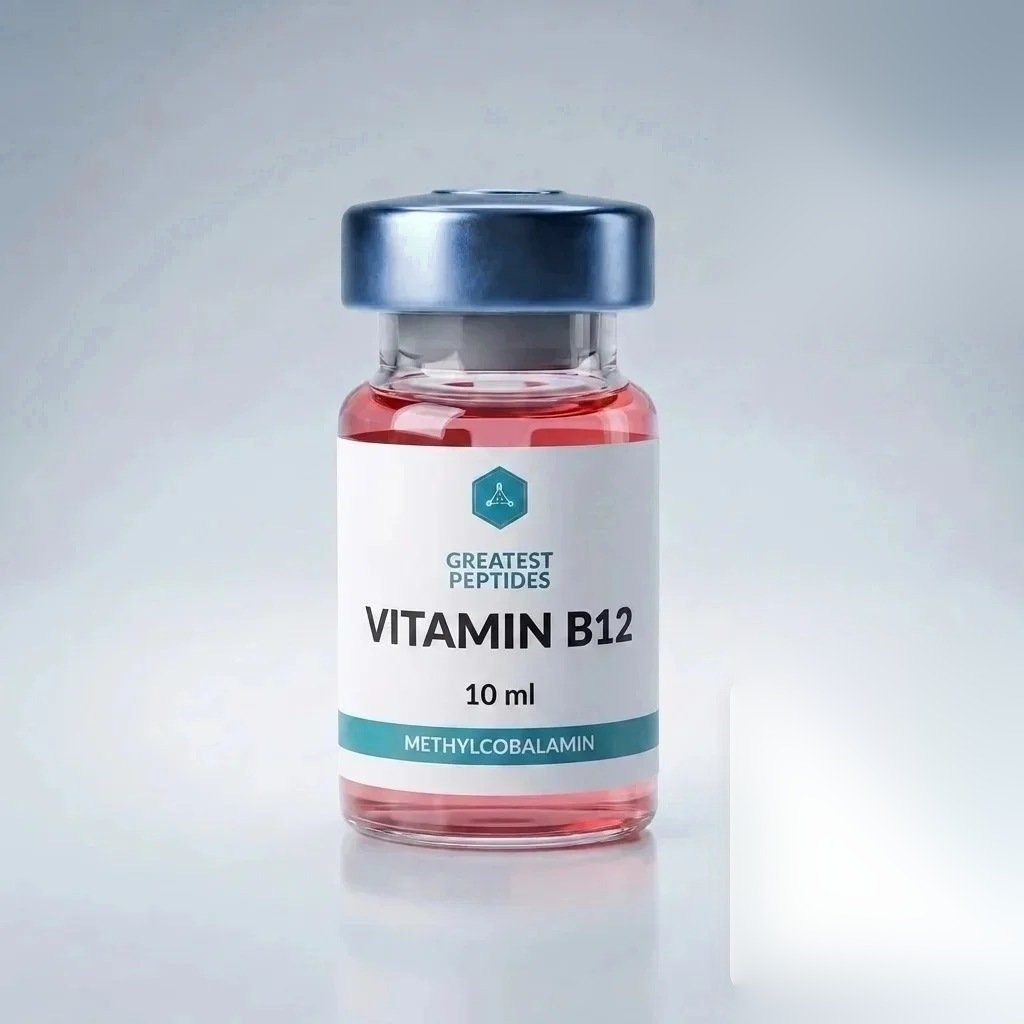
The color is not incidental either. It comes from the cobalt-corrin chromophore itself, not from an added colorant, which makes this one of the very few materials in this catalog where the solution genuinely reports on its own condition by eye. A solution that has lost color intensity, or shifted toward brown or yellow, has lost or altered the chromophore, meaning the corrin ring or the cobalt coordination has been damaged. Photoconversion between cobalamin forms changes the shade rather than removing the color, so a subtle shift and a wholesale fade mean different things. Neither replaces an analytical measurement, but both are real signals.
Beyond light, three chemical vulnerabilities are well documented. The first is pH: cobalamins are most stable in the mildly acidic to neutral range, and strongly acidic or alkaline conditions attack the peripheral amide side chains and the nucleotide loop, giving cleavage products that no longer function as cofactors. The second is ascorbate. Ascorbic acid degrades cobalamin in solution, an interaction reported since the middle of the last century and accelerated by trace copper and iron; the two should not be combined in a working solution, and the caution extends to other strong reducing agents. The third is thermal exposure, which compounds the others.
One thing that is not a problem, in contrast with most of this catalog, is surface adsorption. Cobalamin is a freely water-soluble small molecule with a polar, heavily amidated periphery and does not behave like an amphiphilic peptide on plastic and glass. The failure modes here are photochemical and chemical, not physical.
Analytical notes: color, spectra and elemental confirmation
Cobalamin is one of the rare compounds where an ultraviolet-visible spectrum is a genuinely informative identity check rather than a formality, and the instrument is cheap.
The cobalt-corrin chromophore gives a distinctive three-band absorption pattern. For cyanocobalamin the commonly cited maxima are in the ultraviolet near 278 nm, an intense band near 361 nm, and a broader feature in the 550 nm region responsible for the visible color. The important part for identity work is that this pattern is not shared across the forms. Hydroxocobalamin, methylcobalamin and adenosylcobalamin each give a recognizably different band structure, because the upper axial ligand alters the electronic environment at the cobalt directly. A spectrum will therefore tell you not only that you are looking at a corrinoid but, with a reference spectrum in hand, which corrinoid.
That same sensitivity produces the most important cautionary point on this page. An alkylcobalamin sample must be protected from light throughout preparation and measurement, because the measurement conditions themselves can convert the analyte. Repeatedly scanning a methylcobalamin solution under an unfiltered source will show the spectrum evolving toward that of hydroxocobalamin, often through clean isosbestic points: a satisfying demonstration and a serious analytical hazard. If you see that drift mid-run, the instrument is not misbehaving; the chemistry is proceeding in the cuvette. Low-actinic glassware, amber autosampler vials, subdued room lighting and short standing times are the practical answer.
Reversed-phase HPLC with diode-array detection is the workhorse for form-resolved analysis, and diode-array detection specifically is worth having because it gives a full spectrum at every peak, so identity and separation are established in one run: a peak eluting where hydroxocobalamin should elute, with the hydroxocobalamin spectrum, is a stronger assignment than retention time alone. Because photoconversion generates new species rather than destroying the chromophore, chromatography is also the cleanest way to quantify how much of a sample has converted rather than degraded outright.
Cobalt content by inductively coupled plasma mass spectrometry is an orthogonal check available for no other product in this catalog. The stoichiometry is fixed at one cobalt per corrin, so an elemental cobalt measurement gives an independent handle on content that does not depend on the chromophore, on chromatographic behavior, or on any assumption about the upper ligand; cobalt is also monoisotopic, which simplifies the measurement. What it cannot do is distinguish intact cobalamin from degraded corrinoids or free cobalt salts, so it complements a chromatographic method and never substitutes for one.
The classic potency method is microbiological growth against a cobalamin-requiring organism, and it survives in the compendial methods. Its historical weakness, that certain corrinoid analogs support microbial growth without being active in mammalian enzymes, is why intrinsic-factor binding assays and chromatographic methods displaced it for identity work. Where a specific form matters, chromatography with spectral confirmation answers the question.
Cobalamin forms and B-vitamin products this is confused with
| Often mistaken for | How it actually differs from Vitamin B12 |
|---|
| Cyanocobalamin | The form carrying a cyanide group in the upper axial position. It is essentially a laboratory artifact rather than a biological form, the cyanide having been introduced during the original 1940s isolation work. It is by a wide margin the most photostable and the easiest to crystallize, which is why it became the standard commercial and compendial form, and its ultraviolet-visible maxima near 361 nm and in the 550 nm region are the reference spectrum most often quoted. |
|---|
| Hydroxocobalamin | Carries a hydroxo group in the upper position, and exists in equilibrium with the aquo form depending on pH. It has no carbon-cobalt bond, so it is not photolabile in the way the alkyl forms are, and it is the compound those forms convert into when their carbon-cobalt bond is photolyzed. That makes it both a distinct material and the expected degradation product of two of the others, worth keeping straight when reading a chromatogram. |
|---|
| Methylcobalamin | Carries a methyl group bound directly to cobalt through a carbon-metal bond. It is the cofactor form used by methionine synthase in the cytosol, where the methyl group is the transferred species. It is strongly photolabile and requires light-protected handling at every stage including analysis. Claims that it is inherently superior to cyanocobalamin rest on weaker evidence than their frequency of repetition suggests. |
|---|
| Adenosylcobalamin | Carries a 5'-deoxyadenosyl group on cobalt and is the cofactor form used by methylmalonyl-CoA mutase in the mitochondrion. Its chemistry is radical rather than ionic: the enzyme cleaves the carbon-cobalt bond homolytically to generate a deoxyadenosyl radical. It is the most photosensitive of the four forms and the one most easily lost to careless handling. |
|---|
| Lipo-C lipotropic blend | A multi-component solution rather than a single defined compound. Blends of this type typically include B-vitamin components, frequently a cobalamin among them, alongside methyl donors such as choline and methionine, so the overlap with this listing is real. The practical difference is analytical: a blend requires a method that resolves and quantifies each component, and its composition is defined by its own specification rather than by a single molecular identity. |
|---|
| NAD+ | The other vitamin-derived cofactor in this catalog, built from niacin rather than cobalt. Both are coenzymes rather than receptor ligands, but the chemistry is unrelated: NAD+ performs hydride transfer at a pyridinium ring and has no metal center, while cobalamin does organometallic and radical chemistry at cobalt. They also fail differently in solution, NAD+ by hydrolysis and cobalamin by photolysis. |
|---|
Questions specific to Vitamin B12
Why are there four different forms of B12, and is one of them the real one?
The four forms differ only in what occupies the upper axial position on the cobalt: cyano, hydroxo, methyl or 5'-deoxyadenosyl. Everything else, the corrin ring, the cobalt, the nucleotide loop and the dimethylbenzimidazole base, is identical. Two of them are the biologically functional cofactors: methylcobalamin serves methionine synthase and adenosylcobalamin serves methylmalonyl-CoA mutase. Hydroxocobalamin occurs naturally and is also the photolysis product of the alkyl forms. Cyanocobalamin is the outlier, an artifact of the original purification chemistry that became the standard commercial form because it is far more stable and crystallizes well. So there is no single real form; there is a functional pair, a natural precursor, and a stabilized handling form.
Is methylcobalamin actually better than cyanocobalamin?
The claim is repeated far more confidently than the evidence supports. The mechanistic argument is that supplying a functional form avoids a conversion step, but cellular handling undercuts it: incoming cobalamin of any form is processed by a shared cytosolic step that removes whatever upper ligand it arrived with, after which the cofactor is directed to the cytosol for methylation or to the mitochondrion for adenosylation. Supplying a preformed alkyl form does not obviously bypass that step. The comparative studies that exist are small, heterogeneous and often short, and a large share of the secondary writing cites reviews and manufacturer literature rather than primary comparisons. There are narrower real arguments about retention, excretion and specific processing defects, but they are not the sweeping claim.
Why is the solution red, and what does color loss actually indicate?
The color is intrinsic to the molecule. The cobalt ion sitting in the conjugated corrin macrocycle forms a chromophore that absorbs in the visible range, with a broad feature in the 550 nm region for cyanocobalamin, and the transmitted light is what gives the characteristic deep red to pink appearance. No colorant is involved. Because the color reports directly on the state of the cobalt-corrin system, fading or a shift toward brown or yellow means the chromophore has been damaged, which means the ring or the cobalt coordination has been altered. This is unusual: for most materials in this catalog, appearance tells you almost nothing. Conversion between cobalamin forms changes the shade rather than destroying it, so a subtle color change and a wholesale fade carry different information.
Why does light protection matter more for B12 than for most other reference materials?
Because there is a specific, well-characterized photochemical reaction rather than a vague sensitivity. In methylcobalamin and adenosylcobalamin the upper ligand is attached through a direct carbon-cobalt bond, which is unusually weak for a covalent bond and undergoes homolysis when the molecule absorbs visible or near-ultraviolet light. The alkyl group leaves as a radical, the cobalt is reduced, and under normal aerobic aqueous conditions the endpoint is hydroxocobalamin. That is a different compound with a different spectrum and different cofactor behavior. So light exposure does not merely reduce potency slowly over months; it converts the material into something else on a timescale that matters within a working session. Amber containers, foil, low-actinic glassware and short standing times all follow from that single bond.
Why is serum B12 described in the literature as a weak marker?
Because most of what a total serum measurement captures is not the fraction that reaches cells. Circulating cobalamin is carried by two proteins with different jobs. Transcobalamin delivers cobalamin to tissues through a specific cell-surface receptor. Haptocorrin carries the larger share of what is measurable in serum but does not deliver it to most tissues. A total measurement is therefore dominated by a fraction that is not functionally available, which limits how much it can say about cellular status. This is why two alternatives exist in the literature: holotranscobalamin, which measures the deliverable fraction specifically, and methylmalonic acid, which reads out whether the mutase reaction is actually proceeding. Both have their own confounders, but both address a shortcoming that is structural rather than statistical.
What is the folate trap, and why does it come up in every B12 discussion?
It is one of the more elegant pieces of reasoning in metabolic biochemistry. Folate entering the methylation cycle is reduced to 5-methyltetrahydrofolate by a reaction that is effectively one-way under physiological conditions. The only reaction in human metabolism that converts 5-methyltetrahydrofolate back to tetrahydrofolate is the one catalyzed by methionine synthase, which requires methylcobalamin. If that enzyme is not working, folate accumulates in the methylated form and cannot be returned to the pool that supplies nucleotide synthesis, so a cobalamin limitation produces a folate-shaped hematologic picture even though folate is present. The consequence that made it famous is that supplying folate in another chemical form feeds the nucleotide pathway directly and can normalize the blood picture, while doing nothing for the mitochondrial mutase reaction or for methylation-dependent processes. The visible signal resolves and the underlying biochemistry does not, which is exactly why the fortification literature argued about it for decades.
Why can only bacteria and archaea make B12?
Because the biosynthetic pathway is extraordinarily long and is not present anywhere else. Building the corrin ring takes roughly thirty enzymatic steps, involving ring contraction, cobalt insertion, extensive methylation of the macrocycle, and separate assembly of the nucleotide loop and the dimethylbenzimidazole base, and there are two variant routes distinguished by when cobalt is inserted relative to ring contraction. That entire apparatus is confined to certain bacteria and archaea. No plant, no fungus and no animal encodes it. Everything else acquires cobalamin from those organisms, directly or through a food chain, which is why cobalamin availability shows up as a structuring factor in microbial ecology and in marine biology, where cobalamin auxotrophy among phytoplankton is an active research area. It is also why the compound is more often discussed in microbiology than in nutrition.
Vitamin B12 Solution: Documentation, Handling and Quality Record for This SKU
The section above covers what Vitamin B12 Solution is and what the published literature has looked at. This section is the operational half: what physically arrives when you order this listing, what paperwork comes with it, which fields on that paperwork are worth reading closely, and how to log the material once it is on your bench. It is written for the person who has already decided the compound is relevant and now has to justify the purchase to a supervisor, a grant line or an internal quality process.
Everything below is scoped to this exact listing rather than to research peptides in general. If you want the general version — how to read a certificate of analysis from scratch, what HPLC and mass spectrometry each prove, how to compare two suppliers who both claim 99% — that is on the home page guide, and there is no reason to read it twice.
What ships when you order Vitamin B12 Solution
At a glanceOne sealed container of pre-mixed solution at the listed 1 mg fill, labeled for research use only, dispatched within 24 hours of the order clearing. Batch documentation is available for the lot you receive. Free shipping applies at $150 and above.
This listing is a single fixed presentation, not a size selector. That is deliberate: each presentation gets its own page, its own documentation trail and its own URL, so a citation or a purchase-order line that points at Vitamin B12 Solution at 1 mg points at exactly one thing. If you need a different fill of the same compound and it is not listed, it is not currently in stock rather than hidden behind a dropdown.
| Field | This listing |
|---|
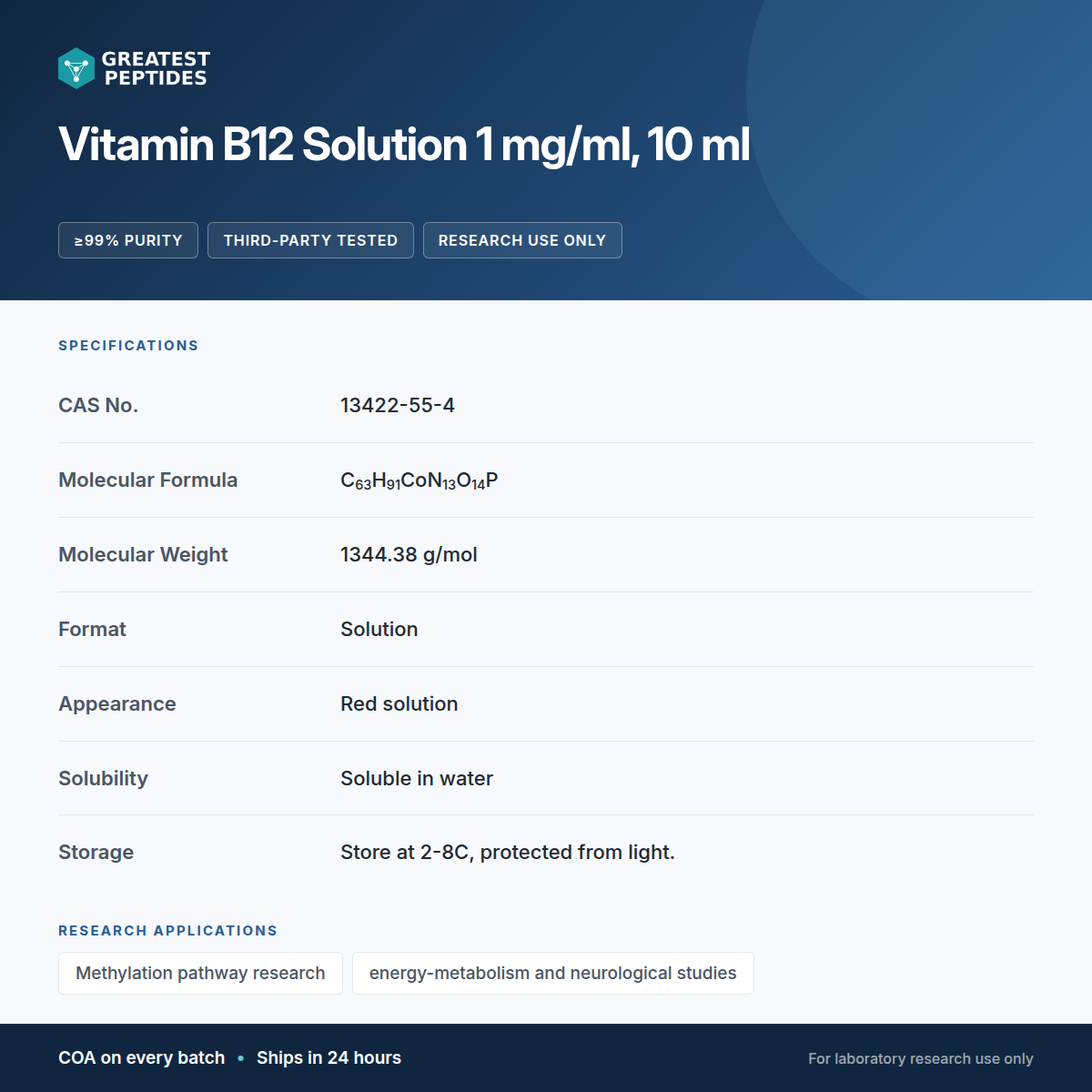
| Listing | Vitamin B12 Solution 1 mg/ml, 10 ml |
| Labeled fill volume | 1 mg |
| Physical form | Pre-mixed liquid in a sealed container |
| Catalog category | Laboratory Solutions & Consumables |
| Compound class | Pre-mixed research solution |
| Intended use | Research use only. Not for human or veterinary use, not for diagnostic use, not a drug or supplement. |
| Dispatch | Within 24 hours of the order clearing |
| Documentation | Batch analytical documentation available for the lot supplied |
| Free shipping threshold | Orders of $150 and above |
Specification summary for Vitamin B12 Solution
The table below is the specification the store publishes for this listing. It is reproduced here from the product record itself rather than retyped, which means it cannot drift away from what the attribute table further up the page says. Where a field is absent it is absent because we do not publish it for this SKU, not because it was left out of this summary.
| CAS No. | 13422-55-4 |
| Purity | >=99% |
| Sequence | N/A (methylcobalamin) |
| Molecular Formula | C63H91CoN13O14P |
| Molecular Weight | 1344.38 g/mol |
| Synthesis | N/A |
| Format | Solution |
| Solubility | Soluble in water |
| Stability & Storage | Store at 2-8C, protected from light. Do not freeze. |
| Applications | Methylation pathway research, energy-metabolism and neurological studies |
| Appearance | Red solution |
| Shipping Conditions | Shipped at ambient temperature; once received, refrigerate at 2-8C |
| Regulatory/Compliance | Manufactured in a facility that adheres to cGMP guidelines |
| Safety Information | Refer to provided MSDS |
A specification table is a claim, and a claim is only worth the record behind it. Every field above is one you can ask us to substantiate against the batch documentation for the lot you were sent. If a field ever fails to match the paperwork, that is a defect on our side and we would rather hear about it than not.
This item ships already in solution, so the questions that matter are concentration accuracy, container compatibility and time in the liquid state - not reconstitution arithmetic, which has already happened.
The analytical record behind this lot
A certificate of analysis is not a quality badge. It is a measurement report about one specific batch, produced on a specific date by a specific method, and its value to you is entirely a function of how much of that context it discloses. For Vitamin B12 Solution the fields worth checking first are the ones that tie the document to the container in your hand.
| Field on the certificate | Why it matters for this SKU |
|---|
| Lot or batch identifier | Ties the document to the vial. A certificate with no lot reference describes some batch, not necessarily yours. |
| Compound name and, where applicable, sequence | This is the identity claim. For a pre-mixed research solution it is the field that distinguishes the material from its close relatives. |
| Analytical method and conditions | A purity figure without a method is a number without units. Column, gradient and detection wavelength change what the figure means. |
| Date of analysis | Establishes how old the measurement is relative to the material. A recent vial with a two-year-old certificate is a documentation gap. |
| Who performed the analysis | In-house and independent third-party results are both legitimate; they are not the same claim, and the document should say which it is. |
| The chromatogram or spectrum itself | A summary table can be typed by anyone. A trace can be read, and a reader who knows the compound class can tell whether it is plausible. |
What our documentation for Vitamin B12 Solution does assert is what the analysis measured on the batch that was tested. What it does not assert — and no certificate from any supplier can assert — is that the material is safe, that it is suitable for any use in humans or animals, or that it will reproduce a result reported in a published paper. Those are different questions and a purity figure is not evidence for any of them.
Our batch documentation policy, including how to request the record for a lot you already have, is on the certificate of analysis page. If you need the record before ordering rather than after, ask us through the contact page and reference this listing by name.
How Vitamin B12 Solution is checked before it reaches this catalog
Three questions have to be answered separately before a compound gets a page here, and collapsing them into one percentage is the most common way a supplier listing becomes misleading.
| Question | What answers it | What it does not tell you |
|---|
| Identity — is this the right molecule? | Mass determination, and sequence confirmation where the material is a defined chain | Nothing about how much of the vial is that molecule |
| Purity — what proportion of the detected material is the target? | Chromatographic separation with a stated method | Nothing about what the other fraction actually is, unless the impurities are themselves identified |
| Content — how much target material is actually in the container? | Quantitative determination against the labeled fill | Nothing about identity or purity; a vial can be accurately filled with the wrong thing |
For Vitamin B12 Solution, concentration verification and stability-indicating analysis appropriate to each constituent are the assay formats the published work in this area tends to use, which matters when you are deciding whether the material as supplied is fit for the experiment you have in mind. A compound that is clean enough for a binding assay is not automatically clean enough for a quantitative cell-based readout where a co-eluting impurity could carry activity of its own.
Content is the field most often missing from a supplier listing, and it is the one that changes your arithmetic. A vial labeled 1 mg contains that much total solid, and total solid includes counter-ion, residual water and whatever else survived the process. If you need the peptide mass rather than the vial mass to be exact, that is a specific request to make in advance, not an assumption to carry into a calculation.
Receiving, inspecting and storing Vitamin B12 Solution
The most useful five minutes you will spend on this material are the five minutes immediately after the package is opened, because that is the only moment at which you can still distinguish a transit problem from a handling problem of your own.
- Confirm the label on the container matches this listing, including the fill volume, and record the lot identifier in your notebook before anything else happens.
- Inspect the closure and seal. A compromised closure is a reason to stop, not a reason to proceed carefully.
- Check the solution for clarity, color and any visible particulate, and record what you see rather than only whether it looked acceptable.
- Note the fill level. A container that arrives visibly short is a documentation issue worth raising immediately.
- Photograph the label and the container on arrival. It costs nothing and it settles later questions instantly.
- Store it in the dark, at the temperature stated for this listing, and write down the date it entered storage.
- Decide your aliquot plan before the first opening, not after it.
A solution has no dry shelf life to fall back on. Its clock started when it was filled, not when you opened it.
Because this item ships in solution there is no dry state to fall back on. The useful discipline is to treat the container as a stock that is already on the clock: minimize the number of times it is opened, keep it out of light, and record every withdrawal rather than reconstructing the history later from how much is left.
Working out concentration for a pre-mixed preparation
Because this item arrives already in solution, the reconstitution step has happened before it reached you and the arithmetic that remains is dilution arithmetic: the stated concentration multiplied by the volume you withdraw gives the amount of material in that withdrawal, and any further dilution scales it down proportionally. The figure to record is the stated concentration on the label together with the volume actually withdrawn, not an assumed round number. Our reconstitution calculator handles the dilution direction as well as the reconstitution direction.
What to record for Vitamin B12 Solution so the work is reproducible
Reproducibility in this area fails at the material-provenance step far more often than at the analysis step. The fields below are the ones that let somebody else — a reviewer, a collaborator, or you in eighteen months — work out whether two sets of results were generated with comparable material.
- Supplier and the exact listing name, including the fill size, rather than just the compound name
- Lot identifier, and the date the batch documentation was issued
- Date received, and the storage conditions and location it went into
- Stated concentration from the label, and the date the container was first opened
- Every withdrawal: date, volume and what it was used for
- Any dilutions made, with the diluent and its lot
- Any deviation from plan, including deviations that seemed unimportant at the time
- Whether the material was research-use-only labeled, which for this listing it is
Comparing suppliers on this exact SKU
Comparing Vitamin B12 Solution across suppliers on price alone is comparing two numbers that may not describe the same thing. These are the questions that make the comparison meaningful, with our answers next to them so you can hold us to the same standard you would hold anyone else.
| Question to ask any supplier | Our answer for this listing |
|---|
| Is batch documentation available for the specific lot I will receive, not a representative lot? | Yes — the record is tied to the lot supplied. Policy on the certificate of analysis page. |
| Does the analytical method appear on the document, or only the result? | The method context belongs on the document; a bare percentage is not a complete record. |
| Is the labeled figure total solid or target-compound mass? | Labeled as the fill for this presentation. If you need the distinction resolved for a calculation, ask before ordering. |
| Is the listing labeled research use only throughout, without use claims? | Yes, and deliberately so. No use, benefit or outcome is claimed anywhere on this page. |
| How quickly does it dispatch, and is that a promise or an average? | Within 24 hours of the order clearing. |
| Can I reach a person about the paperwork rather than only about the order? | Yes — the contact page reaches us directly. |
| Is there a published position on what the documentation does not prove? | Yes. It is stated on this page and on every product page. |
A supplier who answers all seven honestly is a better bet than a supplier who is ten percent cheaper and answers four. A supplier who cannot answer the first one at all is not selling you documented material; they are selling you a container.
Compliance boundary for Vitamin B12 Solution
Vitamin B12 Solution is supplied for laboratory research use only. It is not a drug, not a supplement, not a cosmetic and not a medical device. It is not for human or veterinary administration, not for diagnostic use, and not for use in food. That is not a disclaimer bolted onto a sales page — it is the actual scope of what is being sold, and it constrains what can honestly be written about it.
| Language that stays inside the boundary | Language that does not |
|---|
| "Supplied for research use only" | Any phrasing that implies a personal or clinical use |
| "Published work in this area has examined the individual constituents, each of which has its own separate literature" | "Vitamin B12 Solution does X" stated as an established effect |
| "Purity determined by the stated method on the tested batch" | "Pharmaceutical grade", "medical grade", "safe" |
| "Concentration arithmetic for preparing laboratory aliquots" | Anything framed as a dose, a protocol or a schedule |
| "Not for human or veterinary use" | Silence on the point, which readers correctly interpret as evasion |
| Naming the model system a finding came from | Reporting an animal or in-vitro finding as though it were a human finding |
The reason to be precise about this is not only regulatory. Research literature on this class of material is genuinely interesting and genuinely incomplete, and overstating it makes the real findings harder to see. Where published work is referenced on this site it is referenced as what was measured, in what system, at what scale — not as a property of the vial.
Other Laboratory Solutions & Consumables listings
These share a catalog category with Vitamin B12 Solution, which means the documentation and handling considerations above largely transfer to them. Their compound-specific sections do not — each has its own identity, its own literature and its own analytical profile.
The full catalog is on the shop page, and the longer written material is in our research guides.
Questions about ordering Vitamin B12 Solution
Is Vitamin B12 Solution documentation available before I order?
Yes. Ask through the contact page and reference this listing by name. Our general position on batch documentation is on the certificate of analysis page. If a supplier will not show you the record until after payment has cleared, that is worth noticing.
What does the 1 mg figure on the label actually refer to?
It is the labeled fill for this presentation. For lyophilized material the labeled mass is total solid unless the documentation states otherwise, and total solid includes counter-ion and residual moisture as well as target compound. If your calculation depends on the distinction, resolve it against the batch record rather than assuming.
How fast does Vitamin B12 Solution ship?
Within 24 hours of the order clearing. Orders of $150 and above ship free. Transit time after dispatch depends on the service selected at checkout.
Can I buy Vitamin B12 Solution for personal use?
No. This material is supplied for laboratory research use only. It is not a drug, supplement or cosmetic, it is not for human or veterinary administration, and nothing on this page should be read as guidance for any such use.
How should this preparation be stored once opened?
Keep it dark, at the temperature stated for this listing, and treat the first opening as the start of its useful life rather than the date of first use. Record each withdrawal. A solution has no dry shelf life to fall back on. Its clock started when it was filled, not when you opened it.
Does a high purity figure mean Vitamin B12 Solution is safe?
No, and this is the single most common misreading of a certificate of analysis. Purity describes what proportion of the detected material was the target compound in the batch that was tested, by the method stated. It is not a safety assessment, it says nothing about suitability for any use in humans or animals, and it does not become a safety claim by being a large number.
What is Vitamin B12 Solution classified as in your catalog?
It is listed as a pre-mixed liquid preparation, in the Laboratory Solutions & Consumables category. Published work in this area has looked at the individual constituents, each of which has its own separate literature. That is a description of where the literature sits, not a claim about what the material does.
Do you have more general written material on evaluating research peptides?
Yes. The home page guide covers reading a certificate of analysis, what chromatographic and mass-spectrometric methods each prove, and how to compare suppliers. The research guides go deeper on individual topics, and the FAQ covers ordering, shipping and post-shipping questions.
Vitamin B12 Solution 1 mg/ml, 10 ml is supplied strictly for laboratory research use. It is not a drug, supplement, cosmetic or medical device; it is not for human or veterinary use, not for diagnostic use and not for use in food. No statement on this page is intended to describe a therapeutic use, benefit or outcome, and references to published work describe what was measured in the reported model system rather than a property of the material supplied. Purchasers are responsible for handling the material in accordance with the requirements applicable to their institution and jurisdiction.