Research Procurement Information
Buy Lipo-C for Research | RUO COA & Documentation Guide
For laboratory teams evaluating where to buy Lipo-C for research, the priority is documentation, component identity, and research-use-only (RUO) alignment. Lipo-C is a multi-component lipotropic research solution typically formulated around L-methionine (C5H11NO2S, ≈149.2 Da), inositol (C6H12O6, ≈180.2 Da), and choline (as chloride/bitartrate), with some formulations including cyanocobalamin (Vitamin B12)[1]. Because it is a blend, the exact components and concentrations should be confirmed against the batch-specific COA. The individual constituents are described in the literature in lipid-metabolism and one-carbon-metabolism research contexts[2].
Fast AnswerResearchers evaluating where to buy Lipo-C for research should review RUO labeling, a batch-specific certificate of analysis (COA) listing each component and concentration, purity/identity data for constituents, solution clarity, and lot traceability before procurement. Material discussed here is intended for laboratory research use only and is not for human or veterinary use.
What Does “Buy Lipo-C for Research” Mean?
The phrase is addressed as laboratory research-procurement intent — how qualified researchers evaluate a Lipo-C multi-component reference solution through documentation, component identity, and labeling clarity, not personal, clinical, or consumer decision-making.
Formulation Identity & Classification
| Product name | Lipo-C (lipotropic research blend) |
| Typical components | L-methionine, inositol, choline (with or without cyanocobalamin)[1] |
| Methionine | C5H11NO2S, ≈149.2 Da (CAS 63-68-3) |
| Inositol | C6H12O6, ≈180.2 Da (CAS 87-89-8) |
| Choline | Choline chloride C5H14ClNO (CAS 67-48-1) |
| Classification | Multi-component lipotropic solution |
| Product form | Solution (per listing) |
| Regulatory status | Research use only — not for human or veterinary use |
Pathway Context (Lipid & One-Carbon-Metabolism Research)
Published literature discusses methionine, inositol, and choline within lipid-metabolism and one-carbon-metabolism research — methionine and choline as methyl donors and inositol in phospholipid research, in biochemical and cell models[2][3]. On a research product page this context should remain academic literature interpretation used to define the research lane — it is not converted into product-performance language.
COA, Component & Identity Documentation
A Lipo-C COA should be reviewed as a batch-specific record, not a marketing statement. For a blend, look for each component name, concentration, lot number, test date, analytical method, identity confirmation, and solution characteristics. Component list, concentration, method, and lot number should be evaluated together.
| Evaluation area | What to review | Why it matters |
|---|
| RUO labeling | Clear research-use-only language | Separates research procurement from human-use positioning |
| COA availability | Batch-specific certificate for the received lot | Supports lot-level documentation |
| Component list | Each constituent with concentration | A blend must be fully specified to be usable in research |
| Identity testing | HPLC / LC-MS support for constituents | Confirms components match the listed formulation |
| Lot traceability | Lot number matching across records | Supports research recordkeeping |
Analytical Review
For a multi-component solution, HPLC and LC-MS documentation support constituent identity and concentration; each component is evaluated against its expected descriptors[10][11]. ICH Q2(R2) describes validation characteristics used to interpret assay and identity results[7].
Lot Traceability & Batch Documentation
Lot traceability connects the product listing, COA, label, and receiving record. ISO/IEC 17025 addresses the competence of testing laboratories, and NIST resources describe how certificates and lot identifiers support traceability[8][9].
Claim Boundary for RUO Positioning
| Research-safe statement | Non-compliant version to avoid |
|---|
| “Lipo-C constituents are discussed in lipid- and one-carbon-metabolism literature.” | “Lipo-C burns fat or aids weight loss.” |
| “Researchers should confirm each component and concentration on the COA.” | “Buy Lipo-C for fat-loss injections.” |
| “Greatest Peptides supplies Lipo-C as a research-use-only material.” | “Greatest Peptides supplies Lipo-C for treatment.” |
Research Procurement Checklist
- Confirm the material is labeled for research use only.
- Confirm each component and its concentration on the COA.
- Review the batch-specific certificate of analysis for the received lot.
- Confirm identity support (HPLC/LC-MS) for constituents.
- Inspect solution clarity/appearance per the COA.
- Verify the lot number matches across all documentation.
- Document storage and handling conditions in the laboratory record.
How Greatest Peptides Presents Lipo-C
Greatest Peptides supplies Lipo-C as a research-use-only laboratory solution, characterized by a batch-specific COA listing each component and concentration, HPLC/LC-MS documentation, lot-level traceability, and transparent RUO labeling. Products are not intended for human or animal consumption, diagnostic, therapeutic, clinical, or veterinary use.
Published Literature Context
Published literature on Lipo-C constituents spans amino-acid, choline, and inositol biochemistry in metabolic-research models[2][3]. Model-specific findings should not be generalized or interpreted as use guidance for research-use-only materials.
Contributing Researchers
Recognized for published work that shaped the scientific context discussed above
Steven H. Zeisel, MD, PhD — authored foundational research on choline and one-carbon metabolism[2].
Joseph Larner, MD, PhD — authored research on inositol biochemistry[3].
FAQs About Buying Lipo-C for Research
What should researchers check before buying Lipo-C for research?
Confirm each component and concentration on the COA, then review RUO labeling, identity data, solution clarity, and lot traceability.
What is Lipo-C in research documentation?
A multi-component lipotropic research solution typically built around methionine, inositol, and choline (sometimes with cyanocobalamin); confirm the exact formulation on the COA.
Why does a COA matter when buying Lipo-C?
Because it is a blend, the COA is the authoritative record of which components and concentrations are present in the received lot.
Is Lipo-C intended for human or animal use?
No. Material discussed here is intended strictly for laboratory research use only.
How should published literature be interpreted?
As scientific context only. Model-specific findings should not be generalized or read as use guidance for research-use-only materials.
This page addresses Lipo-C only as research-use-only laboratory procurement. Boundary-sensitive terms such as fat loss, weight loss, and injections are referenced here only as research-language examples that must stay separate from RUO product positioning. All product information is for informational and educational purposes only. Products are not intended for human or animal consumption and have not been evaluated by the FDA to diagnose, treat, cure, or prevent any disease.
References
- Reference records for L-methionine (CAS 63-68-3), inositol (CAS 87-89-8), and choline chloride (CAS 67-48-1). Accessed 2026.
- Zeisel SH. Choline: critical role in one-carbon metabolism. Annual Review of Nutrition. 2006.
- Larner J. Inositol biochemistry and signaling. Journal of Biological Chemistry / metabolism literature. 2000s.
- Finkelstein JD. Methionine metabolism. Journal of Nutritional Biochemistry. 1990.
- IUPAC nomenclature for amino acids and small molecules. Recommendations.
- U.S. FDA. Analytical procedures and methods validation for drugs and biologics. 2015.
- U.S. FDA. Q2(R2) Validation of Analytical Procedures. 2024.
- International Organization for Standardization. ISO/IEC 17025:2017. 2017.
- National Institute of Standards and Technology. Reference materials and certificates of analysis. Accessed 2026.
- General HPLC methodology for small-molecule blend analysis. Analytical chemistry literature.
- General LC-MS considerations for multi-component solution identity. Analytical chemistry literature.
Compound profile
Lipo-C: compound profile, literature landscape and handling notes
Lipo-C in one paragraph
Lipo-C is not a peptide and it is not a single compound. It is a multi-component aqueous preparation, and preparations of this type are conventionally built around a core of methionine, inositol and choline, the combination usually abbreviated MIC, together with one or more water-soluble B-vitamin components, most often cyanocobalamin and in some formulations members of the wider B group such as thiamine, riboflavin, pyridoxine or dexpanthenol, and in some cases L-carnitine. Which of those are present in this particular listing, and at what concentrations, is a question for the specification table further down this page rather than for this text, because lipotropic formulations differ substantially between suppliers and no general description can stand in for a specific one. Everything below is written about the component classes and about what the published literature establishes for each of them individually. Nothing here is a claim about what this vial does, and nothing here applies to use in humans or animals.
Where Lipo-C came from
The word lipotropic has a real scientific origin, and it is older and more respectable than its current commercial use suggests. It was coined in nutritional biochemistry in the 1930s to name a specific and reproducible experimental phenomenon: certain dietary factors, choline foremost among them, prevented the accumulation of fat in the livers of experimental animals maintained on diets that lacked them. The observation was clean, it was replicated across laboratories and species, and it survived the transition from descriptive nutrition to mechanistic biochemistry intact. Lipotropic meant, precisely, a dietary factor whose absence produced hepatic fat accumulation and whose restoration reversed it. That is a narrow, testable, well-documented claim, and it remains true.
What followed was equally solid. The mechanism was worked out over the following decades and turned out to be a matter of lipoprotein assembly rather than anything resembling fat combustion. Export of triglyceride from the liver in very-low-density lipoprotein particles requires phosphatidylcholine in the particle surface. An animal that cannot make enough phosphatidylcholine cannot assemble and export those particles at a normal rate, so triglyceride accumulates in the hepatocyte. Choline is the substrate that limits that synthesis when it is scarce, methionine feeds the alternative route to phosphatidylcholine through methylation, and both connect to the same one-carbon network. The original lipotropic finding is therefore not folklore. It is a piece of foundational metabolic biochemistry with a clearly established mechanism.
The distance between that and the modern commercial usage is the thing worth stating plainly. The laboratory sense of the term describes correction of a deficiency in a deficient animal. The commercial sense has drifted into a general association with fat handling that the original work does not support and was never asked to support. The vocabulary carried over; the experimental conditions that gave the vocabulary its meaning did not. A reader encountering the word on a product label is encountering a term of art from 1930s nutritional science being used a long way outside the setting that defined it, and keeping those two senses separate is the single most useful analytical habit to bring to this listing.
Reading the components of a lipotropic blend
There is no structure to read here in the sense that there is for a peptide, because there is no single molecule. What this preparation contains is a set of small molecules drawn from three unrelated chemical classes plus a group of water-soluble vitamins, and the first useful observation is how little they have in common.
Methionine is an amino acid. Its distinguishing feature among the proteinogenic set is the thioether in its side chain, a sulfur atom flanked by two carbon substituents. That sulfur is what makes methionine biochemically interesting, since it is the atom that carries the transferable methyl group in the activated form, and it is also what makes methionine the least stable component of the mixture in an oxidizing environment. As supplied in a blend it is the L-enantiomer, is zwitterionic across the usual range, and behaves like an ordinary amino acid in solution.
Inositol is not an amino acid and not a sugar in the strict sense. It is a cyclohexanehexol, a six-carbon ring carrying a hydroxyl on every carbon, which places it in the sugar-alcohol or cyclic polyol family. Because the six hydroxyls can be arranged above or below the ring plane, there are nine possible stereoisomers, of which myo-inositol is overwhelmingly the dominant biological form and the one meant when a label says inositol without qualification. It is neutral, extremely polar, extremely water-soluble, and, importantly for everything in the analytical section below, it carries no aromatic ring, no carbonyl and no conjugation of any kind.
Choline belongs to a third class again. It is a quaternary ammonium cation, a nitrogen bearing three methyl groups and a hydroxyethyl group, and the critical structural fact is that the positive charge is permanent. Unlike an amine, it cannot be titrated to a neutral form at any accessible pH, so it is cationic in every solution it will ever be in, and it is always accompanied by a counter-ion, typically chloride or bitartrate depending on the salt used.
The vitamin components add a fourth and internally heterogeneous class: a cobalt-containing corrinoid in the case of cyanocobalamin, a substituted isoalloxazine in the case of riboflavin, a thiazolium and pyrimidine assembly in the case of thiamine, and a substituted pyridine in the case of pyridoxine. These share no structural family with one another, let alone with the polyol or the quaternary ammonium cation.
Four unrelated classes, no common target, no common failure mode and no common analytical method. That heterogeneity is the recurring theme of this page, and every section below is a consequence of it. What is actually in this SKU is stated in the specification table further down the page.
What each component class is understood to do
None of the core components is a receptor ligand, and that distinction governs how any concentration-response data on this material should be read. These are metabolic substrates and cofactors. A receptor agonist occupies a defined binding site, and a concentration-response curve for it describes fractional occupancy of that site. A substrate enters a pathway whose flux is set by enzyme capacity, by the availability of every other input, and by demand downstream. Increasing a non-limiting substrate changes nothing, and the shape of the curve carries no information about a binding interaction because there is no single binding interaction to describe. Treating a substrate curve as though it were an occupancy curve is a category error, and it is a common one in secondary discussion of this class of material.
Methionine's established position is as the precursor to S-adenosylmethionine. Methionine adenosyltransferase condenses methionine with adenosine triphosphate to produce a sulfonium compound whose methyl group is transferred by a large family of methyltransferases to DNA, histones, phospholipids, neurotransmitters and small molecules. S-adenosylmethionine is the principal methyl donor of the cell, and this is settled, central biochemistry rather than a hypothesis. The product of the transfer, S-adenosylhomocysteine, is hydrolyzed to homocysteine, which is either remethylated back to methionine or committed to transsulfuration.
Choline has three established fates and they are worth keeping separate. It is phosphorylated and converted through cytidine diphosphate choline to phosphatidylcholine, which is the fate relevant to the original lipotropic observation, since phosphatidylcholine is required for assembly and export of very-low-density lipoprotein particles. It is acetylated to acetylcholine in cholinergic neurons. And it is oxidized to betaine, which serves both as an osmolyte and as a methyl donor in the betaine-homocysteine methyltransferase reaction, which is where the choline and methionine pathways meet.
Inositol's established roles are structural and informational rather than related to lipid transport. It is the head group of phosphatidylinositol, and phosphorylation of that head group generates the phosphoinositide pool from which phospholipase C liberates inositol trisphosphate and diacylglycerol, the classical second-messenger pair. Inositol is also an osmolyte, and it is synthesized endogenously from glucose 6-phosphate, which is relevant when reasoning about whether adding more of it changes anything.
The B-vitamin components enter as cofactor precursors: cobalamin for methionine synthase and methylmalonyl-CoA mutase, thiamine for thiamine pyrophosphate-dependent decarboxylases, riboflavin for flavin cofactors, pyridoxine for pyridoxal phosphate-dependent enzymes including those of transsulfuration. Where L-carnitine is present, its established role is as the carrier moving long-chain fatty acyl groups across the inner mitochondrial membrane through the carnitine palmitoyltransferase system. That role is real and well characterized; whether it is rate-controlling in a system already supplied with carnitine is a separate question the biochemistry does not answer by itself.
What the literature on the individual components establishes
The literature relevant to this listing is component literature, and it varies enormously in strength from component to component. Sorting the strong strands from the thin ones is most of the work.
The strongest strand by a wide margin is choline and hepatic lipid export. The 1930s animal work was followed by decades of mechanistic study that established the phosphatidylcholine requirement for very-low-density lipoprotein assembly, identified both routes to phosphatidylcholine synthesis, and characterized the enzymes involved. Controlled depletion and repletion studies in humans in the 1990s established that adults maintained on choline-deficient formulations developed measurable hepatic and muscle abnormalities that reversed on restoration, and that susceptibility varied with sex, hormonal status and common genetic variants in the relevant pathways. That body of work culminated in a real and citable landmark: in 1998 the US Institute of Medicine formally recognized choline as an essential nutrient and set an Adequate Intake for it. That is a strong, replicated, institutionally adjudicated literature, and there is no reason to be skeptical of it on its own terms.
The second strong strand is one-carbon metabolism as a network. The connections among methionine, folate, vitamin B12 and betaine in the remethylation of homocysteine are established at the level of purified enzymes, cell systems, human genetics and controlled human studies. The methionine loading test, which probes remethylation capacity by challenging it, is a standard clinical research tool precisely because the pathway is well enough understood to be interrogated that way. Vitamin B12's role as the cofactor of methionine synthase, and the biochemical consequences of B12 deficiency, are similarly well established, and B12 deficiency is a genuine and diagnosable state with a large clinical literature behind it.
The inositol literature is real but narrower and more mixed. The biochemistry of the phosphoinositide signaling system is substantial and not in dispute. Clinically, myo-inositol has been studied in defined contexts, notably in polycystic ovary syndrome, in gestational glucose handling and in preterm infants, and the quality of that literature is uneven: trials are often small and heterogeneous in design, and in the preterm setting an early positive signal was not confirmed by a larger later trial.
Methionine's own literature is dominated by its role as an essential amino acid and by the consequences of excess rather than of addition, since a methionine load raises circulating homocysteine and is used experimentally for that reason. Riboflavin, thiamine and pyridoxine have deficiency literatures that are old, solid and specific to deficiency states.
What none of this literature is, is literature on the blend. Every strand above was generated with a single component, usually as an oral nutrient, usually in a deficiency or depletion design. That is the subject of the next section.
Why a blend is the hardest thing in this catalog to evaluate
This is the section that matters most here, and there is no gentle way to write it: the problems are structural, not matters of degree.
The first and largest is that essentially no controlled literature exists on the blend as a blend. Every citation offered for a lipotropic preparation is a study of one component in isolation, usually supplied orally, in a deficiency or depletion design, in a context bearing no relation to this one. Evidence for a component is not evidence for a mixture containing it. The mixture is a different material with different interactions, uncharacterized in the peer-reviewed record.
The second is the deficiency-to-repletion leap, the most common error in the nutritional literature, committed here in an especially clean form. The original lipotropic findings corrected an induced deficiency in a deficient animal. Such a result shows the factor is necessary. It says nothing about adding more of it to a system that already has enough, because the two experiments have different shapes: one restores a limiting input, the other increases a non-limiting one. Necessity is not sufficiency, and a curve that rises steeply out of deficiency is usually flat above it.
The third is attribution, a design problem no care in execution can repair. A mixture cannot assign an observed effect to a component. That requires component-wise controls: each component alone, the vehicle alone, and ideally the mixture minus each component in turn, in the same model and session. The blend precludes this by construction: the proportions are fixed in the vial, and the ability to vary one factor while holding the others constant is gone.
The fourth is that this product name does not identify a material. Formulations differ in which B vitamins are included, whether carnitine is present, which salt forms are used, what the relative concentrations are, and what the pH and preservative system are. Two vials bearing the same name from two suppliers can be genuinely different reagents, so work done with one is not comparable with work done with another. The specification table on this page is the only authority on what is here.
The fifth is the popular framing itself, which is not supported by controlled evidence for the blend and which rests on mistaking a hepatic lipid-export phenomenon observed under deficiency for something else entirely. The accurate statement is not that the blend is weakly supported but that it is unstudied.
How a multi-component aqueous blend behaves
A multi-component aqueous system carries a risk a single compound in a vial does not: the components can act on each other. This is not exotic chemistry. It is ordinary formulation science, and it is what a component-by-component reading misses.
Start with pH: every component has an opinion about it and only one value is available. The B-vitamin components have well-known and non-identical stability optima: thiamine grows notably unstable as pH rises and is best held on the acidic side, cyanocobalamin is most stable in a mildly acidic window, riboflavin is both poorly water-soluble and degraded under alkaline conditions, while an amino acid and a polyol are comparatively indifferent. A single formulation pH is therefore a negotiated compromise rather than an optimum for anything, and a formulation-specific value belonging in the specification table.
Methionine is the oxidation-sensitive component. Its thioether sulfur oxidizes readily to the sulfoxide, driven by dissolved oxygen, promoted by trace transition metals and accelerated by light and by any species generating reactive oxygen. Nothing about the appearance of the solution announces it.
Riboflavin, where present, has the widest reach. It is strongly photolabile, degrading under visible and ultraviolet light to lumiflavin and lumichrome, and it is also an efficient photosensitizer: on absorbing light it transfers that excitation to molecular oxygen or directly to other solutes, generating reactive species inside the vial. That makes it not merely a component that degrades but one that accelerates degradation of its neighbors, methionine prominently among them. A photolabile component in a mixed vial is a whole-vial problem. Cyanocobalamin has its own photolability, cyano ligand and corrin system both susceptible.
Visual assessment is unreliable here, because a strongly colored component masks another's degradation. The deep red of a cobalamin-containing preparation and the yellow of riboflavin dominate anything subtle, and methionine, choline and inositol are colorless and degrade without visual signature. A solution that still looks correct has told you almost nothing, and one whose color has shifted has told you that something happened without telling you to what.
Two physical risks belong to multi-solute systems. Precipitation on cold storage is real: a solution near saturation in its least soluble component at room temperature can drop crystals when chilled, riboflavin being the usual candidate, and whether it redissolves on warming is a matter for inspection. Preservative interaction is the other, since a multi-use aqueous preparation generally contains one and its behavior is pH-dependent.
Analyzing a blend: why one method will not do it
This is the crux of the page: no single chromatographic method covers this material. An amino acid, a neutral polyol, a permanently charged quaternary ammonium cation and a set of vitamins have incompatible requirements for retention and for detection. A certificate here has to be a stack of orthogonal methods, and any single number offered as its purity is not a meaningful figure.
Methionine is poorly retained on a reversed-phase column and has almost no useful ultraviolet absorbance, the thioether not being a chromophore in any practical sense. Quantifying it means a dedicated amino-acid method: pre-column derivatization with an agent such as o-phthalaldehyde to add both retention and a detectable label, classical ion-exchange separation with post-column ninhydrin, or an underivatized LC-MS approach.
Inositol is the hardest for a conventional laboratory. It has no chromophore of any kind, nothing that absorbs usefully in the ultraviolet, and it is so polar that it elutes at the void volume in reversed phase. Detecting it means abandoning ultraviolet detection in favor of refractive index, evaporative light scattering, charged aerosol detection or mass spectrometry; retaining it means a ligand-exchange carbohydrate column, an amino or HILIC phase, or derivatization followed by gas chromatography. Refractive index is also incompatible with gradient elution.
Choline is a different problem again. Its permanent positive charge means it will not retain in reversed phase without an ion-pairing agent, and such agents contaminate a system and are unwelcome ahead of mass spectrometry. The natural approaches are hydrophilic interaction chromatography with mass-spectrometric detection, or ion chromatography with conductivity or aerosol detection. Like inositol, it has no ultraviolet absorbance.
The vitamins are the easy part, and misleading for that reason. Thiamine, riboflavin, pyridoxine and cyanocobalamin are ultraviolet-active, separate well on reversed phase, and are resolved by a diode-array detector by spectrum as well as by retention. A laboratory running only that method produces a handsome chromatogram in which the three core components are entirely invisible.
Two consequences follow. A single purity percentage by HPLC for this product either describes one component or describes nothing. And area percent is not mass percent even among the components a method does see, because response factors differ by orders of magnitude between a strongly absorbing corrinoid and a weakly absorbing amino acid. Content has to be established per component against authentic reference material, on a method appropriate to it, with its own response factor determined not assumed.
Blends and single components this is confused with
| Often mistaken for | How it actually differs from Lipo-C |
|---|
| Vitamin B12 solution | The cleanest contrast in the catalog: a single defined molecule in water at a stated concentration, with one identity, one assay, one stability profile and one meaningful purity figure. A cyanocobalamin solution can be characterized completely by methods any laboratory has. Where a B12 component is present in a lipotropic blend it is one of several species sharing a vial, and none of that analytical simplicity survives the mixing. |
|---|
| NAD+ | The other metabolic-cofactor listing, and often filed alongside this one, but structurally and analytically a different situation. NAD+ is a single defined dinucleotide with a defined mass, a strong ultraviolet chromophore, a known set of degradation products and a single assay that answers the question. It is a compound; this is a formulation. Data on one says nothing about the other. |
|---|
| MOTS-c | Grouped commercially with metabolic research material, but it is a peptide: a defined sequence with a defined mass, characterized by the ordinary combination of reversed-phase chromatography and mass spectrometry, and carrying a hypothesized mechanism at the level of cellular signaling. A blend of small-molecule nutrients has no sequence, no single mass and no proposed receptor, and the two belong in different sections of any methods write-up. |
|---|
| MIC without B12 | The methionine, inositol and choline core supplied without any vitamin component. It is a different formulation from a B-vitamin-containing one, not a subset of it in any operational sense, since removing the cobalamin removes the strongly colored and photolabile species and changes both the visual inspection and the analytical requirement. Products labeled MIC and products labeled Lipo-C are not interchangeable reagents. |
|---|
| L-carnitine | Present in some lipotropic formulations and absent from others, which is itself the point. Like choline it is a quaternary ammonium compound and therefore shares the same analytical awkwardness, but its established biochemistry is the carnitine shuttle for long-chain fatty acyl transport into mitochondria, which is a different pathway from one-carbon metabolism entirely. Whether it is in this SKU is a question for the specification table. |
|---|
| Phosphatidylcholine | Frequently confused with choline and chemically a long way from it. Choline is a small water-soluble cation; phosphatidylcholine is a phospholipid with two fatty acyl chains, insoluble in water, formulated as a dispersion or with a solubilizing agent rather than as a true solution. Choline is a precursor to it. The two have different formulation problems, different analytical methods and separate literatures. |
|---|
Questions specific to Lipo-C
What did the word lipotropic originally mean in the scientific literature?
It named a specific experimental observation from 1930s nutritional biochemistry: dietary factors, choline chief among them, whose absence caused fat to accumulate in the livers of experimental animals fed deficient diets and whose restoration reversed that accumulation. The mechanism was later established and is a matter of lipoprotein assembly rather than fat breakdown, since export of triglyceride from the liver requires phosphatidylcholine in the particle surface and choline is the limiting substrate for making it when choline is scarce. That is genuine, replicated, foundational science. The modern commercial use of the term has traveled a long way from it, and the two senses should not be allowed to blur into each other when reading anything written about this class of preparation.
Is the evidence for choline evidence for this blend?
No, and this is the most important distinction on the page. The choline literature is strong, including controlled human depletion and repletion work and formal recognition of choline as an essential nutrient by the US Institute of Medicine in 1998. All of it was generated with choline studied as a single factor, usually as an oral nutrient, usually in a deficiency or depletion design. A mixture containing choline alongside an amino acid, a polyol and several vitamins is a different material with different interactions and a different set of possible outcomes, and it has not been characterized in the peer-reviewed record. Evidence for a component establishes something about that component. It establishes nothing about the preparation the component is sitting in.
Why do formulations sold under this name differ so much between suppliers?
Because there is no reference standard defining the composition. Lipotropic is a descriptive category rather than a specification, so each supplier chooses which components to include, at what concentrations, in which salt forms, at what pH and with what preservative system. Some include only the methionine, inositol and choline core; some add cyanocobalamin; some add a wider set of B vitamins; some add carnitine. The practical consequence for a bench researcher is that two vials with the same name are not the same reagent, results obtained with one are not comparable with results obtained with another, and any reference to a lipotropic formulation that does not state the full composition is uninterpretable. The specification table on this page and the documentation supplied with the lot are the only authority on what this listing contains.
Why is a single purity percentage not meaningful for this product?
Because purity as normally reported is a statement about one substance, and there is no one substance here. A percentage derived from a single chromatographic run describes whatever that method could retain and whatever the detector could see, and no single method sees all of these components. A reversed-phase separation with ultraviolet detection will render the vitamins beautifully and will not detect inositol or choline at all, both of which lack any useful chromophore, while methionine elutes near the void with almost no absorbance. Even among the components a method does see, area percent is not mass percent, because response factors differ by orders of magnitude. What a preparation of this type requires is content established for each component separately, against reference material for that component, on a method suited to it.
What does a deficiency-correction finding generalize to, and what does it not?
It generalizes to the claim that the factor is necessary, and to predictions about what happens in other deficient systems. It does not generalize to a system that already has enough. Those are two different experiments: one restores a limiting input, the other adds to a non-limiting one, and the concentration-response relationships they probe are different regions of the same curve. The region out of deficiency is typically steep and the region above sufficiency is typically flat. Sliding from one to the other is the most common error in the nutritional literature, and the lipotropic story is a textbook case, since the founding experiments were performed specifically in animals made deficient and are routinely cited as though they described a replete system.
Why does riboflavin light sensitivity affect the whole vial rather than just the riboflavin?
Because riboflavin is not only photolabile, it is a photosensitizer. On absorbing visible or ultraviolet light it reaches an excited state that can transfer that excitation to molecular oxygen or directly to other solutes, generating reactive species inside the container. Those species do not confine themselves to riboflavin. Methionine is the obvious casualty, since its thioether sulfur oxidizes readily to the sulfoxide, but any oxidizable component is exposed. This is the general reason a photolabile component in a mixed formulation is a whole-preparation problem rather than a component-specific one, and it is also why light protection matters even for the components that are themselves indifferent to light. Cyanocobalamin carries its own separate photolability.
How do methionine, inositol and choline relate to each other metabolically?
Methionine and choline are closely connected; inositol is essentially unrelated to either. Methionine is activated to S-adenosylmethionine, the principal methyl donor of the cell, and one of the routes to phosphatidylcholine proceeds by three successive methylations of phosphatidylethanolamine using that donor. Running the other way, choline is oxidized to betaine, which donates a methyl group to homocysteine to regenerate methionine, a reaction that sits alongside the folate and vitamin B12-dependent route through methionine synthase. So methionine, choline, betaine, folate and B12 form one interlocking one-carbon network. Inositol sits outside it entirely: it is a cyclic polyol, the head group of phosphatidylinositol and the origin of the inositol-phosphate second messengers, and it is not a methyl donor, not a methyl acceptor and not part of that network at all.
Lipo-C: Documentation, Handling and Quality Record for This SKU
The section above covers what Lipo-C is and what the published literature has looked at. This section is the operational half: what physically arrives when you order this listing, what paperwork comes with it, which fields on that paperwork are worth reading closely, and how to log the material once it is on your bench. It is written for the person who has already decided the compound is relevant and now has to justify the purchase to a supervisor, a grant line or an internal quality process.
Everything below is scoped to this exact listing rather than to research peptides in general. If you want the general version — how to read a certificate of analysis from scratch, what HPLC and mass spectrometry each prove, how to compare two suppliers who both claim 99% — that is on the home page guide, and there is no reason to read it twice.
What ships when you order Lipo-C
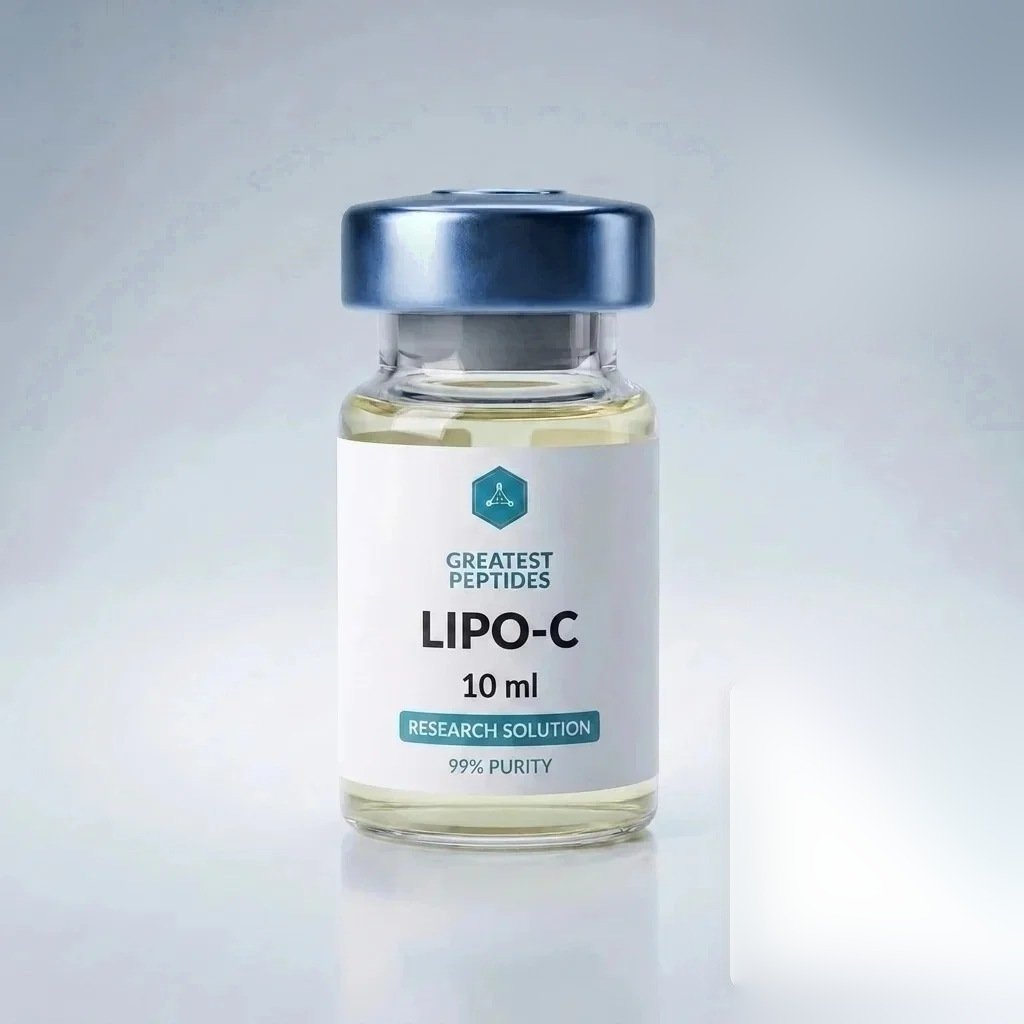
At a glanceOne sealed container of pre-mixed solution at the listed 10 ml fill, labeled for research use only, dispatched within 24 hours of the order clearing. Batch documentation is available for the lot you receive. Free shipping applies at $150 and above.
This listing is a single fixed presentation, not a size selector. That is deliberate: each presentation gets its own page, its own documentation trail and its own URL, so a citation or a purchase-order line that points at Lipo-C at 10 ml points at exactly one thing. If you need a different fill of the same compound and it is not listed, it is not currently in stock rather than hidden behind a dropdown.
| Field | This listing |
|---|
| Listing | Lipo-C (Lipotropic Blend) 10 ml |
| Labeled fill volume | 10 ml |
| Physical form | Pre-mixed liquid in a sealed container |
| Catalog category | Peptide Blends & Multi-Component Formulations |
| Compound class | Pre-mixed research solution |
| Intended use | Research use only. Not for human or veterinary use, not for diagnostic use, not a drug or supplement. |
| Dispatch | Within 24 hours of the order clearing |
| Documentation | Batch analytical documentation available for the lot supplied |
| Free shipping threshold | Orders of $150 and above |
Specification summary for Lipo-C
The table below is the specification the store publishes for this listing. It is reproduced here from the product record itself rather than retyped, which means it cannot drift away from what the attribute table further up the page says. Where a field is absent it is absent because we do not publish it for this SKU, not because it was left out of this summary.
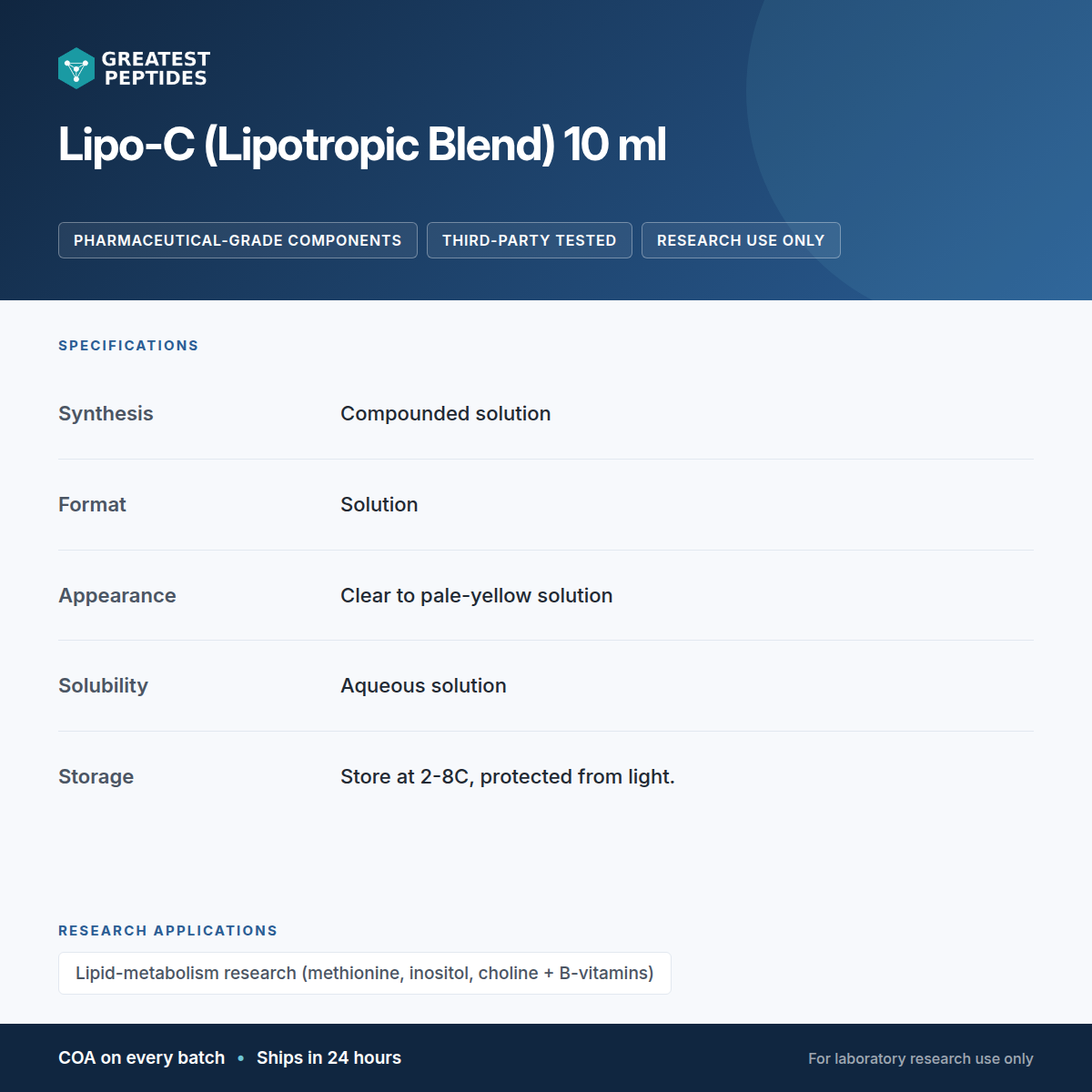
| CAS No. | N/A (lipotropic blend) |
| Purity | Pharmaceutical-grade components |
| Sequence | N/A |
| Molecular Formula | N/A (multi-component blend) |
| Molecular Weight | N/A |
| Synthesis | Compounded solution |
| Format | Solution |
| Solubility | Aqueous solution |
| Stability & Storage | Store at 2-8C, protected from light. Do not freeze. |
| Applications | Lipid-metabolism research (methionine, inositol, choline + B-vitamins) |
| Appearance | Clear to pale-yellow solution |
| Shipping Conditions | Shipped at ambient temperature; once received, refrigerate at 2-8C |
| Regulatory/Compliance | Manufactured in a facility that adheres to cGMP guidelines |
| Safety Information | Refer to provided MSDS |
A specification table is a claim, and a claim is only worth the record behind it. Every field above is one you can ask us to substantiate against the batch documentation for the lot you were sent. If a field ever fails to match the paperwork, that is a defect on our side and we would rather hear about it than not.
This item ships already in solution, so the questions that matter are concentration accuracy, container compatibility and time in the liquid state - not reconstitution arithmetic, which has already happened.
The analytical record behind this lot
A certificate of analysis is not a quality badge. It is a measurement report about one specific batch, produced on a specific date by a specific method, and its value to you is entirely a function of how much of that context it discloses. For Lipo-C the fields worth checking first are the ones that tie the document to the container in your hand.
| Field on the certificate | Why it matters for this SKU |
|---|
| Lot or batch identifier | Ties the document to the vial. A certificate with no lot reference describes some batch, not necessarily yours. |
| Compound name and, where applicable, sequence | This is the identity claim. For a pre-mixed research solution it is the field that distinguishes the material from its close relatives. |
| Analytical method and conditions | A purity figure without a method is a number without units. Column, gradient and detection wavelength change what the figure means. |
| Date of analysis | Establishes how old the measurement is relative to the material. A recent vial with a two-year-old certificate is a documentation gap. |
| Who performed the analysis | In-house and independent third-party results are both legitimate; they are not the same claim, and the document should say which it is. |
| The chromatogram or spectrum itself | A summary table can be typed by anyone. A trace can be read, and a reader who knows the compound class can tell whether it is plausible. |
What our documentation for Lipo-C does assert is what the analysis measured on the batch that was tested. What it does not assert — and no certificate from any supplier can assert — is that the material is safe, that it is suitable for any use in humans or animals, or that it will reproduce a result reported in a published paper. Those are different questions and a purity figure is not evidence for any of them.
Our batch documentation policy, including how to request the record for a lot you already have, is on the certificate of analysis page. If you need the record before ordering rather than after, ask us through the contact page and reference this listing by name.
How Lipo-C is checked before it reaches this catalog
Three questions have to be answered separately before a compound gets a page here, and collapsing them into one percentage is the most common way a supplier listing becomes misleading.
| Question | What answers it | What it does not tell you |
|---|
| Identity — is this the right molecule? | Mass determination, and sequence confirmation where the material is a defined chain | Nothing about how much of the vial is that molecule |
| Purity — what proportion of the detected material is the target? | Chromatographic separation with a stated method | Nothing about what the other fraction actually is, unless the impurities are themselves identified |
| Content — how much target material is actually in the container? | Quantitative determination against the labeled fill | Nothing about identity or purity; a vial can be accurately filled with the wrong thing |
For Lipo-C, concentration verification and stability-indicating analysis appropriate to each constituent are the assay formats the published work in this area tends to use, which matters when you are deciding whether the material as supplied is fit for the experiment you have in mind. A compound that is clean enough for a binding assay is not automatically clean enough for a quantitative cell-based readout where a co-eluting impurity could carry activity of its own.
Content is the field most often missing from a supplier listing, and it is the one that changes your arithmetic. A vial labeled 10 ml contains that much total solid, and total solid includes counter-ion, residual water and whatever else survived the process. If you need the peptide mass rather than the vial mass to be exact, that is a specific request to make in advance, not an assumption to carry into a calculation.
Receiving, inspecting and storing Lipo-C
The most useful five minutes you will spend on this material are the five minutes immediately after the package is opened, because that is the only moment at which you can still distinguish a transit problem from a handling problem of your own.
- Confirm the label on the container matches this listing, including the fill volume, and record the lot identifier in your notebook before anything else happens.
- Inspect the closure and seal. A compromised closure is a reason to stop, not a reason to proceed carefully.
- Check the solution for clarity, color and any visible particulate, and record what you see rather than only whether it looked acceptable.
- Note the fill level. A container that arrives visibly short is a documentation issue worth raising immediately.
- Photograph the label and the container on arrival. It costs nothing and it settles later questions instantly.
- Store it in the dark, at the temperature stated for this listing, and write down the date it entered storage.
- Decide your aliquot plan before the first opening, not after it.
A solution has no dry shelf life to fall back on. Its clock started when it was filled, not when you opened it.
Because this item ships in solution there is no dry state to fall back on. The useful discipline is to treat the container as a stock that is already on the clock: minimize the number of times it is opened, keep it out of light, and record every withdrawal rather than reconstructing the history later from how much is left.
Working out concentration for a pre-mixed preparation
Because this item arrives already in solution, the reconstitution step has happened before it reached you and the arithmetic that remains is dilution arithmetic: the stated concentration multiplied by the volume you withdraw gives the amount of material in that withdrawal, and any further dilution scales it down proportionally. The figure to record is the stated concentration on the label together with the volume actually withdrawn, not an assumed round number. Our reconstitution calculator handles the dilution direction as well as the reconstitution direction.
What to record for Lipo-C so the work is reproducible
Reproducibility in this area fails at the material-provenance step far more often than at the analysis step. The fields below are the ones that let somebody else — a reviewer, a collaborator, or you in eighteen months — work out whether two sets of results were generated with comparable material.
- Supplier and the exact listing name, including the fill size, rather than just the compound name
- Lot identifier, and the date the batch documentation was issued
- Date received, and the storage conditions and location it went into
- Stated concentration from the label, and the date the container was first opened
- Every withdrawal: date, volume and what it was used for
- Any dilutions made, with the diluent and its lot
- Any deviation from plan, including deviations that seemed unimportant at the time
- Whether the material was research-use-only labeled, which for this listing it is
Comparing suppliers on this exact SKU
Comparing Lipo-C across suppliers on price alone is comparing two numbers that may not describe the same thing. These are the questions that make the comparison meaningful, with our answers next to them so you can hold us to the same standard you would hold anyone else.
| Question to ask any supplier | Our answer for this listing |
|---|
| Is batch documentation available for the specific lot I will receive, not a representative lot? | Yes — the record is tied to the lot supplied. Policy on the certificate of analysis page. |
| Does the analytical method appear on the document, or only the result? | The method context belongs on the document; a bare percentage is not a complete record. |
| Is the labeled figure total solid or target-compound mass? | Labeled as the fill for this presentation. If you need the distinction resolved for a calculation, ask before ordering. |
| Is the listing labeled research use only throughout, without use claims? | Yes, and deliberately so. No use, benefit or outcome is claimed anywhere on this page. |
| How quickly does it dispatch, and is that a promise or an average? | Within 24 hours of the order clearing. |
| Can I reach a person about the paperwork rather than only about the order? | Yes — the contact page reaches us directly. |
| Is there a published position on what the documentation does not prove? | Yes. It is stated on this page and on every product page. |
A supplier who answers all seven honestly is a better bet than a supplier who is ten percent cheaper and answers four. A supplier who cannot answer the first one at all is not selling you documented material; they are selling you a container.
Compliance boundary for Lipo-C
Lipo-C is supplied for laboratory research use only. It is not a drug, not a supplement, not a cosmetic and not a medical device. It is not for human or veterinary administration, not for diagnostic use, and not for use in food. That is not a disclaimer bolted onto a sales page — it is the actual scope of what is being sold, and it constrains what can honestly be written about it.
| Language that stays inside the boundary | Language that does not |
|---|
| "Supplied for research use only" | Any phrasing that implies a personal or clinical use |
| "Published work in this area has examined the individual constituents, each of which has its own separate literature" | "Lipo-C does X" stated as an established effect |
| "Purity determined by the stated method on the tested batch" | "Pharmaceutical grade", "medical grade", "safe" |
| "Concentration arithmetic for preparing laboratory aliquots" | Anything framed as a dose, a protocol or a schedule |
| "Not for human or veterinary use" | Silence on the point, which readers correctly interpret as evasion |
| Naming the model system a finding came from | Reporting an animal or in-vitro finding as though it were a human finding |
The reason to be precise about this is not only regulatory. Research literature on this class of material is genuinely interesting and genuinely incomplete, and overstating it makes the real findings harder to see. Where published work is referenced on this site it is referenced as what was measured, in what system, at what scale — not as a property of the vial.
Other Peptide Blends & Multi-Component Formulations listings
These share a catalog category with Lipo-C, which means the documentation and handling considerations above largely transfer to them. Their compound-specific sections do not — each has its own identity, its own literature and its own analytical profile.
The full catalog is on the shop page, and the longer written material is in our research guides.
Questions about ordering Lipo-C
Is Lipo-C documentation available before I order?
Yes. Ask through the contact page and reference this listing by name. Our general position on batch documentation is on the certificate of analysis page. If a supplier will not show you the record until after payment has cleared, that is worth noticing.
What does the 10 ml figure on the label actually refer to?
It is the labeled fill for this presentation. For lyophilized material the labeled mass is total solid unless the documentation states otherwise, and total solid includes counter-ion and residual moisture as well as target compound. If your calculation depends on the distinction, resolve it against the batch record rather than assuming.
How fast does Lipo-C ship?
Within 24 hours of the order clearing. Orders of $150 and above ship free. Transit time after dispatch depends on the service selected at checkout.
Can I buy Lipo-C for personal use?
No. This material is supplied for laboratory research use only. It is not a drug, supplement or cosmetic, it is not for human or veterinary administration, and nothing on this page should be read as guidance for any such use.
How should this preparation be stored once opened?
Keep it dark, at the temperature stated for this listing, and treat the first opening as the start of its useful life rather than the date of first use. Record each withdrawal. A solution has no dry shelf life to fall back on. Its clock started when it was filled, not when you opened it.
Does a high purity figure mean Lipo-C is safe?
No, and this is the single most common misreading of a certificate of analysis. Purity describes what proportion of the detected material was the target compound in the batch that was tested, by the method stated. It is not a safety assessment, it says nothing about suitability for any use in humans or animals, and it does not become a safety claim by being a large number.
What is Lipo-C classified as in your catalog?
It is listed as a pre-mixed liquid preparation, in the Peptide Blends & Multi-Component Formulations category. Published work in this area has looked at the individual constituents, each of which has its own separate literature. That is a description of where the literature sits, not a claim about what the material does.
Do you have more general written material on evaluating research peptides?
Yes. The home page guide covers reading a certificate of analysis, what chromatographic and mass-spectrometric methods each prove, and how to compare suppliers. The research guides go deeper on individual topics, and the FAQ covers ordering, shipping and post-shipping questions.
Lipo-C (Lipotropic Blend) 10 ml is supplied strictly for laboratory research use. It is not a drug, supplement, cosmetic or medical device; it is not for human or veterinary use, not for diagnostic use and not for use in food. No statement on this page is intended to describe a therapeutic use, benefit or outcome, and references to published work describe what was measured in the reported model system rather than a property of the material supplied. Purchasers are responsible for handling the material in accordance with the requirements applicable to their institution and jurisdiction.