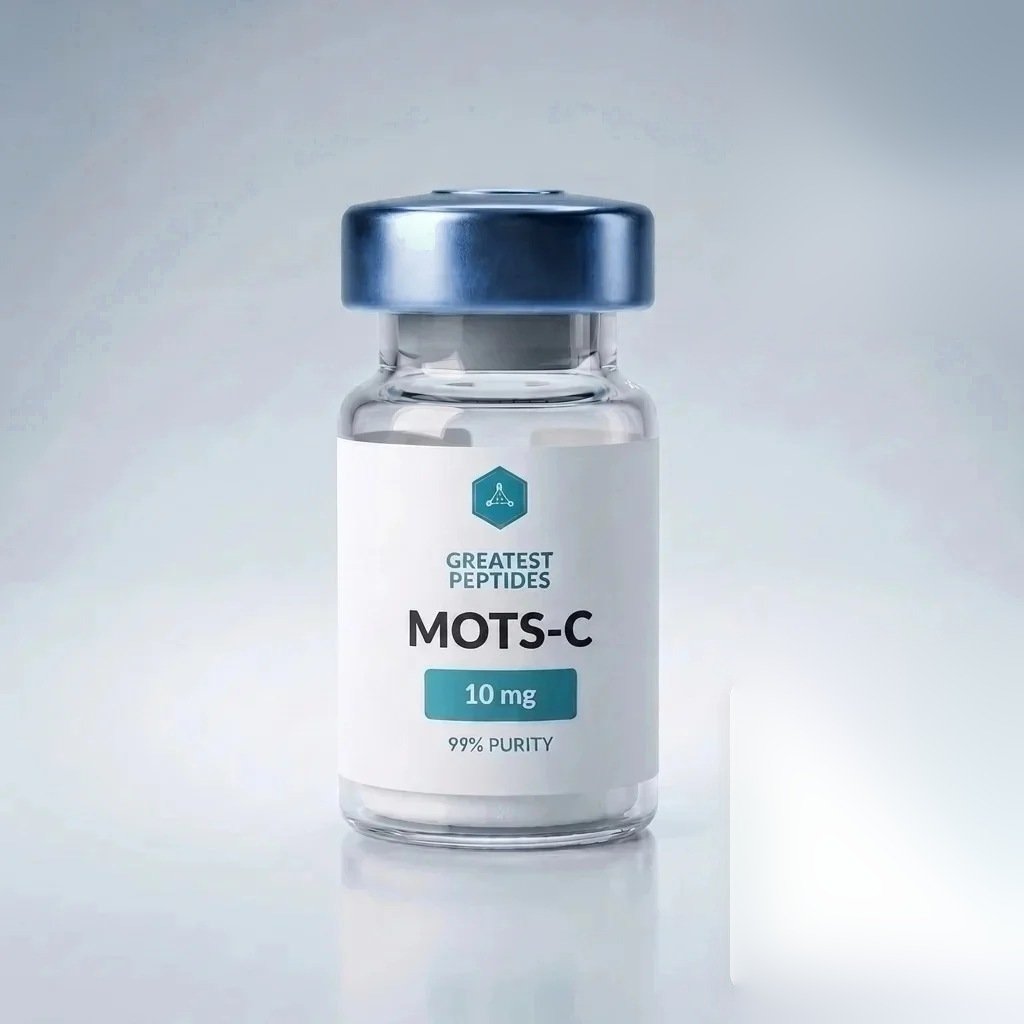
Research Procurement Information
Buy MOTS-c for Research | RUO COA & Documentation Guide
For laboratory teams evaluating where to buy MOTS-c for research, the priority is documentation, compound identity, and research-use-only (RUO) alignment. MOTS-c is a 16‑amino‑acid mitochondrial-derived peptide (sequence Met-Arg-Trp-Gln-Glu-Met-Gly-Tyr-Ile-Phe-Tyr-Pro-Arg-Lys-Leu-Arg) catalogued by PubChem with the molecular formula C101H152N28O22S2 and a molecular weight of approximately 2,177.6 g/mol (PubChem CID 146675088)[1] (CAS 146591-15-1). It is unusual in being encoded within the mitochondrial 12S rRNA region[2].
Fast AnswerResearchers evaluating where to buy MOTS-c for research should review RUO labeling, a batch-specific certificate of analysis (COA), HPLC purity data, LC-MS or comparable identity support, sequence/mass consistency, and lot traceability before procurement. Material discussed here is intended for laboratory research use only and is not for human or veterinary use.
What Does “Buy MOTS-c for Research” Mean?
The phrase is addressed as laboratory research-procurement intent — how qualified researchers, institutions, and technical buyers evaluate a MOTS-c reference material through documentation, analytical support, and labeling clarity, not personal, clinical, or consumer decision-making.
Compound Identity & Classification
| Compound name | MOTS-c (mitochondrial-derived peptide) |
| PubChem CID | 146675088[1] |
| CAS number | 146591-15-1 |
| Molecular formula | C101H152N28O22S2[1] |
| Molecular weight | ≈ 2,177.6 g/mol[1] |
| Sequence | MRWQEMGYIFYPRKLR |
| Origin | Encoded within the mitochondrial 12S rRNA region[2] |
| Product form | Lyophilized powder |
| Purity target | ≥ 99% (see batch-specific COA) |
| Regulatory status | Research use only — not for human or veterinary use |
Pathway Context (Mitochondrial-Derived Peptide & Metabolic Research)
Published literature describes MOTS-c within mitochondrial-derived peptide and metabolic-regulation research, with reported AMPK-pathway and metabolic-homeostasis involvement in cell and preclinical models[2][3]. On a research product page this pathway context should remain academic literature interpretation used to define the research lane — it is not converted into product-performance language.
COA, Purity & Identity Documentation
A MOTS-c COA should be reviewed as a batch-specific record, not a marketing statement. Look for compound name, lot number, test date, stated purity, analytical method, identity confirmation, and sequence/mass information. Purity, identity, method, and lot number should be evaluated together.
| Evaluation area | What to review | Why it matters |
|---|
| RUO labeling | Clear research-use-only language | Separates research procurement from human-use positioning |
| COA availability | Batch-specific certificate for the received lot | Supports lot-level documentation |
| Purity data | HPLC area-percent support for stated purity | Helps evaluate material consistency |
| Identity testing | LC-MS / mass-spec confirmation vs expected mass | Confirms the material matches the listed peptide |
| Lot traceability | Lot number matching across records | Supports research recordkeeping |
HPLC, LC-MS & Analytical Review
HPLC documentation supports purity assessment; LC-MS or mass-spectrometry documentation supports identity confirmation and molecular-mass review[10][11]. For a 16-residue peptide, mass data confirming the observed mass against the expected value are useful alongside HPLC purity data. ICH Q2(R2) describes validation characteristics used to interpret assay, purity, and identity results[7].
Lot Traceability & Batch Documentation
Lot traceability connects the product listing, COA, label, and receiving record. ISO/IEC 17025 addresses the competence of testing laboratories, and NIST resources describe how certificates and lot identifiers support traceability[8][9].
Claim Boundary for RUO Positioning
| Research-safe statement | Non-compliant version to avoid |
|---|
| “MOTS-c is discussed in published literature on mitochondrial-derived peptide research.” | “MOTS-c boosts metabolism or reverses aging.” |
| “Researchers should review COA and identity data before procurement.” | “Buy MOTS-c for metabolism.” |
| “Greatest Peptides supplies MOTS-c as a research-use-only material.” | “Greatest Peptides supplies MOTS-c for treatment.” |
Research Procurement Checklist
- Confirm the material is labeled for research use only.
- Review the batch-specific certificate of analysis for the received lot.
- Confirm purity is supported by HPLC analytical data.
- Confirm identity is supported by LC-MS or mass spectrometry.
- Compare compound name, sequence, formula, and mass across the page, label, and COA.
- Verify the lot number matches across all documentation.
- Document storage and handling conditions in the laboratory record.
How Greatest Peptides Presents MOTS-c
Greatest Peptides supplies MOTS-c as a research-use-only laboratory material in lyophilized powder form, positioned around a stated ≥99% purity target, batch-specific COA availability, HPLC/LC-MS documentation, lot-level traceability, and transparent RUO labeling. Products are not intended for human or animal consumption, diagnostic, therapeutic, clinical, or veterinary use.
Published Literature Context
Published MOTS-c literature spans mitochondrial-derived peptide discovery and preclinical metabolic-regulation research models[2][3]. Model-specific findings should not be generalized or interpreted as use guidance for research-use-only materials.
Contributing Researchers
Recognized for published work that shaped the scientific context discussed above
Changhan David Lee, PhD — co-described the mitochondrial-derived peptide MOTS-c and its role in metabolic-regulation research[2].
Pinchas Cohen, MD — co-authored the discovery and characterization of MOTS-c in metabolic research[3].
FAQs About Buying MOTS-c for Research
What should researchers check before buying MOTS-c for research?
Review RUO labeling, the batch-specific COA, stated purity with HPLC support, LC-MS identity data, sequence/mass consistency, and lot traceability.
What is MOTS-c in research documentation?
A 16-amino-acid mitochondrial-derived peptide (MRWQEMGYIFYPRKLR) with molecular formula C101H152N28O22S2 and a molecular weight near 2,177.6 g/mol.
Why does a COA matter when buying MOTS-c?
It connects the listing to batch-specific documentation: compound name, lot number, test date, purity, and identity method for the received lot.
Is MOTS-c intended for human or animal use?
No. Material discussed here is intended strictly for laboratory research use only.
How should published literature be interpreted?
As scientific context only. Model-specific findings should not be generalized or read as use guidance for research-use-only materials.
This page addresses MOTS-c only as research-use-only laboratory procurement. Boundary-sensitive terms such as metabolism, exercise, aging, and insulin sensitivity are referenced here only as research-language examples that must stay separate from RUO product positioning. All product information is for informational and educational purposes only. Products are not intended for human or animal consumption and have not been evaluated by the FDA to diagnose, treat, cure, or prevent any disease.
References
- National Center for Biotechnology Information. MOTS-c, CID 146675088. PubChem Compound record. Accessed 2026.
- Lee C, et al. The mitochondrial-derived peptide MOTS-c promotes metabolic homeostasis and regulates insulin sensitivity. Cell Metabolism. 2015. PMID 25738459.
- Cohen P, et al. Mitochondrial-derived peptides in metabolic research (review). Trends in Endocrinology & Metabolism. 2019.
- Registry record for MOTS-c, CAS 146591-15-1. Accessed 2026.
- IUPAC-IUB Joint Commission. Nomenclature and symbolism for amino acids and peptides. 1983.
- U.S. FDA. Analytical procedures and methods validation for drugs and biologics. 2015.
- U.S. FDA. Q2(R2) Validation of Analytical Procedures. 2024.
- International Organization for Standardization. ISO/IEC 17025:2017. 2017.
- National Institute of Standards and Technology. Reference materials and certificates of analysis. Accessed 2026.
- Mant CT, et al. HPLC analysis and purification of peptides. Methods in Molecular Biology. 2007.
- Steen H, Mann M. Peptide sequencing. Nature Reviews Molecular Cell Biology. 2004. PMID 15340378.
Compound profile
MOTS-c: compound profile, literature landscape and handling notes
MOTS-c in one paragraph
MOTS-c is a 16-residue peptide whose open reading frame sits in mitochondrial DNA, inside the gene for the 12S ribosomal RNA, rather than anywhere in the nuclear genome. That single fact is the reason the compound is interesting and the reason a large fraction of secondary descriptions of it go wrong in the same direction. It belongs to a small family of mitochondrial-derived peptides that were found by scanning a genome nobody had been reading for protein-coding content, and it has no confirmed cell-surface receptor. The mechanism reported for it is intracellular and metabolic, running through the folate-methionine cycle and an accumulating nucleotide intermediate rather than through ligand binding at a membrane, and that distinction changes what a competent assay around it looks like. The published record is young, concentrated in a small number of groups, and weighted heavily toward rodent and cell-culture work. Everything below describes that published record. Nothing here is a claim about what this vial does, and nothing here is applicable to use in humans or animals.
Where MOTS-c came from
MOTS-c was described by Changhan Lee, Pinchas Cohen and colleagues at the University of Southern California, and the name is an unusually literal piece of documentation: mitochondrial open reading frame of the 12S ribosomal RNA, type-c. Read the expansion slowly and it tells you the whole discovery method. The starting material was not a tissue extract, a purified activity, or a fraction that did something in an assay. It was a genome sequence, and specifically a genome sequence that had been considered closed for thirty years. The human mitochondrial genome is small, fully sequenced since the early 1980s, and annotated with thirteen protein-coding genes, two ribosomal RNAs and a set of transfer RNAs. The working assumption behind that annotation was that thirteen was the complete protein inventory.
The reason anyone went looking for a fourteenth was humanin, a peptide encoded within the 16S ribosomal RNA gene that had turned up years earlier through a functional screen rather than a sequence scan. Humanin was an anomaly with an existence proof attached: a peptide-coding frame inside a ribosomal RNA gene, found because somebody was looking for something that rescued cells, not because somebody was reading the sequence. Once that anomaly existed, the obvious follow-up was to invert the method and read the rest of the mitochondrial genome systematically for short frames with the statistical signature of coding sequence. MOTS-c came out of that inversion, as did the small humanin-like peptides, the SHLP series, from the same 16S region.
This ordering matters for how you read the literature. For most compounds in a research catalog, an activity was observed and a molecule was then chased down. Here the molecule was predicted first and the activity was assigned afterward, which means the functional characterization was built on top of a bioinformatic claim rather than the other way around. The trailing letter in the name is a serial designator, a quiet reminder that this frame was one entry on a candidate list rather than a lone find.
Reading the structure of MOTS-c
The exact residue string, formula and mass for this listing are printed in the specification table further down this page, taken from the product record, and are not restated here. What is worth spelling out is what the composition implies, because for a peptide this short almost every property follows directly from a handful of residues.
Sixteen residues is short enough that the molecule has no tertiary structure to speak of, but the published work describes it as having helical propensity, and two regions within it are treated as functional in the primary literature. One is a hydrophobic stretch in the middle of the sequence, built from tyrosine, isoleucine, phenylalanine and a second tyrosine in succession. The other is a cluster of basic residues at the carboxy-terminal end, arginine and lysine with a leucine between them. That combination, a compact hydrophobic face plus a short cationic tail, is a recognizable architecture: it is what protein-transduction and nuclear-localization motifs tend to look like, and it is the structural basis of the published argument that this peptide can cross compartment boundaries and reach chromatin. Treat that as a structural inference with supporting cell-biology data, not as a settled transport mechanism.
The rest of the composition sets the handling profile. There are two methionines, which is a lot for a 16-mer and which makes oxidation the dominant chemical liability. There is a single tryptophan, which is both a second oxidation site and, more usefully, a genuine ultraviolet chromophore. There are no cysteines at all, so disulfide scrambling, the problem that dominates handling for cyclic-peptide items elsewhere in this catalog, simply does not arise. There is one proline, near the carboxy-terminal end, which interrupts helical continuity. Counting charges, four residues are basic against a single acidic one, so the peptide is strongly cationic at neutral pH and its isoelectric point is high.
One structural point specific to mitochondrial-derived peptides deserves emphasis. Mitochondria use a genetic code that differs from the standard one at several codons, including the reassignment of two arginine codons to termination. This peptide is arginine-rich. Read the mitochondrial DNA frame with the mitochondrial code and you do not obtain the 16-residue string in the specification table; you obtain an interrupted frame. The sequence everyone works with is the frame read with the standard cytoplasmic code.
The target and the pathway in more detail
The single most important thing to establish about MOTS-c is a negative: there is no confirmed cell-surface receptor for it. No orphan G-protein-coupled receptor has been deorphanized as its target, no membrane binding partner has been cloned and validated as the mediator of its effects, and the published mechanism does not require one. This is not a minor bookkeeping detail. Nearly every other peptide in this catalog is described by a receptor and a potency at that receptor, and the entire apparatus of half-maximal effective concentrations, competition binding, selectivity ratios and receptor-null controls assumes that model. None of that apparatus transfers here.
What the literature reports instead is a metabolic mechanism operating inside the cell. MOTS-c is described as acting on the folate-methionine cycle and on the de novo purine biosynthesis pathway that is tethered to it. Interrupting flux through that junction causes an intermediate, 5-aminoimidazole-4-carboxamide ribonucleotide, universally abbreviated AICAR, to accumulate. AICAR is a well-established endogenous activator of AMP-activated protein kinase, the cell's principal energy-stress sensor. So the reported chain is: peptide inhibits an enzymatic step, a metabolite builds up, and that metabolite activates a kinase. Downstream readouts described in the literature include glucose transporter translocation to the plasma membrane and the broader transcriptional consequences of AMP-activated protein kinase activation.
State the difference plainly, because it is routinely blurred. Saying that a compound activates AMP-activated protein kinase through metabolite accumulation is a categorically different claim from saying that it agonizes a receptor. It predicts a time lag, because a metabolite pool has to fill before the kinase responds. It predicts dependence on the metabolic state of the cell and on the composition of the culture medium, particularly folate and purine availability, in a way that receptor agonism does not. It predicts that AICAR itself should reproduce the downstream signal, and that manipulating the folate cycle directly should occlude it. And it means that a concentration response curve fitted to a downstream readout is not a binding curve and should never be reported as an affinity.
A second, partly separate mechanism is described in the same body of work: under metabolic or oxidative stress the peptide is reported to translocate to the nucleus, associate with chromatin, and participate in stress-responsive transcription, with activating transcription factor 1 named among its interaction partners and with occupancy reported at promoters carrying antioxidant response elements. More recently a direct intracellular protein binding partner, casein kinase 2, has been reported in skeletal muscle. Both of these are intracellular claims, and both compound the access question that runs through the whole field.
What the published literature on MOTS-c actually measures
Read the MOTS-c literature by asking what was physically measured in each paper, because the topic headings are broad and the measurements are narrow.
The founding work is a metabolic characterization. Its core evidence is metabolomic: profiling of cells exposed to the peptide showed accumulation of folate-cycle and purine-pathway intermediates, AICAR among them, and that pattern is the actual observation from which the mechanism is inferred. Alongside it sit cell-based readouts in cultured myotubes, principally glucose uptake and glucose transporter translocation to the plasma membrane, plus phosphorylation of AMP-activated protein kinase and its canonical substrate as the biochemical confirmation that the kinase is engaged. Those are the measurements. They are good measurements, and they are cell-culture measurements.
The second body of work is rodent metabolic phenotyping: whole-animal glucose handling, insulin sensitivity indices, body composition, indirect calorimetry, and skeletal muscle histology and gene expression, in wild-type mice and in diet-manipulated models. Almost everything commonly asserted about the peptide at the level of a whole organism traces to this category, and it is mouse work.
The third is the exercise literature. Reports describe increases in MOTS-c messenger RNA and peptide levels in skeletal muscle and in circulation following exercise, in mice and in human samples, and this observation is what generated the widely repeated framing of the peptide as an exercise-linked signal. What is measured is a concentration change that accompanies exercise. That is a correlation. Distinguishing an effector from a bystander requires interventions that most of these studies did not perform.
The fourth is human genetics rather than human pharmacology. A mitochondrial DNA polymorphism, m.1382A>C, changes a single residue within the peptide-coding frame, substituting glutamine for the lysine at position 14, and this variant has been reported as associated with exceptional longevity in a Japanese cohort and, in later work, with muscle fiber composition, physical performance measures and metabolic phenotypes. These are association studies in defined populations.
A fifth and expanding category applies the peptide in specific tissue models, including retina, bone, kidney, cardiac tissue and models of membrane repair. This is where the field is growing, and it is also where the evidentiary standard is most variable, since many of these are first reports in a new tissue with no independent replication behind them.
Where the MOTS-c literature is thin or frequently misread
This is a young field with an unusually concentrated authorship, and it should be read with that in mind. A substantial fraction of the mechanistic literature originates with the group that identified the peptide or with collaborators of that group. That is not an accusation; it is the normal shape of a field ten years old. But it means that independent replication is much thinner than citation counts imply, because a heavily cited finding cited many times by people who did not repeat it is still a single finding.
The central unresolved problem, and the one the field addresses least often head-on, is access. The reported mechanism is intracellular at every step: an enzyme in the folate-methionine cycle, a cytosolic metabolite pool, a kinase, and in the second arm of the story a nuclear compartment and chromatin. A peptide supplied from outside the cell has to reach those compartments. Sixteen residues with a cationic tail is a plausible starting point for a transduction argument, and the literature does make that argument, but plausibility is not quantification. How much of the material applied to a culture reaches the cytosol, at what rate, in what state of chemical integrity, and whether the intracellular concentration achieved bears any relationship to the nominal concentration in the medium are questions with no satisfying published answer. Until they have one, every mechanistic result rests on an unmeasured step.
Related and equally unsettled is where the peptide is made in the first place. The frame is in mitochondrial DNA, but the 16-residue product corresponds to reading it with the standard cytoplasmic code, not the mitochondrial one, which points toward translation outside the organelle from an exported transcript. That inference is discussed in the primary literature and is not closed, and it undercuts the tidy story that a mitochondrially encoded peptide is a mitochondrially made peptide.
Three narrower cautions. The longevity polymorphism result is association data in specific populations with the variant reported as effectively confined to certain East Asian mitochondrial haplogroups, which makes population stratification the obvious alternative explanation and makes generalization unsafe. The exercise findings are correlational. And endogenous quantitation of a 16-residue peptide in plasma by immunoassay is analytically hard, because a short peptide offers few independent epitopes and cross-reactivity is difficult to exclude; circulating concentration figures across papers should not be assumed comparable.
How MOTS-c behaves in solution
Supplied as lyophilized solid, MOTS-c behaves in solution like what it is: a short, strongly basic, unmodified peptide with no cysteines. That combination makes it considerably better behaved than the acylated and cyclic items elsewhere in this catalog, and its problems are different in kind rather than merely smaller.
Solubility in water and in aqueous buffers at neutral pH is good, which follows from the charge balance: four basic residues against one acidic residue leaves the molecule well solvated and far from its isoelectric point at physiological pH. The corollary is that solubility falls as pH rises toward the isoelectric point, so alkaline buffers are the wrong place to prepare stock material. There is no disulfide to scramble and no free thiol to oxidize into a dimer, which removes the most common failure mode for cyclic peptides entirely.
Oxidation is the liability that replaces it. Two methionines and a tryptophan in a 16-residue chain constitute an unusually high density of oxidation-prone side chains. Methionine oxidizes readily to the sulfoxide on exposure to dissolved oxygen, to trace metal contamination in buffers, and to peroxide impurities in some solvents and plastics, and the reaction is accelerated by elevated pH and by light. Tryptophan is photosensitive in its own right and its oxidation products are more varied and less reversible. The practical consequences are to keep working solutions cold, to limit their exposure to room light, to prefer freshly prepared buffers of known provenance over old ones that may have accumulated peroxides, and to keep headspace small. A chelating agent in the buffer suppresses metal-catalyzed oxidation but changes the matrix and has to be recorded.
Two slower chemistries deserve a note. The glutamine in the sequence can deamidate to glutamate on prolonged storage in solution, which changes charge as well as mass. And the free amino-terminal methionine leaves an unprotected alpha-amino group available for adventitious modification.
Adsorption is real but modest compared with amphiphilic peptides. The relevant interaction is electrostatic rather than hydrophobic: a strongly cationic peptide binds to the negatively charged silanol groups on untreated glass, so glass is a poorer choice than low-binding polypropylene for dilute solutions. Freeze-thaw cycling remains the most avoidable loss mechanism. A degraded preparation typically shows no visible change at all, which is the point worth remembering: for this peptide, clarity in the vial is not evidence of integrity, and chromatography is.
Analytical notes specific to MOTS-c
Two features of this sequence make its analytical profile unusual for a short peptide.
The first is ultraviolet detection. Most 16-residue catalog peptides contain no tryptophan and no tyrosine, which makes absorbance at 280 nanometers useless and pushes quantitation onto far-ultraviolet peptide-bond absorbance or onto mass-by-difference. This sequence is the exception: one tryptophan and two tyrosines give it a real 280 nanometer chromophore and a calculable extinction coefficient, so spectrophotometric determination against that coefficient is available here and measures peptide rather than vial contents. Two caveats. That reading reports chromophore, not purity, so an oxidized preparation still absorbs. And routine chromatographic detection should still sit at 214 or 220 nanometers, where the amide bond absorbs and impurities lacking aromatic residues remain visible.
The second is chromatographic behavior. A strongly cationic peptide on a reversed-phase column tends to elute early, and residual acidic silanols on the stationary phase interact with its basic residues and produce tailing. Trifluoroacetic acid as an ion-pairing modifier suppresses much of this by masking the positive charges, which is why methods for basic peptides depend far more heavily on the ion-pairing agent than methods for neutral ones, and why switching to formic acid for mass-spectrometry compatibility can change the separation substantially.
By mass spectrometry the same basicity is an advantage: four basic sites on a short chain ionize efficiently in positive-mode electrospray and give a clean multiply charged series. The satellite family to expect is oxidation, and it is larger here than for most peptides: two methionines plus a tryptophan mean plus-sixteen and plus-thirty-two species can arise at multiple positions, so intact-mass data alone will not tell you which residue oxidized. Glutamine deamidation adds a plus-one species.
The identity risk specific to this listing is the single-residue variant: an ortholog difference, or the polymorphic form that substitutes glutamine for the lysine at position 14. That is exactly what the human designation in the product name exists to exclude, and that particular substitution is nearly invisible to a low-resolution instrument, since lysine and glutamine share the same nominal residue mass and differ by roughly four hundredths of a dalton. Resolving it requires high-resolution mass or fragmentation data. Trypsin is also a poor protease choice for confirmatory sequencing here, since it cleaves after arginine and lysine and this sequence is dense in both; a protease with different specificity, or direct fragmentation of the intact peptide, is more informative.
Compounds researchers confuse with MOTS-c
| Often mistaken for | How it actually differs from MOTS-c |
|---|
| NAD+ | Grouped with MOTS-c as a mitochondrial and metabolic listing, and otherwise unrelated. NAD+ is a nucleotide cofactor, not a gene product, not a peptide, and not sequence defined; it participates stoichiometrically in redox chemistry and as a substrate for enzymes including sirtuins. Its identity is established by ultraviolet and chromatographic methods appropriate to a small molecule, and nothing in the peptide analytical framework described above applies to it. |
|---|
| Humanin | The other well-known mitochondrial-derived peptide, and the reason anyone scanned the mitochondrial genome in the first place. Its frame lies in the 16S ribosomal RNA gene rather than the 12S, it is longer, and it was found through a functional screen rather than by sequence analysis. Its published literature centers on cytoprotection and apoptosis rather than on the folate cycle. Shared provenance, different pathway. |
|---|
| SHLP1 through SHLP6 | The small humanin-like peptides, also encoded within the 16S ribosomal RNA gene and identified by the same in-silico reading-frame approach that produced MOTS-c. They are family members in the strict sense, but each has its own reported activity profile and the individual peptides are far more thinly characterized than either MOTS-c or humanin. They should never be treated as interchangeable stand-ins. |
|---|
| AICAR and metformin | The standard reference activators of AMP-activated protein kinase, and the correct comparators for any experiment claiming AMP-activated protein kinase involvement. AICAR is not an analog of MOTS-c; it is the metabolite whose accumulation the published mechanism proposes as the intermediate step, which makes it a positive control rather than a competitor. Metformin engages the same kinase by a different upstream route again. |
|---|
| Semaglutide | Commercially shelved near MOTS-c under a metabolic heading and mechanistically nothing like it. Semaglutide is an acylated peptide agonist at a defined cell-surface receptor, with binding affinities, potency values and receptor-null controls available. MOTS-c has no confirmed receptor and an intracellular reported mechanism. Comparing them on potency is a category error, not a close call. |
|---|
| AOD9604 | Another short metabolism-adjacent peptide whose mechanism is contested, which is where the resemblance ends. AOD9604 is a fragment of a nuclear-encoded protein hormone, defined by what it was cut from; MOTS-c is a complete reading frame in mitochondrial DNA. The evidentiary weaknesses in the two records are also different in kind: one is a failed separability hypothesis, the other an unmeasured transport step. |
|---|
Questions specific to MOTS-c
What does the word "human" in the product name actually specify?
It commits the record to one exact residue string rather than to a family resemblance. Mitochondrial-derived peptides are routinely described as conserved across mammals, and conservation is not identity: a datasheet saying conserved tells you nothing about which string is in the vial. The human designation is doing identity work, distinguishing the human mitochondrial DNA derived sequence from an ortholog and from the naturally occurring polymorphic form that substitutes glutamine for the lysine at position 14. For a 16-residue peptide a single-residue difference is a substantial fraction of the molecule and can alter charge, chromatographic retention and, in the published functional literature, activity. The sequence printed in the specification table is what the analytical documentation should confirm.
Is MOTS-c a receptor agonist?
On the published evidence, no. There is no cloned and validated cell-surface receptor for it, and the mechanism described in the literature does not need one: the reported chain runs through inhibition of a step in the folate-methionine cycle, accumulation of the metabolite AICAR, and activation of AMP-activated protein kinase. This matters practically. Concentration response data for MOTS-c reflect a metabolic cascade with a pool that has to fill, not occupancy of a binding site, so the fitted midpoint is not an affinity and should not be reported as one. Comparisons against receptor-agonist potency figures for other catalog peptides are not meaningful comparisons.
Why does the mitochondrial genetic code matter for a peptide supplied in a vial?
Because the code determines which peptide the reading frame specifies. The mitochondrial genetic code differs from the standard one at several codons, including reassignment of two arginine codons to termination signals, and this sequence is arginine-rich. Read the mitochondrial DNA frame with the mitochondrial code and you get an interrupted frame rather than the 16-residue peptide; read it with the standard cytoplasmic code and you get the sequence in the specification table. That is not a curiosity. It is evidence bearing on where the endogenous peptide is translated, and it complicates the shorthand that a mitochondrially encoded peptide must be made inside the mitochondrion.
What controls would make an AMP-activated protein kinase claim convincing?
At minimum, three additions. First, a positive control that activates the kinase by a known route, with AICAR being the obvious choice precisely because it is the proposed intermediate. Second, loss-of-function on the kinase itself, whether pharmacological inhibition or a genetic knockout or knockdown, to test whether the downstream readout depends on the kinase at all. Third, direct evidence that the proposed intermediate step actually occurred in your system, meaning measurement of the metabolite pool rather than inference from the downstream endpoint. Manipulating folate and purine availability in the medium gives a fourth, orthogonal handle, since a folate-cycle mechanism should be sensitive to it and receptor-mediated signaling should not.
Do the mitochondrial-derived peptides share a mechanism because they share an origin?
No, and this is one of the more common inferential slips in secondary writing about the family. Humanin, the SHLP peptides and MOTS-c are grouped because of where their reading frames sit, in mitochondrial ribosomal RNA genes, not because of any shared pathway, receptor or structural motif. The grouping is genomic, in the same way that two nuclear genes on the same chromosome are not thereby functionally related. Humanin's published literature is largely about cytoprotection and apoptosis; MOTS-c's is largely about the folate cycle and AMP-activated protein kinase. Data on one is not background support for a claim about another.
Can absorbance at 280 nanometers be used to quantify this peptide?
Yes, which is not true of most short peptides and is worth exploiting. The sequence contains a tryptophan and two tyrosines, so there is a genuine 280 nanometer chromophore and a calculable extinction coefficient, which makes spectrophotometric determination against that coefficient a real option. That measures peptide rather than total vial contents, so it avoids the systematic overestimate you get from assuming labeled mass equals peptide mass when counter-ion, residual water and salt are included. Two limits: the reading reports chromophore, not integrity, so an oxidized preparation still absorbs; and tryptophan oxidation itself perturbs the spectrum, which makes an unexpected absorbance ratio a useful early warning.
What is the weakest link in the published MOTS-c mechanism?
Compartment access. Every step of the reported mechanism happens inside the cell: an enzymatic step in the folate-methionine cycle, a cytosolic metabolite pool, a kinase, and in the second arm of the story a nuclear compartment and chromatin binding. Material supplied from outside has to get there. The literature offers a structural argument, based on the hydrophobic core and the cationic carboxy-terminal cluster, but a plausible transduction motif is not a measured transport efficiency. How much intact peptide reaches the cytosol, over what time course, and what intracellular concentration corresponds to a given concentration in the medium are not well answered. Anyone designing work around this compound should treat that as the assumption most worth testing directly.
MOTS-c: Documentation, Handling and Quality Record for This SKU
The section above covers what MOTS-c is and what the published literature has looked at. This section is the operational half: what physically arrives when you order this listing, what paperwork comes with it, which fields on that paperwork are worth reading closely, and how to log the material once it is on your bench. It is written for the person who has already decided the compound is relevant and now has to justify the purchase to a supervisor, a grant line or an internal quality process.
Everything below is scoped to this exact listing rather than to research peptides in general. If you want the general version — how to read a certificate of analysis from scratch, what HPLC and mass spectrometry each prove, how to compare two suppliers who both claim 99% — that is on the home page guide, and there is no reason to read it twice.
What ships when you order MOTS-c
At a glanceOne sealed vial of lyophilized material at the listed 10 mg fill, labeled for research use only, dispatched within 24 hours of the order clearing. Batch documentation is available for the lot you receive. Free shipping applies at $150 and above.
This listing is a single fixed presentation, not a size selector. That is deliberate: each presentation gets its own page, its own documentation trail and its own URL, so a citation or a purchase-order line that points at MOTS-c at 10 mg points at exactly one thing. If you need a different fill of the same compound and it is not listed, it is not currently in stock rather than hidden behind a dropdown.
| Field | This listing |
|---|
| Listing | MOTS-c (Human) 10 mg |
| Labeled fill mass | 10 mg |
| Physical form | Lyophilized powder in a sealed vial |
| Catalog category | Metabolic & Mitochondrial Compounds |
| Compound class | Mitochondrial and cofactor research compound |
| Intended use | Research use only. Not for human or veterinary use, not for diagnostic use, not a drug or supplement. |
| Dispatch | Within 24 hours of the order clearing |
| Documentation | Batch analytical documentation available for the lot supplied |
| Free shipping threshold | Orders of $150 and above |
Specification summary for MOTS-c
The table below is the specification the store publishes for this listing. It is reproduced here from the product record itself rather than retyped, which means it cannot drift away from what the attribute table further up the page says. Where a field is absent it is absent because we do not publish it for this SKU, not because it was left out of this summary.
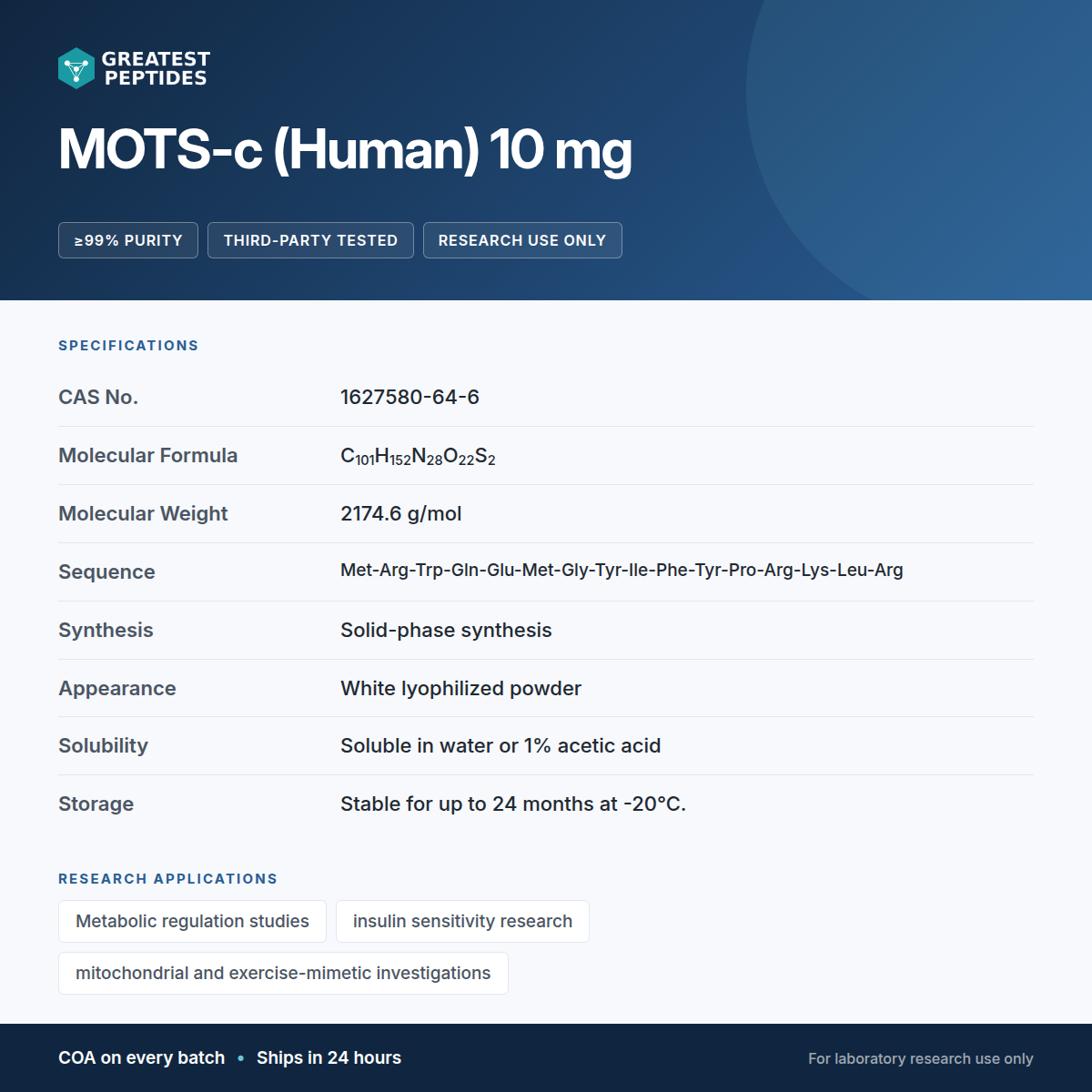
| CAS No. | 1627580-64-6 |
| Purity | ≥99% |
| Sequence | Met-Arg-Trp-Gln-Glu-Met-Gly-Tyr-Ile-Phe-Tyr-Pro-Arg-Lys-Leu-Arg |
| Molecular Formula | C101H152N28O22S2 |
| Molecular Weight | 2174.6 g/mol |
| Synthesis | Solid-phase synthesis |
| Solubility | Soluble in water or 1% acetic acid |
| Stability & Storage | Stable for up to 24 months at -20°C. After reconstitution, may be stored at 4°C for up to 4 weeks or at -20°C for up to 6 months. |
| Applications | Metabolic regulation studies, insulin sensitivity research, mitochondrial and exercise-mimetic investigations |
| Appearance | White lyophilized powder |
| Shipping Conditions | Shipped at ambient temperature; once received, store at -20°C |
| Regulatory/Compliance | Manufactured in a facility that adheres to cGMP guidelines |
| Safety Information | Refer to provided MSDS |
A specification table is a claim, and a claim is only worth the record behind it. Every field above is one you can ask us to substantiate against the batch documentation for the lot you were sent. If a field ever fails to match the paperwork, that is a defect on our side and we would rather hear about it than not.
Cofactor and mitochondrially encoded material in this group is often assayed by methods borrowed from small-molecule chemistry rather than peptide chemistry, so the certificate may reference a different analytical convention than a standard peptide COA.
The analytical record behind this lot
A certificate of analysis is not a quality badge. It is a measurement report about one specific batch, produced on a specific date by a specific method, and its value to you is entirely a function of how much of that context it discloses. For MOTS-c the fields worth checking first are the ones that tie the document to the container in your hand.
| Field on the certificate | Why it matters for this SKU |
|---|
| Lot or batch identifier | Ties the document to the vial. A certificate with no lot reference describes some batch, not necessarily yours. |
| Compound name and, where applicable, sequence | This is the identity claim. For a mitochondrial and cofactor research compound it is the field that distinguishes the material from its close relatives. |
| Analytical method and conditions | A purity figure without a method is a number without units. Column, gradient and detection wavelength change what the figure means. |
| Date of analysis | Establishes how old the measurement is relative to the material. A recent vial with a two-year-old certificate is a documentation gap. |
| Who performed the analysis | In-house and independent third-party results are both legitimate; they are not the same claim, and the document should say which it is. |
| The chromatogram or spectrum itself | A summary table can be typed by anyone. A trace can be read, and a reader who knows the compound class can tell whether it is plausible. |
What our documentation for MOTS-c does assert is what the analysis measured on the batch that was tested. What it does not assert — and no certificate from any supplier can assert — is that the material is safe, that it is suitable for any use in humans or animals, or that it will reproduce a result reported in a published paper. Those are different questions and a purity figure is not evidence for any of them.
Our batch documentation policy, including how to request the record for a lot you already have, is on the certificate of analysis page. If you need the record before ordering rather than after, ask us through the contact page and reference this listing by name.
How MOTS-c is checked before it reaches this catalog
Three questions have to be answered separately before a compound gets a page here, and collapsing them into one percentage is the most common way a supplier listing becomes misleading.
| Question | What answers it | What it does not tell you |
|---|
| Identity — is this the right molecule? | Mass determination, and sequence confirmation where the material is a defined chain | Nothing about how much of the vial is that molecule |
| Purity — what proportion of the detected material is the target? | Chromatographic separation with a stated method | Nothing about what the other fraction actually is, unless the impurities are themselves identified |
| Content — how much target material is actually in the container? | Quantitative determination against the labeled fill | Nothing about identity or purity; a vial can be accurately filled with the wrong thing |
For MOTS-c, respirometry, mitochondrial membrane potential assays and metabolite quantification are the assay formats the published work in this area tends to use, which matters when you are deciding whether the material as supplied is fit for the experiment you have in mind. A compound that is clean enough for a binding assay is not automatically clean enough for a quantitative cell-based readout where a co-eluting impurity could carry activity of its own.
Content is the field most often missing from a supplier listing, and it is the one that changes your arithmetic. A vial labeled 10 mg contains that much total solid, and total solid includes counter-ion, residual water and whatever else survived the process. If you need the peptide mass rather than the vial mass to be exact, that is a specific request to make in advance, not an assumption to carry into a calculation.
Receiving, inspecting and storing MOTS-c
The most useful five minutes you will spend on this material are the five minutes immediately after the package is opened, because that is the only moment at which you can still distinguish a transit problem from a handling problem of your own.
- Confirm the label on the container matches this listing, including the fill mass, and record the lot identifier in your notebook before anything else happens.
- Inspect the closure and seal. A compromised closure is a reason to stop, not a reason to proceed carefully.
- Look at the cake. Note its appearance and position; a cake that has collapsed, shifted or gone glassy is telling you something about the vial's history in transit.
- Let a cold vial reach room temperature before opening it, so that atmospheric moisture condenses outside the vial rather than into the material.
- Photograph the label and the container on arrival. It costs nothing and it settles later questions instantly.
- Store it in the dark, at the temperature stated for this listing, and write down the date it entered storage.
- Decide your aliquot plan before the first opening, not after it.
Cofactor material in this group is more prone to oxidative change than a plain peptide chain, and headspace air in a partly used vial is part of that exposure.
The general rule for lyophilized material is that the dry state is the stable state and every transition away from it costs you something. Freeze-thaw cycling is the specific mechanism most likely to degrade MOTS-c after it reaches you, and it is entirely under your control: a single reconstitution split into pre-planned aliquots exposes the material once, while repeatedly warming and refreezing one container exposes it as many times as you open it. There is a fuller treatment of the mechanism in our guide on freeze-thaw cycles in peptide research materials and on storage and handling.
Preparing aliquots from a 10 mg vial: the measurement arithmetic
This is arithmetic, not guidance. The only thing the table below does is tell you what concentration you are holding after you have added a known volume of diluent to a vial labeled 10 mg, so that the figure in your notebook and the figure in the container are the same figure. It says nothing about how much material any experiment should use, and it is not applicable to any use in humans or animals.
| Diluent added | Resulting concentration | Amount in 0.1 mL | Amount in 0.05 mL | Aliquots of 0.25 mL |
|---|
| 1 mL | 10 mg/mL | 1,000 µg | 500 µg | 4 |
| 2 mL | 5 mg/mL | 500 µg | 250 µg | 8 |
| 3 mL | 3.33 mg/mL | 333.3 µg | 166.7 µg | 12 |
| 5 mL | 2 mg/mL | 200 µg | 100 µg | 20 |
Every figure above is the same division: the labeled mass of MOTS-c divided by the volume of diluent added. Nothing in the table is a recommendation about how much material to use in an experiment — it is the arithmetic that tells you what concentration you are holding once you have added a known volume, so that the number you write in the notebook matches what is in the container.
Two things routinely go wrong at this step. The first is treating the labeled mass as the peptide mass; as noted above, the labeled figure is total solid unless the documentation says otherwise, so a concentration derived from it is a nominal concentration. Say so in your methods rather than implying a precision the specification does not support. The second is ignoring the volume the solid itself occupies — small at these masses, but not zero, and it means the final volume is very slightly greater than the volume you added.
If you want to work backwards from a target concentration to a diluent volume, or to check a figure against a different vial size, our peptide reconstitution calculator does the same division in both directions and shows its working.
What to record for MOTS-c so the work is reproducible
Reproducibility in this area fails at the material-provenance step far more often than at the analysis step. The fields below are the ones that let somebody else — a reviewer, a collaborator, or you in eighteen months — work out whether two sets of results were generated with comparable material.
- Supplier and the exact listing name, including the fill size, rather than just the compound name
- Lot identifier, and the date the batch documentation was issued
- Date received, and the storage conditions and location it went into
- Date of reconstitution, the diluent used and its lot, and the volume actually added
- Nominal concentration obtained, stated as nominal rather than as measured
- Aliquot scheme: how many, what volume, stored where
- Freeze-thaw count for each aliquot at the point of use
- Any deviation from plan, including deviations that seemed unimportant at the time
- Whether the material was research-use-only labeled, which for this listing it is
Comparing suppliers on this exact SKU
Comparing MOTS-c across suppliers on price alone is comparing two numbers that may not describe the same thing. These are the questions that make the comparison meaningful, with our answers next to them so you can hold us to the same standard you would hold anyone else.
| Question to ask any supplier | Our answer for this listing |
|---|
| Is batch documentation available for the specific lot I will receive, not a representative lot? | Yes — the record is tied to the lot supplied. Policy on the certificate of analysis page. |
| Does the analytical method appear on the document, or only the result? | The method context belongs on the document; a bare percentage is not a complete record. |
| Is the labeled figure total solid or target-compound mass? | Labeled as the fill for this presentation. If you need the distinction resolved for a calculation, ask before ordering. |
| Is the listing labeled research use only throughout, without use claims? | Yes, and deliberately so. No use, benefit or outcome is claimed anywhere on this page. |
| How quickly does it dispatch, and is that a promise or an average? | Within 24 hours of the order clearing. |
| Can I reach a person about the paperwork rather than only about the order? | Yes — the contact page reaches us directly. |
| Is there a published position on what the documentation does not prove? | Yes. It is stated on this page and on every product page. |
A supplier who answers all seven honestly is a better bet than a supplier who is ten percent cheaper and answers four. A supplier who cannot answer the first one at all is not selling you documented material; they are selling you a container.
Compliance boundary for MOTS-c
MOTS-c is supplied for laboratory research use only. It is not a drug, not a supplement, not a cosmetic and not a medical device. It is not for human or veterinary administration, not for diagnostic use, and not for use in food. That is not a disclaimer bolted onto a sales page — it is the actual scope of what is being sold, and it constrains what can honestly be written about it.
| Language that stays inside the boundary | Language that does not |
|---|
| "Supplied for research use only" | Any phrasing that implies a personal or clinical use |
| "Published work in this area has examined mitochondrial function markers, oxidative-stress endpoints and cellular energetics" | "MOTS-c does X" stated as an established effect |
| "Purity determined by the stated method on the tested batch" | "Pharmaceutical grade", "medical grade", "safe" |
| "Concentration arithmetic for preparing laboratory aliquots" | Anything framed as a dose, a protocol or a schedule |
| "Not for human or veterinary use" | Silence on the point, which readers correctly interpret as evasion |
| Naming the model system a finding came from | Reporting an animal or in-vitro finding as though it were a human finding |
The reason to be precise about this is not only regulatory. Research literature on this class of material is genuinely interesting and genuinely incomplete, and overstating it makes the real findings harder to see. Where published work is referenced on this site it is referenced as what was measured, in what system, at what scale — not as a property of the vial.
Other Metabolic & Mitochondrial Compounds listings
These share a catalog category with MOTS-c, which means the documentation and handling considerations above largely transfer to them. Their compound-specific sections do not — each has its own identity, its own literature and its own analytical profile.
| Listing | Price |
|---|
| AOD9604 10 mg | $42.99 Original price was: $42.99.$37.99Current price is: $37.99. |
| NAD+ | $54.99 – $79.99Price range: $54.99 through $79.99 |
The full catalog is on the shop page, and the longer written material is in our research guides.
Questions about ordering MOTS-c
Is MOTS-c documentation available before I order?
Yes. Ask through the contact page and reference this listing by name. Our general position on batch documentation is on the certificate of analysis page. If a supplier will not show you the record until after payment has cleared, that is worth noticing.
What does the 10 mg figure on the label actually refer to?
It is the labeled fill for this presentation. For lyophilized material the labeled mass is total solid unless the documentation states otherwise, and total solid includes counter-ion and residual moisture as well as target compound. If your calculation depends on the distinction, resolve it against the batch record rather than assuming.
How fast does MOTS-c ship?
Within 24 hours of the order clearing. Orders of $150 and above ship free. Transit time after dispatch depends on the service selected at checkout.
Can I buy MOTS-c for personal use?
No. This material is supplied for laboratory research use only. It is not a drug, supplement or cosmetic, it is not for human or veterinary administration, and nothing on this page should be read as guidance for any such use.
How should MOTS-c be stored before and after reconstitution?
Store the sealed vial dry, dark and at the temperature stated for this listing, and record the date it entered storage. Once material is in solution the useful discipline is to minimize repeated warming: plan the aliquot scheme before the first reconstitution so the material is exposed once rather than once per experiment. Cofactor material in this group is more prone to oxidative change than a plain peptide chain, and headspace air in a partly used vial is part of that exposure.
How much diluent should I add to a 10 mg vial?
That depends entirely on the concentration your protocol calls for, which is your decision and not something a product page can answer. What the table above provides is the arithmetic: labeled mass divided by added volume gives concentration. The reconstitution calculator runs the same division in either direction.
Does a high purity figure mean MOTS-c is safe?
No, and this is the single most common misreading of a certificate of analysis. Purity describes what proportion of the detected material was the target compound in the batch that was tested, by the method stated. It is not a safety assessment, it says nothing about suitability for any use in humans or animals, and it does not become a safety claim by being a large number.
What is MOTS-c classified as in your catalog?
It is listed as a cofactor or mitochondrially encoded sequence, in the Metabolic & Mitochondrial Compounds category. Published work in this area has looked at mitochondrial function markers, oxidative-stress endpoints and cellular energetics. That is a description of where the literature sits, not a claim about what the material does.
Do you have more general written material on evaluating research peptides?
Yes. The home page guide covers reading a certificate of analysis, what chromatographic and mass-spectrometric methods each prove, and how to compare suppliers. The research guides go deeper on individual topics, and the FAQ covers ordering, shipping and post-shipping questions.
MOTS-c (Human) 10 mg is supplied strictly for laboratory research use. It is not a drug, supplement, cosmetic or medical device; it is not for human or veterinary use, not for diagnostic use and not for use in food. No statement on this page is intended to describe a therapeutic use, benefit or outcome, and references to published work describe what was measured in the reported model system rather than a property of the material supplied. Purchasers are responsible for handling the material in accordance with the requirements applicable to their institution and jurisdiction.