$42.99Original price was: $42.99.$37.99Current price is: $37.99.
In stockShips today if ordered by 3 PM ESTUSA fulfillment
Research Studies
✓Studied as a fragment of the growth-hormone molecule in lipid-metabolism research.
✓Investigated for effects on lipolysis pathways in vitro.
✓Used in laboratory models of adipocyte metabolism.
✓Applied in metabolic research assays.
AOD9604 10 mg is supplied at 99%+ purity for in-vitro laboratory research only. Not for human or veterinary use.
Reconstituting this vial? Our free peptide reconstitution calculator converts vial mass and diluent volume into concentration, draw volume and U-100 syringe graduations. Research use only.
ALL ARTICLES AND PRODUCT INFORMATION PROVIDED ON THIS WEBSITE ARE FOR INFORMATIONAL AND EDUCATIONAL PURPOSES ONLY. The products offered on this website are intended solely for research and laboratory use. These products are not intended for human or animal consumption. They are not medicines or drugs and have not been evaluated or approved by the FDA to diagnose, treat, cure, or prevent any disease or medical condition. Any form of bodily introduction is strictly prohibited by law.
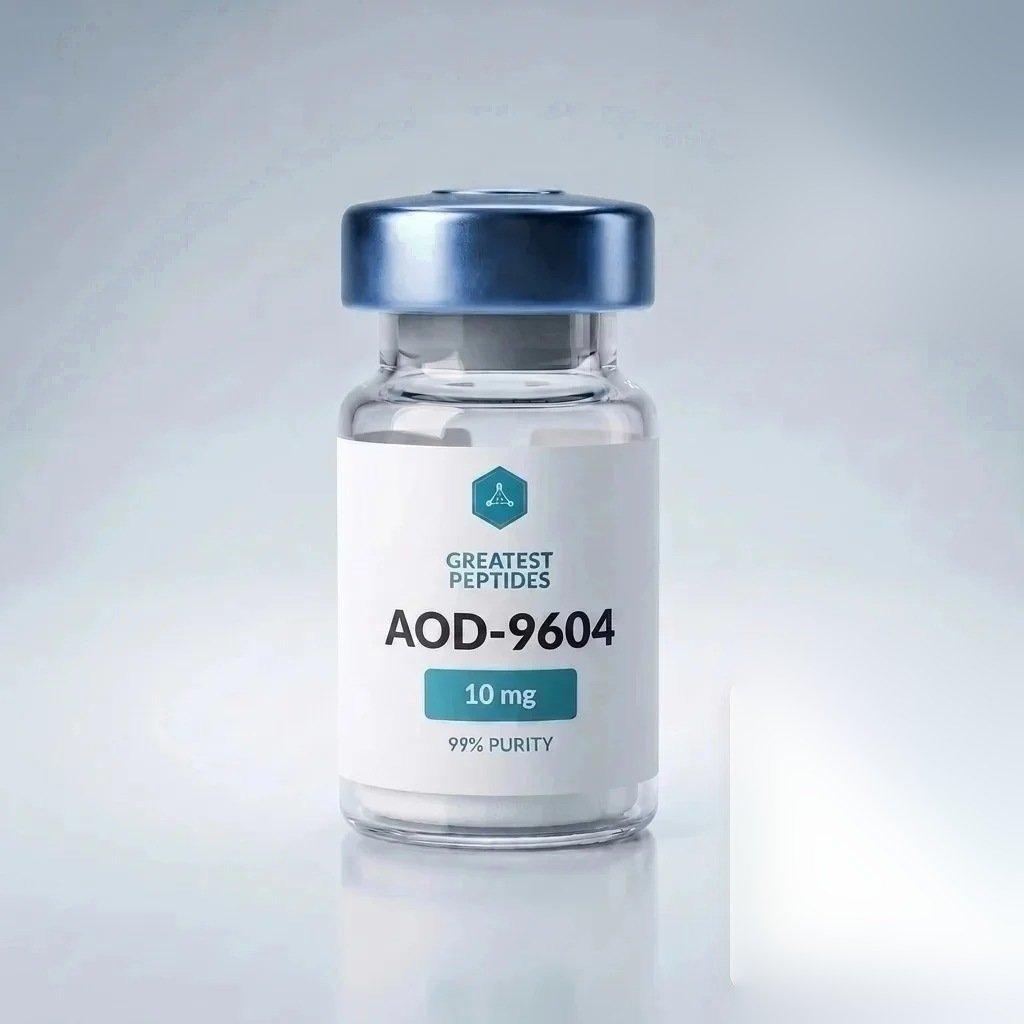
AOD9604, 10 mg per vial, a synthetic growth hormone fragment (lyophilized). For research use only.
Purity: ≥98% HPLC (see batch COA); identity confirmed by LC-MS. A batch-specific Certificate of Analysis (COA) is available for each lot. For laboratory and research use only. Not for human or animal consumption.
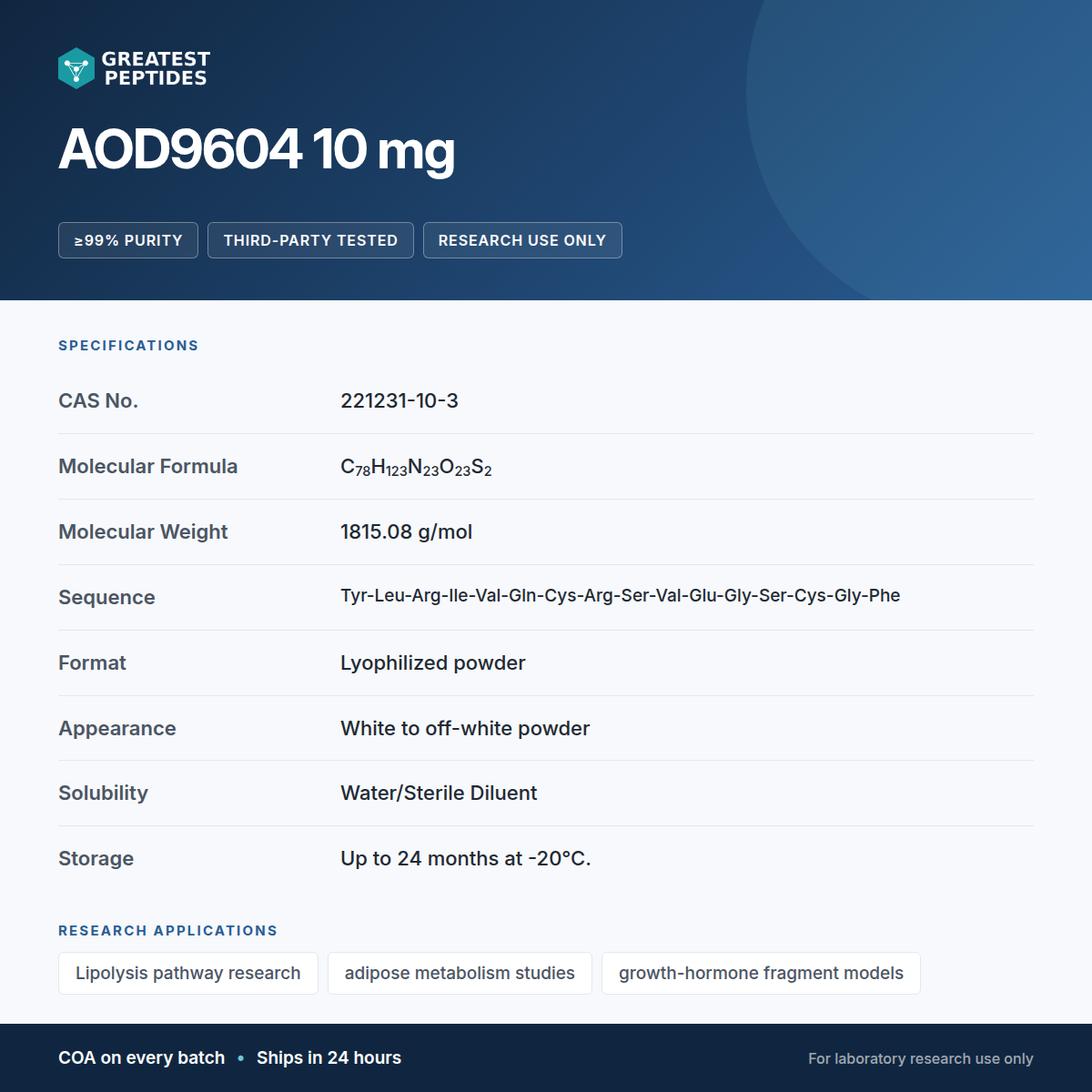
Up to 24 months at -20°C. Avoid repeated freeze-thaw cycles.
Applications
Lipolysis pathway research, adipose metabolism studies, growth-hormone fragment models
Appearance
White to off-white powder
Regulatory/Compliance
Not for human consumption. For research use only.
Safety Information
MSDS available upon request
Shipping Conditions
Shipped at ambient temperature in protective packaging. Lyophilized powder is stable in transit; on arrival, transfer to −20 °C storage as noted above.
Researcher FAQ
How do I reconstitute this peptide?
Use bacteriostatic water (BAC) at a 1–2 mL volume per vial. Add the solvent slowly down the vial wall, swirl gently — never shake. Refrigerate after reconstitution and use within 30 days. For in-vitro laboratory handling only.
How should I store this product?
Lyophilized: 36–46°F (refrigerated) for up to 24 months. Reconstituted: keep refrigerated and protect from light; use within 30 days. Avoid repeated freeze-thaw cycles.
Shipping & tracking?
Orders placed before 3 PM EST ship the same business day from our USA facility. Tracking is emailed within 24 hours. Plain, discreet packaging. Free shipping on orders over $150.
Buy AOD-9604 for Research | RUO COA & Documentation Guide
For laboratory teams evaluating where to buy AOD-9604 for research, the priority is documentation, compound identity, and research-use-only (RUO) alignment. AOD-9604 is a synthetic peptide derived from the C-terminal fragment (176–191) of human growth hormone, catalogued by PubChem with the molecular formula C78H123N23O23S2 and a molecular weight of approximately 1,815.1 g/mol (PubChem CID 16131447)[1] (CAS 221231-10-3). Its reported sequence is Tyr-Leu-Arg-Ile-Val-Gln-Cys-Arg-Ser-Val-Glu-Gly-Ser-Cys-Gly-Phe with a Cys7–Cys15 disulfide bridge.
Fast Answer
Researchers evaluating where to buy AOD-9604 for research should review RUO labeling, a batch-specific certificate of analysis (COA), HPLC purity data, LC-MS or comparable identity support, disulfide/mass consistency, and lot traceability before procurement. Material discussed here is intended for laboratory research use only and is not for human or veterinary use.
What Does “Buy AOD-9604 for Research” Mean?
The phrase is addressed as laboratory research-procurement intent — how qualified researchers, institutions, and technical buyers evaluate an AOD-9604 reference material through documentation, analytical support, and labeling clarity, not personal, clinical, or consumer decision-making.
Compound Identity & Classification
Compound name
AOD-9604 (hGH 176–191 fragment analog)
PubChem CID
16131447[1]
CAS number
221231-10-3
Molecular formula
C78H123N23O23S2[1]
Molecular weight
≈ 1,815.1 g/mol[1]
Sequence
YLRIVQCRSVEGSCGF (Cys7–Cys15 disulfide)
Classification
Growth-hormone-fragment analog[2]
Product form
Lyophilized powder
Purity target
≥ 99% (see batch-specific COA)
Regulatory status
Research use only — not for human or veterinary use
Published literature discusses AOD-9604 and the hGH 176–191 fragment within lipid-metabolism research in cell and preclinical models[2][3]. On a research product page this pathway context should remain academic literature interpretation used to define the research lane — it is not converted into product-performance language.
COA, Purity & Identity Documentation
An AOD-9604 COA should be reviewed as a batch-specific record, not a marketing statement. Look for compound name, lot number, test date, stated purity, analytical method, identity confirmation, disulfide confirmation, and molecular information. Purity, identity, method, and lot number should be evaluated together.
Evaluation area
What to review
Why it matters
RUO labeling
Clear research-use-only language
Separates research procurement from human-use positioning
COA availability
Batch-specific certificate for the received lot
Supports lot-level documentation
Purity data
HPLC area-percent support for stated purity
Helps evaluate material consistency
Identity testing
LC-MS / mass-spec + disulfide confirmation
Confirms the material matches the listed peptide
Lot traceability
Lot number matching across records
Supports research recordkeeping
HPLC, LC-MS & Analytical Review
HPLC documentation supports purity assessment; LC-MS or mass-spectrometry documentation supports identity confirmation and molecular-mass review[10][11]. For a disulfide-bridged peptide, confirming both the mass and the intramolecular disulfide is useful alongside HPLC purity data. ICH Q2(R2) describes validation characteristics used to interpret assay, purity, and identity results[7].
Lot Traceability & Batch Documentation
Lot traceability connects the product listing, COA, label, and receiving record. ISO/IEC 17025 addresses the competence of testing laboratories, and NIST resources describe how certificates and lot identifiers support traceability[8][9].
Claim Boundary for RUO Positioning
Research-safe statement
Non-compliant version to avoid
“AOD-9604 is discussed in published literature on GH-fragment lipid-metabolism research.”
“AOD-9604 burns fat or aids weight loss.”
“Researchers should review COA and identity data before procurement.”
“Buy AOD-9604 for fat loss.”
“Greatest Peptides supplies AOD-9604 as a research-use-only material.”
“Greatest Peptides supplies AOD-9604 for treatment.”
Research Procurement Checklist
Confirm the material is labeled for research use only.
Review the batch-specific certificate of analysis for the received lot.
Confirm purity is supported by HPLC analytical data.
Confirm identity is supported by LC-MS or mass spectrometry, plus disulfide confirmation.
Compare compound name, sequence, formula, and mass across the page, label, and COA.
Verify the lot number matches across all documentation.
Document storage and handling conditions in the laboratory record.
How Greatest Peptides Presents AOD-9604
Greatest Peptides supplies AOD-9604 as a research-use-only laboratory material in lyophilized powder form, positioned around a stated ≥99% purity target, batch-specific COA availability, HPLC/LC-MS documentation, lot-level traceability, and transparent RUO labeling. Products are not intended for human or animal consumption, diagnostic, therapeutic, clinical, or veterinary use.
Published Literature Context
Published AOD-9604 literature spans growth-hormone-fragment chemistry and preclinical lipid-metabolism research models[2][3]. Model-specific findings should not be generalized or interpreted as use guidance for research-use-only materials.
Contributing Researchers
Recognized for published work that shaped the scientific context discussed above
Frank M. Ng, PhD — authored research on the lipolytic domain of human growth hormone (the 176–191 region) underlying AOD-9604[2].
Metabolic Pharmaceuticals research group — characterized the AOD-9604 hGH-fragment analog in lipid-metabolism research[3].
FAQs About Buying AOD-9604 for Research
What should researchers check before buying AOD-9604 for research?
Review RUO labeling, the batch-specific COA, stated purity with HPLC support, LC-MS identity data plus disulfide confirmation, and lot traceability.
What is AOD-9604 in research documentation?
A synthetic peptide based on the hGH 176–191 fragment (YLRIVQCRSVEGSCGF, Cys7–Cys15 disulfide) with molecular formula C78H123N23O23S2 and a molecular weight near 1,815.1 g/mol.
Why does a COA matter when buying AOD-9604?
It connects the listing to batch-specific documentation, including disulfide confirmation, for the received lot.
Is AOD-9604 intended for human or animal use?
No. Material discussed here is intended strictly for laboratory research use only.
How should published literature be interpreted?
As scientific context only. Model-specific findings should not be generalized or read as use guidance for research-use-only materials.
This page addresses AOD-9604 only as research-use-only laboratory procurement. Boundary-sensitive terms such as fat loss, weight, metabolism, and lipolysis are referenced here only as research-language examples that must stay separate from RUO product positioning. All product information is for informational and educational purposes only. Products are not intended for human or animal consumption and have not been evaluated by the FDA to diagnose, treat, cure, or prevent any disease.
References
National Center for Biotechnology Information. AOD-9604, CID 16131447. PubChem Compound record. Accessed 2026.
Ng FM, et al. Lipolytic activity of the C-terminal region (176–191) of human growth hormone. Peptide/endocrinology literature. 2000s.
Metabolic Pharmaceuticals. Characterization of AOD-9604 hGH-fragment analog (research). 2000s.
Registry record for AOD-9604, CAS 221231-10-3. Accessed 2026.
IUPAC-IUB Joint Commission. Nomenclature and symbolism for amino acids and peptides. 1983.
U.S. FDA. Analytical procedures and methods validation for drugs and biologics. 2015.
U.S. FDA. Q2(R2) Validation of Analytical Procedures. 2024.
International Organization for Standardization. ISO/IEC 17025:2017. 2017.
National Institute of Standards and Technology. Reference materials and certificates of analysis. Accessed 2026.
Mant CT, et al. HPLC analysis and purification of peptides. Methods in Molecular Biology. 2007.
Steen H, Mann M. Peptide sequencing. Nature Reviews Molecular Cell Biology. 2004. PMID 15340378.
Compound profile
AOD9604: compound profile, literature landscape and handling notes
AOD9604 in one paragraph
AOD9604 is a short synthetic peptide corresponding to the C-terminal region of human growth hormone, conventionally cited as residues 176-191, carrying an additional tyrosine at the N-terminus that is not present in the parent protein. It exists because of a specific and testable hypothesis: that the lipolytic activity attributed to growth hormone resides in a discrete C-terminal domain, and that this domain can be excised from the protein and used on its own without carrying along the growth-promoting, IGF-1-inducing and insulin-antagonizing activities that require the intact molecule and its receptor-binding surfaces. That separability hypothesis is the spine of everything written about this compound, and it is worth stating plainly at the outset that it is a hypothesis with mixed support rather than a settled result. The negative half of the claim is better evidenced than the positive half. Everything below describes the published research record. Nothing here is a claim about what this vial does, and nothing here is applicable to use in humans or animals.
Where AOD9604 came from
The intellectual history of AOD9604 begins well before the peptide itself, in a long argument about whether growth hormone is one activity or several. Growth hormone measurably influences both skeletal growth and lipid handling, and by the 1970s and 1980s a body of work in hypophysectomized rodents had established that these two readouts do not always move together. Some preparations and some fragments appeared to influence adipose tissue without producing the growth response, which suggested to several groups that the protein might be functionally modular: a growth-promoting activity requiring the intact fold and its receptor-dimerizing surfaces, and a metabolic activity carried by a smaller and more portable piece.
Work on proteolytic and synthetic fragments of human growth hormone through the 1980s and 1990s concentrated attention on the C-terminal region, and the segment usually cited as residues 176-191 became the candidate lipolytic domain. Groups principally associated with Australian academic and biotechnology research pursued this fragment through rodent obesity models and adipocyte preparations, and AOD9604 emerged from that line as the version taken forward into formal development. The name itself is a development code rather than a chemical descriptor, which is one small reason the compound is so often described imprecisely in secondary sources.
Two features of that history matter for anyone planning work with the material. First, the compound was designed against a hypothesis rather than discovered against a target. There is no receptor that AOD9604 was optimized to bind, and this is not an oversight in the literature but a genuine feature of the compound's origin. Second, its development path was unusual. Beyond conventional pharmaceutical evaluation, the compound has been assessed in food-ingredient and cosmetic regulatory contexts, which means statements about it circulate in several mutually incompatible registers. A claim written for one of those frameworks is routinely quoted as though it were evidence in another, and untangling which register a given assertion came from is a necessary first step in reading anything about this compound.
Reading the structure of AOD9604
The sequence, formula and mass for this listing are printed in the specification table further down this page and are not restated here. What is worth interpreting is the design logic, because AOD9604 is structurally unusual in a way that carries real analytical consequences.
The molecule is a sixteen-residue stretch corresponding to the C-terminal region of human growth hormone with one additional residue on the front. That added residue is a tyrosine, and the reason usually given for its presence is refreshingly candid: it was added to permit radioiodination and to supply an ultraviolet chromophore. In other words the residue exists for analytical rather than pharmacological purposes. That is unusual enough to be worth dwelling on. Most modifications you encounter in this catalog are pharmacological, intended to block a protease, extend circulation or retune receptor affinity. Here a residue was appended so that the peptide could be traced and measured. It is a useful reminder that not every deviation from a native sequence is a potency argument, and that reading a modification correctly requires knowing what it was for.
The second structural point is the one most often skipped. In intact growth hormone, the corresponding region does not exist as a free linear stretch. It carries cysteine residues that in the parent protein participate in a disulfide bond closing a small C-terminal loop, and the whole region is held in a defined conformation by the surrounding four-helix bundle. An isolated synthetic fragment, prepared as a linear chain, does not reproduce that constraint. It is conformationally free in a way the same residues in the parent protein are not.
This has a direct bearing on the separability hypothesis. If the lipolytic activity of growth hormone genuinely lives in a discrete domain, the domain in question is a constrained loop presented on a folded surface, not a floppy linear peptide. Whether the isolated fragment can recapitulate that presentation is exactly the question, and the structural argument cuts both ways: it explains why a fragment might behave differently from the parent, and it also explains why a fragment might fail to behave like the parent at all. Whether the cysteine residues in any given preparation are free thiols or paired is itself an analytical question rather than an assumption, and it is one worth confirming against the documentation for a lot.
The target and the pathway in more detail
AOD9604 has no confirmed receptor. This is the single most important fact about its pharmacology and the one most consistently softened in secondary material, so it is worth stating without hedging: there is no identified binding site through which its reported effects are understood to be transduced.
That absence is not merely a gap in characterization. Published work reports that AOD9604 does not bind the growth hormone receptor. If that finding holds, it constrains interpretation sharply in both directions. On the one hand it supports the separability premise, because a fragment that cannot engage the receptor responsible for the growth-promoting and IGF-1-inducing arm of growth hormone signaling should not produce those effects. That is the negative half of the separability claim, and it is the half with the better evidence behind it. On the other hand it removes the most obvious candidate mechanism for any positive effect. Whatever the fragment is reported to do in adipose tissue, it cannot be doing it through the receptor that mediates growth hormone action.
The proposed mechanisms that remain center on adipocyte metabolism directly: reported influences on lipolysis and on lipogenic enzyme activity in fat cells, and in the rodent work a reported change in expression of the beta-3 adrenergic receptor in adipose tissue. That last observation is the closest thing in the literature to a molecular handle, and it comes with a caveat serious enough to dominate any reading of it. Beta-3 adrenergic biology differs substantially between rodents and humans. The receptor's expression pattern, its contribution to adipose lipolysis and its pharmacology are not the same across the two, and this is not a subtle discrepancy but one of the best-documented translation failures in metabolic pharmacology. An entire generation of beta-3-directed compounds performed convincingly in rodent adipose tissue and did not reproduce those findings in human work, for reasons intrinsic to the receptor's differing role in the two species.
So the mechanistic picture is a chain with a weak link at every joint: an unidentified proximal target, a downstream marker whose biology is species-divergent, and a functional readout in tissue preparations that does not by itself establish how the signal was initiated. None of that makes the observations wrong. It does mean that describing AOD9604 as having a mechanism, in the sense a pharmacologist would use the word, overstates what has been shown.
What the published literature on AOD9604 actually measures
The AOD9604 literature falls into three groups with very different weights, and the common failure in reading it is treating them as though they carried equal evidentiary force.
The first group is rodent work. Obesity models, including genetically obese and diet-induced obese rodents, form the historical backbone of the compound's case. This is where the fragment was reported to influence adipose tissue mass and lipid metabolism without the growth response associated with intact growth hormone, and where the beta-3 adrenergic receptor expression observations were made. It is a coherent and internally reasonable body of work. It is also almost entirely preclinical, concentrated in a relatively small number of related groups, and subject to the species caveat described above.
The second group is cell and tissue work: isolated adipocytes and adipocyte cultures, explanted adipose tissue, and assays of lipolytic and lipogenic activity. This is the mechanistically most interesting material because it isolates the tissue of interest from whole-animal confounders, and it is where a bench researcher would most reasonably look for a reference method. It is also, being in vitro, the material most exposed to the question of whether an effect observed at the concentrations used in a dish reflects anything about the intact organism.
The third group is human clinical work, and this is where the compound's public reputation and its actual record diverge most sharply. AOD9604 has been through human trials in an obesity context. Those trials are frequently cited as supportive. The plain summary is that their primary endpoints were largely not met. The compound did not demonstrate in those studies the effect that the rodent work would have predicted. This is not an obscure or contested reading; it is the reason the compound did not proceed as a conventional pharmaceutical, and it is the reason its subsequent regulatory history moved into food-ingredient and cosmetic evaluation instead.
That regulatory diversion produces a fourth category of citation that is not literature at all but is regularly quoted as though it were: regulatory submissions, safety determinations made for ingredient purposes, and manufacturer documentation. A safety assessment conducted for one regulatory framework speaks to that framework's question and not to efficacy, mechanism or bench utility. Conflating the two is the most common citation error made about this compound.
Where the AOD9604 literature is thin or frequently misread
This is the section that matters most for AOD9604, because the distance between what the compound is claimed to do and what has been demonstrated is wider here than for most entries in this catalog.
The first and largest gap is the human trial outcome. The rodent work predicted an effect on adipose tissue in an obesity context. Human studies were conducted to test that prediction. Their primary endpoints were largely not met. That result is the single most informative datum in the entire AOD9604 record, because it is the direct test of the compound's founding hypothesis in the species of interest, and it is also the datum most reliably absent from promotional material. Vendor descriptions routinely cite the existence of human clinical trials as evidence of validation while omitting what those trials found. A researcher who encounters "clinically studied" without "endpoints not met" has been given half a sentence.
The second gap is the rodent beta-3 adrenergic translation problem described above. A mechanistic marker that is species-divergent cannot carry a cross-species mechanistic argument, and the history of beta-3-directed pharmacology is a cautionary case study rather than a supporting one.
The third is logical and applies to fragment compounds generally. A claim of the form "this fragment retains function X but not function Y" contains two assertions, and both require demonstration. For AOD9604 the two halves are not equally supported. The negative half, that the fragment does not engage the growth hormone receptor and does not produce the growth-promoting arm of the parent's activity, is comparatively well evidenced. The positive half, that it retains a distinct lipolytic function in a form that translates, is the half the human data failed to confirm. A compound can successfully not do something and still not do the thing it was designed for, and "separable from the growth effects" is not a synonym for "active".
The fourth is citation transfer. Because AOD9604 is derived from human growth hormone, discussion of it frequently imports the intact-hGH literature wholesale. That literature describes a protein that binds and dimerizes a receptor AOD9604 is reported not to bind. Data generated with the parent protein cannot be used to support claims about the fragment, and a reference list that leans on growth hormone papers to characterize this fragment is describing a different molecule.
How AOD9604 behaves in solution
AOD9604 is a short peptide, and its solution behavior is that of a short peptide rather than that of the acylated or highly modified molecules elsewhere in this catalog. It carries no lipid chain, so it is not a surfactant and does not self-associate in the way the fatty-acylated analogs do, and it is not a folded protein, so it has no tertiary structure to lose. In its isolated synthetic form it is handled as a linear chain, which simplifies some things and complicates others.
Solubility in aqueous buffer is generally good for a peptide of this composition, and the material is supplied lyophilized. The behavior worth planning around is adsorption. Short peptides at low concentration lose a real and often surprising fraction of their content to container walls, pipette tips and filter membranes, and because AOD9604 has no albumin-binding element to keep it in solution, that loss is straightforwardly proportional to surface area and inversely proportional to concentration. A dilute working solution prepared in an untreated tube may be measurably weaker at the point of use than at the point of preparation. Low-binding labware, minimized transfer steps and avoiding unnecessary filtration all help, and preparing at a higher concentration then diluting immediately before use helps more than preparing dilute and storing.
Chemical liabilities follow from composition. Tyrosine is oxidizable, and the added N-terminal tyrosine that makes this peptide convenient to measure is also a site to protect from prolonged light exposure and from oxidizing conditions. Where cysteine residues are present as free thiols rather than paired, they are the most reactive feature in the molecule and will oxidize on standing in neutral to alkaline aqueous solution with atmospheric oxygen available, producing intramolecular or intermolecular disulfide species that are chemically distinct from the starting material. This is the single most likely route by which a solution of this peptide changes identity without any visible sign.
Freeze-thaw cycling remains the avoidable loss mechanism it is for every peptide: aliquot once at a concentration you will use, rather than returning repeatedly to a stock. A degraded solution may show faint haze or fine particulate, but the more common presentation is no visual change at all alongside a shifted chromatographic profile, which is why appearance is not a stability assay. The storage figure in the specification table above is the product record for this material and should be read together with the documentation supplied with the lot.
Analytical notes specific to AOD9604
AOD9604 has one genuine analytical advantage over most small peptides in this catalog, and it is worth using deliberately rather than letting it go unnoticed: the added N-terminal tyrosine gives the molecule a real chromophore at 280 nanometers.
That matters more than it sounds. Many of the short peptides in this category contain neither tryptophan nor tyrosine, and for those, absorbance at 280 nanometers is effectively useless as a concentration basis. Concentration then rests on peptide-bond absorbance in the far ultraviolet, which is matrix-sensitive and demands a matched standard, or on amino acid analysis, or in practice on mass-by-difference: weigh the vial contents, assume the labeled mass is peptide, divide by volume. Mass-by-difference is the weakest of these because the labeled mass includes counter-ion, residual water and residual salt, none of which is peptide, and the discrepancy is frequently in the tens of percent. A tyrosine-containing peptide can instead be quantified spectrophotometrically against a calculated extinction coefficient derived from its aromatic content, which measures the peptide itself rather than everything in the vial. That is a categorically better answer to "how much is actually here", and it is available here in a way it is not for most of the neighboring listings.
Identity work is conventional but has one specific trap. Intact mass by electrospray establishes the molecular species, and tandem mass spectrometry establishes the sequence, and both are worth having because for a peptide of this size the intact mass alone does not distinguish sequence isomers or positional variants. The size itself is the complication in chromatography: a short peptide elutes early in reversed phase, in the region where solvent-front artifacts, residual synthesis reagents and truncated sequences also elute, so co-elution of impurities with the main peak is a realistic concern rather than a theoretical one. A shallow gradient and a purity figure supported by mass-spectrometric peak assignment are more informative here than an area-percent number from a single fast run.
The substitution risk specific to this compound deserves naming. A preparation could be the correct growth hormone fragment and simply lack the added N-terminal tyrosine. That material is a chemically reasonable peptide, will look clean by chromatography, and differs from AOD9604 by a single residue. The mass difference is small relative to the whole molecule and trivially resolvable by mass spectrometry, but it is entirely invisible to a purity figure, to a chromatogram read without a reference standard, and to anyone reading the label. It also destroys the one analytical advantage described above, since the untyrosinated fragment has no useful 280 nanometer absorbance. If the ultraviolet handle is part of your quantitation plan, confirming the tyrosine is present is not a formality.
Compounds researchers confuse with AOD9604
Often mistaken for
How it actually differs from AOD9604
Recombinant human growth hormone (somatropin)
The intact 191-residue protein, produced recombinantly, with a folded four-helix-bundle structure and two disulfide bonds. It binds and dimerizes the growth hormone receptor and drives hepatic IGF-1 production. AOD9604 is a short synthetic fragment of its C-terminal region and is reported not to bind that receptor. The two are not comparable materials and the intact-protein literature does not transfer to the fragment.
hGH fragment 176-191 without the N-terminal tyrosine
The same C-terminal segment prepared without the added tyrosine. It is the substitution risk most specific to this listing: chemically plausible, chromatographically similar, and differing by one residue. It also lacks the aromatic chromophore, so it cannot be quantified by 280 nanometer absorbance. Identity here has to rest on mass spectrometry rather than on a purity figure or a label.
A 44-residue analog of growth-hormone-releasing hormone that acts upstream at a pituitary receptor to stimulate release of endogenous growth hormone. It is a secretagogue with a defined receptor and a substantial clinical record. AOD9604 is a downstream fragment with no confirmed receptor that is reported not to engage growth hormone signaling at all. Opposite ends of the axis.
The 1-29 fragment of growth-hormone-releasing hormone, retaining the receptor binding and activation determinants of the full hormone. It is the standard example of a fragment that genuinely does reproduce the parent's activity at the parent's receptor, which makes it a useful contrast: fragment strategies sometimes work, and the question is always whether the specific fragment retained the specific function.
A modified insulin-like growth factor 1 analog acting at the IGF-1 receptor, which sits downstream of growth hormone action on the liver. It represents precisely the arm of growth hormone biology that the AOD9604 separability hypothesis proposes to leave behind, so the two are complementary tools for opposite questions rather than related compounds.
A mitochondrially encoded peptide studied for effects on metabolic regulation and substrate handling. It shares a research context with AOD9604, adipose and metabolic tissue, but shares no structural or evolutionary relationship, no proposed receptor, and no derivation from growth hormone. Grouping them as metabolic peptides is a catalog convenience, not a pharmacological statement.
Questions specific to AOD9604
Is AOD9604 a growth hormone?
No, and the distinction is not pedantic. Growth hormone is a folded 191-residue protein whose activity depends on two receptor-binding surfaces that together dimerize the growth hormone receptor. AOD9604 is a short synthetic fragment corresponding to a C-terminal region of that protein, plus an added tyrosine, and it is reported not to bind the growth hormone receptor. It has no tertiary structure, no receptor-dimerizing surfaces and no confirmed receptor of any kind. In records and methods sections the accurate description is a synthetic C-terminal fragment analog of human growth hormone, and the word analog should be read as structural derivation rather than functional equivalence. Describing it as a form of growth hormone imports an entire literature that does not apply to it.
Why is there an extra tyrosine that is not in the parent sequence?
The reason usually given is analytical rather than pharmacological. A tyrosine provides a site for radioiodination, which allows a radiolabeled tracer version of the peptide to be made for binding and distribution studies, and it provides an aromatic chromophore that absorbs at 280 nanometers, which makes ultraviolet detection and spectrophotometric quantitation practical. It is a genuinely unusual case: most sequence modifications you meet in peptide chemistry are there to block a protease, extend circulation or retune receptor affinity, and this one is there so the molecule can be measured. It is a good reminder that reading a modification correctly means knowing what problem it was added to solve, and that not every deviation from a native sequence is an argument about potency.
If AOD9604 does not bind the growth hormone receptor, what is it supposed to act on?
That is the open question, and the honest answer is that no confirmed receptor has been identified. The proposed mechanisms in the published work are effects on adipocytes directly, influences on lipolytic and lipogenic activity in fat cells, with the reported change in beta-3 adrenergic receptor expression in rodent adipose tissue serving as the nearest thing to a molecular handle. The absence of a receptor is doing important work in both directions. It supports the claim that the fragment cannot produce the growth-promoting and IGF-1-inducing effects of the parent protein, since those require the receptor it does not bind. It simultaneously removes the obvious candidate mechanism for any positive effect, which means functional observations in tissue preparations are not by themselves evidence of how a signal was initiated.
Do the rodent adipose findings settle the beta-3 adrenergic question?
No, and this is the caveat that should accompany every citation of that observation. Beta-3 adrenergic receptor biology differs substantially between rodents and humans in expression pattern, in contribution to adipose lipolysis and in pharmacology. This is one of the best-documented translation failures in metabolic pharmacology: a series of beta-3-directed compounds performed convincingly in rodent adipose tissue and did not reproduce those findings in human work, for reasons intrinsic to the receptor's differing role across the two species. A mechanistic marker that is species-divergent cannot carry a cross-species mechanistic argument. If the question matters to your work, the comparison has to be made in a human-derived system rather than inferred from rodent data.
Were the human trials of AOD9604 positive?
Largely not, and this is the part of the record most consistently omitted from descriptions of the compound. AOD9604 was evaluated in human studies in an obesity context, and the primary endpoints were largely not met. The compound did not demonstrate the effect the rodent work predicted. That outcome is the direct test of the founding separability hypothesis in the species of interest, which makes it the most informative single datum in the whole AOD9604 record. The frequently repeated formulation that the compound has been clinically studied is true and incomplete: the existence of trials is not the same as the outcome of trials, and citing the former while omitting the latter is the characteristic misreading of this compound.
Can I cite the intact growth hormone literature to support work on this fragment?
Not for anything mechanistic. The intact-hGH literature describes a folded protein that binds and dimerizes the growth hormone receptor, and AOD9604 is reported not to bind that receptor. Any effect described in the parent literature that depends on receptor engagement, which is most of it, cannot be attributed to the fragment. This is a persistent problem in secondary material about AOD9604, where reference lists lean heavily on growth hormone papers to characterize a molecule that shares sequence with the parent but not, on the available evidence, its pharmacology. Growth hormone papers are legitimate background for the separability hypothesis itself, because they establish what is being separated from what. They are not evidence about the fragment.
What makes AOD9604 easier to quantify than most short peptides in this catalog?
The added tyrosine. Many short catalog peptides contain no tryptophan or tyrosine, which leaves absorbance at 280 nanometers useless and pushes quantitation onto far-ultraviolet peptide-bond absorbance, amino acid analysis, or in practice mass-by-difference. Mass-by-difference assumes the labeled vial contents are all peptide, which they are not: counter-ion, residual water and residual salt are included, and the discrepancy is often in the tens of percent. With a tyrosine present you can determine concentration spectrophotometrically against a calculated extinction coefficient, which measures the peptide rather than everything in the vial. The corollary is that confirming the tyrosine is actually present matters, because the untyrosinated fragment is a real substitution risk and has no usable 280 nanometer signal.
Documentation and handling reference
AOD9604: Documentation, Handling and Quality Record for This SKU
The section above covers what AOD9604 is and what the published literature has looked at. This section is the operational half: what physically arrives when you order this listing, what paperwork comes with it, which fields on that paperwork are worth reading closely, and how to log the material once it is on your bench. It is written for the person who has already decided the compound is relevant and now has to justify the purchase to a supervisor, a grant line or an internal quality process.
Everything below is scoped to this exact listing rather than to research peptides in general. If you want the general version — how to read a certificate of analysis from scratch, what HPLC and mass spectrometry each prove, how to compare two suppliers who both claim 99% — that is on the home page guide, and there is no reason to read it twice.
What ships when you order AOD9604
At a glance
One sealed vial of lyophilized material at the listed 10 mg fill, labeled for research use only, dispatched within 24 hours of the order clearing. Batch documentation is available for the lot you receive. Free shipping applies at $150 and above.
This listing is a single fixed presentation, not a size selector. That is deliberate: each presentation gets its own page, its own documentation trail and its own URL, so a citation or a purchase-order line that points at AOD9604 at 10 mg points at exactly one thing. If you need a different fill of the same compound and it is not listed, it is not currently in stock rather than hidden behind a dropdown.
Field
This listing
Listing
AOD9604 10 mg
Labeled fill mass
10 mg
Physical form
Lyophilized powder in a sealed vial
Catalog category
Metabolic & Mitochondrial Compounds
Compound class
Metabolic-fragment research peptide
Intended use
Research use only. Not for human or veterinary use, not for diagnostic use, not a drug or supplement.
Dispatch
Within 24 hours of the order clearing
Documentation
Batch analytical documentation available for the lot supplied
Free shipping threshold
Orders of $150 and above
Specification summary for AOD9604
The table below is the specification the store publishes for this listing. It is reproduced here from the product record itself rather than retyped, which means it cannot drift away from what the attribute table further up the page says. Where a field is absent it is absent because we do not publish it for this SKU, not because it was left out of this summary.
Up to 24 months at -20°C. Avoid repeated freeze-thaw cycles.
Applications
Lipolysis pathway research, adipose metabolism studies, growth-hormone fragment models
Appearance
White to off-white powder
Regulatory/Compliance
Not for human consumption. For research use only.
Safety Information
MSDS available upon request
A specification table is a claim, and a claim is only worth the record behind it. Every field above is one you can ask us to substantiate against the batch documentation for the lot you were sent. If a field ever fails to match the paperwork, that is a defect on our side and we would rather hear about it than not.
Fragment materials are defined by where the parent sequence was cut. Two suppliers can both be truthful about the name and still ship different fragments, so the sequence on the certificate is the field that settles it.
The analytical record behind this lot
A certificate of analysis is not a quality badge. It is a measurement report about one specific batch, produced on a specific date by a specific method, and its value to you is entirely a function of how much of that context it discloses. For AOD9604 the fields worth checking first are the ones that tie the document to the container in your hand.
Field on the certificate
Why it matters for this SKU
Lot or batch identifier
Ties the document to the vial. A certificate with no lot reference describes some batch, not necessarily yours.
Compound name and, where applicable, sequence
This is the identity claim. For a metabolic-fragment research peptide it is the field that distinguishes the material from its close relatives.
Analytical method and conditions
A purity figure without a method is a number without units. Column, gradient and detection wavelength change what the figure means.
Date of analysis
Establishes how old the measurement is relative to the material. A recent vial with a two-year-old certificate is a documentation gap.
Who performed the analysis
In-house and independent third-party results are both legitimate; they are not the same claim, and the document should say which it is.
The chromatogram or spectrum itself
A summary table can be typed by anyone. A trace can be read, and a reader who knows the compound class can tell whether it is plausible.
What our documentation for AOD9604 does assert is what the analysis measured on the batch that was tested. What it does not assert — and no certificate from any supplier can assert — is that the material is safe, that it is suitable for any use in humans or animals, or that it will reproduce a result reported in a published paper. Those are different questions and a purity figure is not evidence for any of them.
Our batch documentation policy, including how to request the record for a lot you already have, is on the certificate of analysis page. If you need the record before ordering rather than after, ask us through the contact page and reference this listing by name.
How AOD9604 is checked before it reaches this catalog
Three questions have to be answered separately before a compound gets a page here, and collapsing them into one percentage is the most common way a supplier listing becomes misleading.
Question
What answers it
What it does not tell you
Identity — is this the right molecule?
Mass determination, and sequence confirmation where the material is a defined chain
Nothing about how much of the vial is that molecule
Purity — what proportion of the detected material is the target?
Chromatographic separation with a stated method
Nothing about what the other fraction actually is, unless the impurities are themselves identified
Content — how much target material is actually in the container?
Quantitative determination against the labeled fill
Nothing about identity or purity; a vial can be accurately filled with the wrong thing
For AOD9604, adipocyte culture assays, lipolysis readouts and metabolic endpoint work in animal models are the assay formats the published work in this area tends to use, which matters when you are deciding whether the material as supplied is fit for the experiment you have in mind. A compound that is clean enough for a binding assay is not automatically clean enough for a quantitative cell-based readout where a co-eluting impurity could carry activity of its own.
Content is the field most often missing from a supplier listing, and it is the one that changes your arithmetic. A vial labeled 10 mg contains that much total solid, and total solid includes counter-ion, residual water and whatever else survived the process. If you need the peptide mass rather than the vial mass to be exact, that is a specific request to make in advance, not an assumption to carry into a calculation.
Receiving, inspecting and storing AOD9604
The most useful five minutes you will spend on this material are the five minutes immediately after the package is opened, because that is the only moment at which you can still distinguish a transit problem from a handling problem of your own.
Confirm the label on the container matches this listing, including the fill mass, and record the lot identifier in your notebook before anything else happens.
Inspect the closure and seal. A compromised closure is a reason to stop, not a reason to proceed carefully.
Look at the cake. Note its appearance and position; a cake that has collapsed, shifted or gone glassy is telling you something about the vial's history in transit.
Let a cold vial reach room temperature before opening it, so that atmospheric moisture condenses outside the vial rather than into the material.
Photograph the label and the container on arrival. It costs nothing and it settles later questions instantly.
Store it in the dark, at the temperature stated for this listing, and write down the date it entered storage.
Decide your aliquot plan before the first opening, not after it.
Fragments are short enough to handle dry without much drama and short enough that a small weighing error moves the concentration a long way.
The general rule for lyophilized material is that the dry state is the stable state and every transition away from it costs you something. Freeze-thaw cycling is the specific mechanism most likely to degrade AOD9604 after it reaches you, and it is entirely under your control: a single reconstitution split into pre-planned aliquots exposes the material once, while repeatedly warming and refreezing one container exposes it as many times as you open it. There is a fuller treatment of the mechanism in our guide on freeze-thaw cycles in peptide research materials and on storage and handling.
Preparing aliquots from a 10 mg vial: the measurement arithmetic
This is arithmetic, not guidance. The only thing the table below does is tell you what concentration you are holding after you have added a known volume of diluent to a vial labeled 10 mg, so that the figure in your notebook and the figure in the container are the same figure. It says nothing about how much material any experiment should use, and it is not applicable to any use in humans or animals.
Diluent added
Resulting concentration
Amount in 0.1 mL
Amount in 0.05 mL
Aliquots of 0.25 mL
1 mL
10 mg/mL
1,000 µg
500 µg
4
2 mL
5 mg/mL
500 µg
250 µg
8
3 mL
3.33 mg/mL
333.3 µg
166.7 µg
12
5 mL
2 mg/mL
200 µg
100 µg
20
Every figure above is the same division: the labeled mass of AOD9604 divided by the volume of diluent added. Nothing in the table is a recommendation about how much material to use in an experiment — it is the arithmetic that tells you what concentration you are holding once you have added a known volume, so that the number you write in the notebook matches what is in the container.
Two things routinely go wrong at this step. The first is treating the labeled mass as the peptide mass; as noted above, the labeled figure is total solid unless the documentation says otherwise, so a concentration derived from it is a nominal concentration. Say so in your methods rather than implying a precision the specification does not support. The second is ignoring the volume the solid itself occupies — small at these masses, but not zero, and it means the final volume is very slightly greater than the volume you added.
If you want to work backwards from a target concentration to a diluent volume, or to check a figure against a different vial size, our peptide reconstitution calculator does the same division in both directions and shows its working.
What to record for AOD9604 so the work is reproducible
Reproducibility in this area fails at the material-provenance step far more often than at the analysis step. The fields below are the ones that let somebody else — a reviewer, a collaborator, or you in eighteen months — work out whether two sets of results were generated with comparable material.
Supplier and the exact listing name, including the fill size, rather than just the compound name
Lot identifier, and the date the batch documentation was issued
Date received, and the storage conditions and location it went into
Date of reconstitution, the diluent used and its lot, and the volume actually added
Nominal concentration obtained, stated as nominal rather than as measured
Aliquot scheme: how many, what volume, stored where
Freeze-thaw count for each aliquot at the point of use
Any deviation from plan, including deviations that seemed unimportant at the time
Whether the material was research-use-only labeled, which for this listing it is
Comparing suppliers on this exact SKU
Comparing AOD9604 across suppliers on price alone is comparing two numbers that may not describe the same thing. These are the questions that make the comparison meaningful, with our answers next to them so you can hold us to the same standard you would hold anyone else.
Question to ask any supplier
Our answer for this listing
Is batch documentation available for the specific lot I will receive, not a representative lot?
Is there a published position on what the documentation does not prove?
Yes. It is stated on this page and on every product page.
A supplier who answers all seven honestly is a better bet than a supplier who is ten percent cheaper and answers four. A supplier who cannot answer the first one at all is not selling you documented material; they are selling you a container.
Compliance boundary for AOD9604
AOD9604 is supplied for laboratory research use only. It is not a drug, not a supplement, not a cosmetic and not a medical device. It is not for human or veterinary administration, not for diagnostic use, and not for use in food. That is not a disclaimer bolted onto a sales page — it is the actual scope of what is being sold, and it constrains what can honestly be written about it.
Language that stays inside the boundary
Language that does not
"Supplied for research use only"
Any phrasing that implies a personal or clinical use
"Published work in this area has examined lipid metabolism endpoints and receptor-independent signaling in metabolic models"
"AOD9604 does X" stated as an established effect
"Purity determined by the stated method on the tested batch"
"Pharmaceutical grade", "medical grade", "safe"
"Concentration arithmetic for preparing laboratory aliquots"
Anything framed as a dose, a protocol or a schedule
"Not for human or veterinary use"
Silence on the point, which readers correctly interpret as evasion
Naming the model system a finding came from
Reporting an animal or in-vitro finding as though it were a human finding
The reason to be precise about this is not only regulatory. Research literature on this class of material is genuinely interesting and genuinely incomplete, and overstating it makes the real findings harder to see. Where published work is referenced on this site it is referenced as what was measured, in what system, at what scale — not as a property of the vial.
Other Metabolic & Mitochondrial Compounds listings
These share a catalog category with AOD9604, which means the documentation and handling considerations above largely transfer to them. Their compound-specific sections do not — each has its own identity, its own literature and its own analytical profile.
The full catalog is on the shop page, and the longer written material is in our research guides.
Questions about ordering AOD9604
Is AOD9604 documentation available before I order?
Yes. Ask through the contact page and reference this listing by name. Our general position on batch documentation is on the certificate of analysis page. If a supplier will not show you the record until after payment has cleared, that is worth noticing.
What does the 10 mg figure on the label actually refer to?
It is the labeled fill for this presentation. For lyophilized material the labeled mass is total solid unless the documentation states otherwise, and total solid includes counter-ion and residual moisture as well as target compound. If your calculation depends on the distinction, resolve it against the batch record rather than assuming.
How fast does AOD9604 ship?
Within 24 hours of the order clearing. Orders of $150 and above ship free. Transit time after dispatch depends on the service selected at checkout.
Can I buy AOD9604 for personal use?
No. This material is supplied for laboratory research use only. It is not a drug, supplement or cosmetic, it is not for human or veterinary administration, and nothing on this page should be read as guidance for any such use.
How should AOD9604 be stored before and after reconstitution?
Store the sealed vial dry, dark and at the temperature stated for this listing, and record the date it entered storage. Once material is in solution the useful discipline is to minimize repeated warming: plan the aliquot scheme before the first reconstitution so the material is exposed once rather than once per experiment. Fragments are short enough to handle dry without much drama and short enough that a small weighing error moves the concentration a long way.
How much diluent should I add to a 10 mg vial?
That depends entirely on the concentration your protocol calls for, which is your decision and not something a product page can answer. What the table above provides is the arithmetic: labeled mass divided by added volume gives concentration. The reconstitution calculator runs the same division in either direction.
Does a high purity figure mean AOD9604 is safe?
No, and this is the single most common misreading of a certificate of analysis. Purity describes what proportion of the detected material was the target compound in the batch that was tested, by the method stated. It is not a safety assessment, it says nothing about suitability for any use in humans or animals, and it does not become a safety claim by being a large number.
What is AOD9604 classified as in your catalog?
It is listed as a defined fragment of a larger parent sequence, in the Metabolic & Mitochondrial Compounds category. Published work in this area has looked at lipid metabolism endpoints and receptor-independent signaling in metabolic models. That is a description of where the literature sits, not a claim about what the material does.
Do you have more general written material on evaluating research peptides?
Yes. The home page guide covers reading a certificate of analysis, what chromatographic and mass-spectrometric methods each prove, and how to compare suppliers. The research guides go deeper on individual topics, and the FAQ covers ordering, shipping and post-shipping questions.
AOD9604 10 mg is supplied strictly for laboratory research use. It is not a drug, supplement, cosmetic or medical device; it is not for human or veterinary use, not for diagnostic use and not for use in food. No statement on this page is intended to describe a therapeutic use, benefit or outcome, and references to published work describe what was measured in the reported model system rather than a property of the material supplied. Purchasers are responsible for handling the material in accordance with the requirements applicable to their institution and jurisdiction.
Check the documentation before you check the price