$123.99Original price was: $123.99.$109.99Current price is: $109.99.
In stockShips today if ordered by 3 PM ESTUSA fulfillment
Research Studies
✓Studied as a long-acting IGF-1 analog in cell-growth and proliferation research.
✓Investigated for IGF-1-receptor and Akt/mTOR signaling in vitro.
✓Used in laboratory models of myocyte and cell-culture growth.
✓Applied in receptor-binding research assays.
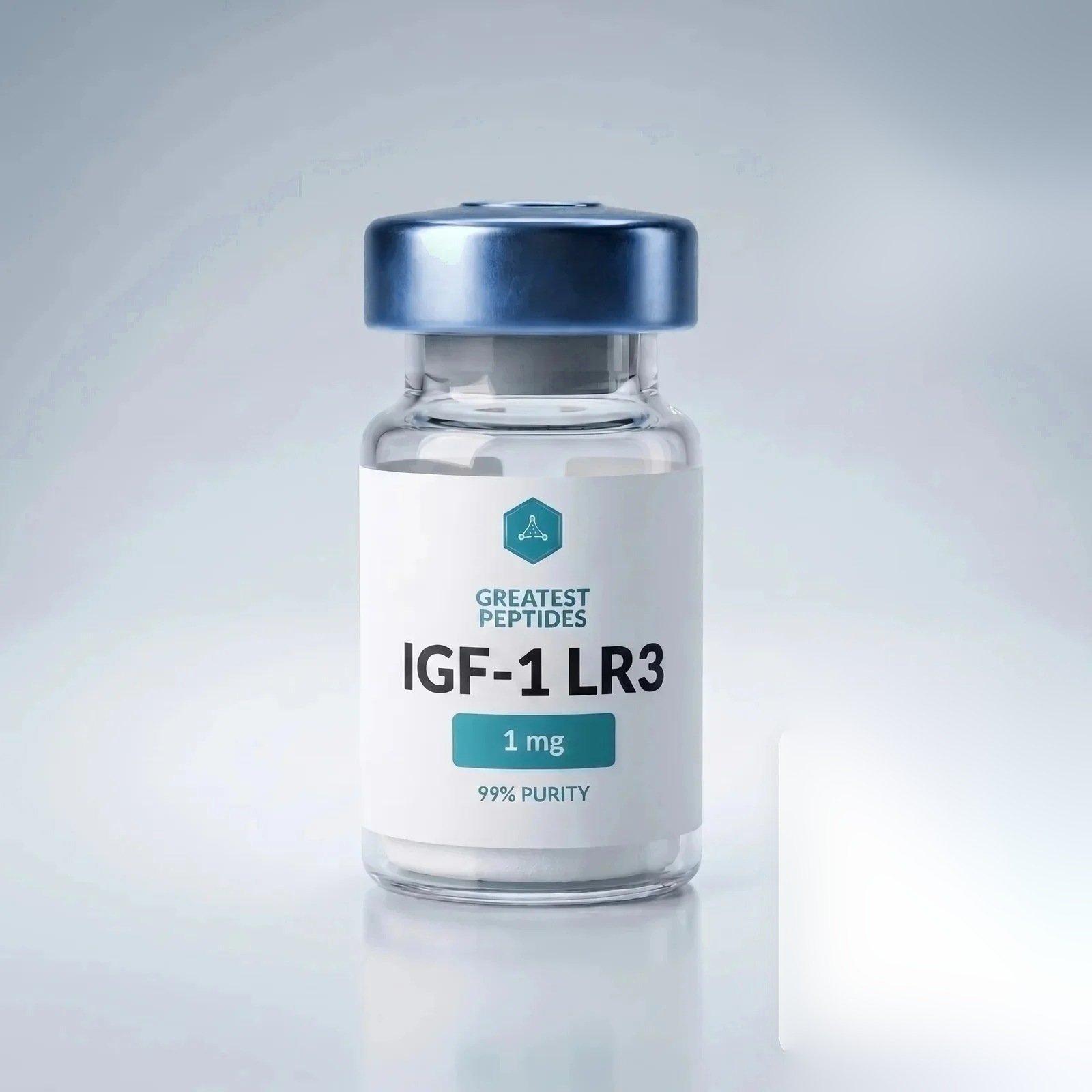
IGF-1 LR3 1 mg is supplied at 99%+ purity for in-vitro laboratory research only. Not for human or veterinary use.
Reconstituting this vial? Our free peptide reconstitution calculator converts vial mass and diluent volume into concentration, draw volume and U-100 syringe graduations. Research use only.
ALL ARTICLES AND PRODUCT INFORMATION PROVIDED ON THIS WEBSITE ARE FOR INFORMATIONAL AND EDUCATIONAL PURPOSES ONLY. The products offered on this website are intended solely for research and laboratory use. These products are not intended for human or animal consumption. They are not medicines or drugs and have not been evaluated or approved by the FDA to diagnose, treat, cure, or prevent any disease or medical condition. Any form of bodily introduction is strictly prohibited by law.
IGF-1 LR3 (Long R3 Insulin-like Growth Factor-1) is an extended-half-life analog of IGF-1, widely studied in cell-growth, proliferation, differentiation, and metabolic-signaling research models. Supplied as a lyophilized powder for controlled laboratory research only.
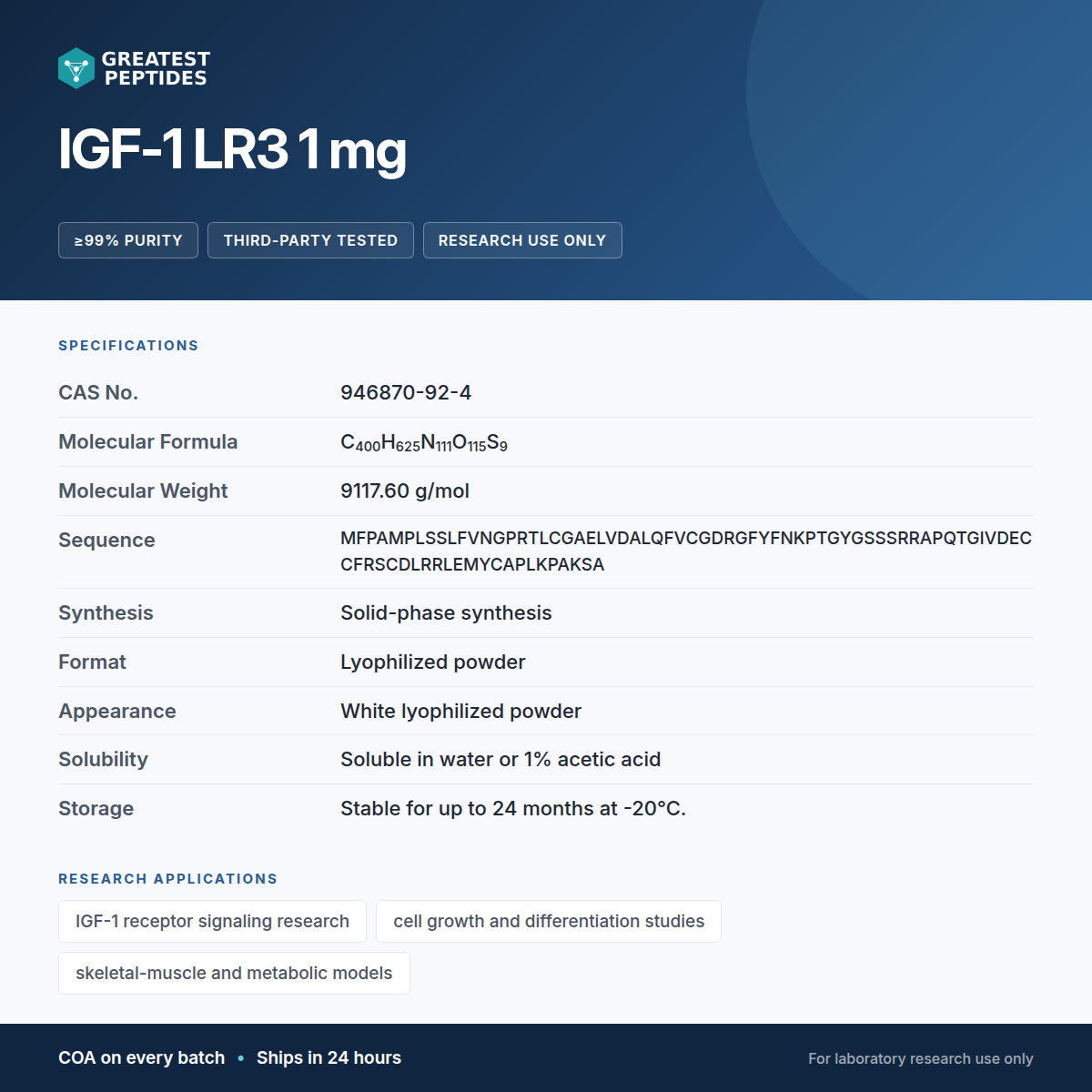
Specifications
Compound: IGF-1 LR3 (Long R3 IGF-1 analog)
Quantity: 1 mg per vial, lyophilized powder
Purity: 99%+ HPLC standard — batch-specific Certificate of Analysis included for your exact lot
Identity: confirmed by LC-MS
Appearance: white lyophilized powder
Documentation: Every vial ships with access to a batch-specific Certificate of Analysis showing HPLC purity, mass-spectrometry identity confirmation, endotoxin, residual solvents, and water content for your exact lot.
Handling & storage: Store lyophilized powder at -20°C. Reconstitute with bacteriostatic water for research handling. Keep out of direct light.
For laboratory and research use only. Not for human or animal consumption.
Stable for up to 24 months at -20°C. After reconstitution, may be stored at 4°C for up to 4 weeks or at -20°C for up to 6 months.
Applications
IGF-1 receptor signaling research, cell growth and differentiation studies, skeletal-muscle and metabolic models
Appearance
White lyophilized powder
Shipping Conditions
Shipped at ambient temperature; once received, store at -20°C
Regulatory/Compliance
Manufactured in a facility that adheres to cGMP guidelines
Safety Information
Refer to provided MSDS
Researcher FAQ
How do I reconstitute this peptide?
Use bacteriostatic water (BAC) at a 1–2 mL volume per vial. Add the solvent slowly down the vial wall, swirl gently — never shake. Refrigerate after reconstitution and use within 30 days. For in-vitro laboratory handling only.
How should I store this product?
Lyophilized: 36–46°F (refrigerated) for up to 24 months. Reconstituted: keep refrigerated and protect from light; use within 30 days. Avoid repeated freeze-thaw cycles.
Shipping & tracking?
Orders placed before 3 PM EST ship the same business day from our USA facility. Tracking is emailed within 24 hours. Plain, discreet packaging. Free shipping on orders over $150.
Buy IGF-1 LR3 for Research | RUO COA & Documentation Guide
For laboratory teams evaluating where to buy IGF-1 LR3 for research, the priority is documentation, compound identity, and research-use-only (RUO) alignment. IGF-1 LR3 (Long Arg3 insulin-like growth factor-1) is an 83‑amino‑acid single-chain analog of human IGF-1 with an arginine substitution at position 3 and a 13-residue N-terminal extension, catalogued by PubChem with the molecular formula C400H625N111O115S9 and a molecular weight of approximately 9,117.6 g/mol (PubChem CID 381123731)[1] (CAS 946870-92-4).
Fast Answer
Researchers evaluating where to buy IGF-1 LR3 for research should review RUO labeling, a batch-specific certificate of analysis (COA), HPLC purity data, LC-MS or comparable identity support, sequence/mass consistency, and lot traceability before procurement. Material discussed here is intended for laboratory research use only and is not for human or veterinary use.
What Does “Buy IGF-1 LR3 for Research” Mean?
The phrase is addressed as laboratory research-procurement intent — how qualified researchers, institutions, and technical buyers evaluate an IGF-1 LR3 reference material through documentation, analytical support, and labeling clarity, not personal, clinical, or consumer decision-making.
Compound Identity & Classification
Compound name
IGF-1 LR3 (Long Arg3 IGF-1)
PubChem CID
381123731[1]
CAS number
946870-92-4
Molecular formula
C400H625N111O115S9[1]
Molecular weight
≈ 9,117.6 g/mol[1]
Format
83-amino-acid single-chain polypeptide (Arg at position 3; 13-residue N-terminal extension)
Classification
IGF-1 analog[2]
Product form
Lyophilized powder
Purity target
≥ 99% (see batch-specific COA)
Regulatory status
Research use only — not for human or veterinary use
Published literature discusses IGF-1 and its analogs within IGF-1 receptor and growth-factor research; the LR3 modifications are reported to reduce affinity for IGF-binding proteins while retaining IGF-1 receptor activity in cell and preclinical models[2][3]. On a research product page this pathway context should remain academic literature interpretation used to define the research lane — it is not converted into product-performance language.
COA, Purity & Identity Documentation
An IGF-1 LR3 COA should be reviewed as a batch-specific record, not a marketing statement. Look for compound name, lot number, test date, stated purity, analytical method, identity confirmation, and sequence/mass information. Because this is a larger single-chain polypeptide, disulfide/folding and mass confirmation matter.
Evaluation area
What to review
Why it matters
RUO labeling
Clear research-use-only language
Separates research procurement from human-use positioning
COA availability
Batch-specific certificate for the received lot
Supports lot-level documentation
Purity data
HPLC area-percent support for stated purity
Helps evaluate material consistency
Identity testing
LC-MS / mass-spec confirmation vs expected mass
Confirms the material matches the listed analog
Lot traceability
Lot number matching across records
Supports research recordkeeping
HPLC, LC-MS & Analytical Review
HPLC documentation supports purity assessment; LC-MS or mass-spectrometry documentation supports identity confirmation and molecular-mass review[10][11]. For an 83-residue single-chain polypeptide, mass and folding confirmation are useful alongside HPLC purity data. ICH Q2(R2) describes validation characteristics used to interpret assay, purity, and identity results[7].
Lot Traceability & Batch Documentation
Lot traceability connects the product listing, COA, label, and receiving record. ISO/IEC 17025 addresses the competence of testing laboratories, and NIST resources describe how certificates and lot identifiers support traceability[8][9].
Claim Boundary for RUO Positioning
Research-safe statement
Non-compliant version to avoid
“IGF-1 LR3 is discussed in published literature on IGF-1 receptor and growth-factor research.”
“IGF-1 LR3 builds muscle or promotes growth.”
“Researchers should review COA and identity data before procurement.”
“Buy IGF-1 LR3 for gains.”
“Greatest Peptides supplies IGF-1 LR3 as a research-use-only material.”
“Greatest Peptides supplies IGF-1 LR3 for treatment.”
Research Procurement Checklist
Confirm the material is labeled for research use only.
Review the batch-specific certificate of analysis for the received lot.
Confirm purity is supported by HPLC analytical data.
Confirm identity is supported by LC-MS or mass spectrometry.
Compare compound name, formula, and mass across the page, label, and COA.
Verify the lot number matches across all documentation.
Document storage and handling conditions in the laboratory record.
How Greatest Peptides Presents IGF-1 LR3
Greatest Peptides supplies IGF-1 LR3 as a research-use-only laboratory material in lyophilized powder form, positioned around a stated ≥99% purity target, batch-specific COA availability, HPLC/LC-MS documentation, lot-level traceability, and transparent RUO labeling. Products are not intended for human or animal consumption, diagnostic, therapeutic, clinical, or veterinary use.
Published Literature Context
Published IGF-1 literature spans growth-factor characterization and preclinical IGF-1 receptor research models[2][3]. Model-specific findings should not be generalized or interpreted as use guidance for research-use-only materials.
Contributing Researchers
Recognized for published work that shaped the scientific context discussed above
René E. Humbel, PhD — co-determined the primary structure of human insulin-like growth factor 1 (IGF-1), the basis for analogs such as IGF-1 LR3[2].
What should researchers check before buying IGF-1 LR3 for research?
Review RUO labeling, the batch-specific COA, stated purity with HPLC support, LC-MS identity data, sequence/mass consistency, and lot traceability.
What is IGF-1 LR3 in research documentation?
An 83-amino-acid single-chain IGF-1 analog (Arg at position 3; 13-residue N-terminal extension) with molecular formula C400H625N111O115S9 and a molecular weight near 9,117.6 g/mol.
Why does a COA matter when buying IGF-1 LR3?
It connects the listing to batch-specific documentation: compound name, lot number, test date, purity, and identity method for the received lot.
Is IGF-1 LR3 intended for human or animal use?
No. Material discussed here is intended strictly for laboratory research use only.
How should published literature be interpreted?
As scientific context only. Model-specific findings should not be generalized or read as use guidance for research-use-only materials.
This page addresses IGF-1 LR3 only as research-use-only laboratory procurement. Boundary-sensitive terms such as muscle, growth, and IGF are referenced here only as research-language examples that must stay separate from RUO product positioning. All product information is for informational and educational purposes only. Products are not intended for human or animal consumption and have not been evaluated by the FDA to diagnose, treat, cure, or prevent any disease.
References
National Center for Biotechnology Information. IGF-1 LR3, CID 381123731. PubChem Compound record. Accessed 2026.
Rinderknecht E, Humbel RE. The amino acid sequence of human insulin-like growth factor I. Journal of Biological Chemistry. 1978. PMID 621920.
Francis GL, et al. Engineered IGF-1 analogs with reduced IGF-binding-protein affinity (research). Biochemical Journal. 1992.
Registry record for IGF-1 LR3, CAS 946870-92-4. Accessed 2026.
IUPAC-IUB Joint Commission. Nomenclature and symbolism for amino acids and peptides. 1983.
U.S. FDA. Analytical procedures and methods validation for drugs and biologics. 2015.
U.S. FDA. Q2(R2) Validation of Analytical Procedures. 2024.
International Organization for Standardization. ISO/IEC 17025:2017. 2017.
National Institute of Standards and Technology. Reference materials and certificates of analysis. Accessed 2026.
Mant CT, et al. HPLC analysis and purification of peptides. Methods in Molecular Biology. 2007.
Steen H, Mann M. Peptide sequencing. Nature Reviews Molecular Cell Biology. 2004. PMID 15340378.
Compound profile
IGF-1 LR3: compound profile, literature landscape and handling notes
IGF-1 LR3 in one paragraph
IGF-1 LR3 is the odd listing in this catalog, and the reason is worth stating before anything else: it is not a peptide in the sense that the rest of these products are peptides. It is an 83-residue recombinant protein, made by expressing an engineered gene in Escherichia coli and purifying the product, not by solid-phase chemical synthesis. That single fact changes what impurities are possible, what an analytical certificate can and cannot tell you, how the material behaves in dilute solution, and how much of a nominal purity figure you should be willing to trust. The molecule itself is a modified form of insulin-like growth factor 1 carrying two deliberate changes that reduce its capture by the IGF binding proteins, which is why it is used as a cell-culture supplement. Everything below describes the published research record and the behavior of the material on a bench. Nothing here is a claim about what this vial does, and nothing here is applicable to use in humans or animals.
Where IGF-1 LR3 came from
Insulin-like growth factor 1 was characterized long before it was called that. It entered the literature as somatomedin C, one of the serum factors that appeared to mediate the growth-promoting activity of pituitary growth hormone rather than being that activity itself, and it was later recognized as a member of the insulin superfamily on structural grounds. Once the sequence was known and recombinant expression became routine, native-sequence human IGF-1 became available as a laboratory reagent and, separately, as a licensed protein under the name mecasermin.
The engineered variants came out of a specific and very practical problem in cell culture. In serum, and in any culture medium containing serum, the great majority of IGF-1 is not free. It is bound to a family of six high-affinity IGF binding proteins, IGFBP-1 through IGFBP-6, which sequester it, buffer its free concentration, and in some contexts present it to the receptor and in others withhold it. A researcher adding native IGF-1 to a serum-containing medium is therefore adding something whose free fraction is set by the binding-protein content of that particular batch of serum rather than by the amount weighed out. That is an unpleasant property in an experiment and an intolerable one in a manufacturing process.
The response was to engineer variants that the binding proteins recognize poorly. Two independent approaches emerged, both exploiting the same region of the molecule. One removed the first three N-terminal residues, giving the truncated form generally written as DES(1-3) IGF-1. The other, which is the material in this listing, combined a 13-residue N-terminal extension with a single substitution at position 3, giving Long R3 IGF-1. The extension also happens to make the construct convenient to express in a bacterial host, which is part of why this particular variant became the standard reagent for serum-free and low-serum media development rather than remaining a curiosity.
For a research buyer the useful piece of that history is that this molecule was designed as a process and cell-culture reagent first. Its literature reflects that, and it is a poor stand-in for native IGF-1 whenever binding-protein biology is part of what you are studying.
Reading the structure of IGF-1 LR3
The full sequence, formula and mass for this listing are printed in the specification table further down this page rather than restated here. What matters is reading the architecture behind those values, because it is genuinely different from every other entry in this catalog.
Start with the scaffold. Native human IGF-1 is a 70-residue single-chain protein with an insulin-like fold: A and B domains homologous to the insulin A and B chains, joined by a C domain that is retained rather than excised as insulin's C-peptide is, plus a short D extension. It is stabilized by three intramolecular disulfide bonds. That is a folded globular protein with a defined tertiary structure, not a flexible short chain that happens to adopt a helix at a receptor interface. Anything you know about how a 30-residue synthetic peptide behaves has to be re-derived here.
Onto that scaffold the LR3 construct adds two changes. The first is the 13-residue N-terminal extension that gives the molecule the Long in its name. The second is a single substitution at position 3 of the native numbering, where the glutamate of the native sequence is replaced by an arginine, which is the R3. Both modifications exist for the same reason, and this is the point most secondary descriptions get wrong by treating them as two unrelated features. The N-terminal region of IGF-1, and the glutamate at position 3 in particular, is a principal contact for the IGF binding proteins. Swapping an acidic residue for a basic one at that position disrupts the interaction. Hanging an unrelated 13-residue tail off the N-terminus disrupts it further, sterically as well as electrostatically. The net effect reported in the literature is a substantial reduction in affinity for the binding proteins while affinity for the receptor itself is much less affected.
The consequence that actually shows up on a bench is this: in a serum-containing medium, the free fraction of added IGF-1 LR3 is much higher than the free fraction of an equal mass of native IGF-1, and it is far less buffered, because the binding-protein reservoir that would normally absorb an excess and release it slowly is largely not engaging with this molecule. That is the whole reason the variant exists, and it is also the reason results obtained with it do not map cleanly onto native IGF-1 biology. The extension is not inert decoration and the substitution is not a stability tweak.
The target and the pathway in more detail
IGF-1 LR3 acts at the type 1 insulin-like growth factor receptor, IGF-1R, and that receptor belongs to a different structural and mechanistic class from the class B G-protein-coupled receptors that dominate the rest of this catalog. IGF-1R is a receptor tyrosine kinase. It is synthesized as a proreceptor that is cleaved into alpha and beta chains and assembled into a covalent heterotetramer, two alpha subunits and two beta subunits held together by disulfide bonds, which sits in the membrane as a preformed dimer even in the absence of ligand. There is no G protein, no cyclic AMP second messenger as the primary readout, and no ligand-induced dimerization step. Ligand binding to the extracellular alpha subunits instead drives a conformational rearrangement that brings the intracellular kinase domains into a productive geometry.
What follows is trans-autophosphorylation of tyrosines in the activation loop of the beta subunits, which raises kinase activity, followed by phosphorylation of additional tyrosines that create docking sites. Two principal branches propagate from there. Insulin receptor substrate proteins, chiefly IRS-1, are recruited and phosphorylated, providing binding sites for the regulatory subunit of phosphoinositide 3-kinase and leading through PIP3 and PDK1 to Akt, and onward to mTOR complex 1, GSK-3 and the FoxO transcription factors. The other branch runs through Shc and Grb2 to SOS, Ras, Raf, MEK and the ERK mitogen-activated protein kinases. In broad terms the published literature associates the first branch more with metabolic and survival readouts and the second more with proliferative ones, but the separation is a tendency rather than a rule and depends heavily on cell background.
The complication that matters most for interpreting any IGF-1R experiment is cross-reactivity. IGF-1R, the insulin receptor and the receptor for IGF-2 sit in an overlapping ligand space, and because both receptors are assembled from half-receptors in the same compartment, cells expressing both will also display IR/IGF-1R hybrid receptors composed of one alpha-beta half of each. Hybrids are not a laboratory artifact; they are present in tissue and their proportion tracks the relative expression of the two parent receptors. A readout obtained after adding an IGF-1 analog to a cell that expresses both receptors is therefore not automatically an IGF-1R readout. Establishing that it is requires a selective kinase inhibitor, a blocking antibody, a receptor-null or knockdown background, or at minimum a parallel insulin comparison, and a large amount of published and unpublished work on this compound does not include any of those.
What the published literature on IGF-1 LR3 actually measures
The published record that genuinely concerns IGF-1 LR3, as opposed to IGF-1 in general, falls into a few distinct bodies of work, and they are not equally useful.
The largest and most reliable body is cell culture and bioprocess literature. Long R3 IGF-1 has been studied and used for many years as a growth-supporting supplement in serum-free and reduced-serum media, including in industrial mammalian expression systems, where the practical questions are how much of it survives in medium over a culture cycle, whether it can substitute for insulin at far lower molar input, and how it interacts with the binding proteins that cells themselves secrete into conditioned medium. This is unglamorous work and it is where the compound's actual reported behavior is best documented.
The second body is receptor and signaling pharmacology, most of it done with native IGF-1 rather than with the LR3 variant. Autophosphorylation assays, IRS-1 phosphorylation, Akt and ERK phosphorylation time courses, and proliferation and survival assays in defined cell lines make up most of it. Where LR3 appears in this literature it is usually as a convenient binding-protein-resistant tool for showing that an effect attributed to IGF-1 is not simply an effect on binding-protein availability, which is a legitimate and rather elegant use of it.
The third body is in vivo rodent work, largely on muscle, bone, gut and neural tissue, some of it using the LR3 variant specifically because its altered clearance and reduced binding-protein capture change tissue exposure relative to native protein. This literature is real, but it is smaller than the volume of confident statements about this compound would lead you to expect, and its endpoints are tissue weights, histology and phosphorylation states rather than anything that transfers to another species.
A fourth category deserves naming precisely because it is so often mistaken for the third. A great deal of what circulates about this compound originates in bodybuilding forums, vendor copy and secondary articles that cite each other rather than any primary source. It is not peer-reviewed, it is not laboratory data, and it should not appear in a methods section or a literature review. When a claim about IGF-1 LR3 cannot be traced to a primary paper in two steps, the usual explanation is that there is no primary paper.
Where the IGF-1 LR3 literature is thin or frequently misread
The most common misreading of this compound is the simplest one: treating IGF-1 LR3 results as IGF-1 results. The variant was built specifically to escape the regulatory layer that governs native IGF-1 availability. Using it and then describing the outcome as what IGF-1 does inverts the logic of the experiment. If binding-protein biology is part of the system under study, LR3 is the wrong reagent; if it is a confound you are deliberately removing, LR3 is the right reagent and the paper needs to say so.
The second gap is the provenance problem described above. A large fraction of the circulated material on this compound is not from the peer-reviewed record at all, and quantitative claims in that material, particularly relative-potency claims against native IGF-1 or against insulin, tend to be repeated without a source. Where the genuine literature exists it is overwhelmingly cell culture and rodent, and the rodent work in particular is routinely over-extrapolated in secondary writing.
The third is receptor attribution, which is worth restating because it is specific to this receptor family. Without an insulin comparison, a selective inhibitor or a null background, an effect measured after adding this protein cannot be assigned cleanly to IGF-1R as opposed to the insulin receptor or to hybrid receptors. Reports that make the assignment without those controls are common.
The fourth is a handling point rather than a data point, and it belongs in the laboratory-practice column. IGF-1 signaling has a long and well-documented association with proliferation and with survival signaling in transformed cells, which is one of the more thoroughly established observations in the whole field. In a research setting that argues for an unusually clear containment, labeling and disposal record for this material: dedicated labware, decontamination of anything that contacted a working solution, and disposal through the same route as other biologically active protein reagents rather than down a sink. That is a statement about how a laboratory should manage a reagent, not health advice, and the relevant authority is your own institutional biosafety and waste procedure.
How IGF-1 LR3 behaves in solution
A recombinant protein is a considerably more fragile object in solution than a short synthetic peptide, and most of the handling problems reported with this material follow from that rather than from anything specific to the sequence.
Surface adsorption is the dominant loss mechanism, and it is worst under exactly the conditions typical of culture work: very dilute solutions, in the nanogram-per-milliliter range at the point of use, handled in tubes and plates with a large surface-to-volume ratio. A protein at that concentration can lose a large and unpredictable fraction of its content to a polypropylene wall or a pipette tip before it reaches the well. This is the main reason carrier protein, commonly bovine or human serum albumin at a low percentage, is added to working dilutions: it saturates the adsorptive sites so the analyte stays in solution. Carrier protein is a matrix change and has to be recorded, and it is incompatible with some downstream analytical work, so the decision belongs in the protocol rather than in a footnote.
Solubility is pH-dependent in the way any folded protein's is. IGF-1 and its variants are conventionally brought into solution in dilute acid, and acidic diluents are common for exactly that reason. Acid keeps the protein away from the pH at which its net charge is lowest and aggregation is most favorable, but it also means the concentrated stock is not at physiological pH and that transferring it into a buffered medium involves a pH transition where local precipitation can occur if it is done abruptly into a small volume.
Aggregation, once it starts, is not reversible in the way peptide association often is. A misfolded or partially unfolded protein exposes hydrophobic surface, and that surface nucleates further aggregation. Freeze-thaw cycling drives this hard, because the ice interface is where proteins unfold. Solutions that have gone this way may show visible haze or fine particulate, but they very often look perfectly clear while having lost most of their activity, which is why appearance is a poor release criterion here.
The 1 mg presentation is not an accident. Culture work consumes this material in extremely small amounts, protein solutions do not keep the way lyophilized material does, and a larger vial would mostly guarantee that most of it degraded before it was used.
Analytical notes specific to IGF-1 LR3
The analytical questions for a recombinant protein are not the same questions as for a synthetic peptide, and a certificate designed for the latter can look complete while leaving the ones that matter unanswered.
Begin with the impurity profile, which is set by the production route. Solid-phase synthesis produces deletion sequences, incomplete deprotection products and residual scavengers. Bacterial expression produces none of those and instead produces host-cell protein, host-cell DNA, endotoxin from the Gram- negative cell wall, species with incorrect or scrambled disulfide pairing, N-terminal heterogeneity from incomplete or over-enthusiastic processing of the initiator methionine and the leader region, methionine oxidation, deamidation, clipped forms generated by host proteases, and covalent or non-covalent aggregate. Endotoxin in particular has no analog in synthetic peptide work and matters for anything that will touch a cell, because it has its own potent biological activity and will generate signal that gets attributed to the protein.
The central point, and the one that most repays attention, concerns folding. This protein carries three intramolecular disulfide bonds. There are several ways those six cysteines can pair, only one of which is correct, and the incorrectly paired species have exactly the same molecular formula and exactly the same mass as the correct one. A mass-spectrometric identity result therefore cannot distinguish them. Neither, in general, can reversed-phase HPLC purity: disulfide isomers can co-elute, and even when they separate, an area-percent figure at a single wavelength tells you the peaks are different, not which peak is the folded protein. It is entirely possible to hold material that is mass-correct, chromatographically clean and biologically inert.
What answers the folding question is orthogonal. Non-reducing versus reducing SDS-PAGE run side by side is the classic and inexpensive approach: correctly folded, intramolecularly bonded protein is more compact and migrates differently under non-reducing conditions, disulfide-linked dimers and higher aggregates appear as bands that collapse to monomer on reduction, and comparing the two lanes tells you something no single-condition method does. Size-exclusion chromatography addresses aggregate state. Peptide mapping with and without reduction can assign the pairings directly. And a cell-based bioassay, receptor autophosphorylation or a proliferation readout in a responsive line, is the only method that answers the question you actually care about, which is whether the molecule works. For a recombinant protein, a functional assay is not an optional extra on top of the chemistry; it is the part of the package the chemistry cannot supply.
Compounds researchers confuse with IGF-1 LR3
Often mistaken for
How it actually differs from IGF-1 LR3
Native IGF-1 (mecasermin)
The unmodified 70-residue human sequence. It lacks both the N-terminal extension and the position-3 substitution, so it is bound avidly by IGFBP-1 through IGFBP-6 and its free fraction in any serum-containing system is set by the binding-protein content of that system. It is the correct reagent when binding-protein biology is part of the question and the correct comparator when it is not.
IGF-1 DES(1-3)
A truncated variant missing the first three N-terminal residues, including the same glutamate that the R3 substitution replaces. It reaches reduced binding-protein affinity by deletion rather than by substitution plus extension, and it is a shorter chain rather than a longer one. Similar design intent, different molecule, different clearance behavior, and data from one does not substitute for the other.
A synthetic 29-residue fragment of growth hormone releasing hormone acting at the GHRH receptor, a class B GPCR on pituitary somatotrophs. It sits far upstream of IGF-1 in the somatotropic axis and works through a completely different receptor class and second-messenger system. Grouping it with IGF-1 LR3 as a similar compound confuses a pathway relationship with a structural one.
A two-component synthetic peptide blend combining a GHRH analog with a growth-hormone-secretagogue receptor agonist. Both components are short chemically synthesized peptides acting on GPCRs upstream in the same axis. IGF-1 LR3 is a recombinant folded protein acting directly on a receptor tyrosine kinase downstream of that axis. Nothing about their chemistry, analysis or handling is comparable.
Insulin
The structural relative that makes IGF-1R experiments hard to interpret. Insulin is a two-chain protein derived from the same ancestral fold and it signals through the insulin receptor, which shares architecture, substrate proteins and downstream branches with IGF-1R and forms hybrid receptors with it. Because the ligand and receptor spaces overlap, insulin is often the single most informative control in an IGF-1R experiment.
Questions specific to IGF-1 LR3
Is IGF-1 LR3 a peptide or a protein?
A protein, and the distinction is not pedantic here. At 83 residues with three intramolecular disulfide bonds and a defined globular fold, it is produced by recombinant expression in Escherichia coli and purification, not by solid-phase chemical synthesis like the short peptides that make up most of this catalog. That changes the impurity classes that are possible, which include host-cell protein and endotoxin rather than deletion sequences; it changes what analysis is required, because folding has to be demonstrated separately from mass; and it changes handling, because folded proteins adsorb, aggregate and denature under conditions a 10-residue peptide tolerates without complaint. Describing it as a peptide in your records will lead whoever reads them to the wrong expectations on all three counts.
Why does the position-3 substitution reduce binding-protein affinity?
Because that residue is part of the principal contact surface the IGF binding proteins use. The N-terminal region of IGF-1 contributes substantially to binding-protein recognition, and the glutamate at position 3 sits in the middle of it. Replacing an acidic side chain with the basic guanidino group of arginine reverses the local charge and disrupts the interaction. The same logic explains the DES(1-3) variant, which achieves a comparable outcome by deleting the first three residues entirely. Importantly, this region contributes much less to receptor binding than to binding-protein binding, which is what makes the modification useful: it separates the two interactions rather than weakening both.
What does the 13-residue N-terminal extension add that the substitution does not?
Two things. Mechanistically it adds steric and electrostatic bulk at the same end of the molecule the binding proteins engage, deepening the reduction in affinity beyond what the single substitution achieves alone. Practically it provides a convenient N-terminal leader for bacterial expression, which is part of why this construct became the standard reagent rather than a laboratory curiosity. The extension is not a stability modification and it is not an analog of the acylation or amidation motifs used on synthetic peptides elsewhere in this catalog. It is a binding-protein evasion feature that happens to be expression-friendly, and it is one reason the molecule cannot be treated as a native sequence in any record.
How do I establish that an effect is IGF-1R-mediated and not through the insulin receptor?
By designing the controls in from the start, because no amount of downstream analysis rescues an experiment that lacks them. The receptors share the IRS-1, PI3K/Akt and Ras/MAPK branches, so a phosphorylation readout alone will not discriminate. The usual approaches are a selective IGF-1R kinase inhibitor or blocking antibody, a receptor-null or knockdown background with add-back, and a parallel insulin comparison at matched receptor occupancy. Remember also that cells expressing both receptors display IR/IGF-1R hybrids whose proportion tracks relative expression, so even a clean IGF-1R-dependent result may be partly hybrid-mediated. Reporting the receptor expression profile of the line you used is part of making the result interpretable.
Does a correct mass on an identity report mean the protein is correctly folded?
No, and this is the single most consequential analytical point for this compound. Three disulfide bonds means six cysteines, and the incorrectly paired isomers have the same molecular formula and the same mass as the correctly paired one. Mass spectrometry cannot separate them. Reversed-phase HPLC frequently cannot either, since isomers may co-elute and an area-percent figure identifies peaks rather than conformations. Non-reducing versus reducing SDS-PAGE run in parallel, size-exclusion chromatography for aggregate state, peptide mapping under both conditions for pairing assignment, or a cell-based functional assay are what actually answer it. Mass-correct, chromatographically clean and biologically inert is a real and not especially rare combination for recombinant protein.
Why is carrier protein so often recommended in working dilutions?
Because at the concentrations culture work uses, adsorption to container surfaces is a first-order loss mechanism rather than a rounding error. A dilute protein solution in an untreated tube or a plastic plate can leave a substantial and irreproducible fraction of its content on the walls and on pipette tips. Adding a carrier protein such as albumin at a low percentage occupies those adsorptive sites so the molecule of interest stays in solution. The trade-off is that the carrier is a large addition to the matrix: it changes the background in protein assays, interferes with some analytical methods, and introduces its own lot-to-lot variability. It should be recorded as a deliberate component of the preparation, not treated as inert.
Can published data generated with native IGF-1 be applied to this variant?
Only with an explicit argument for why it transfers. The two molecules engage the same receptor and the same downstream branches, so qualitative signaling conclusions often carry over. What does not carry over is anything involving availability: free fraction in a serum-containing medium, duration of exposure, sensitivity to the binding proteins that cultured cells secrete into their own conditioned medium, and clearance behavior in vivo. Those are precisely the properties the variant was engineered to change. A study that finds an effect with native IGF-1 in serum-containing medium and a study that finds the same effect with LR3 are not replicating each other, because the concentration of free ligand at the receptor was arrived at by different routes in each.
Documentation and handling reference
IGF-1 LR3: Documentation, Handling and Quality Record for This SKU
The section above covers what IGF-1 LR3 is and what the published literature has looked at. This section is the operational half: what physically arrives when you order this listing, what paperwork comes with it, which fields on that paperwork are worth reading closely, and how to log the material once it is on your bench. It is written for the person who has already decided the compound is relevant and now has to justify the purchase to a supervisor, a grant line or an internal quality process.
Everything below is scoped to this exact listing rather than to research peptides in general. If you want the general version — how to read a certificate of analysis from scratch, what HPLC and mass spectrometry each prove, how to compare two suppliers who both claim 99% — that is on the home page guide, and there is no reason to read it twice.
What ships when you order IGF-1 LR3
At a glance
One sealed vial of lyophilized material at the listed 1 mg fill, labeled for research use only, dispatched within 24 hours of the order clearing. Batch documentation is available for the lot you receive. Free shipping applies at $150 and above.
This listing is a single fixed presentation, not a size selector. That is deliberate: each presentation gets its own page, its own documentation trail and its own URL, so a citation or a purchase-order line that points at IGF-1 LR3 at 1 mg points at exactly one thing. If you need a different fill of the same compound and it is not listed, it is not currently in stock rather than hidden behind a dropdown.
Field
This listing
Listing
IGF-1 LR3 1 mg
Labeled fill mass
1 mg
Physical form
Lyophilized powder in a sealed vial
Catalog category
IGF & Insulin-Class Peptides
Compound class
Recombinant growth-factor analog
Intended use
Research use only. Not for human or veterinary use, not for diagnostic use, not a drug or supplement.
Dispatch
Within 24 hours of the order clearing
Documentation
Batch analytical documentation available for the lot supplied
Free shipping threshold
Orders of $150 and above
Specification summary for IGF-1 LR3
The table below is the specification the store publishes for this listing. It is reproduced here from the product record itself rather than retyped, which means it cannot drift away from what the attribute table further up the page says. Where a field is absent it is absent because we do not publish it for this SKU, not because it was left out of this summary.
Stable for up to 24 months at -20°C. After reconstitution, may be stored at 4°C for up to 4 weeks or at -20°C for up to 6 months.
Applications
IGF-1 receptor signaling research, cell growth and differentiation studies, skeletal-muscle and metabolic models
Appearance
White lyophilized powder
Shipping Conditions
Shipped at ambient temperature; once received, store at -20°C
Regulatory/Compliance
Manufactured in a facility that adheres to cGMP guidelines
Safety Information
Refer to provided MSDS
A specification table is a claim, and a claim is only worth the record behind it. Every field above is one you can ask us to substantiate against the batch documentation for the lot you were sent. If a field ever fails to match the paperwork, that is a defect on our side and we would rather hear about it than not.
Recombinant proteins are not synthesized the same way short peptides are, and the impurity profile reflects that: what you are looking for on the chromatogram is aggregate and clipped-variant content, not deletion sequences.
The analytical record behind this lot
A certificate of analysis is not a quality badge. It is a measurement report about one specific batch, produced on a specific date by a specific method, and its value to you is entirely a function of how much of that context it discloses. For IGF-1 LR3 the fields worth checking first are the ones that tie the document to the container in your hand.
Field on the certificate
Why it matters for this SKU
Lot or batch identifier
Ties the document to the vial. A certificate with no lot reference describes some batch, not necessarily yours.
Compound name and, where applicable, sequence
This is the identity claim. For a recombinant growth-factor analog it is the field that distinguishes the material from its close relatives.
Analytical method and conditions
A purity figure without a method is a number without units. Column, gradient and detection wavelength change what the figure means.
Date of analysis
Establishes how old the measurement is relative to the material. A recent vial with a two-year-old certificate is a documentation gap.
Who performed the analysis
In-house and independent third-party results are both legitimate; they are not the same claim, and the document should say which it is.
The chromatogram or spectrum itself
A summary table can be typed by anyone. A trace can be read, and a reader who knows the compound class can tell whether it is plausible.
What our documentation for IGF-1 LR3 does assert is what the analysis measured on the batch that was tested. What it does not assert — and no certificate from any supplier can assert — is that the material is safe, that it is suitable for any use in humans or animals, or that it will reproduce a result reported in a published paper. Those are different questions and a purity figure is not evidence for any of them.
Our batch documentation policy, including how to request the record for a lot you already have, is on the certificate of analysis page. If you need the record before ordering rather than after, ask us through the contact page and reference this listing by name.
How IGF-1 LR3 is checked before it reaches this catalog
Three questions have to be answered separately before a compound gets a page here, and collapsing them into one percentage is the most common way a supplier listing becomes misleading.
Question
What answers it
What it does not tell you
Identity — is this the right molecule?
Mass determination, and sequence confirmation where the material is a defined chain
Nothing about how much of the vial is that molecule
Purity — what proportion of the detected material is the target?
Chromatographic separation with a stated method
Nothing about what the other fraction actually is, unless the impurities are themselves identified
Content — how much target material is actually in the container?
Quantitative determination against the labeled fill
Nothing about identity or purity; a vial can be accurately filled with the wrong thing
For IGF-1 LR3, cell proliferation assays, receptor phosphorylation readouts and binding-protein competition work are the assay formats the published work in this area tends to use, which matters when you are deciding whether the material as supplied is fit for the experiment you have in mind. A compound that is clean enough for a binding assay is not automatically clean enough for a quantitative cell-based readout where a co-eluting impurity could carry activity of its own.
Content is the field most often missing from a supplier listing, and it is the one that changes your arithmetic. A vial labeled 1 mg contains that much total solid, and total solid includes counter-ion, residual water and whatever else survived the process. If you need the peptide mass rather than the vial mass to be exact, that is a specific request to make in advance, not an assumption to carry into a calculation.
Receiving, inspecting and storing IGF-1 LR3
The most useful five minutes you will spend on this material are the five minutes immediately after the package is opened, because that is the only moment at which you can still distinguish a transit problem from a handling problem of your own.
Confirm the label on the container matches this listing, including the fill mass, and record the lot identifier in your notebook before anything else happens.
Inspect the closure and seal. A compromised closure is a reason to stop, not a reason to proceed carefully.
Look at the cake. Note its appearance and position; a cake that has collapsed, shifted or gone glassy is telling you something about the vial's history in transit.
Let a cold vial reach room temperature before opening it, so that atmospheric moisture condenses outside the vial rather than into the material.
Photograph the label and the container on arrival. It costs nothing and it settles later questions instantly.
Store it in the dark, at the temperature stated for this listing, and write down the date it entered storage.
Decide your aliquot plan before the first opening, not after it.
Proteins in this class are more sensitive to surface adsorption than short peptides. Container choice and fill volume both affect how much material stays in solution.
The general rule for lyophilized material is that the dry state is the stable state and every transition away from it costs you something. Freeze-thaw cycling is the specific mechanism most likely to degrade IGF-1 LR3 after it reaches you, and it is entirely under your control: a single reconstitution split into pre-planned aliquots exposes the material once, while repeatedly warming and refreezing one container exposes it as many times as you open it. There is a fuller treatment of the mechanism in our guide on freeze-thaw cycles in peptide research materials and on storage and handling.
Preparing aliquots from a 1 mg vial: the measurement arithmetic
This is arithmetic, not guidance. The only thing the table below does is tell you what concentration you are holding after you have added a known volume of diluent to a vial labeled 1 mg, so that the figure in your notebook and the figure in the container are the same figure. It says nothing about how much material any experiment should use, and it is not applicable to any use in humans or animals.
Diluent added
Resulting concentration
Amount in 0.1 mL
Amount in 0.05 mL
Aliquots of 0.25 mL
1 mL
1 mg/mL
100 µg
50 µg
4
2 mL
0.5 mg/mL
50 µg
25 µg
8
3 mL
0.33 mg/mL
33.3 µg
16.7 µg
12
5 mL
0.2 mg/mL
20 µg
10 µg
20
Every figure above is the same division: the labeled mass of IGF-1 LR3 divided by the volume of diluent added. Nothing in the table is a recommendation about how much material to use in an experiment — it is the arithmetic that tells you what concentration you are holding once you have added a known volume, so that the number you write in the notebook matches what is in the container.
Two things routinely go wrong at this step. The first is treating the labeled mass as the peptide mass; as noted above, the labeled figure is total solid unless the documentation says otherwise, so a concentration derived from it is a nominal concentration. Say so in your methods rather than implying a precision the specification does not support. The second is ignoring the volume the solid itself occupies — small at these masses, but not zero, and it means the final volume is very slightly greater than the volume you added.
If you want to work backwards from a target concentration to a diluent volume, or to check a figure against a different vial size, our peptide reconstitution calculator does the same division in both directions and shows its working.
What to record for IGF-1 LR3 so the work is reproducible
Reproducibility in this area fails at the material-provenance step far more often than at the analysis step. The fields below are the ones that let somebody else — a reviewer, a collaborator, or you in eighteen months — work out whether two sets of results were generated with comparable material.
Supplier and the exact listing name, including the fill size, rather than just the compound name
Lot identifier, and the date the batch documentation was issued
Date received, and the storage conditions and location it went into
Date of reconstitution, the diluent used and its lot, and the volume actually added
Nominal concentration obtained, stated as nominal rather than as measured
Aliquot scheme: how many, what volume, stored where
Freeze-thaw count for each aliquot at the point of use
Any deviation from plan, including deviations that seemed unimportant at the time
Whether the material was research-use-only labeled, which for this listing it is
Comparing suppliers on this exact SKU
Comparing IGF-1 LR3 across suppliers on price alone is comparing two numbers that may not describe the same thing. These are the questions that make the comparison meaningful, with our answers next to them so you can hold us to the same standard you would hold anyone else.
Question to ask any supplier
Our answer for this listing
Is batch documentation available for the specific lot I will receive, not a representative lot?
Is there a published position on what the documentation does not prove?
Yes. It is stated on this page and on every product page.
A supplier who answers all seven honestly is a better bet than a supplier who is ten percent cheaper and answers four. A supplier who cannot answer the first one at all is not selling you documented material; they are selling you a container.
Compliance boundary for IGF-1 LR3
IGF-1 LR3 is supplied for laboratory research use only. It is not a drug, not a supplement, not a cosmetic and not a medical device. It is not for human or veterinary administration, not for diagnostic use, and not for use in food. That is not a disclaimer bolted onto a sales page — it is the actual scope of what is being sold, and it constrains what can honestly be written about it.
Language that stays inside the boundary
Language that does not
"Supplied for research use only"
Any phrasing that implies a personal or clinical use
"Published work in this area has examined receptor affinity, binding-protein interaction and proliferation endpoints in cell models"
"IGF-1 LR3 does X" stated as an established effect
"Purity determined by the stated method on the tested batch"
"Pharmaceutical grade", "medical grade", "safe"
"Concentration arithmetic for preparing laboratory aliquots"
Anything framed as a dose, a protocol or a schedule
"Not for human or veterinary use"
Silence on the point, which readers correctly interpret as evasion
Naming the model system a finding came from
Reporting an animal or in-vitro finding as though it were a human finding
The reason to be precise about this is not only regulatory. Research literature on this class of material is genuinely interesting and genuinely incomplete, and overstating it makes the real findings harder to see. Where published work is referenced on this site it is referenced as what was measured, in what system, at what scale — not as a property of the vial.
Questions about ordering IGF-1 LR3
Is IGF-1 LR3 documentation available before I order?
Yes. Ask through the contact page and reference this listing by name. Our general position on batch documentation is on the certificate of analysis page. If a supplier will not show you the record until after payment has cleared, that is worth noticing.
What does the 1 mg figure on the label actually refer to?
It is the labeled fill for this presentation. For lyophilized material the labeled mass is total solid unless the documentation states otherwise, and total solid includes counter-ion and residual moisture as well as target compound. If your calculation depends on the distinction, resolve it against the batch record rather than assuming.
How fast does IGF-1 LR3 ship?
Within 24 hours of the order clearing. Orders of $150 and above ship free. Transit time after dispatch depends on the service selected at checkout.
Can I buy IGF-1 LR3 for personal use?
No. This material is supplied for laboratory research use only. It is not a drug, supplement or cosmetic, it is not for human or veterinary administration, and nothing on this page should be read as guidance for any such use.
How should IGF-1 LR3 be stored before and after reconstitution?
Store the sealed vial dry, dark and at the temperature stated for this listing, and record the date it entered storage. Once material is in solution the useful discipline is to minimize repeated warming: plan the aliquot scheme before the first reconstitution so the material is exposed once rather than once per experiment. Proteins in this class are more sensitive to surface adsorption than short peptides. Container choice and fill volume both affect how much material stays in solution.
How much diluent should I add to a 1 mg vial?
That depends entirely on the concentration your protocol calls for, which is your decision and not something a product page can answer. What the table above provides is the arithmetic: labeled mass divided by added volume gives concentration. The reconstitution calculator runs the same division in either direction.
Does a high purity figure mean IGF-1 LR3 is safe?
No, and this is the single most common misreading of a certificate of analysis. Purity describes what proportion of the detected material was the target compound in the batch that was tested, by the method stated. It is not a safety assessment, it says nothing about suitability for any use in humans or animals, and it does not become a safety claim by being a large number.
What is IGF-1 LR3 classified as in your catalog?
It is listed as a recombinant analog rather than a synthetic short chain, in the IGF & Insulin-Class Peptides category. Published work in this area has looked at receptor affinity, binding-protein interaction and proliferation endpoints in cell models. That is a description of where the literature sits, not a claim about what the material does.
Do you have more general written material on evaluating research peptides?
Yes. The home page guide covers reading a certificate of analysis, what chromatographic and mass-spectrometric methods each prove, and how to compare suppliers. The research guides go deeper on individual topics, and the FAQ covers ordering, shipping and post-shipping questions.
IGF-1 LR3 1 mg is supplied strictly for laboratory research use. It is not a drug, supplement, cosmetic or medical device; it is not for human or veterinary use, not for diagnostic use and not for use in food. No statement on this page is intended to describe a therapeutic use, benefit or outcome, and references to published work describe what was measured in the reported model system rather than a property of the material supplied. Purchasers are responsible for handling the material in accordance with the requirements applicable to their institution and jurisdiction.
Check the documentation before you check the price