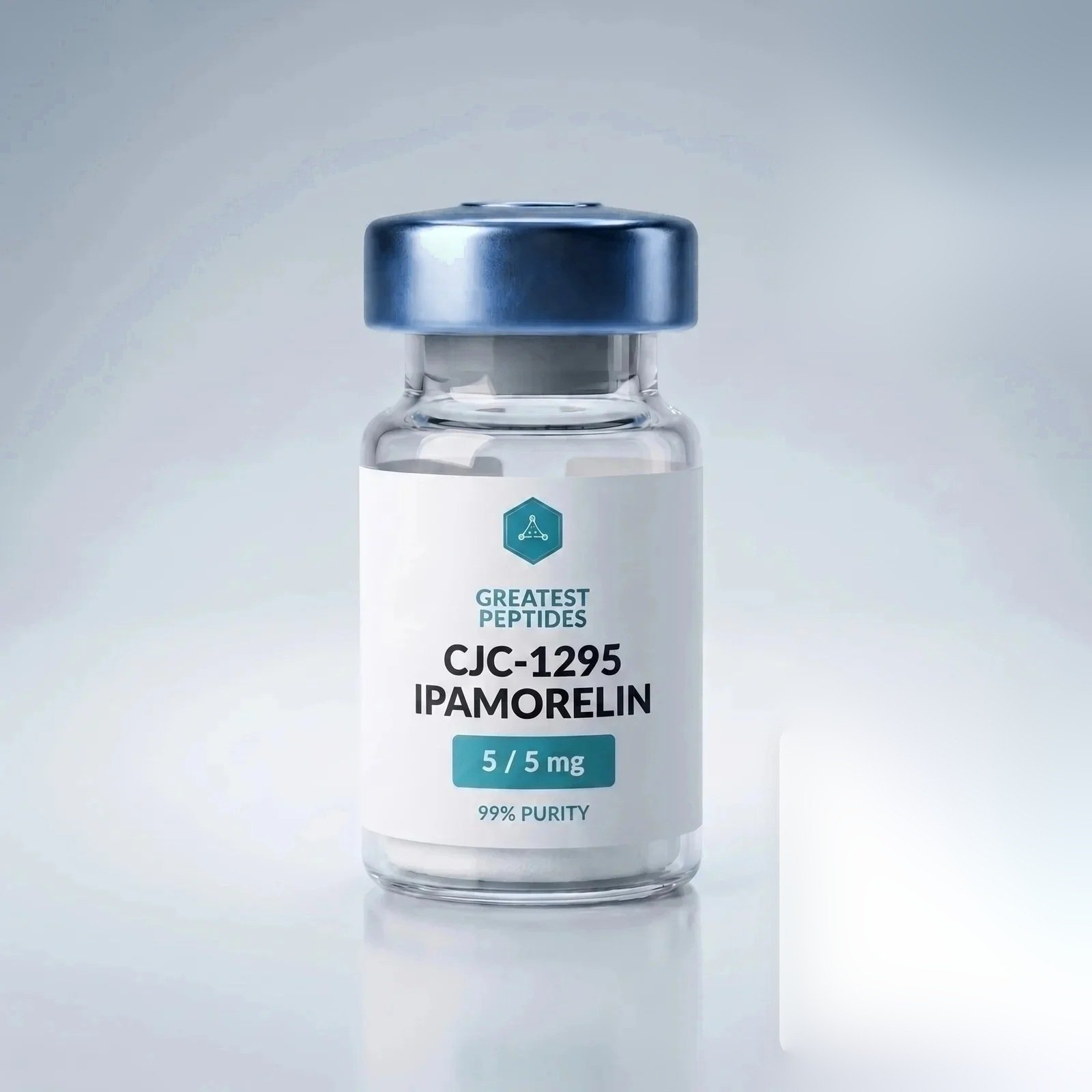
$72.99Original price was: $72.99.$64.99Current price is: $64.99.
In stockShips today if ordered by 3 PM ESTUSA fulfillment
Research Studies
✓Studied as a GHRH analog and ghrelin-receptor agonist combination in endocrine research.
✓Investigated for synergistic GH-secretagogue signaling in vitro.
✓Used in laboratory models of the GH/IGF-1 axis.
✓Applied in receptor-agonism research assays.
CJC-1295 (no DAC) + Ipamorelin 5 mg / 5 mg is supplied at 99%+ purity for in-vitro laboratory research only. Not for human or veterinary use.
Reconstituting this vial? Our free peptide reconstitution calculator converts vial mass and diluent volume into concentration, draw volume and U-100 syringe graduations. Research use only.
ALL ARTICLES AND PRODUCT INFORMATION PROVIDED ON THIS WEBSITE ARE FOR INFORMATIONAL AND EDUCATIONAL PURPOSES ONLY. The products offered on this website are intended solely for research and laboratory use. These products are not intended for human or animal consumption. They are not medicines or drugs and have not been evaluated or approved by the FDA to diagnose, treat, cure, or prevent any disease or medical condition. Any form of bodily introduction is strictly prohibited by law.
CJC-1295 (no DAC) + Ipamorelin 5 mg / 5 mg — Research Grade Blend
This research blend pairs CJC-1295 (no DAC), a growth-hormone-releasing hormone (GHRH) analog, with Ipamorelin, a selective growth-hormone secretagogue (ghrelin-receptor agonist). The combination is widely studied together in growth-hormone-axis and pulsatile-secretion research models. Supplied as a co-formulated lyophilized powder for controlled laboratory research only.
Quantity: 10 mg total per vial, lyophilized powder
Purity: 99%+ HPLC standard — batch-specific Certificate of Analysis included for your exact lot
Identity: confirmed by LC-MS
Appearance: white lyophilized powder
Documentation: Every vial ships with access to a batch-specific Certificate of Analysis showing HPLC purity, mass-spectrometry identity confirmation, endotoxin, residual solvents, and water content for your exact lot.
Handling & storage: Store lyophilized powder at -20°C. Reconstitute with bacteriostatic water for research handling. Keep out of direct light.
For laboratory and research use only. Not for human or animal consumption.
Shipped at ambient temperature; once received, store at -20°C
Regulatory/Compliance
Manufactured in a facility that adheres to cGMP guidelines
Safety Information
Refer to provided MSDS
Researcher FAQ
How do I reconstitute this peptide?
Use bacteriostatic water (BAC) at a 1–2 mL volume per vial. Add the solvent slowly down the vial wall, swirl gently — never shake. Refrigerate after reconstitution and use within 30 days. For in-vitro laboratory handling only.
How should I store this product?
Lyophilized: 36–46°F (refrigerated) for up to 24 months. Reconstituted: keep refrigerated and protect from light; use within 30 days. Avoid repeated freeze-thaw cycles.
Shipping & tracking?
Orders placed before 3 PM EST ship the same business day from our USA facility. Tracking is emailed within 24 hours. Plain, discreet packaging. Free shipping on orders over $150.
Select options
This product has multiple variants. The options may be chosen on the product page
Research Procurement Information
Buy CJC-1295 (no DAC) + Ipamorelin for Research | RUO COA & Documentation Guide
For laboratory teams evaluating where to buy CJC-1295 (no DAC) + Ipamorelin for research, the priority is documentation, component identity, and research-use-only (RUO) alignment. This is a two-component blend: CJC-1295 (no DAC / Modified GRF 1-29), a 29‑amino‑acid GHRH analog with reported molecular formula C152H252N44O42 (≈ 3,367 g/mol)[1], and Ipamorelin, a pentapeptide ghrelin-receptor (GHSR-1a) ligand (sequence Aib-His-D-2-Nal-D-Phe-Lys-NH2, ≈ 711.9 g/mol)[2]. Each component should be confirmed against the batch-specific COA.
Fast Answer
Researchers evaluating where to buy this blend for research should review RUO labeling, a batch-specific certificate of analysis (COA) documenting each component, HPLC purity data, LC-MS or comparable identity support, and lot traceability before procurement. Material discussed here is intended for laboratory research use only and is not for human or veterinary use.
What Does “Buy This Blend for Research” Mean?
The phrase is addressed as laboratory research-procurement intent — how qualified researchers evaluate a multi-component reference material through documentation, analytical support, and labeling clarity, not personal, clinical, or consumer decision-making. Blend composition should be evaluated through documentation and identity review, not expected outcomes.
Component Identity & Classification
Blend name
CJC-1295 (no DAC) + Ipamorelin
Component 1
CJC-1295 (no DAC) / Modified GRF (1-29)
Component 1 formula
C152H252N44O42 (≈ 3,367 g/mol)[1]
Component 1 class
GHRH analog (29 aa)[1]
Component 2
Ipamorelin
Component 2 identity
Aib-His-D-2-Nal-D-Phe-Lys-NH2; ≈ 711.9 g/mol; CAS 170851-70-4[2]
Component 2 class
Ghrelin-receptor (GHSR-1a) pentapeptide[2]
Product form
Lyophilized powder
Purity target
≥ 99% per component (see batch-specific COA)
Regulatory status
Research use only — not for human or veterinary use
Published literature discusses GHRH analogs and ghrelin-receptor secretagogues within growth-hormone-axis research: GHRH analogs at the GHRH receptor and ipamorelin at GHSR-1a, in cell and preclinical models[2][3]. On a research product page this pathway context should remain academic literature interpretation used to define the research lane — it is not converted into product-performance language.
COA, Purity & Identity Documentation
A blend COA should be reviewed as a batch-specific record documenting each component. Look for component names, lot number, test date, stated purity per component, analytical method, and identity confirmation. Blend composition should be evaluated through documentation and identity review.
Evaluation area
What to review
Why it matters
RUO labeling
Clear research-use-only language
Separates research procurement from human-use positioning
COA availability
Batch-specific certificate documenting each component
Supports lot-level documentation
Purity data
HPLC area-percent support per component
Helps evaluate material consistency
Identity testing
LC-MS / mass-spec confirmation of each component
Confirms both components are present as listed
Lot traceability
Lot number matching across records
Supports research recordkeeping
HPLC, LC-MS & Analytical Review
HPLC documentation supports purity assessment; LC-MS or mass-spectrometry documentation supports identity confirmation and molecular-mass review of each component[10][11]. For a multi-component blend, method specificity that resolves both peptides is especially important. ICH Q2(R2) describes validation characteristics used to interpret assay, purity, and identity results[7].
Lot Traceability & Batch Documentation
Lot traceability connects the product listing, COA, label, and receiving record. ISO/IEC 17025 addresses the competence of testing laboratories, and NIST resources describe how certificates and lot identifiers support traceability[8][9].
Claim Boundary for RUO Positioning
Research-safe statement
Non-compliant version to avoid
“The blend components are discussed in published literature on GHRH and ghrelin-receptor research.”
“This blend builds muscle or boosts growth hormone.”
“Researchers should review the per-component COA and identity data before procurement.”
“Buy this blend for gains.”
“Greatest Peptides supplies this blend as a research-use-only material.”
“Greatest Peptides supplies this blend for treatment.”
Research Procurement Checklist
Confirm the material is labeled for research use only.
Review the batch-specific COA documenting each component.
Confirm purity is supported by HPLC analytical data per component.
Confirm identity is supported by LC-MS or mass spectrometry for each component.
Compare component names, formulas, and masses across the page, label, and COA.
Verify the lot number matches across all documentation.
Document storage and handling conditions in the laboratory record.
How Greatest Peptides Presents This Blend
Greatest Peptides supplies the CJC-1295 (no DAC) + Ipamorelin blend as a research-use-only laboratory material in lyophilized powder form, positioned around a stated ≥99% per-component purity target, batch-specific COA availability, HPLC/LC-MS documentation, lot-level traceability, and transparent RUO labeling. Products are not intended for human or animal consumption, diagnostic, therapeutic, clinical, or veterinary use.
Published Literature Context
Published literature on these components spans GHRH-analog and ghrelin-receptor secretagogue research models[2][3]. Model-specific findings should not be generalized or interpreted as use guidance for research-use-only materials.
Contributing Researchers
Recognized for published work that shaped the scientific context discussed above
Kar Raun, PhD — authored the discovery and characterization of ipamorelin as a selective growth-hormone secretagogue[2].
Roger Guillemin, MD, PhD — foundational work characterizing growth-hormone-releasing hormone (GHRH), the basis for GHRH analogs such as Modified GRF (1-29)[3].
FAQs About Buying This Blend for Research
What should researchers check before buying this blend for research?
Review RUO labeling, the batch-specific COA documenting each component, per-component HPLC purity, LC-MS identity data, and lot traceability.
What is in this blend?
CJC-1295 (no DAC / Modified GRF 1-29), a 29-aa GHRH analog (C152H252N44O42, ~3,367 g/mol), and ipamorelin, a ghrelin-receptor pentapeptide (~711.9 g/mol).
Why does a COA matter for a blend?
Blend composition should be evaluated through per-component documentation and identity review, not expected outcomes; the COA should confirm both components for the received lot.
Is this blend intended for human or animal use?
No. Material discussed here is intended strictly for laboratory research use only.
How should published literature be interpreted?
As scientific context only. Model-specific findings should not be generalized or read as use guidance for research-use-only materials.
This page addresses this blend only as research-use-only laboratory procurement. Boundary-sensitive terms such as growth hormone, muscle, recovery, and IGF are referenced here only as research-language examples that must stay separate from RUO product positioning. All product information is for informational and educational purposes only. Products are not intended for human or animal consumption and have not been evaluated by the FDA to diagnose, treat, cure, or prevent any disease.
References
Reported molecular descriptors for CJC-1295 (no DAC) / Modified GRF (1-29) (confirm against batch COA). Accessed 2026.
Raun K, et al. Ipamorelin, the first selective growth hormone secretagogue. European Journal of Endocrinology. 1998. PMID 9849822.
Registry records for ipamorelin (CAS 170851-70-4) and Modified GRF (1-29). Accessed 2026.
IUPAC-IUB Joint Commission. Nomenclature and symbolism for amino acids and peptides. 1983.
U.S. FDA. Analytical procedures and methods validation for drugs and biologics. 2015.
U.S. FDA. Q2(R2) Validation of Analytical Procedures. 2024.
International Organization for Standardization. ISO/IEC 17025:2017. 2017.
National Institute of Standards and Technology. Reference materials and certificates of analysis. Accessed 2026.
Mant CT, et al. HPLC analysis and purification of peptides. Methods in Molecular Biology. 2007.
Steen H, Mann M. Peptide sequencing. Nature Reviews Molecular Cell Biology. 2004. PMID 15340378.
Compound profile
CJC-1295 / Ipamorelin: compound profile, literature landscape and handling notes
CJC-1295 / Ipamorelin in one paragraph
This listing is a two-component vial: 5 mg of CJC-1295 without DAC, more accurately named modified GRF(1-29), together with 5 mg of ipamorelin, co-lyophilized into a single cake. The two are not variants of one another and they are not related by sequence. The first is a 29-residue analog of the N-terminal fragment of growth hormone-releasing hormone carrying four deliberate substitutions; the second is a synthetic pentapeptide built largely from non-proteinogenic residues that acts at the ghrelin receptor and shares no backbone homology with GHRH at all. They are packaged together because the published physiology of the somatotroph involves two separate receptors, and the older literature reports that engaging both produces a larger secretory response than engaging either one alone. Nearly everything awkward about this listing follows from it being a blend: identity, ratio verification, solution behavior and experimental controls all become two problems instead of one. Everything below describes the published research record. Nothing here is a claim about what this vial does, and none of it applies to use in humans or animals.
Where CJC-1295 / Ipamorelin came from
The GHRH side of this blend descends from a line of work that began when growth hormone-releasing hormone was isolated from pancreatic tumor tissue and shown to be a 44-residue peptide whose full activity survived truncation to its first 29 residues. That fragment, prepared as the C-terminal amide, became sermorelin, and it is the parent structure for everything in this part of the catalog that is described as a GHRH analog. Sermorelin is a faithful fragment, which is both its virtue as a reference compound and its weakness as a working reagent: it carries every liability of the native sequence, including a penultimate alanine that makes it a clean substrate for dipeptidyl peptidase-4.
The molecule in this vial is what you get when medicinal chemists take that fragment and repair its four most obvious weak points by substitution. That tetrasubstituted backbone was developed by ConjuChem as the peptide half of a longer-acting construct, and the name CJC-1295 properly belongs to the finished construct, which carried an additional C-terminal residue bearing a reactive linker known as the Drug Affinity Complex. The bare substituted peptide without that linker had no separate trade name, so the research-chemical market back-formed one, and it is now sold almost universally as CJC-1295 no-DAC. The precise name in the older chemistry literature is modified GRF(1-29). Both names appear on documentation, and knowing that they refer to the same substance saves a great deal of confusion.
Ipamorelin comes from an entirely separate program. It emerged from work in the 1990s on synthetic growth hormone secretagogues, a class that had begun with enkephalin-derived hexapeptides and had already produced GHRP-6 and hexarelin. Ipamorelin was reported as a pentapeptide designed for selectivity rather than raw efficacy, and the published claim that distinguished it was not that it released more growth hormone than its predecessors but that it did so with markedly less cross-activation of the corticotropic and lactotropic axes in the preclinical models used at the time. That selectivity claim is the entire reason the compound is still discussed, and it is worth reading the primary description rather than the secondary summaries of it.
Reading the structure of CJC-1295 / Ipamorelin
The sequence, formula and mass figures for both components are printed in the specification table further down this page. What is worth doing here is reading the substitutions, because the GHRH component of this blend is the clearest worked example in the whole catalog of rational stabilization by amino-acid replacement, and once you can read it you can read most of the others.
Four positions differ from the native GRF(1-29) sequence, and they are usually described as D-Ala at position 2, Gln at position 8, Ala at position 15 and Leu at position 27. They fall into three functional classes and it is a mistake to treat them as one undifferentiated set of tweaks.
The first class is protease blockade. Dipeptidyl peptidase-4 cleaves after the residue in position 2 and requires an L-configured alanine or proline there. Substituting the D-enantiomer at that single position inverts the stereochemistry the enzyme has to recognize and the cleavage effectively stops. This is the same design move used at the N-terminus of the incretin analogs elsewhere in this catalog, executed with a D-amino acid rather than with alpha-aminoisobutyric acid, and it is responsible for most of the difference in persistence between this peptide and plain sermorelin.
The second class is chemical liability removal, and it is the one most often skipped in vendor descriptions. Position 8 in the native sequence is an asparagine, and asparagine residues followed by small flexible neighbors are the classic site for deamidation through a cyclic succinimide intermediate, which converts the residue to a mixture of aspartate and isoaspartate and quietly generates a family of variants with the same nominal mass region. Replacing it with glutamine removes that route. Position 27 in the native sequence is a methionine, the most readily oxidized residue in the standard set, and replacing it with the isosteric leucine removes the sulfoxide pathway entirely. Neither substitution is about receptor binding; both are about the molecule staying one molecule.
The third class is affinity and conformation. The glycine-to-alanine change at position 15 sits in the amphipathic helix that the receptor reads, and glycine is the residue that most destabilizes helical structure. Adding a methyl group there stiffens the helix, and increased receptor affinity is the reported consequence.
Ipamorelin is structurally a different kind of object: a short C-terminally amidated pentapeptide containing alpha-aminoisobutyric acid and two D-configured aromatic residues, one of them a bulky naphthyl side chain. It is not a fragment of anything. Its protease resistance is intrinsic, a consequence of being built from residues that mammalian peptidases were never selected to cleave, and its aromatic bulk is what lets a five-residue chain occupy a receptor pocket evolved for an octanoylated 28-residue hormone.
The target and the pathway in more detail
The two components act at two different receptors that happen to sit on the same pituitary cell type, and the receptors are not related to each other in any structural sense.
Modified GRF(1-29) engages the GHRH receptor, a class B secretin-family G-protein-coupled receptor. Like the incretin receptors it couples principally to Gs, so activation raises intracellular cyclic AMP, activates protein kinase A and drives both the immediate release of stored granules and, over a longer timescale, transcriptional effects through CREB on growth hormone gene expression and on somatotroph proliferation. The binding mode is the standard two-domain one for this receptor class: the large extracellular domain captures the C-terminal helix of the ligand, and the ligand N-terminus inserts into the transmembrane bundle to trigger activation. This is exactly why the first two or three residues are so sensitive to modification and why an N-terminally truncated GHRH fragment loses activity while a C-terminally truncated one does not.
Ipamorelin engages the growth hormone secretagogue receptor type 1a, the receptor for ghrelin. This is a class A rhodopsin-family receptor and it couples principally to Gq/11, so activation runs through phospholipase C, inositol trisphosphate and a rise in intracellular calcium rather than through cyclic AMP. GHS-R1a is additionally notable in the literature for a high level of constitutive activity in the absence of ligand, which is a genuine complication when interpreting antagonist and inverse agonist data at this receptor. Its native ligand carries an octanoyl group on serine 3 that is required for activity, and the synthetic secretagogues reproduce that hydrophobic requirement with aromatic side chains instead.
The published rationale for combining the two rests on the fact that these are convergent but mechanistically distinct inputs to the same cell, with a third input, somatostatin acting through its own inhibitory receptors, running against both. Growth hormone secretagogues are reported to act in part by opposing that somatostatin tone as well as by direct stimulation, which is the usual explanation offered for why the combined response exceeds the arithmetic sum of the separate responses. There is also a hypothalamic component in intact animals, since GHS-R1a is expressed on GHRH-producing neurons, so an intact-animal result and an isolated-pituitary-cell result are answering different questions and should not be pooled.
What the published literature on CJC-1295 / Ipamorelin actually measures
The literature relevant to this vial is really three literatures, and the weakest of them is the one about the actual blend.
The deepest and oldest body of work concerns GHRH and its truncated fragments, and it is largely classical endocrine pharmacology: receptor binding and cyclic AMP accumulation in pituitary preparations, secretory response in perifused or dispersed somatotroph cultures, and characterization of the receptor itself after it was cloned. Modified GRF(1-29) enters this literature mainly as a stabilized tool, and the more informative papers are the medicinal-chemistry reports that compare the substituted analog against the parent fragment in the same assay and attribute the difference to specific residues. Those side-by-side comparisons are the most useful citations for this component, because they are internally controlled.
The second body of work concerns the growth hormone secretagogues, and it is substantially larger than most buyers expect. It runs from the original enkephalin-derived hexapeptides through GHRP-6 and hexarelin to the identification of GHS-R1a as an orphan receptor and then to the discovery of ghrelin as its endogenous ligand, which reframed the entire field retroactively. Ipamorelin's own primary literature is a much smaller slice of this: a founding pharmacological description reporting selective growth hormone release with comparatively little effect on the corticotropic and lactotropic axes in the models tested, followed by a modest number of animal studies in bone, gastric motility and catabolic models. It is not a heavily used tool compound in current academic work.
The third body of work is the combination itself, and here the honest statement is that most of what is cited is not about this pair. The classical demonstrations that a GHRH peptide plus a secretagogue peptide produce a supra-additive secretory response were done with native GHRH or sermorelin together with GHRP-6 or hexarelin, in human physiology studies and in animal and pituitary-cell preparations, largely in the 1980s and 1990s. Controlled published work using specifically modified GRF(1-29) plus specifically ipamorelin, in a fixed 1:1 mass ratio, in a defined preparation, is close to absent. The combination is a reasonable extrapolation from receptor logic. It is not an experimentally established finding for this exact pair, and the distinction matters when you write a methods section.
Where the CJC-1295 / Ipamorelin literature is thin or frequently misread
The single largest source of error in secondary material about this compound is the with-DAC versus without-DAC distinction, and it is worth stating bluntly. The Drug Affinity Complex is a maleimidoproline group attached through an added C-terminal residue. Its purpose is to react with the free cysteine thiol on circulating serum albumin and form a covalent bond, so the peptide is no longer a free peptide at all but a permanent albumin conjugate that persists on the order of days. Without that group, the peptide is a short-lived molecule whose persistence is measured in minutes to a small number of hours. These are not two grades of the same product. They produce different time-courses, different secretory profiles and different experimental designs, and a study built around one is uninformative about the other.
The trap is that an enormous quantity of published discussion, vendor copy and forum material simply says CJC-1295 without specifying which form is meant. Half-life figures quoted in days almost certainly refer to the DAC construct. Descriptions of a short pulsatile response almost certainly refer to this one. When you encounter a figure with no qualifier, treat the citation as unusable until you can establish which molecule was in the vial.
The second area of thin evidence is the synergy claim. The idea that GHRH-receptor and ghrelin-receptor stimulation combine more than additively is genuinely supported by older physiology, but that support comes from a different pair of compounds. The specific numeric multipliers that circulate for this blend, the assertions that the combination produces some particular fold increase over either component, are not traceable to a controlled study of this pair and should be treated as folklore rather than data.
Third, ipamorelin's selectivity claim is real but bounded. It rests on preclinical comparisons against GHRP-6 and hexarelin under specific conditions, and selectivity measured against those comparators at those concentrations does not generalize to an absolute absence of cross-axis activity. Reporting it as selective is accurate; reporting it as having no effect on other axes overstates what was measured.
How CJC-1295 / Ipamorelin behaves in solution
Both components arrive as lyophilized solids and, unusually for this catalog, they arrive mixed. A co-lyophilized cake is a single physical object, so anything you do to it you do to both peptides at once, and their properties are not the same.
The GHRH component is a 29-residue amphipathic helix with a substantial complement of charged residues and behaves like a conventional medium-length peptide in aqueous solution: readily soluble in water at neutral to slightly acidic pH, with the usual medium-peptide caveats about adsorption to glass and untreated plastic at low concentration. Its two classic degradation routes have been deliberately engineered out, which is a genuine practical advantage of this analog over plain sermorelin. The asparagine at position 8 that would otherwise deamidate through a succinimide intermediate has been replaced, and the methionine at position 27 that would otherwise oxidize to the sulfoxide has been replaced. The substitutions were made for stability in plasma, but they remove exactly the two processes that most often degrade a peptide sitting in a vial, so the benefit carries over to the bench.
The pentapeptide component is more hydrophobic per unit mass because of its two aromatic side chains, one of them a naphthyl group, and its C-terminal amide removes a charge that would otherwise aid solubility. In practice it dissolves without difficulty, but in a mixed cake the two components do not necessarily wet and dissolve at the same rate, and incomplete or hurried reconstitution can leave a solution that is enriched in one component relative to the other. Allowing the cake to dissolve fully without agitation is more important for a blend than for a single peptide, and vigorous shaking is worse than useless because the air-water interface is where peptides denature.
Freeze-thaw cycling is the usual dominant loss mechanism and it acts on both components, though not equally. A solution that has degraded typically shows faint haze or fine particulates against a dark background before anything is measurable by absorbance, and a blend can go cloudy from one component while the other is still fine. The storage figures printed in the specification table above are the product record for this material and should be read against the documentation supplied with the lot.
Analytical notes specific to CJC-1295 / Ipamorelin
The analytical problem specific to this listing is that the vial contains two chemically unrelated substances and most routine checks only ever see one of them. This is worth working through carefully, because it is the point on which blend documentation most often falls short.
Start with what gross weight tells you, which is almost nothing. Weighing the cake, or trusting the labeled total, confirms only that some quantity of solid is present. It cannot distinguish a correct 5 mg plus 5 mg fill from a 9 mg plus 1 mg fill, and it cannot distinguish either from 10 mg of one component with the other absent. The stated ratio is an assertion about composition and gross mass is not a measurement of composition.
Mass spectrometry as usually reported is similarly incomplete. A certificate that gives a single observed mass has, at best, confirmed the identity of one component. Because the two peptides differ enormously in size, a 29-residue chain against a five-residue chain, they behave very differently in electrospray: the larger one produces a multiply charged envelope requiring deconvolution while the pentapeptide appears as a small number of low-charge-state ions, and depending on the acquisition range and the tuning one of them can be missed entirely. What is actually required is either two separately reported observed masses or, better, an LC-MS run reported as two extracted ion chromatograms, one per component, so that presence and retention time are established independently for each.
Chromatography can address the ratio, but only if it is read correctly. Two peptides this different in hydrophobicity will resolve easily on a reversed-phase gradient, so a properly reported trace should show two well-separated main peaks with an area ratio, not a single purity percentage. The critical subtlety is that area at low ultraviolet wavelengths tracks amide bond absorbance, so response scales roughly with chain length, and an equal-mass blend of a 29-mer and a 5-mer will not produce anything close to equal peak areas. Reading a lopsided area ratio as evidence of a wrong fill is a common and avoidable error. Interpreting the ratio requires either response factors established from the individual reference materials or a detection method that is closer to mass-proportional, and either way the method has to be stated. Orthogonal confirmation, chromatographic separation plus component-specific mass identification, is the only thing that actually establishes that both peptides are present at the stated proportion.
Compounds researchers confuse with CJC-1295 / Ipamorelin
Often mistaken for
How it actually differs from CJC-1295 / Ipamorelin
The unmodified parent. Sermorelin is native GRF(1-29) amide with none of the four substitutions, so it retains the L-alanine at position 2 that makes it a dipeptidyl peptidase-4 substrate, plus the deamidation-prone asparagine and the oxidizable methionine. Same receptor, same binding mode, materially shorter persistence and a shorter shelf stability profile. It is the correct reference compound when you want to attribute an effect to the substitutions themselves.
A full-length GHRH(1-44) analog stabilized by a hexenoyl group attached at the N-terminal tyrosine rather than by internal substitution. Different length, different stabilization strategy, and by far the deepest regulatory and clinical documentation of any GHRH analog. Data generated with tesamorelin does not transfer cleanly to a 29-residue substituted fragment.
CJC-1295 with DAC
The same tetrasubstituted 29-residue backbone plus an added C-terminal residue carrying a maleimidoproline group that bonds covalently to serum albumin. The result circulates as an albumin conjugate with a presence measured in days rather than minutes. Structurally almost identical, pharmacokinetically a different class of molecule, and routinely conflated with this listing in secondary sources.
Ipamorelin alone
The pentapeptide by itself, without the GHRH-receptor arm. It is the control an experiment with this blend most often lacks. Without single-component arms alongside the combination, no observed effect can be assigned to either receptor pathway or to their interaction, which is the main methodological weakness in discussion of blends generally.
GHRP-6
An earlier hexapeptide secretagogue at the same GHS-R1a receptor, derived from the enkephalin-based series. It is reported in the preclinical record to produce appreciably more cross-activation of the corticotropic and lactotropic axes and a marked appetite effect. Most of the classical GHRH-plus-secretagogue synergy literature used this compound, not ipamorelin, which is why that literature transfers to this blend only by analogy.
Hexarelin
A hexapeptide secretagogue carrying a methylated tryptophan, more potent than GHRP-6 in the original comparisons but also reported with greater cross-axis activity and with binding to CD36 in cardiac tissue that is independent of GHS-R1a. That off-receptor interaction makes it a poor substitute for ipamorelin when the question is receptor-specific.
Questions specific to CJC-1295 / Ipamorelin
Is CJC-1295 no-DAC the same thing as CJC-1295 with DAC?
No, and this is the most consequential confusion around this compound. The two share the same tetrasubstituted 29-residue peptide, but the DAC version carries an extra C-terminal residue bearing a maleimidoproline group that reacts with the free thiol on serum albumin and forms a covalent conjugate. That single addition converts a molecule with a persistence of minutes into one with a presence measured in days, and it changes the shape of the secretory response as well as its duration. This listing is the form without that group. Because a great deal of published discussion and vendor material says only CJC-1295 with no qualifier, any half-life figure or time-course description you encounter should be treated as unattributable until you establish which of the two molecules was actually in the preparation.
What is each of the four substitutions in modified GRF(1-29) doing?
They do three different jobs. The D-alanine at position 2 blocks dipeptidyl peptidase-4, which cleaves after that position and requires L-stereochemistry to recognize its substrate; this is the substitution responsible for most of the persistence difference against sermorelin. The glutamine at position 8 and the leucine at position 27 remove chemical liabilities rather than enzymatic ones: the native asparagine at 8 deamidates through a succinimide intermediate and the native methionine at 27 oxidizes to the sulfoxide, and both processes generate variants that are hard to resolve from the parent. The alanine at position 15 replaces a glycine in the helix that the receptor reads, and since glycine is the strongest helix-destabilizing residue, the change stiffens that helix and is reported to raise receptor affinity.
Why is ipamorelin described as selective when GHRP-6 is not?
The selectivity claim is about which pituitary axes respond, not about which receptor is bound. Both compounds are agonists at GHS-R1a. In the preclinical comparisons that established ipamorelin, it produced growth hormone release with substantially less accompanying activation of the corticotropic and lactotropic axes than GHRP-6 or hexarelin at comparable secretory efficacy. That is a real and reproducible reported distinction, but it is bounded by the models and concentrations tested. Describing ipamorelin as more selective than the earlier secretagogues is supported. Describing it as having no cross-axis activity at all goes beyond what the comparisons measured, and that stronger version is the one that circulates most widely.
Is the synergy between the two components experimentally established for this pair?
Not for this pair specifically. The underlying physiology is well supported: work from the 1980s and 1990s repeatedly showed that combining a GHRH peptide with a growth hormone secretagogue produced a secretory response larger than the sum of the individual responses, with the usual explanation invoking both direct stimulation and opposition of somatostatin tone. But that work used native GHRH or sermorelin together with GHRP-6 or hexarelin. Controlled published studies of modified GRF(1-29) plus ipamorelin at a fixed ratio in a defined preparation are essentially absent, and the specific numeric multipliers quoted for this blend are not traceable to any such study. The receptor logic is sound; the quantitative claims attached to it are not sourced.
Why can a single mass check not confirm both peptides in this vial?
Because a mass spectrum confirms the presence of whatever ions it was set up to observe, and the two components here are extremely different objects. The 29-residue peptide ionizes into a multiply charged envelope that has to be deconvoluted; the pentapeptide gives a small number of low-charge-state ions at much lower mass. Depending on the acquisition mass range, the tuning and the ionization conditions, a run optimized for one can effectively fail to report the other. A single observed mass on a document therefore establishes one component and says nothing about the second, or about their proportion. Two separately reported masses, and better still an LC-MS run presented as two extracted ion chromatograms, is what actually confirms a blend.
Can the 1:1 ratio be confirmed from a chromatographic trace?
Only if the trace is read with the detection chemistry in mind. The two peptides differ enough in hydrophobicity to separate cleanly on a reversed-phase gradient, so a properly reported blend trace shows two resolved main peaks with their areas given separately. The catch is that ultraviolet response at the low wavelengths normally used tracks amide bond absorbance, so it scales roughly with chain length. An equal-mass mixture of a 29-residue peptide and a five-residue peptide will therefore give strikingly unequal areas even when the fill is exactly correct, and the aromatic naphthyl group in the pentapeptide skews things further at higher wavelengths. Converting areas to a mass ratio requires response factors from the individual reference materials, or a detection method closer to mass-proportional.
What control arms does an experiment using a two-peptide blend need?
At minimum, each component alone at the same concentration it occupies in the blend, run in the same session. Without those arms, any effect observed with the combination cannot be assigned to the GHRH receptor, to GHS-R1a, or to their interaction, and a supra-additive result cannot be distinguished from a simple additive one. If the interaction itself is the question, adding a selective antagonist arm for each receptor strengthens the assignment considerably, and it is worth deciding in advance whether the preparation is an intact system, where hypothalamic GHS-R1a expression introduces a second site of action, or an isolated pituitary-cell system where it does not. The two answer different questions and their results should not be pooled.
Documentation and handling reference
CJC-1295: Documentation, Handling and Quality Record for This SKU
The section above covers what CJC-1295 is and what the published literature has looked at. This section is the operational half: what physically arrives when you order this listing, what paperwork comes with it, which fields on that paperwork are worth reading closely, and how to log the material once it is on your bench. It is written for the person who has already decided the compound is relevant and now has to justify the purchase to a supervisor, a grant line or an internal quality process.
Everything below is scoped to this exact listing rather than to research peptides in general. If you want the general version — how to read a certificate of analysis from scratch, what HPLC and mass spectrometry each prove, how to compare two suppliers who both claim 99% — that is on the home page guide, and there is no reason to read it twice.
What ships when you order CJC-1295
At a glance
One sealed vial of lyophilized material at the listed 5 mg fill, labeled for research use only, dispatched within 24 hours of the order clearing. Batch documentation is available for the lot you receive. Free shipping applies at $150 and above.
This listing is a single fixed presentation, not a size selector. That is deliberate: each presentation gets its own page, its own documentation trail and its own URL, so a citation or a purchase-order line that points at CJC-1295 at 5 mg points at exactly one thing. If you need a different fill of the same compound and it is not listed, it is not currently in stock rather than hidden behind a dropdown.
Field
This listing
Listing
CJC-1295 (no DAC) + Ipamorelin 5 mg / 5 mg
Labeled fill mass
5 mg
Physical form
Lyophilized powder in a sealed vial
Catalog category
Growth Hormone Secretagogues (GHS)
Compound class
Multi-component research blend
Intended use
Research use only. Not for human or veterinary use, not for diagnostic use, not a drug or supplement.
Dispatch
Within 24 hours of the order clearing
Documentation
Batch analytical documentation available for the lot supplied
Free shipping threshold
Orders of $150 and above
Specification summary for CJC-1295
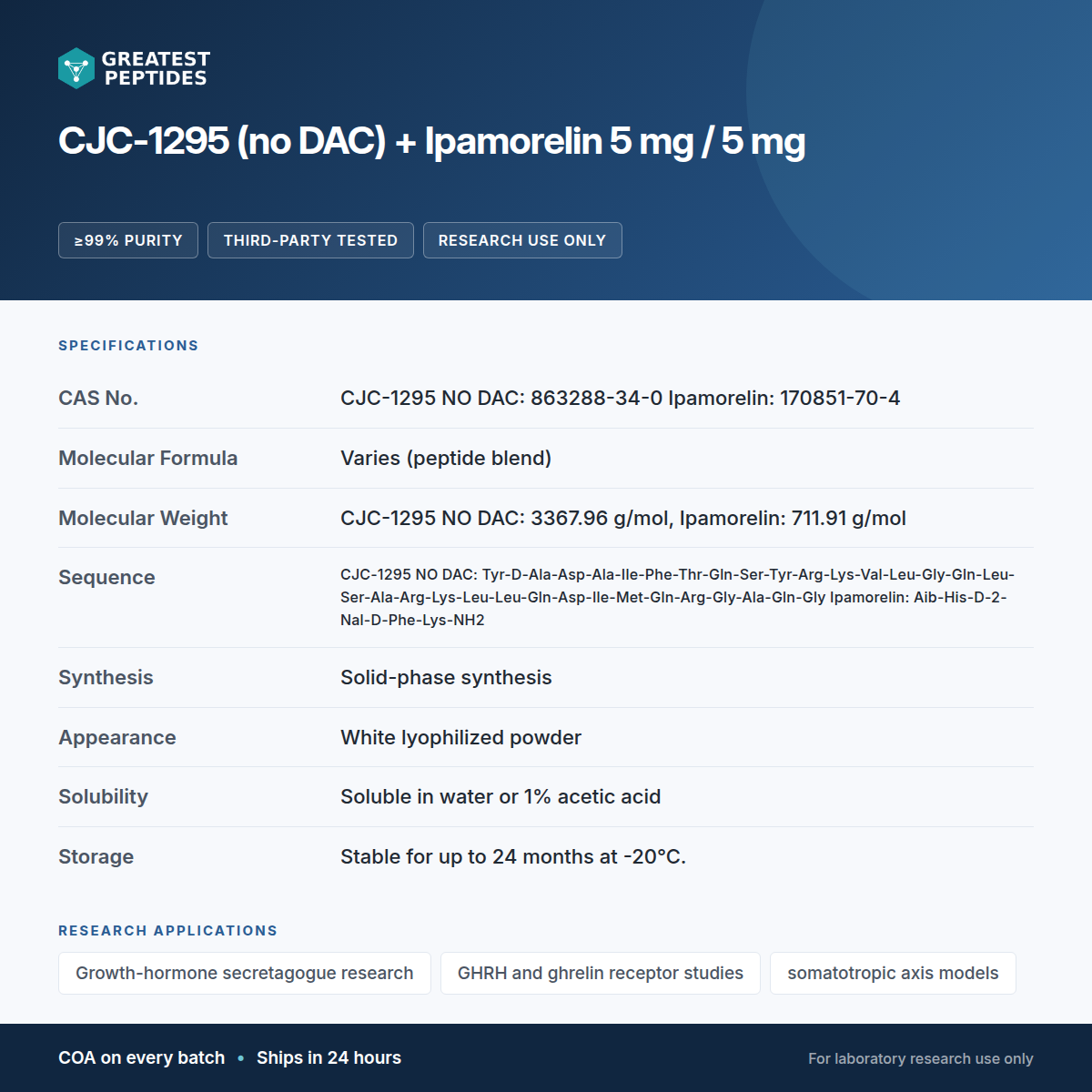
The table below is the specification the store publishes for this listing. It is reproduced here from the product record itself rather than retyped, which means it cannot drift away from what the attribute table further up the page says. Where a field is absent it is absent because we do not publish it for this SKU, not because it was left out of this summary.
CAS No.
CJC-1295 NO DAC: 863288-34-0 Ipamorelin: 170851-70-4
Purity
≥99%
Sequence
CJC-1295 NO DAC: Tyr-D-Ala-Asp-Ala-Ile-Phe-Thr-Gln-Ser-Tyr-Arg-Lys-Val-Leu-Gly-Gln-Leu-Ser-Ala-Arg-Lys-Leu-Leu-Gln-Asp-Ile-Met-Gln-Arg-Gly-Ala-Gln-Gly Ipamorelin: Aib-His-D-2-Nal-D-Phe-Lys-NH2
Molecular Formula
Varies (peptide blend)
Molecular Weight
CJC-1295 NO DAC: 3367.96 g/mol, Ipamorelin: 711.91 g/mol
Synthesis
Solid-phase synthesis
Solubility
Soluble in water or 1% acetic acid
Stability & Storage
Stable for up to 24 months at -20°C. After reconstitution, may be stored at 4°C for up to 4 weeks or at -20°C for up to 6 months.
Shipped at ambient temperature; once received, store at -20°C
Regulatory/Compliance
Manufactured in a facility that adheres to cGMP guidelines
Safety Information
Refer to provided MSDS
A specification table is a claim, and a claim is only worth the record behind it. Every field above is one you can ask us to substantiate against the batch documentation for the lot you were sent. If a field ever fails to match the paperwork, that is a defect on our side and we would rather hear about it than not.
A blend has as many identities as it has components, and a single purity percentage cannot describe it. What a blend certificate needs to show is the identity of each component and the ratio between them; a lone number on the front page does not.
The analytical record behind this lot
A certificate of analysis is not a quality badge. It is a measurement report about one specific batch, produced on a specific date by a specific method, and its value to you is entirely a function of how much of that context it discloses. For CJC-1295 the fields worth checking first are the ones that tie the document to the container in your hand.
Field on the certificate
Why it matters for this SKU
Lot or batch identifier
Ties the document to the vial. A certificate with no lot reference describes some batch, not necessarily yours.
Compound name and, where applicable, sequence
This is the identity claim. For a multi-component research blend it is the field that distinguishes the material from its close relatives.
Analytical method and conditions
A purity figure without a method is a number without units. Column, gradient and detection wavelength change what the figure means.
Date of analysis
Establishes how old the measurement is relative to the material. A recent vial with a two-year-old certificate is a documentation gap.
Who performed the analysis
In-house and independent third-party results are both legitimate; they are not the same claim, and the document should say which it is.
The chromatogram or spectrum itself
A summary table can be typed by anyone. A trace can be read, and a reader who knows the compound class can tell whether it is plausible.
What our documentation for CJC-1295 does assert is what the analysis measured on the batch that was tested. What it does not assert — and no certificate from any supplier can assert — is that the material is safe, that it is suitable for any use in humans or animals, or that it will reproduce a result reported in a published paper. Those are different questions and a purity figure is not evidence for any of them.
Our batch documentation policy, including how to request the record for a lot you already have, is on the certificate of analysis page. If you need the record before ordering rather than after, ask us through the contact page and reference this listing by name.
How CJC-1295 is checked before it reaches this catalog
Three questions have to be answered separately before a compound gets a page here, and collapsing them into one percentage is the most common way a supplier listing becomes misleading.
Question
What answers it
What it does not tell you
Identity — is this the right molecule?
Mass determination, and sequence confirmation where the material is a defined chain
Nothing about how much of the vial is that molecule
Purity — what proportion of the detected material is the target?
Chromatographic separation with a stated method
Nothing about what the other fraction actually is, unless the impurities are themselves identified
Content — how much target material is actually in the container?
Quantitative determination against the labeled fill
Nothing about identity or purity; a vial can be accurately filled with the wrong thing
For CJC-1295, component-resolved analysis, then whatever assay is appropriate to each component individually are the assay formats the published work in this area tends to use, which matters when you are deciding whether the material as supplied is fit for the experiment you have in mind. A compound that is clean enough for a binding assay is not automatically clean enough for a quantitative cell-based readout where a co-eluting impurity could carry activity of its own.
Content is the field most often missing from a supplier listing, and it is the one that changes your arithmetic. A vial labeled 5 mg contains that much total solid, and total solid includes counter-ion, residual water and whatever else survived the process. If you need the peptide mass rather than the vial mass to be exact, that is a specific request to make in advance, not an assumption to carry into a calculation.
Receiving, inspecting and storing CJC-1295
The most useful five minutes you will spend on this material are the five minutes immediately after the package is opened, because that is the only moment at which you can still distinguish a transit problem from a handling problem of your own.
Confirm the label on the container matches this listing, including the fill mass, and record the lot identifier in your notebook before anything else happens.
Inspect the closure and seal. A compromised closure is a reason to stop, not a reason to proceed carefully.
Look at the cake. Note its appearance and position; a cake that has collapsed, shifted or gone glassy is telling you something about the vial's history in transit.
Let a cold vial reach room temperature before opening it, so that atmospheric moisture condenses outside the vial rather than into the material.
Photograph the label and the container on arrival. It costs nothing and it settles later questions instantly.
Store it in the dark, at the temperature stated for this listing, and write down the date it entered storage.
Decide your aliquot plan before the first opening, not after it.
Components in a blend do not necessarily degrade at the same rate, so a blend can drift out of its stated ratio while still looking intact.
The general rule for lyophilized material is that the dry state is the stable state and every transition away from it costs you something. Freeze-thaw cycling is the specific mechanism most likely to degrade CJC-1295 after it reaches you, and it is entirely under your control: a single reconstitution split into pre-planned aliquots exposes the material once, while repeatedly warming and refreezing one container exposes it as many times as you open it. There is a fuller treatment of the mechanism in our guide on freeze-thaw cycles in peptide research materials and on storage and handling.
Preparing aliquots from a 5 mg vial: the measurement arithmetic
This is arithmetic, not guidance. The only thing the table below does is tell you what concentration you are holding after you have added a known volume of diluent to a vial labeled 5 mg, so that the figure in your notebook and the figure in the container are the same figure. It says nothing about how much material any experiment should use, and it is not applicable to any use in humans or animals.
Diluent added
Resulting concentration
Amount in 0.1 mL
Amount in 0.05 mL
Aliquots of 0.25 mL
1 mL
5 mg/mL
500 µg
250 µg
4
2 mL
2.5 mg/mL
250 µg
125 µg
8
3 mL
1.67 mg/mL
166.7 µg
83.3 µg
12
5 mL
1 mg/mL
100 µg
50 µg
20
Every figure above is the same division: the labeled mass of CJC-1295 divided by the volume of diluent added. Nothing in the table is a recommendation about how much material to use in an experiment — it is the arithmetic that tells you what concentration you are holding once you have added a known volume, so that the number you write in the notebook matches what is in the container.
Two things routinely go wrong at this step. The first is treating the labeled mass as the peptide mass; as noted above, the labeled figure is total solid unless the documentation says otherwise, so a concentration derived from it is a nominal concentration. Say so in your methods rather than implying a precision the specification does not support. The second is ignoring the volume the solid itself occupies — small at these masses, but not zero, and it means the final volume is very slightly greater than the volume you added.
If you want to work backwards from a target concentration to a diluent volume, or to check a figure against a different vial size, our peptide reconstitution calculator does the same division in both directions and shows its working.
What to record for CJC-1295 so the work is reproducible
Reproducibility in this area fails at the material-provenance step far more often than at the analysis step. The fields below are the ones that let somebody else — a reviewer, a collaborator, or you in eighteen months — work out whether two sets of results were generated with comparable material.
Supplier and the exact listing name, including the fill size, rather than just the compound name
Lot identifier, and the date the batch documentation was issued
Date received, and the storage conditions and location it went into
Date of reconstitution, the diluent used and its lot, and the volume actually added
Nominal concentration obtained, stated as nominal rather than as measured
Aliquot scheme: how many, what volume, stored where
Freeze-thaw count for each aliquot at the point of use
Any deviation from plan, including deviations that seemed unimportant at the time
Whether the material was research-use-only labeled, which for this listing it is
Comparing suppliers on this exact SKU
Comparing CJC-1295 across suppliers on price alone is comparing two numbers that may not describe the same thing. These are the questions that make the comparison meaningful, with our answers next to them so you can hold us to the same standard you would hold anyone else.
Question to ask any supplier
Our answer for this listing
Is batch documentation available for the specific lot I will receive, not a representative lot?
Is there a published position on what the documentation does not prove?
Yes. It is stated on this page and on every product page.
A supplier who answers all seven honestly is a better bet than a supplier who is ten percent cheaper and answers four. A supplier who cannot answer the first one at all is not selling you documented material; they are selling you a container.
Compliance boundary for CJC-1295
CJC-1295 is supplied for laboratory research use only. It is not a drug, not a supplement, not a cosmetic and not a medical device. It is not for human or veterinary administration, not for diagnostic use, and not for use in food. That is not a disclaimer bolted onto a sales page — it is the actual scope of what is being sold, and it constrains what can honestly be written about it.
Language that stays inside the boundary
Language that does not
"Supplied for research use only"
Any phrasing that implies a personal or clinical use
"Published work in this area has examined the literature for each component separately - a blend as a combination is generally not what has been studied"
"CJC-1295 does X" stated as an established effect
"Purity determined by the stated method on the tested batch"
"Pharmaceutical grade", "medical grade", "safe"
"Concentration arithmetic for preparing laboratory aliquots"
Anything framed as a dose, a protocol or a schedule
"Not for human or veterinary use"
Silence on the point, which readers correctly interpret as evasion
Naming the model system a finding came from
Reporting an animal or in-vitro finding as though it were a human finding
The reason to be precise about this is not only regulatory. Research literature on this class of material is genuinely interesting and genuinely incomplete, and overstating it makes the real findings harder to see. Where published work is referenced on this site it is referenced as what was measured, in what system, at what scale — not as a property of the vial.
Other Growth Hormone Secretagogues (GHS) listings
These share a catalog category with CJC-1295, which means the documentation and handling considerations above largely transfer to them. Their compound-specific sections do not — each has its own identity, its own literature and its own analytical profile.
$95.99Original price was: $95.99.$84.99Current price is: $84.99.
The full catalog is on the shop page, and the longer written material is in our research guides.
Questions about ordering CJC-1295
Is CJC-1295 documentation available before I order?
Yes. Ask through the contact page and reference this listing by name. Our general position on batch documentation is on the certificate of analysis page. If a supplier will not show you the record until after payment has cleared, that is worth noticing.
What does the 5 mg figure on the label actually refer to?
It is the labeled fill for this presentation. For lyophilized material the labeled mass is total solid unless the documentation states otherwise, and total solid includes counter-ion and residual moisture as well as target compound. If your calculation depends on the distinction, resolve it against the batch record rather than assuming.
How fast does CJC-1295 ship?
Within 24 hours of the order clearing. Orders of $150 and above ship free. Transit time after dispatch depends on the service selected at checkout.
Can I buy CJC-1295 for personal use?
No. This material is supplied for laboratory research use only. It is not a drug, supplement or cosmetic, it is not for human or veterinary administration, and nothing on this page should be read as guidance for any such use.
How should CJC-1295 be stored before and after reconstitution?
Store the sealed vial dry, dark and at the temperature stated for this listing, and record the date it entered storage. Once material is in solution the useful discipline is to minimize repeated warming: plan the aliquot scheme before the first reconstitution so the material is exposed once rather than once per experiment. Components in a blend do not necessarily degrade at the same rate, so a blend can drift out of its stated ratio while still looking intact.
How much diluent should I add to a 5 mg vial?
That depends entirely on the concentration your protocol calls for, which is your decision and not something a product page can answer. What the table above provides is the arithmetic: labeled mass divided by added volume gives concentration. The reconstitution calculator runs the same division in either direction.
Does a high purity figure mean CJC-1295 is safe?
No, and this is the single most common misreading of a certificate of analysis. Purity describes what proportion of the detected material was the target compound in the batch that was tested, by the method stated. It is not a safety assessment, it says nothing about suitability for any use in humans or animals, and it does not become a safety claim by being a large number.
What is CJC-1295 classified as in your catalog?
It is listed as a co-lyophilized combination of separately specified components, in the Growth Hormone Secretagogues (GHS) category. Published work in this area has looked at the literature for each component separately - a blend as a combination is generally not what has been studied. That is a description of where the literature sits, not a claim about what the material does.
Do you have more general written material on evaluating research peptides?
Yes. The home page guide covers reading a certificate of analysis, what chromatographic and mass-spectrometric methods each prove, and how to compare suppliers. The research guides go deeper on individual topics, and the FAQ covers ordering, shipping and post-shipping questions.
CJC-1295 (no DAC) + Ipamorelin 5 mg / 5 mg is supplied strictly for laboratory research use. It is not a drug, supplement, cosmetic or medical device; it is not for human or veterinary use, not for diagnostic use and not for use in food. No statement on this page is intended to describe a therapeutic use, benefit or outcome, and references to published work describe what was measured in the reported model system rather than a property of the material supplied. Purchasers are responsible for handling the material in accordance with the requirements applicable to their institution and jurisdiction.
Check the documentation before you check the price