$61.99Original price was: $61.99.$54.99Current price is: $54.99.
In stockShips today if ordered by 3 PM ESTUSA fulfillment
Research Studies
✓Studied as a copper-binding tripeptide in skin-remodeling and collagen research.
✓Investigated for effects on extracellular-matrix and antioxidant pathways in vitro.
✓Used in laboratory models of fibroblast activity and tissue regeneration.
✓Applied in copper-transport and gene-expression research assays.
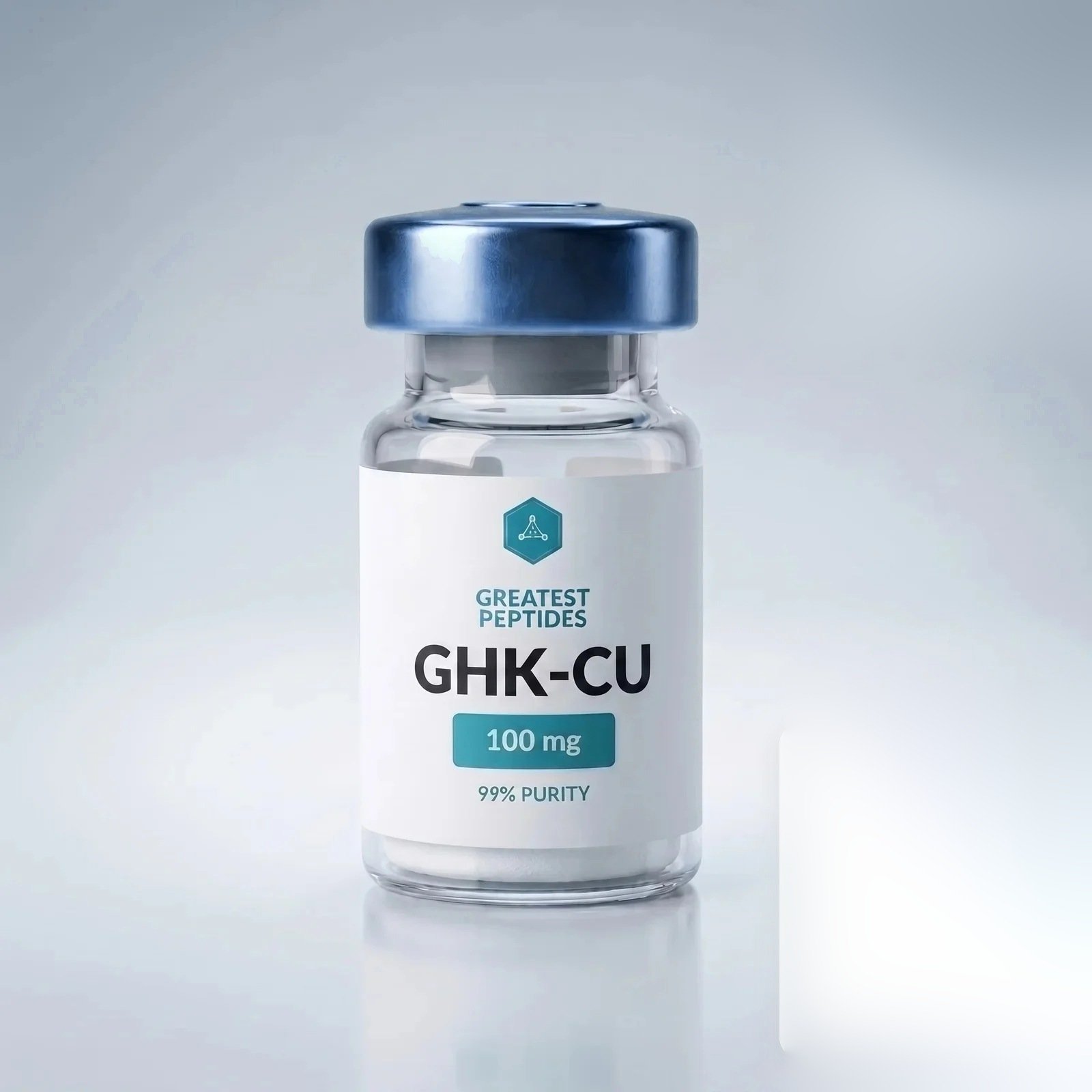
GHK-CU 100 mg is supplied at 99%+ purity for in-vitro laboratory research only. Not for human or veterinary use.
Reconstituting this vial? Our free peptide reconstitution calculator converts vial mass and diluent volume into concentration, draw volume and U-100 syringe graduations. Research use only.
ALL ARTICLES AND PRODUCT INFORMATION PROVIDED ON THIS WEBSITE ARE FOR INFORMATIONAL AND EDUCATIONAL PURPOSES ONLY. The products offered on this website are intended solely for research and laboratory use. These products are not intended for human or animal consumption. They are not medicines or drugs and have not been evaluated or approved by the FDA to diagnose, treat, cure, or prevent any disease or medical condition. Any form of bodily introduction is strictly prohibited by law.
GHK-Cu is a naturally occurring copper-binding tripeptide (glycyl-L-histidyl-L-lysine complexed with copper(II)). It is one of the most extensively studied peptides in skin, collagen, and tissue-remodeling research. Greatest Peptides supplies GHK-Cu as a >99% pure powder for laboratory research use only.
GHK-Cu 100 mg — Research Grade
GHK-Cu is a naturally occurring copper-binding tripeptide (glycyl-L-histidyl-L-lysine : copper) widely studied in skin-remodeling, wound-repair, and tissue-regeneration research models. Supplied as a lyophilized powder for controlled laboratory research only.
Specifications
Compound: GHK-Cu (copper tripeptide)
Quantity: 100 mg per vial, lyophilized powder
Purity: 99%+ HPLC standard — batch-specific Certificate of Analysis included for your exact lot
Identity: confirmed by LC-MS
Appearance: blue lyophilized powder
Documentation: Every vial ships with access to a batch-specific Certificate of Analysis showing HPLC purity, mass-spectrometry identity confirmation, endotoxin, residual solvents, and water content for your exact lot.
Handling & storage: Store lyophilized powder at -20°C. Reconstitute with bacteriostatic water for research handling. Keep out of direct light.
For laboratory and research use only. Not for human or animal consumption.
In published preclinical literature, GHK-Cu has been investigated for its role in copper transport, collagen and glycosaminoglycan synthesis in fibroblast models, extracellular-matrix remodeling, and broad gene-expression modulation. It is one of the most cited copper peptides in dermatological and wound-research models.
These observations describe outcomes reported in laboratory and animal research models only. GHK-Cu is a research chemical — it is not a dietary supplement, drug, or therapeutic product, and nothing here describes effects in humans.
Related Research Topics
GHK-Cu and collagen synthesis research
Copper peptides overview
GHK-Cu in skin-remodeling models
Frequently Asked Questions
What is GHK-Cu used for in research?
GHK-Cu is used strictly as a tool compound in laboratory research, as described in the overview above. It is studied in controlled models only.
Is GHK-Cu research use only?
Yes. All compounds from Greatest Peptides are supplied strictly for laboratory and research use only. They are not intended for human or veterinary use.
What purity is your GHK-Cu?
Supplied at 99%+ HPLC purity with a batch-specific Certificate of Analysis (COA) confirming purity by HPLC and identity by mass spectrometry for your exact lot.
How should GHK-Cu be stored?
Lyophilized GHK-Cu is typically kept refrigerated and protected from light for short-term handling, and frozen (-20°C) for longer-term storage.
How is GHK-Cu supplied?
GHK-Cu ships as a lyophilized powder per vial, requiring reconstitution with a suitable solvent prior to research use.
Additional information
Weight
15 lbs
CAS No.
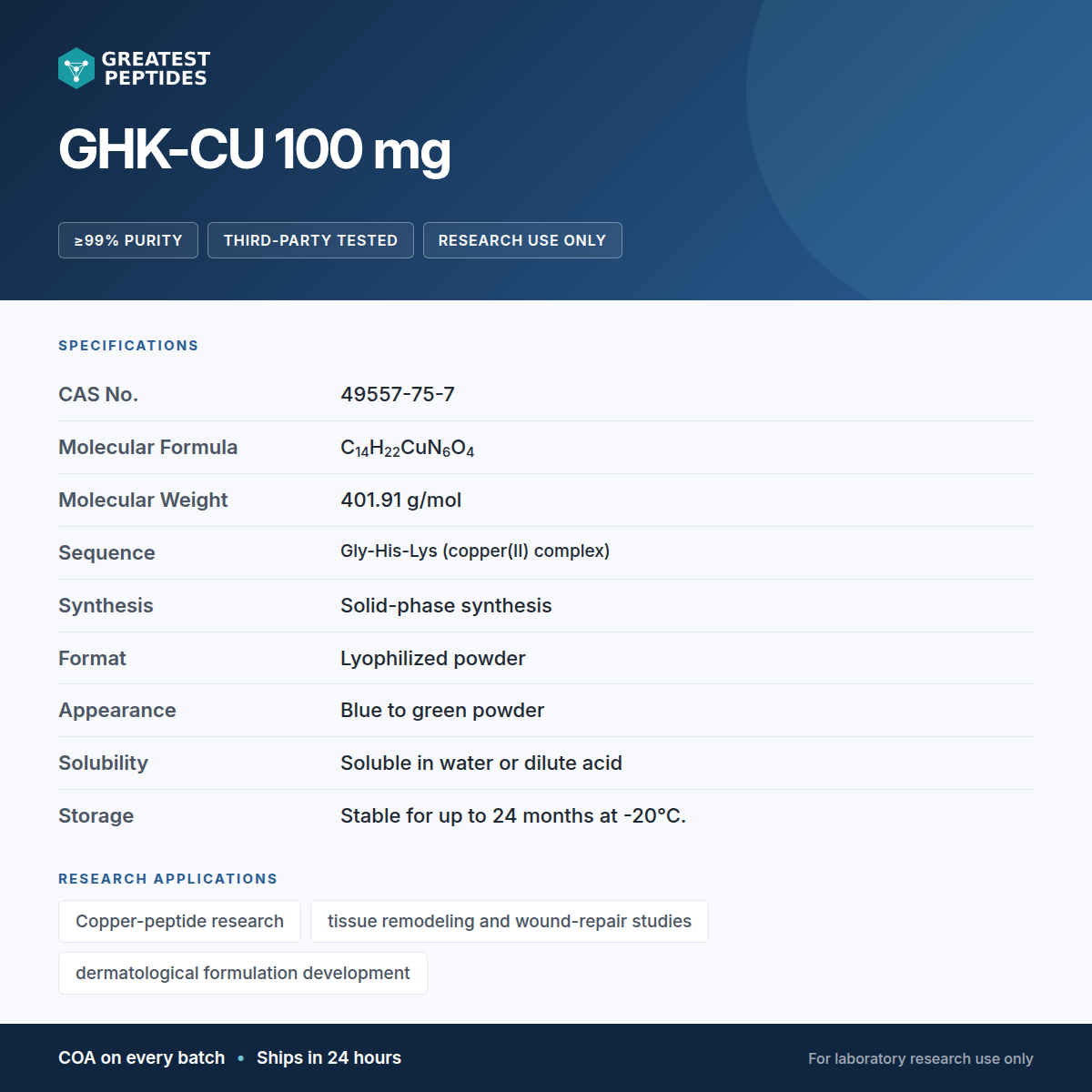
49557-75-7
Purity
≥99%
Sequence
Gly-His-Lys (copper(II) complex)
Molecular Formula
C14H22CuN6O4
Molecular Weight
401.91 g/mol
Synthesis
Solid-phase synthesis
Format
Lyophilized powder
Solubility
Soluble in water or dilute acid
Stability & Storage
Stable for up to 24 months at -20°C. After reconstitution, may be stored at 4°C for up to 4 weeks or at -20°C for up to 6 months.
Applications
Copper-peptide research, tissue remodeling and wound-repair studies, dermatological formulation development
Appearance
Blue to green powder
Shipping Conditions
Shipped at ambient temperature; once received, store at -20°C
Regulatory/Compliance
Manufactured in a facility that adheres to cGMP guidelines
Safety Information
Refer to provided MSDS
Researcher FAQ
How do I reconstitute this peptide?
Use bacteriostatic water (BAC) at a 1–2 mL volume per vial. Add the solvent slowly down the vial wall, swirl gently — never shake. Refrigerate after reconstitution and use within 30 days. For in-vitro laboratory handling only.
How should I store this product?
Lyophilized: 36–46°F (refrigerated) for up to 24 months. Reconstituted: keep refrigerated and protect from light; use within 30 days. Avoid repeated freeze-thaw cycles.
Shipping & tracking?
Orders placed before 3 PM EST ship the same business day from our USA facility. Tracking is emailed within 24 hours. Plain, discreet packaging. Free shipping on orders over $150.
Buy GHK-Cu for Research | RUO COA & Documentation Guide
For laboratory teams evaluating where to buy GHK-Cu for research, the priority is documentation, compound identity, and research-use-only (RUO) alignment. GHK-Cu is the copper(II) complex of the tripeptide glycyl-L-histidyl-L-lysine (GHK). The copper complex is catalogued with the molecular formula C14H22CuN6O4 and a molecular weight of approximately 403.9 g/mol (PubChem CID 71587328; free peptide GHK CID 73587)[1]. The free peptide carries CAS 49557-75-7 and the copper complex CAS 89030-95-5.
Fast Answer
Researchers evaluating where to buy GHK-Cu for research should review RUO labeling, a batch-specific certificate of analysis (COA), HPLC purity data, LC-MS or comparable identity support, copper-content/complex confirmation, and lot traceability before procurement. Material discussed here is intended for laboratory research use only and is not for human or veterinary use.
What Does “Buy GHK-Cu for Research” Mean?
The phrase is addressed as laboratory research-procurement intent — how qualified researchers, institutions, and technical buyers evaluate a GHK-Cu reference material through documentation, analytical support, and labeling clarity, not personal, clinical, or consumer decision-making.
Compound Identity & Classification
Compound name
GHK-Cu (copper tripeptide-1)
PubChem CID
71587328 (Cu complex); 73587 (free GHK)[1]
CAS number
89030-95-5 (Cu complex); 49557-75-7 (free peptide)
Molecular formula
C14H22CuN6O4 (complex)[1]
Molecular weight
≈ 403.9 g/mol (complex)[1]
Peptide sequence
Gly-His-Lys (with Cu2+)
Classification
Copper-peptide complex[2]
Product form
Lyophilized powder
Purity target
≥ 99% (see batch-specific COA)
Regulatory status
Research use only — not for human or veterinary use
Published literature discusses GHK and GHK-Cu within copper-peptide and tissue-remodeling research, reporting copper coordination and roles in extracellular-matrix and gene-modulation research models[2][3]. On a research product page this pathway context should remain academic literature interpretation used to define the research lane — it is not converted into product-performance language.
COA, Purity & Identity Documentation
A GHK-Cu COA should be reviewed as a batch-specific record, not a marketing statement. Look for compound name, lot number, test date, stated purity, analytical method, identity confirmation, copper-complex confirmation, and molecular information. Purity, identity, method, and lot number should be evaluated together.
Evaluation area
What to review
Why it matters
RUO labeling
Clear research-use-only language
Separates research procurement from human-use positioning
COA availability
Batch-specific certificate for the received lot
Supports lot-level documentation
Purity data
HPLC area-percent support for stated purity
Helps evaluate material consistency
Identity testing
LC-MS / mass-spec + copper-complex confirmation
Confirms the material matches the listed complex
Lot traceability
Lot number matching across records
Supports research recordkeeping
HPLC, LC-MS & Analytical Review
HPLC documentation supports purity assessment; LC-MS or mass-spectrometry documentation supports identity confirmation and molecular-mass review[10][11]. For a copper-peptide complex, confirming both the peptide identity and the copper complexation is useful alongside HPLC purity data. ICH Q2(R2) describes validation characteristics used to interpret assay, purity, and identity results[7].
Lot Traceability & Batch Documentation
Lot traceability connects the product listing, COA, label, and receiving record. ISO/IEC 17025 addresses the competence of testing laboratories, and NIST resources describe how certificates and lot identifiers support traceability[8][9].
Claim Boundary for RUO Positioning
Research-safe statement
Non-compliant version to avoid
“GHK-Cu is discussed in published literature on copper-peptide and tissue-remodeling research.”
“GHK-Cu rejuvenates skin or grows hair.”
“Researchers should review COA and identity data before procurement.”
“Buy GHK-Cu for anti-aging.”
“Greatest Peptides supplies GHK-Cu as a research-use-only material.”
“Greatest Peptides supplies GHK-Cu for treatment.”
Research Procurement Checklist
Confirm the material is labeled for research use only.
Review the batch-specific certificate of analysis for the received lot.
Confirm purity is supported by HPLC analytical data.
Confirm identity is supported by LC-MS or mass spectrometry, plus copper-complex confirmation.
Compare compound name, formula, and mass across the page, label, and COA.
Verify the lot number matches across all documentation.
Document storage and handling conditions in the laboratory record.
How Greatest Peptides Presents GHK-Cu
Greatest Peptides supplies GHK-Cu as a research-use-only laboratory material in lyophilized powder form, positioned around a stated ≥99% purity target, batch-specific COA availability, HPLC/LC-MS documentation, lot-level traceability, and transparent RUO labeling. Products are not intended for human or animal consumption, diagnostic, therapeutic, clinical, or veterinary use.
Published Literature Context
Published GHK and GHK-Cu literature spans copper-coordination chemistry and preclinical tissue-remodeling research models[2][3]. Model-specific findings should not be generalized or interpreted as use guidance for research-use-only materials.
Contributing Researchers
Recognized for published work that shaped the scientific context discussed above
Loren Pickart, PhD — described the GHK tripeptide and the GHK-Cu complex and authored reviews of copper-peptide research[2].
Anna Margolina, PhD — co-authored review work on GHK-Cu copper-peptide research context[3].
FAQs About Buying GHK-Cu for Research
What should researchers check before buying GHK-Cu for research?
Review RUO labeling, the batch-specific COA, stated purity with HPLC support, LC-MS identity data plus copper-complex confirmation, and lot traceability.
What is GHK-Cu in research documentation?
The copper(II) complex of the tripeptide Gly-His-Lys, with complex molecular formula C14H22CuN6O4 and a molecular weight near 403.9 g/mol.
Why does a COA matter when buying GHK-Cu?
It connects the listing to batch-specific documentation, including copper-complex confirmation, for the received lot.
Is GHK-Cu intended for human or animal use?
No. Material discussed here is intended strictly for laboratory research use only.
How should published literature be interpreted?
As scientific context only. Model-specific findings should not be generalized or read as use guidance for research-use-only materials.
This page addresses GHK-Cu only as research-use-only laboratory procurement. Boundary-sensitive terms such as skin, anti-aging, hair, and collagen are referenced here only as research-language examples that must stay separate from RUO product positioning. All product information is for informational and educational purposes only. Products are not intended for human or animal consumption and have not been evaluated by the FDA to diagnose, treat, cure, or prevent any disease.
References
National Center for Biotechnology Information. GHK-Cu (copper complex) CID 71587328; GHK CID 73587. PubChem Compound records. Accessed 2026.
Pickart L, Margolina A. Regenerative and protective actions of the GHK-Cu peptide (review). International Journal of Molecular Sciences. 2018. PMID 30049990.
Pickart L, et al. The human tripeptide GHK and copper-peptide research (review). Peptide/biochemistry literature. 2015.
Registry record for GHK-Cu, CAS 89030-95-5. Accessed 2026.
IUPAC-IUB Joint Commission. Nomenclature and symbolism for amino acids and peptides. 1983.
U.S. FDA. Analytical procedures and methods validation for drugs and biologics. 2015.
U.S. FDA. Q2(R2) Validation of Analytical Procedures. 2024.
International Organization for Standardization. ISO/IEC 17025:2017. 2017.
National Institute of Standards and Technology. Reference materials and certificates of analysis. Accessed 2026.
Mant CT, et al. HPLC analysis and purification of peptides. Methods in Molecular Biology. 2007.
Steen H, Mann M. Peptide sequencing. Nature Reviews Molecular Cell Biology. 2004. PMID 15340378.
Compound profile
GHK-Cu: compound profile, literature landscape and handling notes
GHK-Cu in one paragraph
GHK-Cu is not a peptide in the sense that the rest of this catalog uses the word. It is a coordination complex: a three-residue human sequence, glycyl-L-histidyl-L-lysine, bound to a copper(II) ion through a defined set of donor atoms. That distinction is not pedantry. It changes what the material is, how it behaves in a buffer, what an analytical certificate can and cannot tell you, and which published findings should be attributed to the organic ligand rather than to the metal it carries. GHK is also one of the few sequences in this catalog that is genuinely endogenous rather than designed, which gives it a different kind of literature: older, broader, more dermatological and cosmetic than pharmacological, and considerably more variable in rigor. Everything below describes the published research record and the behavior of the material on a bench. Nothing here is a claim about what this vial does, and nothing here is applicable to use in humans or animals.
Where GHK-Cu came from
The tripeptide entered the literature in the 1970s as an activity rather than as a molecule. Work on human plasma fractions reported that something in plasma modulated the behavior of hepatic tissue in culture, and that the effect differed between fractions from younger and older donors. Purification of that activity converged on a very small peptide, and the sequence turned out to be glycyl-L-histidyl-L-lysine. At that stage it was described as a growth-modulating factor, and the copper had nothing to do with the story.
The copper-binding property was recognized afterward, and it reframed the compound completely. The tripeptide has a donor-atom arrangement that binds copper(II) with high affinity under physiological conditions, and once that was appreciated it became clear that most of the reported activity tracked the complex rather than the free ligand. Preparations that had been characterized as GHK were, in plasma or in serum-containing medium, almost certainly GHK-Cu. Modern work generally specifies the complex, and the naming convention GHK-Cu exists precisely to force that distinction.
Two further points about provenance matter for how the record should be read. The first is that GHK is a real human sequence rather than a synthetic construct. It appears within the collagen alpha-2(I) chain and is described in the literature as being liberated by proteolysis during tissue remodeling, which gives it a plausible endogenous source and makes it one of the very few compounds in this catalog with a non-hypothetical physiological counterpart.
The second is that a large share of the GHK corpus, including several of the most-cited review articles, traces back to a small number of investigators with continuous involvement in the field since the original isolation. This is not an accusation; it is a structural feature of the literature that affects how much independent confirmation any given claim actually has. The frequently repeated statement that plasma GHK abundance declines substantially with age is the clearest example. It is asserted far more often than it is measured, the underlying measurements are few and old, and the figure gets passed from review to review without anyone returning to a primary determination.
Reading the structure of GHK-Cu
Three residues, in the order glycine, histidine, lysine, with a free N-terminal amine and a free C-terminal carboxylate. The sequence, formula and mass for this listing appear in the specification table further down this page. What that table cannot convey, and what actually defines the compound, is the coordination chemistry.
Copper(II) in GHK-Cu is held by nitrogen donors contributed by the first two residues. The alpha-amino nitrogen of the glycine, the deprotonated amide nitrogen of the peptide bond between glycine and histidine, and an imidazole nitrogen of the histidine side chain form the primary coordination sphere. The fourth equatorial position is occupied by an exchangeable ligand, which in practice means water, a buffer component, or a donor atom from another molecule in solution. This gives an approximately square-planar arrangement, the geometry expected for a d9 copper(II) center subject to Jahn-Teller distortion, with weak axial interactions completing the picture.
The deprotonated amide nitrogen is the feature to hold on to, because it is what makes the complex pH-dependent in a way that a plain peptide never is. Amide nitrogens are not acidic in isolation; they only deprotonate because the metal center stabilizes the resulting anion. Take the pH down and that stabilization is lost, the amide reprotonates, and the complex comes apart. This is why the speciation of GHK-Cu is a function of pH rather than a fixed property of the powder.
The lysine side chain sits outside the coordination sphere entirely. It is not a donor, but it is not inert either. Its protonated epsilon-amino group carries positive charge that affects solubility, chromatographic retention and interaction with polyanionic matrix components, and in a physiological setting the lysine face is implicated in ternary complex formation with serum albumin, which has its own high-affinity N-terminal copper site. The relevant species in serum-containing medium is therefore frequently not the isolated binary complex.
One consequence of all this deserves emphasis because it has no analog anywhere else in the catalog: the ratio of peptide to copper is a genuine specification parameter. A plain peptide has a sequence and a purity. A metal complex has a sequence, a purity, and a stoichiometry, and material sold at a nominal one-to-one ratio can in practice carry excess free ligand or, worse, excess uncomplexed copper.
The target and the pathway in more detail
There is no GHK-Cu receptor. Searching for one is the single most common conceptual error made about this compound, and the published mechanistic work does not support the framing. What the literature actually describes is better summarized as copper-dependent enzyme cofactor logistics: the complex participates in the movement of copper between ligands of differing affinity, and the downstream observations follow from where the copper ends up.
Copper in biological systems is never free. It is handed between proteins in a thermodynamic hierarchy, and the relevant partners named in the GHK literature include serum albumin, which has a dedicated high-affinity N-terminal site, ceruloplasmin as the dominant circulating copper protein, metallothioneins as high-capacity intracellular sinks, and cuproenzymes that require the metal to function. The stability of GHK-Cu sits in an intermediate window, high enough to hold copper against casual competition and low enough that transfer to stronger acceptors remains accessible. That intermediate position is exactly what makes a shuttle role plausible and also exactly what makes the compound behave differently in defined medium, in serum-containing medium and in a tissue matrix. Direction of transfer is a property of the system, not of the vial.
Two cuproenzymes recur throughout the work. Lysyl oxidase, which requires copper and initiates the covalent cross-linking of collagen and elastin, connects copper availability directly to extracellular-matrix maturation. Copper-zinc superoxide dismutase connects it to antioxidant capacity. Neither of these is activated by GHK-Cu in a receptor sense; the proposed relationship is cofactor supply.
Beyond the enzymes, the reported effects concentrate on extracellular-matrix gene expression. Published work describes changes in collagen transcripts, in glycosaminoglycan and proteoglycan synthesis, and in the balance between matrix metalloproteinases and their tissue inhibitors, the TIMPs. That balance is the more interesting readout of the two, because a compound that raised both synthesis and degradation would look very different in a remodeling assay from one that shifted the ratio.
Finally there is a substantial body of cell-culture observation on fibroblast behavior, including proliferation, migration and matrix deposition, with a smaller keratinocyte literature alongside it. These are the assays where an effect is most reproducibly reported and also where copper artifacts are hardest to exclude.
What the published literature on GHK-Cu actually measures
The GHK-Cu literature is large, old and unusually heterogeneous in quality, and sorting it by type before citing anything from it saves a great deal of trouble.
The first and most defensible body of work is dermatological and wound-model research in animals. These studies typically apply the complex in a controlled injury model and score closure, tensile properties of the repaired tissue, histology and matrix composition. The models are standard, the endpoints are measurable, and the reported direction of effect is reasonably consistent across groups. This is the part of the record that most resembles conventional preclinical pharmacology, and it is the part worth citing when the question is whether the compound does anything at all in a living tissue.
The second body is cell culture: fibroblasts, keratinocytes and to a lesser extent endothelial and neural cell models, with proliferation, migration, matrix protein output and enzyme activity as readouts. Concentrations used span a wide range, and the useful studies are the ones that include a copper-salt control arm and a free-peptide arm rather than only vehicle. Many do not.
The third body is gene-expression profiling. There is a well-known set of analyses reporting broad transcriptional shifts in fibroblasts exposed to the complex, sometimes framed through comparison against reference expression databases. These are hypothesis-generating datasets. They report that transcript abundance changed, which is not the same claim as that a function changed, and the gap between those two statements is where most over-reading of this compound happens.
The fourth body is cosmetic science, and it is the largest by sheer count. It ranges from careful formulation and stability work, which is genuinely useful because it addresses how the complex survives in a real matrix, to small, uncontrolled, unblinded, industry-funded panel studies of multi-ingredient preparations in which the complex is one component among many. A study of a finished formulation cannot attribute an effect to any single ingredient in it, and a great deal of secondary writing about GHK-Cu does exactly that.
Cutting across all four bodies is a reporting problem worth checking for in any paper you intend to rely on. Because the compound is a metal complex, the methods section needs to state which species was used, how the copper content was established, what the medium contained by way of copper, chelators and reductants, and whether a copper-salt control was run. Papers that report only a concentration in micromolar terms and a compound name have left the most important variables unspecified.
Where the GHK-Cu literature is thin or frequently misread
The recurring problem with this compound is attribution, and it appears in four distinct forms.
The first is the free-peptide versus complex ambiguity. Papers, abstracts and vendor documents use GHK and GHK-Cu interchangeably, and older work predates the convention entirely. Since the two are different chemical species with different properties, a citation that does not specify which was used, and ideally how the copper content was verified, is of limited value. When the experiment was run in serum-containing medium the distinction partly collapses anyway, because free GHK will acquire copper from the medium, but that only means the effective species was never under the experimenter's control.
The second is stoichiometry. Material sold as GHK-Cu is frequently supplied without an independent determination of copper content, and a name on a label is not a measurement. Preparations with the correct peptide and too little copper, and preparations carrying free copper salt in addition to the complex, are both consistent with a clean peptide purity figure.
The third, and the one with real experimental consequences, is copper redox chemistry. Copper cycles between the divalent and monovalent states and, in the presence of a reductant and any peroxide, participates in Fenton-type chemistry that generates hydroxyl radicals. Cell-culture medium is not a benign environment in this respect: it commonly contains ascorbate or other reductants. An excess of loosely bound copper in such a system produces oxidative stress, and oxidative stress produces transcriptional and proliferative changes that are easily read as biological activity of the compound. Coordination within the tripeptide is generally described as attenuating this behavior relative to a free copper salt, which is a good argument for the complex and a very good argument for knowing exactly how much uncomplexed copper is present.
The fourth is the over-reading of expression profiling already noted, compounded by the age-related decline claim, which is repeated with a confidence that the primary measurements do not support.
How GHK-Cu behaves in solution
GHK-Cu in solution is blue, and the color is not decorative. It arises from d-d transitions of the copper(II) center in its nitrogen-rich coordination environment, which means the color is a direct report on the coordination sphere. A correctly constituted solution is a clear blue to blue-violet. That gives you a diagnostic that no other compound in this catalog offers: if a solution of this material is colorless, the copper is no longer coordinated the way it should be, and if it is green or has drifted toward green, the coordination environment has changed, most often through displacement of a nitrogen donor by a different ligand or through partial dissociation. Faint turbidity with a colorless supernatant suggests copper has come out as an insoluble salt.
The pH dependence follows directly from the deprotonated amide nitrogen discussed above. In acidic conditions the complex dissociates, and the blue fades. Neutral to mildly alkaline conditions favor the intact complex. Strongly alkaline conditions introduce a different problem, precipitation of copper hydroxide and, in phosphate buffers, of copper phosphate. Buffer choice therefore matters more here than for a plain peptide, and buffers containing strong donor or chelating components are best avoided.
Two classes of additive are outright incompatible. Chelators, EDTA above all, have far higher affinity for copper(II) than the tripeptide does and will strip the metal quantitatively; a GHK-Cu solution in an EDTA-containing buffer is a solution of free GHK and a copper-EDTA complex. Reducing agents are the other class. Ascorbate, dithiothreitol and TCEP reduce copper(II) to copper(I), and the donor set that stabilizes the divalent ion does not stabilize the monovalent one, so the complex is destroyed and the released copper becomes redox-active. Any protocol that includes a reduction step is incompatible with keeping this material intact.
Copper complexes are also photosensitive, and light exposure can drive both ligand oxidation and metal-centered photochemistry, so amber containers and dark storage are ordinary practice.
The 100 mg quantity in this listing is much larger than the 5 to 20 mg typical elsewhere in the catalog, and the reason is straightforward: the published work uses this compound at micromolar to millimolar working concentrations rather than the nanomolar concentrations at which receptor agonists are studied, and formulation and matrix-stability work consumes material quickly. Vial size here reflects how the compound is used, not how potent it is.
Analytical notes specific to GHK-Cu
Analytical characterization of a metal complex is not the same exercise as characterization of a peptide, and the standard package is incomplete for this material in a specific and predictable way.
Mass spectrometry first. Electrospray of a coordination complex is unreliable in a way that catches people out: the complex can dissociate in the source, so the ion you observe may well be the free tripeptide rather than the copper adduct. Observing free GHK on a spectrum is therefore not evidence that the sample contained no copper, and reporting it as such is a real error that appears in supplied documentation. Gentle source conditions improve survival of the complex, and when it does survive there is a genuinely useful signature: copper has two stable isotopes, with the lighter accounting for roughly sixty-nine percent of natural abundance and the heavier roughly thirty-one percent. That produces a characteristic doublet separated by two mass units with an approximately two-to-one intensity ratio, which is unmistakable against the ordinary isotope envelope of a small peptide and is one of the few unambiguous confirmations that the metal is present in the ionized species. Note also that coordination involves loss of protons from the ligand, so the observed mass of the complex is not simply the peptide mass plus the copper mass.
Chromatography next. Reversed-phase methods for peptides typically run in acid, most often with trifluoroacetic acid, and acid dissociates this complex. A conventional purity chromatogram is therefore largely a purity chromatogram of the tripeptide, which is worth knowing but is not a measurement of the complex. Where the complex does partially survive, on-column dissociation and re-equilibration during the run produce peak splitting, shoulders and pronounced tailing, and these are chemistry rather than a bad column. Residual metal in the flow path adds further irreproducibility.
The measurement that actually settles the question is orthogonal copper quantitation. Atomic absorption spectroscopy or ICP-MS on a digested sample gives total copper independent of the peptide, and combining that with peptide content establishes stoichiometry rather than assuming it. ICP-MS has the additional benefit of reporting other metals, which is how you learn whether iron or zinc has partly displaced the copper. Ultraviolet-visible spectroscopy of the d-d absorption band is a cheap, non-destructive complement that reports on coordination rather than on total metal, and the two together are far more informative than either alone.
Compounds researchers confuse with GHK-Cu
Often mistaken for
How it actually differs from GHK-Cu
GHK (free tripeptide, no copper)
The same three residues without the metal. It is a different chemical species with different solution behavior, different chromatography and no blue color, and the majority of the reported activity in the literature is attributed to the complex rather than to the free ligand. In serum-containing medium the free peptide will scavenge copper, so the species you added is not necessarily the species that acted.
A pre-combined preparation containing this complex alongside two unrelated peptides. Attribution of any observation in a blend is impossible without single-component arms, and there is a chemical concern specific to this combination: the other components and any excipients present are additional potential ligands and potential reductants for the copper center.
Copper peptide cosmetic preparations
A category label rather than a compound. Commercial copper peptide preparations vary in which peptide is used, in copper content, in whether the complex is intact in the finished matrix, and in what else is in the formulation. Published panel studies of such preparations cannot be cited as characterization of the isolated complex.
An unrelated peptide fragment associated with actin-binding thymosin beta-4 biology, with no metal center and no coordination chemistry. It is frequently discussed alongside GHK-Cu in tissue-repair contexts, which is a shared research theme rather than any mechanistic relationship. Nothing about handling GHK-Cu transfers to it.
Copper gluconate and other simple copper salts
Copper salts deliver the same metal without the tripeptide ligand, and they are the essential control arm for any GHK-Cu experiment. A salt provides more loosely bound, more redox-active copper at the same total metal content. If a reported effect is reproduced by a copper salt at matched copper concentration, the peptide is not what produced it.
Questions specific to GHK-Cu
Is GHK-Cu a peptide or a coordination complex?
Both descriptions are partly right, and the second is the more useful one. The organic component is a genuine three-residue peptide with a human sequence, but the material supplied and studied under this name is that peptide bound to copper(II) through nitrogen donors from its first two residues. Almost every property that distinguishes it from an ordinary short peptide, its color, its pH sensitivity, its incompatibility with chelators and reducing agents, its awkward behavior in mass spectrometry and reversed-phase chromatography, is a property of the metal center rather than of the peptide. Records and methods sections should specify the complex explicitly, because GHK and GHK-Cu are not interchangeable terms.
Why does the copper-to-peptide ratio matter if the label already says GHK-Cu?
Because the name states an intent and the ratio states a fact. Peptide purity by chromatography tells you about the ligand and says nothing about how much metal is present or how much of it is coordinated. A preparation short on copper contains free tripeptide, which behaves differently. A preparation carrying excess copper contains a loosely bound, redox-active metal pool that is not chemically equivalent to the complex and is the most likely source of artifacts in a culture experiment. Stoichiometry is a separate measurement from purity and requires an orthogonal method such as atomic absorption or ICP-MS. This is a specification dimension that plain peptides in this catalog simply do not have.
What does the color of a GHK-Cu solution tell you?
More than you would expect. The blue arises from d-d transitions of copper(II) in its nitrogen coordination environment, which makes color a direct visual report on the coordination sphere rather than an incidental property. A clear blue to blue-violet solution is consistent with an intact complex. A colorless solution indicates the copper is no longer coordinated as intended, which most often means low pH, a chelator in the buffer, or a reducing agent that has converted the metal to the monovalent state. A green cast points to a changed ligand environment or partial dissociation. Turbidity with a colorless supernatant suggests the copper has precipitated as an insoluble salt.
Can this compound be used in a buffer or medium containing ascorbate or DTT?
Not while expecting the complex to remain intact. Ascorbate, dithiothreitol and TCEP all reduce copper(II) to copper(I), and the donor arrangement in this tripeptide stabilizes the divalent ion specifically. Reduction therefore dismantles the complex and liberates copper in its most redox-active form, which in an oxygenated, peroxide-containing environment participates in Fenton-type chemistry. Two things follow: the chemical identity of what is in the well is no longer what was weighed out, and the oxidative stress generated can itself change transcription and proliferation in ways that look like compound activity. The same argument applies to EDTA and other chelators, which strip the metal outright.
Why does mass spectrometry sometimes show the free tripeptide instead of the complex?
Because coordination complexes can dissociate in the electrospray source. The observed ion is then the ligand alone, which is a real analytical outcome and not evidence that the sample lacked copper. Softer source conditions improve survival of the intact species. When the complex does ionize intact, the copper isotope pattern is a decisive confirmation: the two stable isotopes occur at roughly sixty-nine and thirty-one percent natural abundance, giving a distinctive doublet two mass units apart at approximately a two-to-one intensity ratio that is nothing like the isotope envelope of a small peptide. Remember also that complexation involves loss of protons from the ligand, so the mass is not the simple sum of peptide and metal.
How much of the reported activity should be attributed to copper rather than to the peptide?
This is the central unresolved question in the field and it is not answerable from most published work, because the controls needed to answer it are frequently absent. The informative design compares four arms at matched concentrations: the complex, the free tripeptide, a simple copper salt, and vehicle. Studies with all four are a minority. The mechanistic picture that the literature does support, copper delivery to and from higher-affinity acceptors and to copper-requiring enzymes, implies the metal is doing much of the work and the peptide is determining where and how readily it goes. That is a different claim from the peptide having intrinsic activity of its own, and the two are routinely conflated.
Is the claim that GHK levels fall with age well established?
It is widely repeated and thinly supported. The assertion appears in a great many reviews and secondary articles, usually without a citation to a primary determination, and the primary measurements it ultimately rests on are few, old, and made with methods that predate current analytical practice for quantifying small peptides in plasma. Quantifying this particular species in a biological matrix is genuinely difficult, because the free peptide and the complex interconvert depending on available copper and competing ligands, so what an assay reports depends heavily on how the sample was handled. Treat the decline claim as a plausible hypothesis that has been asserted far more often than it has been measured.
Documentation and handling reference
GHK-CU: Documentation, Handling and Quality Record for This SKU
The section above covers what GHK-CU is and what the published literature has looked at. This section is the operational half: what physically arrives when you order this listing, what paperwork comes with it, which fields on that paperwork are worth reading closely, and how to log the material once it is on your bench. It is written for the person who has already decided the compound is relevant and now has to justify the purchase to a supervisor, a grant line or an internal quality process.
Everything below is scoped to this exact listing rather than to research peptides in general. If you want the general version — how to read a certificate of analysis from scratch, what HPLC and mass spectrometry each prove, how to compare two suppliers who both claim 99% — that is on the home page guide, and there is no reason to read it twice.
What ships when you order GHK-CU
At a glance
One sealed vial of lyophilized material at the listed 100 mg fill, labeled for research use only, dispatched within 24 hours of the order clearing. Batch documentation is available for the lot you receive. Free shipping applies at $150 and above.
This listing is a single fixed presentation, not a size selector. That is deliberate: each presentation gets its own page, its own documentation trail and its own URL, so a citation or a purchase-order line that points at GHK-CU at 100 mg points at exactly one thing. If you need a different fill of the same compound and it is not listed, it is not currently in stock rather than hidden behind a dropdown.
Field
This listing
Listing
GHK-CU 100 mg
Labeled fill mass
100 mg
Physical form
Lyophilized powder in a sealed vial
Catalog category
Copper-Peptide Complexes
Compound class
Cosmetic-science research peptide
Intended use
Research use only. Not for human or veterinary use, not for diagnostic use, not a drug or supplement.
Dispatch
Within 24 hours of the order clearing
Documentation
Batch analytical documentation available for the lot supplied
Free shipping threshold
Orders of $150 and above
Specification summary for GHK-CU
The table below is the specification the store publishes for this listing. It is reproduced here from the product record itself rather than retyped, which means it cannot drift away from what the attribute table further up the page says. Where a field is absent it is absent because we do not publish it for this SKU, not because it was left out of this summary.
CAS No.
49557-75-7
Purity
≥99%
Sequence
Gly-His-Lys (copper(II) complex)
Molecular Formula
C14H22CuN6O4
Molecular Weight
401.91 g/mol
Synthesis
Solid-phase synthesis
Format
Lyophilized powder
Solubility
Soluble in water or dilute acid
Stability & Storage
Stable for up to 24 months at -20°C. After reconstitution, may be stored at 4°C for up to 4 weeks or at -20°C for up to 6 months.
Applications
Copper-peptide research, tissue remodeling and wound-repair studies, dermatological formulation development
Appearance
Blue to green powder
Shipping Conditions
Shipped at ambient temperature; once received, store at -20°C
Regulatory/Compliance
Manufactured in a facility that adheres to cGMP guidelines
Safety Information
Refer to provided MSDS
A specification table is a claim, and a claim is only worth the record behind it. Every field above is one you can ask us to substantiate against the batch documentation for the lot you were sent. If a field ever fails to match the paperwork, that is a defect on our side and we would rather hear about it than not.
Copper-complexed and acetylated materials in this group carry a coordinated metal or a blocking group that the analytical record has to account for. A trace that ignores the complex is measuring the wrong molecule.
The analytical record behind this lot
A certificate of analysis is not a quality badge. It is a measurement report about one specific batch, produced on a specific date by a specific method, and its value to you is entirely a function of how much of that context it discloses. For GHK-CU the fields worth checking first are the ones that tie the document to the container in your hand.
Field on the certificate
Why it matters for this SKU
Lot or batch identifier
Ties the document to the vial. A certificate with no lot reference describes some batch, not necessarily yours.
Compound name and, where applicable, sequence
This is the identity claim. For a cosmetic-science research peptide it is the field that distinguishes the material from its close relatives.
Analytical method and conditions
A purity figure without a method is a number without units. Column, gradient and detection wavelength change what the figure means.
Date of analysis
Establishes how old the measurement is relative to the material. A recent vial with a two-year-old certificate is a documentation gap.
Who performed the analysis
In-house and independent third-party results are both legitimate; they are not the same claim, and the document should say which it is.
The chromatogram or spectrum itself
A summary table can be typed by anyone. A trace can be read, and a reader who knows the compound class can tell whether it is plausible.
What our documentation for GHK-CU does assert is what the analysis measured on the batch that was tested. What it does not assert — and no certificate from any supplier can assert — is that the material is safe, that it is suitable for any use in humans or animals, or that it will reproduce a result reported in a published paper. Those are different questions and a purity figure is not evidence for any of them.
Our batch documentation policy, including how to request the record for a lot you already have, is on the certificate of analysis page. If you need the record before ordering rather than after, ask us through the contact page and reference this listing by name.
How GHK-CU is checked before it reaches this catalog
Three questions have to be answered separately before a compound gets a page here, and collapsing them into one percentage is the most common way a supplier listing becomes misleading.
Question
What answers it
What it does not tell you
Identity — is this the right molecule?
Mass determination, and sequence confirmation where the material is a defined chain
Nothing about how much of the vial is that molecule
Purity — what proportion of the detected material is the target?
Chromatographic separation with a stated method
Nothing about what the other fraction actually is, unless the impurities are themselves identified
Content — how much target material is actually in the container?
Quantitative determination against the labeled fill
Nothing about identity or purity; a vial can be accurately filled with the wrong thing
For GHK-CU, fibroblast culture work, collagen and elastin expression assays and reconstructed-epidermis models are the assay formats the published work in this area tends to use, which matters when you are deciding whether the material as supplied is fit for the experiment you have in mind. A compound that is clean enough for a binding assay is not automatically clean enough for a quantitative cell-based readout where a co-eluting impurity could carry activity of its own.
Content is the field most often missing from a supplier listing, and it is the one that changes your arithmetic. A vial labeled 100 mg contains that much total solid, and total solid includes counter-ion, residual water and whatever else survived the process. If you need the peptide mass rather than the vial mass to be exact, that is a specific request to make in advance, not an assumption to carry into a calculation.
Receiving, inspecting and storing GHK-CU
The most useful five minutes you will spend on this material are the five minutes immediately after the package is opened, because that is the only moment at which you can still distinguish a transit problem from a handling problem of your own.
Confirm the label on the container matches this listing, including the fill mass, and record the lot identifier in your notebook before anything else happens.
Inspect the closure and seal. A compromised closure is a reason to stop, not a reason to proceed carefully.
Look at the cake. Note its appearance and position; a cake that has collapsed, shifted or gone glassy is telling you something about the vial's history in transit.
Let a cold vial reach room temperature before opening it, so that atmospheric moisture condenses outside the vial rather than into the material.
Photograph the label and the container on arrival. It costs nothing and it settles later questions instantly.
Store it in the dark, at the temperature stated for this listing, and write down the date it entered storage.
Decide your aliquot plan before the first opening, not after it.
Copper-complexed material is light-sensitive in a way most of the catalog is not, and a visible color shift is a handling signal worth recording.
The general rule for lyophilized material is that the dry state is the stable state and every transition away from it costs you something. Freeze-thaw cycling is the specific mechanism most likely to degrade GHK-CU after it reaches you, and it is entirely under your control: a single reconstitution split into pre-planned aliquots exposes the material once, while repeatedly warming and refreezing one container exposes it as many times as you open it. There is a fuller treatment of the mechanism in our guide on freeze-thaw cycles in peptide research materials and on storage and handling.
Preparing aliquots from a 100 mg vial: the measurement arithmetic
This is arithmetic, not guidance. The only thing the table below does is tell you what concentration you are holding after you have added a known volume of diluent to a vial labeled 100 mg, so that the figure in your notebook and the figure in the container are the same figure. It says nothing about how much material any experiment should use, and it is not applicable to any use in humans or animals.
Diluent added
Resulting concentration
Amount in 0.1 mL
Amount in 0.05 mL
Aliquots of 0.25 mL
1 mL
100 mg/mL
10,000 µg
5,000 µg
4
2 mL
50 mg/mL
5,000 µg
2,500 µg
8
3 mL
33.33 mg/mL
3,333.3 µg
1,666.7 µg
12
5 mL
20 mg/mL
2,000 µg
1,000 µg
20
Every figure above is the same division: the labeled mass of GHK-CU divided by the volume of diluent added. Nothing in the table is a recommendation about how much material to use in an experiment — it is the arithmetic that tells you what concentration you are holding once you have added a known volume, so that the number you write in the notebook matches what is in the container.
Two things routinely go wrong at this step. The first is treating the labeled mass as the peptide mass; as noted above, the labeled figure is total solid unless the documentation says otherwise, so a concentration derived from it is a nominal concentration. Say so in your methods rather than implying a precision the specification does not support. The second is ignoring the volume the solid itself occupies — small at these masses, but not zero, and it means the final volume is very slightly greater than the volume you added.
If you want to work backwards from a target concentration to a diluent volume, or to check a figure against a different vial size, our peptide reconstitution calculator does the same division in both directions and shows its working.
What to record for GHK-CU so the work is reproducible
Reproducibility in this area fails at the material-provenance step far more often than at the analysis step. The fields below are the ones that let somebody else — a reviewer, a collaborator, or you in eighteen months — work out whether two sets of results were generated with comparable material.
Supplier and the exact listing name, including the fill size, rather than just the compound name
Lot identifier, and the date the batch documentation was issued
Date received, and the storage conditions and location it went into
Date of reconstitution, the diluent used and its lot, and the volume actually added
Nominal concentration obtained, stated as nominal rather than as measured
Aliquot scheme: how many, what volume, stored where
Freeze-thaw count for each aliquot at the point of use
Any deviation from plan, including deviations that seemed unimportant at the time
Whether the material was research-use-only labeled, which for this listing it is
Comparing suppliers on this exact SKU
Comparing GHK-CU across suppliers on price alone is comparing two numbers that may not describe the same thing. These are the questions that make the comparison meaningful, with our answers next to them so you can hold us to the same standard you would hold anyone else.
Question to ask any supplier
Our answer for this listing
Is batch documentation available for the specific lot I will receive, not a representative lot?
Is there a published position on what the documentation does not prove?
Yes. It is stated on this page and on every product page.
A supplier who answers all seven honestly is a better bet than a supplier who is ten percent cheaper and answers four. A supplier who cannot answer the first one at all is not selling you documented material; they are selling you a container.
Compliance boundary for GHK-CU
GHK-CU is supplied for laboratory research use only. It is not a drug, not a supplement, not a cosmetic and not a medical device. It is not for human or veterinary administration, not for diagnostic use, and not for use in food. That is not a disclaimer bolted onto a sales page — it is the actual scope of what is being sold, and it constrains what can honestly be written about it.
Language that stays inside the boundary
Language that does not
"Supplied for research use only"
Any phrasing that implies a personal or clinical use
"Published work in this area has examined matrix protein expression, fibroblast response and barrier-function markers in skin models"
"GHK-CU does X" stated as an established effect
"Purity determined by the stated method on the tested batch"
"Pharmaceutical grade", "medical grade", "safe"
"Concentration arithmetic for preparing laboratory aliquots"
Anything framed as a dose, a protocol or a schedule
"Not for human or veterinary use"
Silence on the point, which readers correctly interpret as evasion
Naming the model system a finding came from
Reporting an animal or in-vitro finding as though it were a human finding
The reason to be precise about this is not only regulatory. Research literature on this class of material is genuinely interesting and genuinely incomplete, and overstating it makes the real findings harder to see. Where published work is referenced on this site it is referenced as what was measured, in what system, at what scale — not as a property of the vial.
Questions about ordering GHK-CU
Is GHK-CU documentation available before I order?
Yes. Ask through the contact page and reference this listing by name. Our general position on batch documentation is on the certificate of analysis page. If a supplier will not show you the record until after payment has cleared, that is worth noticing.
What does the 100 mg figure on the label actually refer to?
It is the labeled fill for this presentation. For lyophilized material the labeled mass is total solid unless the documentation states otherwise, and total solid includes counter-ion and residual moisture as well as target compound. If your calculation depends on the distinction, resolve it against the batch record rather than assuming.
How fast does GHK-CU ship?
Within 24 hours of the order clearing. Orders of $150 and above ship free. Transit time after dispatch depends on the service selected at checkout.
Can I buy GHK-CU for personal use?
No. This material is supplied for laboratory research use only. It is not a drug, supplement or cosmetic, it is not for human or veterinary administration, and nothing on this page should be read as guidance for any such use.
How should GHK-CU be stored before and after reconstitution?
Store the sealed vial dry, dark and at the temperature stated for this listing, and record the date it entered storage. Once material is in solution the useful discipline is to minimize repeated warming: plan the aliquot scheme before the first reconstitution so the material is exposed once rather than once per experiment. Copper-complexed material is light-sensitive in a way most of the catalog is not, and a visible color shift is a handling signal worth recording.
How much diluent should I add to a 100 mg vial?
That depends entirely on the concentration your protocol calls for, which is your decision and not something a product page can answer. What the table above provides is the arithmetic: labeled mass divided by added volume gives concentration. The reconstitution calculator runs the same division in either direction.
Does a high purity figure mean GHK-CU is safe?
No, and this is the single most common misreading of a certificate of analysis. Purity describes what proportion of the detected material was the target compound in the batch that was tested, by the method stated. It is not a safety assessment, it says nothing about suitability for any use in humans or animals, and it does not become a safety claim by being a large number.
What is GHK-CU classified as in your catalog?
It is listed as a complexed or end-modified short sequence, in the Copper-Peptide Complexes category. Published work in this area has looked at matrix protein expression, fibroblast response and barrier-function markers in skin models. That is a description of where the literature sits, not a claim about what the material does.
Do you have more general written material on evaluating research peptides?
Yes. The home page guide covers reading a certificate of analysis, what chromatographic and mass-spectrometric methods each prove, and how to compare suppliers. The research guides go deeper on individual topics, and the FAQ covers ordering, shipping and post-shipping questions.
GHK-CU 100 mg is supplied strictly for laboratory research use. It is not a drug, supplement, cosmetic or medical device; it is not for human or veterinary use, not for diagnostic use and not for use in food. No statement on this page is intended to describe a therapeutic use, benefit or outcome, and references to published work describe what was measured in the reported model system rather than a property of the material supplied. Purchasers are responsible for handling the material in accordance with the requirements applicable to their institution and jurisdiction.
Check the documentation before you check the price