$134.99Original price was: $134.99.$119.99Current price is: $119.99.
In stockShips today if ordered by 3 PM ESTUSA fulfillment
Research Studies
✓A research blend of BPC-157, GHK-Cu and TB-500 for combined tissue-repair research.
✓Investigated for angiogenesis, collagen and cell-migration signaling in vitro.
✓Used in laboratory models of regeneration.
✓Applied in multi-peptide research assays.
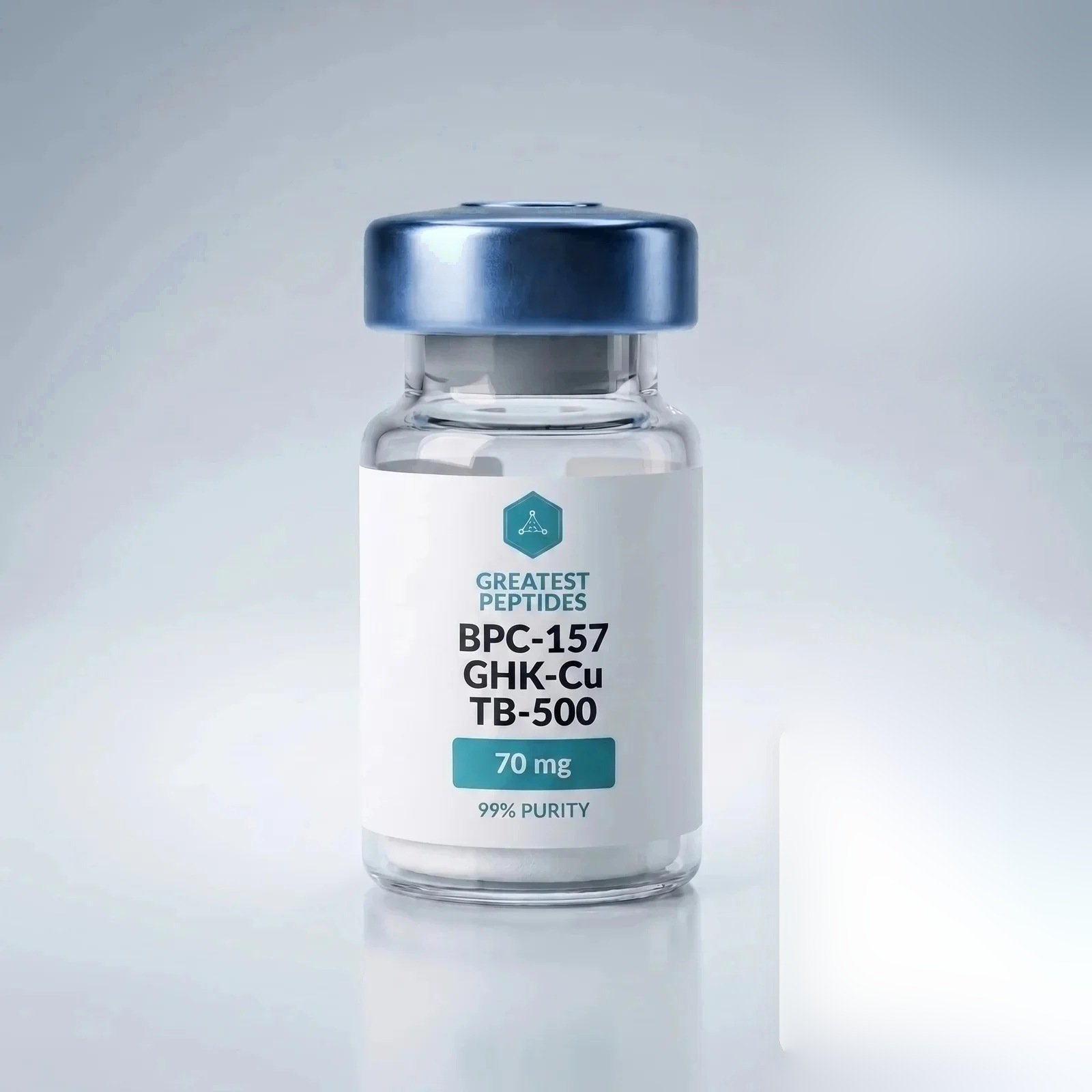
BPC-157 + GHK-Cu + TB-500 70 mg is supplied at 99%+ purity for in-vitro laboratory research only. Not for human or veterinary use.
Reconstituting this vial? Our free peptide reconstitution calculator converts vial mass and diluent volume into concentration, draw volume and U-100 syringe graduations. Research use only.
ALL ARTICLES AND PRODUCT INFORMATION PROVIDED ON THIS WEBSITE ARE FOR INFORMATIONAL AND EDUCATIONAL PURPOSES ONLY. The products offered on this website are intended solely for research and laboratory use. These products are not intended for human or animal consumption. They are not medicines or drugs and have not been evaluated or approved by the FDA to diagnose, treat, cure, or prevent any disease or medical condition. Any form of bodily introduction is strictly prohibited by law.
This research blend combines three of the most-studied recovery-research peptides: BPC-157 (pentadecapeptide), GHK-Cu (copper tripeptide), and TB-500 (Thymosin Beta-4 fragment). Together they are widely studied in tissue-repair, angiogenesis, and regeneration research models. Supplied as a co-formulated lyophilized powder for controlled laboratory research only.
Quantity: 70 mg total per vial, lyophilized powder
Purity: 99%+ HPLC standard — batch-specific Certificate of Analysis included for your exact lot
Identity: confirmed by LC-MS
Appearance: lyophilized powder
Documentation: Every vial ships with access to a batch-specific Certificate of Analysis showing HPLC purity, mass-spectrometry identity confirmation, endotoxin, residual solvents, and water content for your exact lot.
Handling & storage: Store lyophilized powder at -20°C. Reconstitute with bacteriostatic water for research handling. Keep out of direct light.
For laboratory and research use only. Not for human or animal consumption.
Shipped at ambient temperature in protective packaging. Lyophilized powder is stable in transit; on arrival, transfer to −20 °C storage as noted above.
Researcher FAQ
How do I reconstitute this peptide?
Use bacteriostatic water (BAC) at a 1–2 mL volume per vial. Add the solvent slowly down the vial wall, swirl gently — never shake. Refrigerate after reconstitution and use within 30 days. For in-vitro laboratory handling only.
How should I store this product?
Lyophilized: 36–46°F (refrigerated) for up to 24 months. Reconstituted: keep refrigerated and protect from light; use within 30 days. Avoid repeated freeze-thaw cycles.
Shipping & tracking?
Orders placed before 3 PM EST ship the same business day from our USA facility. Tracking is emailed within 24 hours. Plain, discreet packaging. Free shipping on orders over $150.
Buy BPC-157 + GHK + TB-500 Blend for Research | RUO COA & Documentation Guide
For laboratory teams evaluating where to buy the BPC-157 + GHK + TB-500 blend for research, the priority is documentation, per-component identity, and research-use-only (RUO) alignment. This is a three-component peptide blend combining BPC-157 (a synthetic pentadecapeptide, C62H98N16O22, ≈1,419.5 Da), GHK (glycyl-L-histidyl-L-lysine, C14H24N6O4, ≈340.4 Da), and TB-500 (a fragment associated with thymosin beta-4, Tβ4 is C212H350N56O78S, ≈4,963 Da)[1]. Because it is a blend, each component and its amount should be confirmed against the batch-specific COA. The individual components are described in the literature in cytoprotective, copper-peptide, and actin-regulation research contexts[2][3][4].
Fast Answer
Researchers evaluating where to buy this BPC-157 + GHK + TB-500 blend for research should review RUO labeling, a batch-specific certificate of analysis (COA) listing each peptide and its amount, HPLC purity and LC-MS identity data for the constituents, and lot traceability before procurement. Material discussed here is intended for laboratory research use only and is not for human or veterinary use.
What Does “Buy This Blend for Research” Mean?
The phrase is addressed as laboratory research-procurement intent — how qualified researchers evaluate a multi-peptide reference blend through documentation, per-component identity, and labeling clarity, not personal, clinical, or consumer decision-making.
Formulation Identity & Classification
Product name
BPC-157 + GHK + TB-500 blend
BPC-157
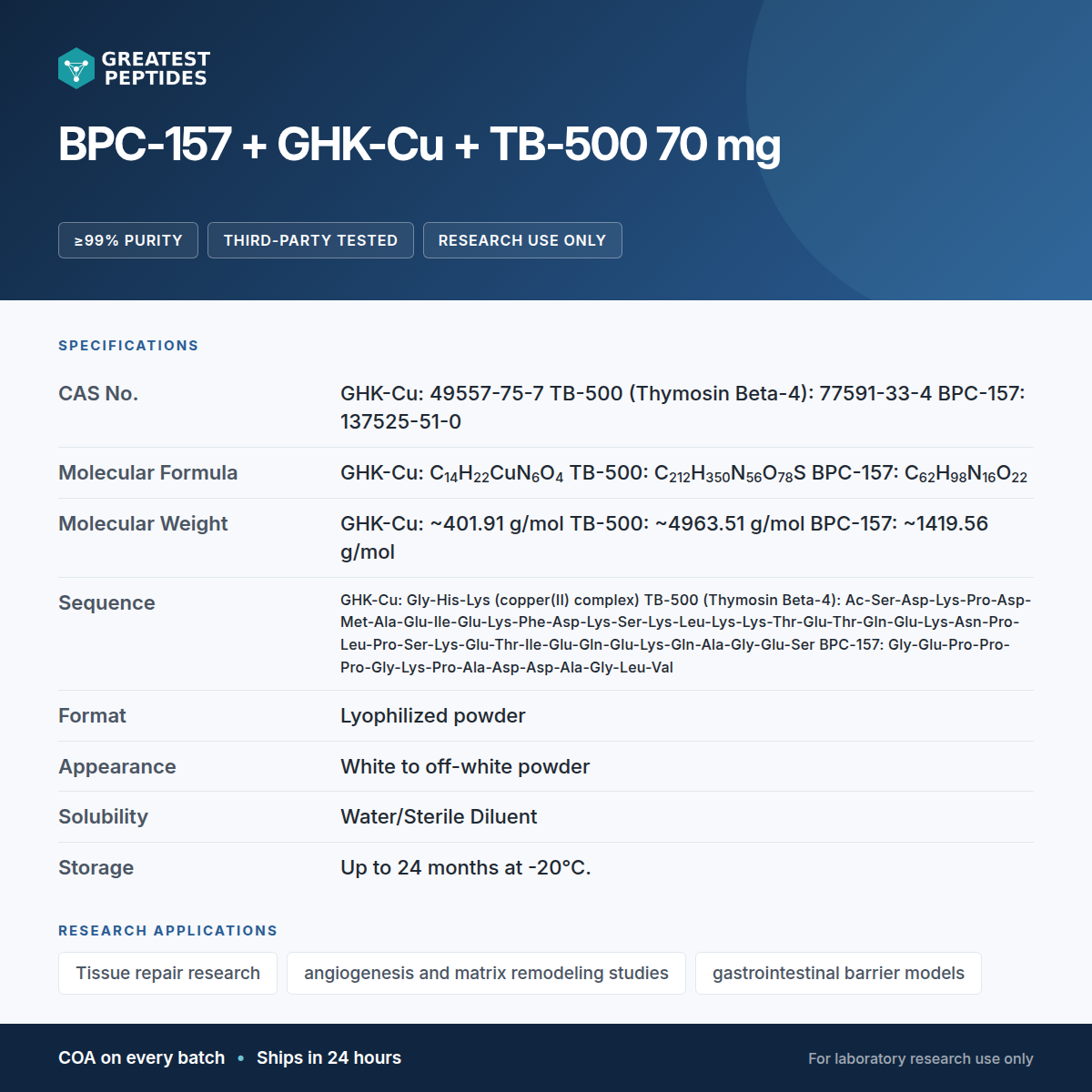
C62H98N16O22, ≈1,419.5 Da (pentadecapeptide)[1]
GHK
C14H24N6O4, ≈340.4 Da (CAS 49557-75-7)[1]
TB-500 (Tβ4)
C212H350N56O78S, ≈4,963 Da[1]
Classification
Multi-component peptide research blend
Product form
Lyophilized powder
Purity target
Per-component, see batch-specific COA
Regulatory status
Research use only — not for human or veterinary use
Published literature discusses BPC-157 in cytoprotection and angiogenesis research, GHK in copper-binding and matrix-remodeling research, and thymosin beta-4 (associated with TB-500) in actin-sequestration and tissue-repair research, across cell and preclinical models[2][3][4]. On a research product page this context should remain academic literature interpretation used to define the research lane — it is not converted into product-performance language.
COA, Component & Identity Documentation
A blend COA should be reviewed as a batch-specific record, not a marketing statement. For a multi-peptide blend, look for each peptide name, amount, lot number, test date, per-component purity, analytical method, and identity confirmation. Component list, amounts, method, and lot number should be evaluated together.
Evaluation area
What to review
Why it matters
RUO labeling
Clear research-use-only language
Separates research procurement from human-use positioning
COA availability
Batch-specific certificate for the received lot
Supports lot-level documentation
Component list
Each peptide with its amount
A blend must be fully specified to be usable in research
Purity data
Per-component HPLC area-percent support
Helps evaluate each constituent's consistency
Identity testing
LC-MS confirmation vs expected mass for each peptide
Confirms constituents match the listed blend
HPLC, LC-MS & Analytical Review
HPLC documentation supports per-component purity assessment; LC-MS documentation supports identity confirmation and molecular-mass review for each constituent against its expected value[10][11]. ICH Q2(R2) describes validation characteristics used to interpret assay, purity, and identity results[7].
Lot Traceability & Batch Documentation
Lot traceability connects the product listing, COA, label, and receiving record. ISO/IEC 17025 addresses the competence of testing laboratories, and NIST resources describe how certificates and lot identifiers support traceability[8][9].
Claim Boundary for RUO Positioning
Research-safe statement
Non-compliant version to avoid
“The blend's components are discussed in cytoprotection, copper-peptide, and actin-regulation literature.”
“This blend heals injuries or repairs tissue.”
“Researchers should confirm each peptide and amount on the COA.”
“Buy this blend for recovery.”
“Greatest Peptides supplies this blend as a research-use-only material.”
“Greatest Peptides supplies this blend for treatment.”
Research Procurement Checklist
Confirm the material is labeled for research use only.
Confirm each peptide and its amount on the COA.
Review the batch-specific certificate of analysis for the received lot.
Confirm per-component purity is supported by HPLC data.
Confirm per-component identity is supported by LC-MS.
Verify the lot number matches across all documentation.
Document storage and handling conditions in the laboratory record.
How Greatest Peptides Presents This Blend
Greatest Peptides supplies the BPC-157 + GHK + TB-500 blend as a research-use-only laboratory material in lyophilized powder form, characterized by a batch-specific COA listing each peptide and amount, HPLC/LC-MS documentation, lot-level traceability, and transparent RUO labeling. Products are not intended for human or animal consumption, diagnostic, therapeutic, clinical, or veterinary use.
Published Literature Context
Published literature on the blend's components spans peptide chemistry, cytoprotection, copper-peptide, and actin-regulation research models[2][3][4]. Model-specific findings should not be generalized or interpreted as use guidance for research-use-only materials.
Contributing Researchers
Recognized for published work that shaped the scientific context discussed above
Predrag Sikirić, MD, PhD — authored foundational research on BPC-157 in cytoprotection research[2].
Loren Pickart, PhD — characterized the GHK copper-peptide in matrix-remodeling research[3].
Allan Goldstein, PhD — authored foundational research on thymosin beta-4 (associated with TB-500)[4].
FAQs About Buying This Blend for Research
What should researchers check before buying this blend for research?
Confirm each peptide and its amount on the COA, then review RUO labeling, per-component purity (HPLC), identity (LC-MS), and lot traceability.
What is in the BPC-157 + GHK + TB-500 blend?
Three peptides: BPC-157 (≈1,419.5 Da), GHK (≈340.4 Da), and TB-500 (thymosin beta-4-associated, ≈4,963 Da); confirm amounts on the COA.
Why does a COA matter when buying a blend?
Because it is multi-component, the COA is the authoritative record of which peptides and amounts are present, with per-component purity and identity for the received lot.
Is this blend intended for human or animal use?
No. Material discussed here is intended strictly for laboratory research use only.
How should published literature be interpreted?
As scientific context only. Model-specific findings should not be generalized or read as use guidance for research-use-only materials.
This page addresses the BPC-157 + GHK + TB-500 blend only as research-use-only laboratory procurement. Boundary-sensitive terms such as healing, tissue repair, and recovery are referenced here only as research-language examples that must stay separate from RUO product positioning. All product information is for informational and educational purposes only. Products are not intended for human or animal consumption and have not been evaluated by the FDA to diagnose, treat, cure, or prevent any disease.
References
Reference records for BPC-157 (PubChem CID 9941957), GHK (CAS 49557-75-7), and thymosin beta-4 (PubChem CID 16132341). Accessed 2026.
Sikirić P, Seiwerth S, et al. Stable gastric pentadecapeptide BPC-157 in cytoprotection research. Current Pharmaceutical Design. 2011.
Pickart L, Margolina A. GHK copper peptide in tissue-remodeling research. International Journal of Molecular Sciences. 2018.
Goldstein AL, Kleinman HK. Thymosin beta-4 in tissue-repair research. Expert Opinion / Annals NYAS. 2010s.
IUPAC-IUB nomenclature for peptides and proteins. Recommendations.
U.S. FDA. Analytical procedures and methods validation for drugs and biologics. 2015.
U.S. FDA. Q2(R2) Validation of Analytical Procedures. 2024.
International Organization for Standardization. ISO/IEC 17025:2017. 2017.
National Institute of Standards and Technology. Reference materials and certificates of analysis. Accessed 2026.
Mant CT, et al. HPLC analysis and purification of peptides. Methods in Molecular Biology. 2007.
Steen H, Mann M. Peptide sequencing by mass spectrometry. Nature Reviews Molecular Cell Biology. 2004. PMID 15340378.
Compound profile
BPC-157 / GHK-Cu / TB-500 blend: compound profile, literature landscape and handling notes
BPC-157 / GHK-Cu / TB-500 blend in one paragraph
This listing is a single vial containing three different substances co-lyophilized together, 70 mg of total material divided among BPC-157, GHK-Cu and TB-500. The three are not chemically related and share no common line of research. What holds them together is a commercial format rather than a published pharmacology: there is no peer-reviewed characterization of this three-way combination, and each component carries its own separate and unequal evidence base. Those evidence bases do not add. This page therefore treats the blend as a blend, which is where the blend-specific problems live: a heterogeneous solid containing a metal complex alongside two peptides, one diluent that has to serve all three, a ratio that gross weight cannot establish, and readouts that cannot be assigned to a component. The pharmacology of each component is covered in depth on its own product page, linked in the table below. Everything here describes the published research record and the behavior of the material on a bench. Nothing here is a claim about what this vial does, and nothing here applies to use in humans or animals.
Where BPC-157 / GHK-Cu / TB-500 blend came from
The three-component repair blend is a packaging decision rather than a discovery, and the honest version of its origin story says so at the outset. No published paper proposes this combination, describes a preparation containing these three species, or reports an experiment in which they were applied together. The format arose in the research-chemical market, where combining separately sold materials into one listing is an ordinary commercial move, and it propagated between vendors the way conventions in that market usually do, by imitation rather than by evidence.
The rationale that is offered for it is plausible on its face and untested in fact. All three components appear in the literature in overlapping tissue-repair contexts, and all three are proposed to act by mechanisms that do not obviously collide. That is a reasonable basis for a hypothesis. It is not a result. Grouping compounds by the kind of model they have been studied in, rather than by a shared or complementary molecular target, is a weak organizing principle, and it is the only principle this blend has.
The three histories behind the vial are unrelated and very unequal in strength. BPC-157 descends from a gastroenterology line of work concerned with gastric cytoprotection, and its corpus is large, overwhelmingly rodent, and heavily concentrated in one group. GHK-Cu descends from separate work on a copper-binding tripeptide identified in human plasma, and its record is dominated by coordination chemistry and by cell-culture and matrix-biology studies. TB-500 is a synthetic fragment of thymosin beta-4, an endogenous actin-sequestering protein whose molecular function is genuinely well characterized, though the fragment is not the parent. Different decades, different fields, different standards of evidence.
The practical consequence follows directly. Any citation offered in support of this listing is a citation about one component studied by itself, usually in a model that had nothing to do with the other two. Placing three substances in one vial creates a preparation with no literature of its own, assembled from three literatures that were never designed to be combined.
Reading the structure of BPC-157 / GHK-Cu / TB-500 blend
The sequences, formulas, masses and the stated composition for this listing are printed in the specification table further down this page. What is worth developing here is something the table cannot convey, which is that this vial does not contain three variations on a theme. It contains three different classes of chemical matter that happen to share a cake.
The BPC-157 component is an ordinary unmodified linear peptide of fifteen residues: no cysteines and therefore no disulfides, no non-proteinogenic residues, no acylation, no C-terminal amidation, a free acid terminus, and a proline-rich backbone. Its chemistry is conventional peptide chemistry and its characteristic failure modes are the conventional ones, deletion and truncation impurities from synthesis and slow hydrolytic and isomerization routes in solution.
The GHK-Cu component is not a peptide in the same sense at all. It is a coordination complex: a tripeptide ligand, glycyl-histidyl-lysine, bound to copper in the divalent state through the N-terminal amine, a deprotonated backbone amide nitrogen and the imidazole nitrogen of the histidine side chain. The metal is not an additive or a contaminant, it is part of the identity of the substance. A preparation that has lost its copper still has the same amino-acid sequence and is nevertheless a different material, and no sequence-based check will notice the difference. Everything that follows in the handling and analytical sections traces back to this one fact.
The TB-500 component is a short fragment carrying the actin-binding motif of thymosin beta-4. Its striking structural feature is charge density: a high proportion of lysine and glutamate residues in a very short chain, no aromatic residues, no cysteines, no hydrophobic core, and no stable secondary structure when free in aqueous solution. It is among the most hydrophilic species in this catalog, which is why it behaves so differently on a reversed-phase column from either of the others.
Three chemical classes means three stability profiles and three analytical requirements sharing one container. The degradation routes do not even belong to the same branch of chemistry: the peptides degrade by hydrolysis, isomerization and oxidation, while the copper complex changes by ligand exchange, by reduction of the metal, and by displacement of copper by any competing binder that reaches it. A single lyophilization cycle, a single residual-moisture specification and a single storage statement have to serve all three, and they were not optimized for any of them individually.
The target and the pathway in more detail
None of the three components has a confirmed cell-surface receptor. That is not a hedge, it is the state of the field for all three, and it is the fact that governs everything else in this section. There is no binding partner established for any of them, no published saturable binding curve that has been independently reproduced, and no genetic model in which deleting a candidate target abolishes a reported effect.
The proposed mechanism for the TB-500 component runs through actin, and it is the best-defined of the three because its parent protein has a real molecular function: thymosin beta-4 binds monomeric G-actin and sequesters it, buffering the pool available for filament assembly. The fragment carries the motif associated with that binding. The detail, and the question of how much of the parent's behavior the fragment retains, belongs on the TB-500 product page and is treated there.
The proposed mechanism for the GHK-Cu component is copper chemistry rather than receptor pharmacology: delivery or sequestration of copper relevant to copper-dependent enzymes, and reported changes in extracellular-matrix gene expression in cultured cells. That literature and its limits are covered on the GHK-Cu product page.
The proposed mechanism for the BPC-157 component is pathway-level throughout: reported sensitivity of effects to manipulation of the nitric oxide system, and reported changes in growth-factor and adhesion-signaling readouts. Those are downstream observations rather than a target, and the BPC-157 product page sets out why that distinction matters.
Now the point that only belongs here. Three separately unvalidated mechanisms do not compose into a validated one. The argument implicitly made by the blend is that the three do not interfere because they act at different places, but that argument requires knowing where each acts, and for all three that is precisely what is not known. The absence of any shared receptor also removes the usual tool for predicting combination behavior: when two agents converge on one target you can reason about competition, cooperativity or occupancy, and when they do not, there is nothing to reason from. Claims of additivity or synergy for this combination are therefore not merely unsupported, they are untestable in principle without running the combination experiment with the components separately as controls, which is exactly the experiment that has not been published.
What the published literature on BPC-157 / GHK-Cu / TB-500 blend actually measures
The literature on this combination is, as far as the peer-reviewed record goes, nonexistent. That sentence is the whole section in compressed form, and the rest of it is about why that absence matters more than it first appears.
There is literature on each component individually, and it is unequal in both volume and quality. The BPC-157 record is large, almost entirely rodent injury models, and concentrated in one research line. The GHK-Cu record is smaller, older in origin, and split between coordination chemistry and cell-culture matrix biology, with a substantial applied literature outside the biomedical journals. The TB-500 record is smaller again and sits in the shadow of a much better developed literature on the full-length parent protein. Each of those bodies of work is discussed on its own product page. None of them was generated with the other two present.
What per-component data cannot tell you is exactly the thing a blend raises. Interaction effects are not predictable from the properties of the parts, and there are two independent kinds at issue here. The first is chemical: whether the three species are inert toward one another in the vial and in solution, which is a question about redox activity, metal-ligand competition and oxidation, and which has an answer that depends on the specific formulation rather than on any published pharmacology. The second is biological: whether the reported effects of the components in a shared model are additive, subadditive, or opposing at some point. Both kinds of interaction are, by construction, invisible to studies that used one component alone.
It is worth being precise about what would count as combination literature, because vendor summaries routinely present three single-agent citations as though they were evidence for a mixture. The minimum would be an experiment in which the combination and each component alone were run in the same model, in the same session, with a vehicle arm, and in which the composition of the mixture was analytically confirmed. No such report exists for these three. Until one does, the correct statement is not that the combination is unsupported by strong evidence but that it is unstudied, which is a different and cleaner claim.
Where the BPC-157 / GHK-Cu / TB-500 blend literature is thin or frequently misread
This is the section that does the most work for this listing, because nearly everything problematic about it is structural rather than a matter of degree.
The first gap is the complete absence of combination data described above. No paper has characterized this preparation, so every property attributed to it is inferred, and inference across three unrelated mechanisms with no shared target is not reliable inference.
The second is composition. The title states a total mass, and a total mass is close to uninformative about a mixture. Seventy milligrams of material distributed one way and seventy milligrams distributed another way are different reagents with the same label. Whatever ratio applies to this listing is a matter for the specification table and the documentation supplied with the lot, and the general point stands regardless of what that ratio is: a blend cannot be characterized by gross weight, and a concentration calculated from total mass describes no component in the vial.
The third is chemical compatibility, and it is the one most often skipped entirely. Copper in the divalent state is redox-active. Putting it in the same solid, and much more importantly in the same solution, as two peptides is not a neutral act. Copper-catalyzed oxidation of methionine and histidine side chains is well-documented chemistry, as is copper-mediated cleavage of a peptide backbone at coordination sites. Whether those reactions proceed at a meaningful rate here depends on pH, oxygen, temperature, concentration and the presence of any reducing species, none of which is fixed by the label. The components are not obviously inert toward one another, and nobody has published data showing that they are.
The fourth is attribution, which is a design problem rather than a chemistry one. Any result obtained with a blend has at least three candidate causes plus their interactions and plus any product of their reaction with each other. There is no analysis that recovers a component-specific conclusion from a mixture experiment after the fact. That makes a blend a poor choice for mechanistic work regardless of what is in it.
The fifth is that reconstitution fixes the ratio permanently. Once the cake is in solution, the proportions are locked, and the ability to vary one factor while holding the others constant, which is the basic move of experimental design, is gone for the life of that vial.
How BPC-157 / GHK-Cu / TB-500 blend behaves in solution
The three components have genuinely different optimal handling conditions, and a single vial forces a single set of conditions on all of them. That compromise, rather than any one component's behavior, is the real subject here.
The two peptide components are undemanding. Both are freely water-soluble, neither carries a lipid chain or a hydrophobic core, and both tolerate a fairly wide range of pH and buffer composition without dramatic consequences. The copper complex is the constrained one. Its stability depends on the metal staying coordinated to the tripeptide, which makes it sensitive to pH, since the deprotonated amide nitrogen that helps hold the copper is pH-dependent, and outright incompatible with two whole classes of common additive. Chelating agents compete for the metal directly; anything in the ethylenediamine tetraacetate family, and to a lesser degree citrate and some phosphate systems, will pull copper off the peptide. Reducing agents are the other hazard, because reduction of the metal changes its coordination preferences and can release it from the complex, and thiol reagents of the kind routinely present in cell-biology buffers both reduce and chelate.
The consequence is that a diluent chosen to protect one component may harm another. A buffer with a chelator in it, which is a perfectly sensible choice for a plain peptide where trace metals catalyze oxidation, is close to the worst possible choice for the copper complex. A preserved diluent containing benzyl alcohol raises a different question again, since benzyl alcohol is a solvent and mild denaturant whose interaction with a metal complex is not the same as its interaction with a small linear peptide. There is no universally correct answer, only a choice that must be recorded because it is part of the experimental condition.
One genuinely useful feature of this blend is visual. The copper complex is colored, and a reconstituted solution carries a distinct blue tint that a solution of either peptide alone would not have. That color is a real and immediate diagnostic for the copper component: loss or change of the tint, or the appearance of a precipitate, indicates that something has happened to the complex. Its limitation is equally important. The color reports only on the metal center. Both peptide components are colorless, both degrade without visible change, and a solution that is still perfectly blue tells you nothing at all about whether they are intact.
Analytical notes specific to BPC-157 / GHK-Cu / TB-500 blend
Three components means three orthogonal confirmations, not one, and this is the most practically useful thing on this page. A certificate that establishes one species establishes one species; it says nothing about the other two and nothing about the proportions among them.
Start with identity by mass. A single intact-mass measurement confirms at most one component, and for the copper complex it may not confirm even that. Electrospray ionization is an energetic environment for a coordination compound, and a metal-peptide complex can dissociate in the source, so what is observed may be the free tripeptide rather than the intact complex. Seeing the ligand mass is therefore not proof that the copper was ever there, and a report of the complex mass should state the source conditions under which it survived. Copper also has two abundant natural isotopes, which gives any genuinely copper-containing ion a distinctive isotope pattern; that pattern, when present, is far more informative than the nominal mass alone.
Ultraviolet detection is the next trap. The three species differ enormously in response. The two peptide components have essentially no useful aromatic content, so 280 nm is not available for them at all, and the histidine in the tripeptide does not rescue it. That leaves the amide bond in the low ultraviolet, around 214 nm, as the only common detection channel, and response there scales roughly with peptide-bond count. A tripeptide, a fifteen-residue peptide and a fragment of intermediate length therefore give very different signals per unit mass. The direct consequence is that area percentages from a single-wavelength chromatogram are not mass percentages, and reading a three-peak trace as though the areas were proportions is simply wrong.
Establishing that the stated composition is actually present takes one of two routes. Either three chromatographic peaks are separately quantified against authentic reference material for each component, with response factors determined rather than assumed, or LC-MS is run with three extracted ion chromatograms so that each species is tracked on its own channel. Both routes should be paired with an independent measurement of copper by an elemental method, because copper quantitation answers a question no peptide-based method can: how much metal is present, as distinct from how much ligand. Retention behavior helps here, since the highly charged fragment, the small polar complex and the mid-length peptide are unlikely to co-elute, but resolution is a prerequisite for quantitation, not a substitute for it.
Compounds researchers confuse with BPC-157 / GHK-Cu / TB-500 blend
Often mistaken for
How it actually differs from BPC-157 / GHK-Cu / TB-500 blend
The same peptide sold on its own. Buying it separately gets you three things this vial cannot: a ratio you set yourself rather than one fixed at the factory, a result attributable to one substance, and a diluent chosen for a plain peptide rather than compromised to accommodate a copper complex. Its documentation also describes one species, so purity and identity figures mean what they normally mean.
The copper complex on its own. Bought separately it can be reconstituted in a diluent free of chelators and reducing agents, quantified for copper without two peptides in the background, and stored under conditions chosen for a coordination compound. In the blend, none of those choices is available independently, and its blue color is the only component-specific signal you get for free.
The actin-binding fragment on its own. Separately supplied it can be varied against a fixed amount of anything else, run as its own arm in a controlled comparison, and characterized by methods suited to a short, highly charged, non-aromatic peptide. It is also the component whose contribution is hardest to detect in a mixture, since it lacks both a chromophore and a metal center.
Thymosin beta-4, full length
The endogenous 43-residue protein from which the TB-500 fragment is taken. It has a defined molecular function as a G-actin sequestering protein and a substantially deeper literature than the fragment, including work the fragment inherits by association rather than by evidence. Data generated with the full-length protein does not transfer to a fragment, and it certainly does not transfer to a three-component mixture containing one.
A tripeptide corresponding to the C-terminal end of alpha-melanocyte-stimulating hormone, studied mainly in inflammation models. It is the same length as the GHK ligand and is sometimes mentally filed alongside it for that reason, but it carries no metal, has an identified parent hormone with established melanocortin pharmacology, and is a single defined species rather than a component of a mixture.
Questions specific to BPC-157 / GHK-Cu / TB-500 blend
Why is there no published literature on this three-component combination?
Because the combination was assembled commercially rather than experimentally. Nobody set out to test whether these three substances do something together; a vendor put three separately sold items in one vial, and the format spread. There is published work on each component alone, generated in different decades by different fields with different standards of evidence, and none of those studies had the other two present. Three single-agent citations are not evidence for a mixture, and presenting them that way is the most common error made about this listing. The accurate description of the combination is not that it is weakly supported but that it is unstudied, which is a cleaner and more useful thing to write in a methods section.
Do the three components react with each other in the vial or in solution?
Nobody has published data either way, which is not the same as no. Copper in the divalent state is redox-active, and this preparation places it in the same solid, and after reconstitution in the same solution, as two peptides. Copper-catalyzed oxidation of methionine and histidine side chains is well-documented chemistry, and so is copper-mediated cleavage of a peptide backbone at coordination sites. Whether either proceeds at a rate that matters here depends on pH, dissolved oxygen, temperature, concentration and whether any reducing species is present, none of which the label fixes. The defensible position is that the components are not obviously inert toward one another and that anyone relying on the composition should confirm it analytically after reconstitution rather than assume it.
How do I confirm that all three components are actually present?
By three orthogonal measurements, not one. A single intact-mass result confirms at most one species. For the copper complex specifically, electrospray conditions can strip the metal in the source, so observing the free tripeptide mass does not prove the copper was there; the copper isotope pattern in a surviving complex ion is much better evidence, and an elemental measurement of copper is better still because it answers a question no peptide method can. For the two peptide components, separate chromatographic peaks tracked by extracted ion chromatograms, or quantified against authentic reference material, are what establish presence. Any one of these alone leaves two of three components unconfirmed.
Why is a blend a poor choice for mechanistic work?
Because it destroys attribution. Any observation made with this vial has at least three candidate causes, plus every interaction among them, plus any product of the components reacting with one another. No statistical treatment recovers a component-specific conclusion from a mixture experiment after the fact; the information was never collected. Reconstitution makes it worse by fixing the proportions permanently, so the basic move of experimental design, varying one factor while holding the others constant, is unavailable for the life of that solution. Work that needs to know which substance did something has to use the components separately, with the mixture included as an additional arm if the mixture itself is the object of study.
Can the ratio of the three components be worked out from the total mass?
No. A total mass constrains the sum and says nothing about the split, and a blend cannot be characterized by gross weight. It is also worth noting that even the sum is not purely active material, since peptides are normally supplied as salts with residual water and counterion contributing to the weighed mass. Whatever composition applies to this listing is a matter for the specification table on this page and the documentation supplied with the lot. Determining it independently requires either three separately quantified chromatographic peaks with real response factors, since ultraviolet response at 214 nm scales with peptide-bond count and area percent is therefore not mass percent, or LC-MS with one extracted ion channel per component, plus an elemental copper number.
What does the copper component constrain about diluent choice?
More than the peptides do, which is why it drives the decision. The complex depends on the metal staying coordinated to the tripeptide, so it is sensitive to pH and outright incompatible with two common classes of additive. Chelators compete for the copper directly, so buffers containing ethylenediamine tetraacetate, and to a lesser extent citrate and some phosphate systems, will strip it. Reducing agents change the oxidation state and can release the metal, and thiol reagents both reduce and chelate. Since the two peptide components tolerate a much wider range, any single diluent is a compromise weighted toward protecting the complex. The blue tint of a reconstituted solution is a useful running check on that component, but it reports only on the metal center and says nothing about whether the peptides are intact.
Documentation and handling reference
BPC-157 + GHK-Cu + TB-500: Documentation, Handling and Quality Record for This SKU
The section above covers what BPC-157 + GHK-Cu + TB-500 is and what the published literature has looked at. This section is the operational half: what physically arrives when you order this listing, what paperwork comes with it, which fields on that paperwork are worth reading closely, and how to log the material once it is on your bench. It is written for the person who has already decided the compound is relevant and now has to justify the purchase to a supervisor, a grant line or an internal quality process.
Everything below is scoped to this exact listing rather than to research peptides in general. If you want the general version — how to read a certificate of analysis from scratch, what HPLC and mass spectrometry each prove, how to compare two suppliers who both claim 99% — that is on the home page guide, and there is no reason to read it twice.
What ships when you order BPC-157 + GHK-Cu + TB-500
At a glance
One sealed vial of lyophilized material at the listed 70 mg fill, labeled for research use only, dispatched within 24 hours of the order clearing. Batch documentation is available for the lot you receive. Free shipping applies at $150 and above.
This listing is a single fixed presentation, not a size selector. That is deliberate: each presentation gets its own page, its own documentation trail and its own URL, so a citation or a purchase-order line that points at BPC-157 + GHK-Cu + TB-500 at 70 mg points at exactly one thing. If you need a different fill of the same compound and it is not listed, it is not currently in stock rather than hidden behind a dropdown.
Field
This listing
Listing
BPC-157 + GHK-Cu + TB-500 70 mg
Labeled fill mass
70 mg
Physical form
Lyophilized powder in a sealed vial
Catalog category
Peptide Blends & Multi-Component Formulations
Compound class
Multi-component research blend
Intended use
Research use only. Not for human or veterinary use, not for diagnostic use, not a drug or supplement.
Dispatch
Within 24 hours of the order clearing
Documentation
Batch analytical documentation available for the lot supplied
Free shipping threshold
Orders of $150 and above
Specification summary for BPC-157 + GHK-Cu + TB-500
The table below is the specification the store publishes for this listing. It is reproduced here from the product record itself rather than retyped, which means it cannot drift away from what the attribute table further up the page says. Where a field is absent it is absent because we do not publish it for this SKU, not because it was left out of this summary.
A specification table is a claim, and a claim is only worth the record behind it. Every field above is one you can ask us to substantiate against the batch documentation for the lot you were sent. If a field ever fails to match the paperwork, that is a defect on our side and we would rather hear about it than not.
A blend has as many identities as it has components, and a single purity percentage cannot describe it. What a blend certificate needs to show is the identity of each component and the ratio between them; a lone number on the front page does not.
The analytical record behind this lot
A certificate of analysis is not a quality badge. It is a measurement report about one specific batch, produced on a specific date by a specific method, and its value to you is entirely a function of how much of that context it discloses. For BPC-157 + GHK-Cu + TB-500 the fields worth checking first are the ones that tie the document to the container in your hand.
Field on the certificate
Why it matters for this SKU
Lot or batch identifier
Ties the document to the vial. A certificate with no lot reference describes some batch, not necessarily yours.
Compound name and, where applicable, sequence
This is the identity claim. For a multi-component research blend it is the field that distinguishes the material from its close relatives.
Analytical method and conditions
A purity figure without a method is a number without units. Column, gradient and detection wavelength change what the figure means.
Date of analysis
Establishes how old the measurement is relative to the material. A recent vial with a two-year-old certificate is a documentation gap.
Who performed the analysis
In-house and independent third-party results are both legitimate; they are not the same claim, and the document should say which it is.
The chromatogram or spectrum itself
A summary table can be typed by anyone. A trace can be read, and a reader who knows the compound class can tell whether it is plausible.
What our documentation for BPC-157 + GHK-Cu + TB-500 does assert is what the analysis measured on the batch that was tested. What it does not assert — and no certificate from any supplier can assert — is that the material is safe, that it is suitable for any use in humans or animals, or that it will reproduce a result reported in a published paper. Those are different questions and a purity figure is not evidence for any of them.
Our batch documentation policy, including how to request the record for a lot you already have, is on the certificate of analysis page. If you need the record before ordering rather than after, ask us through the contact page and reference this listing by name.
How BPC-157 + GHK-Cu + TB-500 is checked before it reaches this catalog
Three questions have to be answered separately before a compound gets a page here, and collapsing them into one percentage is the most common way a supplier listing becomes misleading.
Question
What answers it
What it does not tell you
Identity — is this the right molecule?
Mass determination, and sequence confirmation where the material is a defined chain
Nothing about how much of the vial is that molecule
Purity — what proportion of the detected material is the target?
Chromatographic separation with a stated method
Nothing about what the other fraction actually is, unless the impurities are themselves identified
Content — how much target material is actually in the container?
Quantitative determination against the labeled fill
Nothing about identity or purity; a vial can be accurately filled with the wrong thing
For BPC-157 + GHK-Cu + TB-500, component-resolved analysis, then whatever assay is appropriate to each component individually are the assay formats the published work in this area tends to use, which matters when you are deciding whether the material as supplied is fit for the experiment you have in mind. A compound that is clean enough for a binding assay is not automatically clean enough for a quantitative cell-based readout where a co-eluting impurity could carry activity of its own.
Content is the field most often missing from a supplier listing, and it is the one that changes your arithmetic. A vial labeled 70 mg contains that much total solid, and total solid includes counter-ion, residual water and whatever else survived the process. If you need the peptide mass rather than the vial mass to be exact, that is a specific request to make in advance, not an assumption to carry into a calculation.
Receiving, inspecting and storing BPC-157 + GHK-Cu + TB-500
The most useful five minutes you will spend on this material are the five minutes immediately after the package is opened, because that is the only moment at which you can still distinguish a transit problem from a handling problem of your own.
Confirm the label on the container matches this listing, including the fill mass, and record the lot identifier in your notebook before anything else happens.
Inspect the closure and seal. A compromised closure is a reason to stop, not a reason to proceed carefully.
Look at the cake. Note its appearance and position; a cake that has collapsed, shifted or gone glassy is telling you something about the vial's history in transit.
Let a cold vial reach room temperature before opening it, so that atmospheric moisture condenses outside the vial rather than into the material.
Photograph the label and the container on arrival. It costs nothing and it settles later questions instantly.
Store it in the dark, at the temperature stated for this listing, and write down the date it entered storage.
Decide your aliquot plan before the first opening, not after it.
Components in a blend do not necessarily degrade at the same rate, so a blend can drift out of its stated ratio while still looking intact.
The general rule for lyophilized material is that the dry state is the stable state and every transition away from it costs you something. Freeze-thaw cycling is the specific mechanism most likely to degrade BPC-157 + GHK-Cu + TB-500 after it reaches you, and it is entirely under your control: a single reconstitution split into pre-planned aliquots exposes the material once, while repeatedly warming and refreezing one container exposes it as many times as you open it. There is a fuller treatment of the mechanism in our guide on freeze-thaw cycles in peptide research materials and on storage and handling.
Preparing aliquots from a 70 mg vial: the measurement arithmetic
This is arithmetic, not guidance. The only thing the table below does is tell you what concentration you are holding after you have added a known volume of diluent to a vial labeled 70 mg, so that the figure in your notebook and the figure in the container are the same figure. It says nothing about how much material any experiment should use, and it is not applicable to any use in humans or animals.
Diluent added
Resulting concentration
Amount in 0.1 mL
Amount in 0.05 mL
Aliquots of 0.25 mL
1 mL
70 mg/mL
7,000 µg
3,500 µg
4
2 mL
35 mg/mL
3,500 µg
1,750 µg
8
3 mL
23.33 mg/mL
2,333.3 µg
1,166.7 µg
12
5 mL
14 mg/mL
1,400 µg
700 µg
20
Every figure above is the same division: the labeled mass of BPC-157 + GHK-Cu + TB-500 divided by the volume of diluent added. Nothing in the table is a recommendation about how much material to use in an experiment — it is the arithmetic that tells you what concentration you are holding once you have added a known volume, so that the number you write in the notebook matches what is in the container.
Two things routinely go wrong at this step. The first is treating the labeled mass as the peptide mass; as noted above, the labeled figure is total solid unless the documentation says otherwise, so a concentration derived from it is a nominal concentration. Say so in your methods rather than implying a precision the specification does not support. The second is ignoring the volume the solid itself occupies — small at these masses, but not zero, and it means the final volume is very slightly greater than the volume you added.
If you want to work backwards from a target concentration to a diluent volume, or to check a figure against a different vial size, our peptide reconstitution calculator does the same division in both directions and shows its working.
What to record for BPC-157 + GHK-Cu + TB-500 so the work is reproducible
Reproducibility in this area fails at the material-provenance step far more often than at the analysis step. The fields below are the ones that let somebody else — a reviewer, a collaborator, or you in eighteen months — work out whether two sets of results were generated with comparable material.
Supplier and the exact listing name, including the fill size, rather than just the compound name
Lot identifier, and the date the batch documentation was issued
Date received, and the storage conditions and location it went into
Date of reconstitution, the diluent used and its lot, and the volume actually added
Nominal concentration obtained, stated as nominal rather than as measured
Aliquot scheme: how many, what volume, stored where
Freeze-thaw count for each aliquot at the point of use
Any deviation from plan, including deviations that seemed unimportant at the time
Whether the material was research-use-only labeled, which for this listing it is
Comparing suppliers on this exact SKU
Comparing BPC-157 + GHK-Cu + TB-500 across suppliers on price alone is comparing two numbers that may not describe the same thing. These are the questions that make the comparison meaningful, with our answers next to them so you can hold us to the same standard you would hold anyone else.
Question to ask any supplier
Our answer for this listing
Is batch documentation available for the specific lot I will receive, not a representative lot?
Is there a published position on what the documentation does not prove?
Yes. It is stated on this page and on every product page.
A supplier who answers all seven honestly is a better bet than a supplier who is ten percent cheaper and answers four. A supplier who cannot answer the first one at all is not selling you documented material; they are selling you a container.
Compliance boundary for BPC-157 + GHK-Cu + TB-500
BPC-157 + GHK-Cu + TB-500 is supplied for laboratory research use only. It is not a drug, not a supplement, not a cosmetic and not a medical device. It is not for human or veterinary administration, not for diagnostic use, and not for use in food. That is not a disclaimer bolted onto a sales page — it is the actual scope of what is being sold, and it constrains what can honestly be written about it.
Language that stays inside the boundary
Language that does not
"Supplied for research use only"
Any phrasing that implies a personal or clinical use
"Published work in this area has examined the literature for each component separately - a blend as a combination is generally not what has been studied"
"BPC-157 + GHK-Cu + TB-500 does X" stated as an established effect
"Purity determined by the stated method on the tested batch"
"Pharmaceutical grade", "medical grade", "safe"
"Concentration arithmetic for preparing laboratory aliquots"
Anything framed as a dose, a protocol or a schedule
"Not for human or veterinary use"
Silence on the point, which readers correctly interpret as evasion
Naming the model system a finding came from
Reporting an animal or in-vitro finding as though it were a human finding
The reason to be precise about this is not only regulatory. Research literature on this class of material is genuinely interesting and genuinely incomplete, and overstating it makes the real findings harder to see. Where published work is referenced on this site it is referenced as what was measured, in what system, at what scale — not as a property of the vial.
Other Peptide Blends & Multi-Component Formulations listings
These share a catalog category with BPC-157 + GHK-Cu + TB-500, which means the documentation and handling considerations above largely transfer to them. Their compound-specific sections do not — each has its own identity, its own literature and its own analytical profile.
$128.99Original price was: $128.99.$114.99Current price is: $114.99.
The full catalog is on the shop page, and the longer written material is in our research guides.
Questions about ordering BPC-157 + GHK-Cu + TB-500
Is BPC-157 + GHK-Cu + TB-500 documentation available before I order?
Yes. Ask through the contact page and reference this listing by name. Our general position on batch documentation is on the certificate of analysis page. If a supplier will not show you the record until after payment has cleared, that is worth noticing.
What does the 70 mg figure on the label actually refer to?
It is the labeled fill for this presentation. For lyophilized material the labeled mass is total solid unless the documentation states otherwise, and total solid includes counter-ion and residual moisture as well as target compound. If your calculation depends on the distinction, resolve it against the batch record rather than assuming.
How fast does BPC-157 + GHK-Cu + TB-500 ship?
Within 24 hours of the order clearing. Orders of $150 and above ship free. Transit time after dispatch depends on the service selected at checkout.
Can I buy BPC-157 + GHK-Cu + TB-500 for personal use?
No. This material is supplied for laboratory research use only. It is not a drug, supplement or cosmetic, it is not for human or veterinary administration, and nothing on this page should be read as guidance for any such use.
How should BPC-157 + GHK-Cu + TB-500 be stored before and after reconstitution?
Store the sealed vial dry, dark and at the temperature stated for this listing, and record the date it entered storage. Once material is in solution the useful discipline is to minimize repeated warming: plan the aliquot scheme before the first reconstitution so the material is exposed once rather than once per experiment. Components in a blend do not necessarily degrade at the same rate, so a blend can drift out of its stated ratio while still looking intact.
How much diluent should I add to a 70 mg vial?
That depends entirely on the concentration your protocol calls for, which is your decision and not something a product page can answer. What the table above provides is the arithmetic: labeled mass divided by added volume gives concentration. The reconstitution calculator runs the same division in either direction.
Does a high purity figure mean BPC-157 + GHK-Cu + TB-500 is safe?
No, and this is the single most common misreading of a certificate of analysis. Purity describes what proportion of the detected material was the target compound in the batch that was tested, by the method stated. It is not a safety assessment, it says nothing about suitability for any use in humans or animals, and it does not become a safety claim by being a large number.
What is BPC-157 + GHK-Cu + TB-500 classified as in your catalog?
It is listed as a co-lyophilized combination of separately specified components, in the Peptide Blends & Multi-Component Formulations category. Published work in this area has looked at the literature for each component separately - a blend as a combination is generally not what has been studied. That is a description of where the literature sits, not a claim about what the material does.
Do you have more general written material on evaluating research peptides?
Yes. The home page guide covers reading a certificate of analysis, what chromatographic and mass-spectrometric methods each prove, and how to compare suppliers. The research guides go deeper on individual topics, and the FAQ covers ordering, shipping and post-shipping questions.
BPC-157 + GHK-Cu + TB-500 70 mg is supplied strictly for laboratory research use. It is not a drug, supplement, cosmetic or medical device; it is not for human or veterinary use, not for diagnostic use and not for use in food. No statement on this page is intended to describe a therapeutic use, benefit or outcome, and references to published work describe what was measured in the reported model system rather than a property of the material supplied. Purchasers are responsible for handling the material in accordance with the requirements applicable to their institution and jurisdiction.
Check the documentation before you check the price