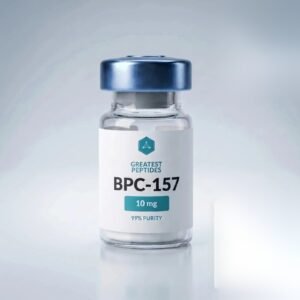
$38.99Original price was: $38.99.$34.99Current price is: $34.99.
In stockShips today if ordered by 3 PM ESTUSA fulfillment
Research Studies
✓Studied as an α-MSH tripeptide fragment in inflammation research.
✓Investigated for NF-κB and cytokine-signaling pathways in vitro.
✓Used in laboratory models of gut-barrier and immune response.
✓Applied in anti-inflammatory research assays.
KPV 10 mg is supplied at 99%+ purity for in-vitro laboratory research only. Not for human or veterinary use.
Reconstituting this vial? Our free peptide reconstitution calculator converts vial mass and diluent volume into concentration, draw volume and U-100 syringe graduations. Research use only.
ALL ARTICLES AND PRODUCT INFORMATION PROVIDED ON THIS WEBSITE ARE FOR INFORMATIONAL AND EDUCATIONAL PURPOSES ONLY. The products offered on this website are intended solely for research and laboratory use. These products are not intended for human or animal consumption. They are not medicines or drugs and have not been evaluated or approved by the FDA to diagnose, treat, cure, or prevent any disease or medical condition. Any form of bodily introduction is strictly prohibited by law.
KPV is a synthetic tripeptide (lysine-proline-valine) corresponding to the C-terminal fragment of alpha-melanocyte-stimulating hormone (alpha-MSH). It is widely used as a research tool in inflammation and gut-barrier models. Greatest Peptides supplies KPV as a >99% pure lyophilized powder for laboratory research use only.
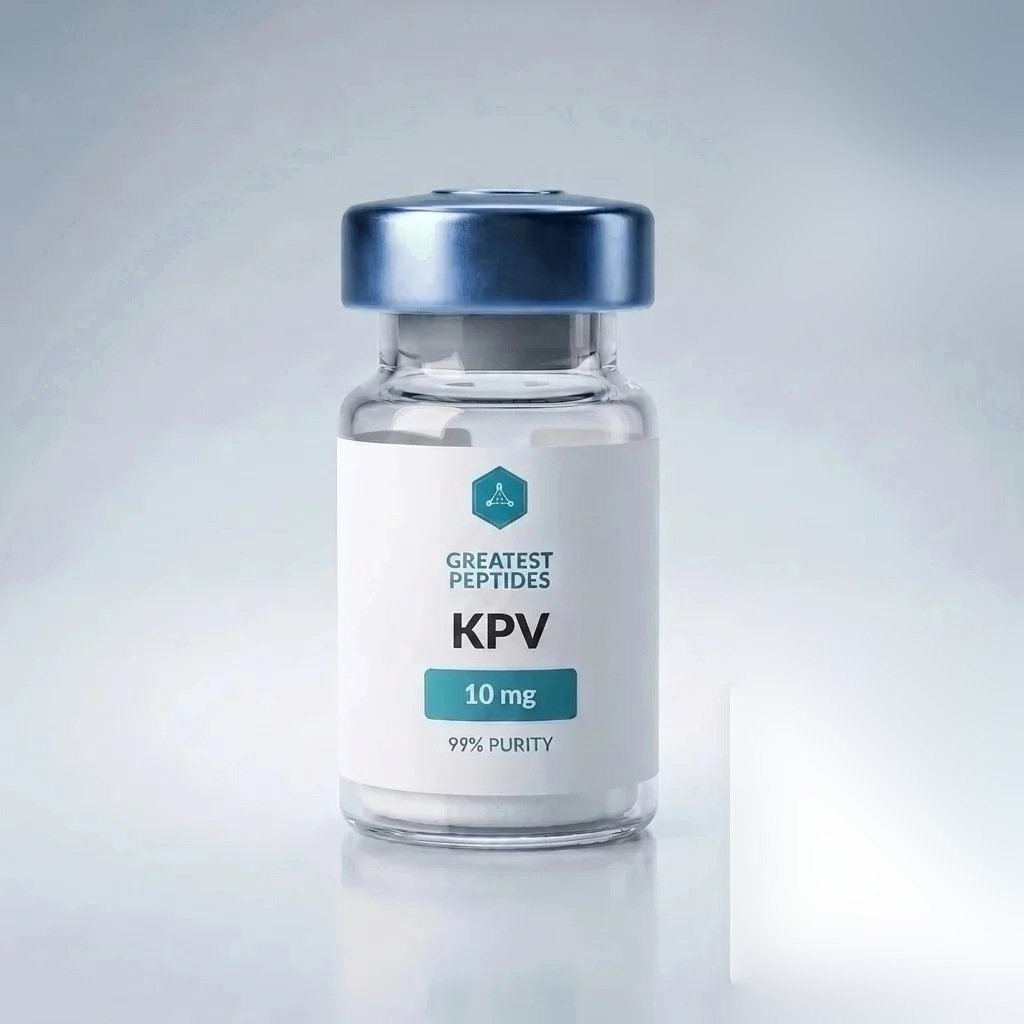
KPV, 10 mg per vial, a lysine-proline-valine tripeptide (lyophilized). For research use only.
Purity: ≥98% HPLC (see batch COA); identity confirmed by LC-MS. A batch-specific Certificate of Analysis (COA) is available for each lot. For laboratory and research use only. Not for human or animal consumption.
KPV Research Overview
In published preclinical literature, KPV has been investigated for its relationship to the NF-κB signaling pathway, modulation of pro-inflammatory cytokines, and intestinal epithelial transport via PepT1. It is frequently used as a model compound in colitis and mucosal-barrier research.
These observations describe outcomes reported in laboratory and animal research models only. KPV is a research chemical — it is not a dietary supplement, drug, or therapeutic product, and nothing here describes effects in humans.
Related Research Topics
KPV and the NF-κB pathway
Alpha-MSH fragment peptides in research
KPV in gut-barrier models
Frequently Asked Questions
What is KPV used for in research?
KPV is used strictly as a tool compound in laboratory research, as described in the overview above. It is studied in controlled models only.
Is KPV research use only?
Yes. All compounds from Greatest Peptides are supplied strictly for laboratory and research use only. They are not intended for human or veterinary use.
What purity is your KPV?
Supplied at 99%+ HPLC purity with a batch-specific Certificate of Analysis (COA) confirming purity by HPLC and identity by mass spectrometry for your exact lot.
How should KPV be stored?
Lyophilized KPV is typically kept refrigerated and protected from light for short-term handling, and frozen (-20°C) for longer-term storage.
How is KPV supplied?
KPV ships as a white lyophilized powder, 10 mg per vial, requiring reconstitution with a suitable solvent prior to research use.
Additional information
CAS No.
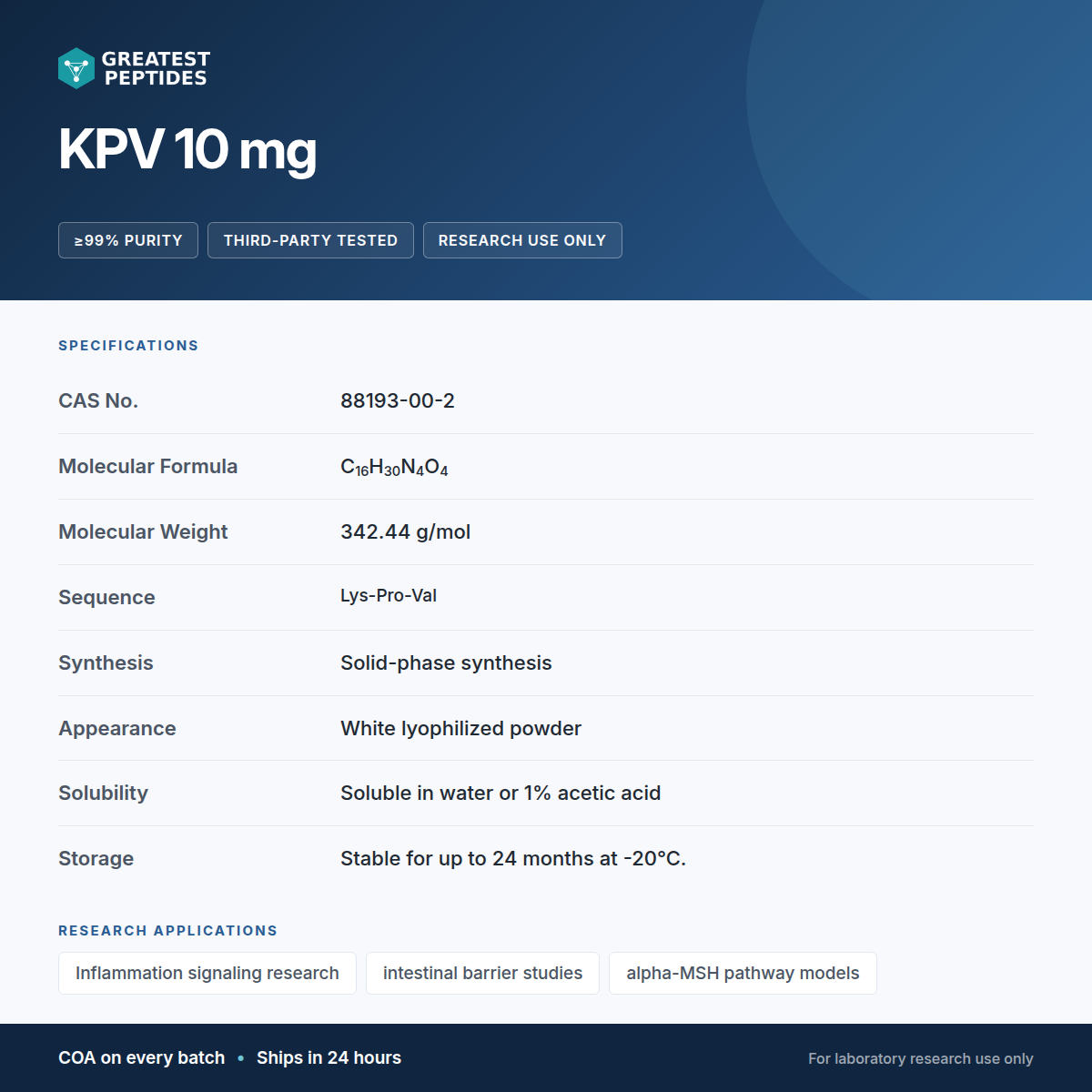
88193-00-2
Purity
≥99%
Sequence
Lys-Pro-Val
Molecular Formula
C16H30N4O4
Molecular Weight
342.44 g/mol
Synthesis
Solid-phase synthesis
Solubility
Soluble in water or 1% acetic acid
Stability & Storage
Stable for up to 24 months at -20°C. After reconstitution, may be stored at 4°C for up to 4 weeks or at -20°C for up to 6 months.
Shipped at ambient temperature; once received, store at -20°C
Regulatory/Compliance
Manufactured in a facility that adheres to cGMP guidelines
Safety Information
Refer to provided MSDS
Researcher FAQ
How do I reconstitute this peptide?
Use bacteriostatic water (BAC) at a 1–2 mL volume per vial. Add the solvent slowly down the vial wall, swirl gently — never shake. Refrigerate after reconstitution and use within 30 days. For in-vitro laboratory handling only.
How should I store this product?
Lyophilized: 36–46°F (refrigerated) for up to 24 months. Reconstituted: keep refrigerated and protect from light; use within 30 days. Avoid repeated freeze-thaw cycles.
Shipping & tracking?
Orders placed before 3 PM EST ship the same business day from our USA facility. Tracking is emailed within 24 hours. Plain, discreet packaging. Free shipping on orders over $150.
Buy KPV for Research | RUO COA & Documentation Guide
For laboratory teams evaluating where to buy KPV for research, the priority is documentation, compound identity, and research-use-only (RUO) alignment. KPV is a tripeptide composed of lysine-proline-valine (Lys-Pro-Val), corresponding to the C-terminal 11–13 sequence of alpha-melanocyte-stimulating hormone (α-MSH)[2][3]. Its reported molecular formula is C16H30N4O4 with a molecular weight of approximately 342.4 g/mol; because small-peptide descriptors vary by salt form, identity should be confirmed against the batch-specific COA.
Fast Answer
Researchers evaluating where to buy KPV for research should review RUO labeling, a batch-specific certificate of analysis (COA), HPLC purity data, LC-MS or comparable identity support, sequence/mass consistency, and lot traceability before procurement. Material discussed here is intended for laboratory research use only and is not for human or veterinary use.
What Does “Buy KPV for Research” Mean?
The phrase is addressed as laboratory research-procurement intent — how qualified researchers, institutions, and technical buyers evaluate a KPV reference material through documentation, analytical support, and labeling clarity, not personal, clinical, or consumer decision-making.
Compound Identity & Classification
Compound name
KPV (Lys-Pro-Val tripeptide)
Origin
C-terminal fragment (11–13) of α-MSH[2][3]
Molecular formula
C16H30N4O4 (reported; confirm against batch COA)
Molecular weight
≈ 342.4 g/mol (reported; salt-form dependent)
Sequence
Lys-Pro-Val
Format
3-amino-acid synthetic peptide
Product form
Lyophilized powder
Purity target
≥ 99% (see batch-specific COA)
Regulatory status
Research use only — not for human or veterinary use
Published literature discusses KPV within melanocortin-pathway and mucosal-inflammation research, reporting melanocortin-receptor interaction (e.g., MC1R/MC3R) and NF-κB-related signaling in cell and preclinical models[2][3]. On a research product page this pathway context should remain academic literature interpretation used to define the research lane — it is not converted into product-performance language.
COA, Purity & Identity Documentation
A KPV COA should be reviewed as a batch-specific record, not a marketing statement. Look for compound name, lot number, test date, stated purity, analytical method, identity confirmation, and molecular information. Purity, identity, method, and lot number should be evaluated together.
Evaluation area
What to review
Why it matters
RUO labeling
Clear research-use-only language
Separates research procurement from human-use positioning
COA availability
Batch-specific certificate for the received lot
Supports lot-level documentation
Purity data
HPLC area-percent support for stated purity
Helps evaluate material consistency
Identity testing
LC-MS / mass-spec confirmation vs expected mass
Confirms the material matches the listed peptide
Lot traceability
Lot number matching across records
Supports research recordkeeping
HPLC, LC-MS & Analytical Review
HPLC documentation supports purity assessment; LC-MS or mass-spectrometry documentation supports identity confirmation and molecular-mass review[10][11]. For a short tripeptide, mass data confirming the observed mass against the expected value are especially useful alongside HPLC purity data. ICH Q2(R2) describes validation characteristics used to interpret assay, purity, and identity results[7].
Lot Traceability & Batch Documentation
Lot traceability connects the product listing, COA, label, and receiving record. ISO/IEC 17025 addresses the competence of testing laboratories, and NIST resources describe how certificates and lot identifiers support traceability[8][9].
Claim Boundary for RUO Positioning
Research-safe statement
Non-compliant version to avoid
“KPV is discussed in published literature on melanocortin and mucosal-inflammation research.”
“KPV treats inflammation or gut conditions.”
“Researchers should review COA and identity data before procurement.”
“Buy KPV for gut health.”
“Greatest Peptides supplies KPV as a research-use-only material.”
“Greatest Peptides supplies KPV for treatment.”
Research Procurement Checklist
Confirm the material is labeled for research use only.
Review the batch-specific certificate of analysis for the received lot.
Confirm purity is supported by HPLC analytical data.
Confirm identity is supported by LC-MS or mass spectrometry.
Compare compound name, sequence, formula, and mass across the page, label, and COA.
Verify the lot number matches across all documentation.
Document storage and handling conditions in the laboratory record.
How Greatest Peptides Presents KPV
Greatest Peptides supplies KPV as a research-use-only laboratory material in lyophilized powder form, positioned around a stated ≥99% purity target, batch-specific COA availability, HPLC/LC-MS documentation, lot-level traceability, and transparent RUO labeling. Products are not intended for human or animal consumption, diagnostic, therapeutic, clinical, or veterinary use.
Published Literature Context
Published KPV literature spans melanocortin-fragment characterization and preclinical mucosal-inflammation research models[2][3]. Model-specific findings should not be generalized or interpreted as use guidance for research-use-only materials.
Contributing Researchers
Recognized for published work that shaped the scientific context discussed above
Didier Merlin, PhD — authored research on the tripeptide KPV and intestinal-inflammation research models, including PepT1-mediated uptake studies[2].
Thomas A. Luger, MD — authored review work on α-MSH and related melanocortin peptides that informs KPV’s scientific context[3].
FAQs About Buying KPV for Research
What should researchers check before buying KPV for research?
Review RUO labeling, the batch-specific COA, stated purity with HPLC support, LC-MS identity data, sequence/mass consistency, and lot traceability.
What is KPV in research documentation?
KPV is a lysine-proline-valine tripeptide corresponding to the α-MSH 11–13 fragment, with reported molecular formula C16H30N4O4 and molecular weight near 342.4 g/mol.
Why does a COA matter when buying KPV?
It connects the listing to batch-specific documentation: compound name, lot number, test date, purity, and identity method for the received lot.
Is KPV intended for human or animal use?
No. Material discussed here is intended strictly for laboratory research use only.
How should published literature be interpreted?
As scientific context only. Model-specific findings should not be generalized or read as use guidance for research-use-only materials.
This page addresses KPV only as research-use-only laboratory procurement. Boundary-sensitive terms such as inflammation, colitis, gut, skin, and IBD are referenced here only as research-language examples that must stay separate from RUO product positioning. All product information is for informational and educational purposes only. Products are not intended for human or animal consumption and have not been evaluated by the FDA to diagnose, treat, cure, or prevent any disease.
References
Reported molecular descriptors for the KPV (Lys-Pro-Val) tripeptide (confirm against batch COA). Accessed 2026.
Brzoska T, Luger TA, et al. Alpha-MSH and related melanocortin peptides: anti-inflammatory research (review). Endocrine Reviews. 2008. PMID 18436830.
Registry record for the KPV tripeptide. Accessed 2026.
IUPAC-IUB Joint Commission. Nomenclature and symbolism for amino acids and peptides. 1983.
U.S. FDA. Analytical procedures and methods validation for drugs and biologics. 2015.
U.S. FDA. Q2(R2) Validation of Analytical Procedures. 2024.
International Organization for Standardization. ISO/IEC 17025:2017. 2017.
National Institute of Standards and Technology. Reference materials and certificates of analysis. Accessed 2026.
Mant CT, et al. HPLC analysis and purification of peptides. Methods in Molecular Biology. 2007.
Steen H, Mann M. Peptide sequencing. Nature Reviews Molecular Cell Biology. 2004. PMID 15340378.
Compound profile
KPV: compound profile, literature landscape and handling notes
KPV in one paragraph
KPV is a tripeptide, lysine-proline-valine, corresponding to residues 11 to 13 of alpha-melanocyte-stimulating hormone. It is in this catalog for one reason that is genuinely interesting rather than merely commercial: the published record reports that much of the anti-inflammatory activity attributed to alpha-MSH survives truncation down to this three-residue tail, while the pigmentary activity does not, because the melanocortin-receptor pharmacophore that drives pigmentation sits elsewhere in the parent sequence and is simply absent here. That makes KPV the clearest example in this catalog of functional dissociation by truncation, and it is also what makes the compound easy to misdescribe. Almost every claim circulated about KPV was measured on alpha-MSH, not on KPV. Everything below describes the published research record and the behavior of the material on a bench. Nothing here is a claim about what this vial does, and nothing here is applicable to use in humans or animals.
Where KPV came from
The origin of KPV is a subtraction rather than a synthesis program. Alpha-melanocyte-stimulating hormone is one of the peptides cleaved from pro-opiomelanocortin, the same precursor protein that yields adrenocorticotropic hormone and the endorphins. Alpha-MSH is a thirteen-residue, C-terminally amidated peptide, and the classical literature on it is pigmentary: it was characterized as the signal that drives melanin production, and its name records that history.
What redirected the field was the observation, accumulated across several decades of work, that alpha-MSH also suppressed inflammatory readouts in systems that had nothing to do with pigment cells. That raised the structural question that produced KPV. If a single thirteen-residue peptide carries two apparently unrelated activities, are they carried by the same part of the molecule? The way to find out is to cut the peptide up and test the pieces, and that is what was done. The His-Phe-Arg-Trp core in the middle of the sequence had already been identified as the message segment that melanocortin receptors read, so removing it should abolish pigmentary signaling. The reported result was that the C-terminal fragment, and ultimately the last three residues, retained a substantial part of the anti-inflammatory readouts while the pigmentary readouts went away with the core.
That is the whole conceptual content of KPV, and it is worth stating plainly because it is routinely inverted in secondary writing. KPV is not a small version of alpha-MSH. It is the part of alpha-MSH that is left when the receptor-binding motif is deleted, and its interest lies precisely in what it lacks. A researcher planning work on this molecule should treat the alpha-MSH literature as background context for the hypothesis rather than as evidence about the tripeptide, because the entire premise of the compound is that the two behave differently. The corpus that actually concerns KPV as a distinct entity is much younger and much smaller than the corpus that concerns its parent.
Reading the structure of KPV
The exact sequence string, formula and mass for this listing are printed in the specification table further down this page, taken from the product record rather than restated here. What is worth doing is reading the three residues, because with only three there is nowhere for a structural feature to hide and each one is doing identifiable work.
Lysine contributes the only ionizable side chain of consequence: a primary amine that is protonated across the entire practical pH range, giving the peptide a fixed positive charge and a large part of its aqueous solubility. Proline is the conformational element. Its side chain closes back onto the backbone nitrogen, which removes an amide hydrogen, restricts the backbone dihedral angles the residue can adopt, and makes the preceding peptide bond capable of populating both cis and trans states at equilibrium rather than sitting overwhelmingly trans as ordinary peptide bonds do. In a tripeptide that single feature dominates the conformational description: the molecule is not a flexible string, it is a short, partially rigid unit with two accessible backbone geometries. Valine supplies a branched hydrophobic terminus, which is a notable choice given how polar the rest of the molecule is.
The point that deserves more honesty than it usually gets is the C-terminus. Two distinct molecules travel under the name KPV in the literature: the free acid, terminating in a carboxylate, and the amide, terminating in a primary amide. They are not the same compound. They differ in net charge at neutral pH, in hydrogen-bonding capacity at that end of the molecule, and in mass by a small increment. Alpha-MSH itself is C-terminally amidated, so the amide is the form that genuinely reproduces the parent peptide's terminus, and papers that intend to model the alpha-MSH C-terminus generally specify the amide. A great deal of vendor and secondary material does not specify at all, which means that a reader comparing two sources may be comparing two molecules without knowing it. Which form a given listing is should be read from the specification table further down this page rather than assumed from the three-letter name.
The target and the pathway in more detail
This is the section where an honest entry has to say that the mechanism is unsettled, because it is, and because the confident mechanistic paragraphs that circulate about KPV are mostly imported from alpha-MSH.
The first candidate is melanocortin receptor involvement, and the structural argument against it is strong. The melanocortin receptors read the His-Phe-Arg-Trp message sequence; that motif is not present in a lysine-proline-valine tripeptide. Reported KPV activity in cells that do not express the relevant receptors, and in preparations where receptor antagonism does not abolish the readout, has been used to argue for a receptor-independent route. The literature is not unanimous on this, and some work continues to invoke melanocortin receptor participation, particularly MC1R, in specific cell types. The reasonable position is that receptor-independent action is the better-supported reading of the published data while receptor participation has not been formally excluded in every system.
The second candidate is a direct intracellular effect on inflammatory transcription, specifically interference with nuclear translocation of NF-kappaB. Several reports describe the peptide reducing NF-kappaB pathway activation in stimulated epithelial and immune cells, which is a readout compatible with the peptide acting inside the cell rather than at its surface.
That immediately raises the question of how a peptide gets in, and the third element of the story is the most interesting one in this catalog. PepT1 is a proton-coupled oligopeptide transporter that moves di- and tripeptides across the apical membrane of intestinal epithelial cells. Its substrate specificity is essentially defined by peptides of exactly the length KPV is, and its expression is reported to increase in inflamed intestinal tissue. That combination supplies a plausible and testable route by which a tripeptide could reach an intracellular target, and it also predicts tissue selectivity, since the transporter is not uniformly expressed. Almost every other compound in this catalog acts at a cell-surface receptor; KPV is the one where a transporter is a central part of the proposed mechanism. Whether transport is required for activity, or merely one route among several, is not settled, and studies that manipulate transporter expression are the ones worth reading closely.
What the published literature on KPV actually measures
The KPV literature is small, and its small size is the most important thing to know about it before reading any single paper. This is not a compound with thousands of independent citations; it is a compound with a modest corpus in which individual papers carry disproportionate weight.
The largest component is cell culture. Intestinal epithelial cell lines stimulated with an inflammatory agonist, then assayed for cytokine output, for NF-kappaB pathway activation by reporter or by translocation imaging, and for barrier readouts such as transepithelial electrical resistance, are the standard preparation. Immune cell lines, including monocyte and macrophage lines, appear in a similar role. Keratinocyte and fibroblast work appears in the dermatological arm. These experiments measure changes in inflammatory signaling in a dish under defined stimulation, which is a narrow and well-defined claim, and they are the source of most of the mechanistic reasoning in the previous section.
The second component is rodent colitis models, most often chemically induced colitis in mice, with readouts including histological scoring, tissue cytokine measurement and body weight as a proxy for disease severity. These are the experiments most often cited when the compound is discussed, and they are also the ones where the transporter argument gets its supporting evidence, because the intestinal epithelium is where PepT1 lives. A subset of this work compares delivery routes and formulations, which is mechanistically informative rather than translational.
The third and thinnest component is dermatological, largely in vitro and in explant preparations, looking at inflammatory readouts in skin-derived cells. It is worth noting what this arm does not contain: given that the defining property of KPV is the loss of pigmentary activity, one might expect a substantial body of work explicitly testing pigment-cell readouts with the tripeptide as a negative control. That comparison is made far less often than the strength of the claim would warrant, and much of the confidence that KPV lacks pigmentary activity rests on the structural argument about the missing message motif rather than on a broad set of direct measurements.
What is essentially absent is a controlled clinical literature. There is no body of registered interventional trial reporting for KPV comparable even to the modest records behind other compounds in this catalog. Anyone citing KPV should describe the evidence base as preclinical, because that is a complete and accurate description of it, and should distinguish sharply in their own writing between a result obtained with the tripeptide and a result obtained with alpha-MSH.
Where the KPV literature is thin or frequently misread
Four specific problems recur in how the KPV record is read, and all four are avoidable.
The first is mechanistic overconfidence. The mechanism is not settled. Receptor-independent action, intracellular interference with NF-kappaB translocation, and transporter-mediated entry are three claims of different evidential strength that are frequently presented as one coherent established pathway. They are not equally supported, and none of them is closed. Writing that states the mechanism flatly is overstating the record.
The second is the amide-versus-acid ambiguity, which quietly contaminates cross-paper comparison. If one report used the amide and another used the free acid, and neither says so in the abstract, a reader comparing their numbers is comparing two molecules. This is a mundane problem rather than a deep one, but it is a real reason why apparently conflicting results in a small corpus may not conflict at all.
The third is the weight-of-a-single-paper problem. In a corpus this size, one well-cited study becomes the factual basis for a large fraction of everything written afterward, and secondary sources cite each other rather than returning to the primary report. Before relying on a specific claim about KPV, it is worth tracing it back and checking whether it rests on one experiment in one cell line from one group, because often it does.
The fourth is the largest and it is a marketing artifact rather than a scientific one. KPV is routinely promoted using claims drawn wholesale from the far bigger alpha-MSH literature, which inverts the entire premise of the compound. The reason KPV exists as a distinct research object is that it is not alpha-MSH and does not do everything alpha-MSH does. Importing the parent's evidence to support the fragment discards the only interesting fact about the fragment. If a claim about KPV is sourced to a paper whose methods used alpha-MSH, it is a claim about alpha-MSH.
How KPV behaves in solution
A tripeptide sits at the small end of what behaves in a recognizably peptide-like way, and several of the habits researchers bring from working with thirty-residue peptides mislead here.
Solubility is not the problem it is elsewhere in this catalog. With a permanently charged lysine side chain and only one hydrophobic residue, KPV dissolves readily in water and in ordinary aqueous buffers, and the aggregation and self-association behavior that dominates acylated or amphiphilic peptides is not a significant feature. There is no hydrophobic face to bury and no secondary structure to nucleate on.
The arithmetic point is more practically useful and it catches people out. Molar amount per unit mass scales inversely with molecular weight, so a milligram of a tripeptide contains far more moles than a milligram of a thirty-residue peptide. A researcher who has internalized a feel for what a given mass corresponds to in molar terms from working with larger peptides will underestimate the molar content here by roughly an order of magnitude. Molar concentrations should be calculated from the mass in the specification table rather than estimated from habit.
Two smaller behaviors are worth recording. Proline cis-trans isomerization interconverts on a timescale that can be comparable to a chromatographic separation, which is a solution-phase property with an analytical consequence noted below. And short peptides are lost to surfaces and to filtration more readily than their size suggests: with so little molecule, a proportionally small absolute loss to a container wall, a syringe filter membrane or a pipette tip is a large fractional loss, and filter membranes are not all equally inert toward small charged solutes. Pre-rinsing a filter, minimizing transfer steps and using low-binding labware all help.
Freeze-thaw cycling is less damaging here than for a structured peptide, since there is no fold to disrupt, but repeated cycling still concentrates solutes at the ice interface and still costs material to the walls of the vessel. The storage statement in the specification table is the product record for this material and should be checked against the documentation supplied with the lot.
Analytical notes specific to KPV
Analysis of a tripeptide is not simply an easier version of analysis of a larger peptide; it is harder in specific ways, and the standard documentation package is weaker here than it looks.
Intact mass by electrospray is weakly discriminating at this size. A tripeptide produces a low mass-to-charge ion, most likely singly protonated, in a region of the spectrum crowded with solvent clusters, salts, plasticizers and small organic contaminants. Many unrelated species land within a small window of the expected value. An intact mass consistent with the target is therefore a much weaker identity claim here than the same measurement would be for a thirty-residue peptide producing a distinctive multiply charged envelope. Tandem mass spectrometry, giving fragment ions that establish the residue order, is what actually confirms that the material is lysine-proline-valine and not some other arrangement of the same composition. For a three-residue peptide, sequence confirmation is not a luxury.
The acid-versus-amide question is also a mass spectrometry question, and it is an easy one to miss. The two forms differ by a small increment, well within the tolerance that a loosely specified method will accept as a match. If the distinction matters to the work, the mass tolerance has to be tight enough to resolve it and the reported figure has to be compared like for like, monoisotopic against monoisotopic or average against average.
Purity by area percent has a systematic problem here that deserves to be better known. Ultraviolet detection at around 214 nanometers responds principally to the peptide bond, so the response of a peptide scales roughly with how many peptide bonds it contains. In a mixture of very short species, area percent is therefore not proportional to molar or mass composition: a two-residue impurity is under-represented relative to a three-residue main component, and a longer impurity is over-represented. Area-percent purity in this size range should be read as a comparative number within one method, not as a composition.
There is no aromatic residue in the sequence, so there is no absorbance at 280 nanometers and no convenient spectrophotometric quantification. Concentration has to come from mass, from amino acid analysis or from a calibrated chromatographic method against a reference. Finally, the proline isomerization noted above can broaden or split peaks on a reversed-phase column, and that is a property of the molecule rather than evidence of an impure preparation.
Compounds researchers confuse with KPV
Often mistaken for
How it actually differs from KPV
alpha-MSH (alpha-melanocyte-stimulating hormone)
The thirteen-residue parent peptide, C-terminally amidated, containing the His-Phe-Arg-Trp melanocortin message core that KPV lacks. It is a melanocortin receptor agonist with a large pigmentary literature; KPV is not. Nearly all mechanistic claims circulated about KPV were actually measured on alpha-MSH, and importing them discards the one property that makes the tripeptide worth studying separately.
Afamelanotide and Melanotan II
Synthetic alpha-MSH analogs built to retain and strengthen melanocortin receptor engagement, with the message core intact and stabilizing substitutions or cyclization added. They are designed toward the pigmentary and receptor pharmacology that KPV was defined by removing. Grouping them with KPV because both trace to alpha-MSH is a taxonomic error, not a pharmacological similarity.
A melanocortin receptor agonist derived from the same alpha-MSH lineage, retaining the core message motif and acting at melanocortin receptors, principally MC4R and MC3R in the published work. It represents the opposite design decision from KPV: keep the receptor-binding pharmacophore and tune selectivity, rather than delete it and see what activity survives. Same ancestor, inverse strategy.
A fifteen-residue synthetic peptide from an unrelated line of work, most often studied in rodent injury and gastrointestinal models. It is confused with KPV because the two appear in overlapping catalog contexts and both have gut-focused preclinical literature, but they share no sequence, no proposed receptor or transporter, and no common precursor protein.
KPV-amide versus KPV free acid
Two distinct molecules with the same three-letter name, differing at the C-terminus and therefore in charge state at neutral pH and in mass by a small increment. The amide corresponds to the true alpha-MSH C-terminus, since the parent is amidated. Papers and vendor listings often omit which was used, so cross-source comparison should confirm the terminus before treating results as describing the same compound.
Questions specific to KPV
Is KPV a smaller version of alpha-MSH?
No, and that framing is the single most common error about it. KPV is the C-terminal tripeptide of alpha-MSH, residues 11 to 13, which means it is what remains after the melanocortin message core His-Phe-Arg-Trp has been removed. A smaller version implies a compound that does the same things less strongly. The published premise for KPV is the opposite: it is reported to retain a portion of the parent peptide's anti-inflammatory readouts while losing the pigmentary activity that depends on the deleted core. It is a fragment defined by what it does not contain. In methods sections and records, describing it as the C-terminal tripeptide of alpha-MSH is accurate; describing it as an alpha-MSH analog is not.
Why would truncation remove pigmentary activity but not anti-inflammatory activity?
Because they are attributed to different parts of the molecule. Melanocortin receptors recognize a short internal message sequence, His-Phe-Arg-Trp, and pigmentary signaling depends on that recognition. Delete the motif and the receptor no longer reads the peptide, so the pigmentary readout disappears. The anti-inflammatory readouts reported for the C-terminal fragment do not appear to require that motif, which is precisely why the fragment was interesting enough to study on its own. Whether the surviving activity works through a different receptor, through an intracellular target reached after transport, or through more than one route is the unresolved part. The dissociation itself is the well-reported observation; the explanation for it is not settled.
Does KPV act at melanocortin receptors?
The published position is contested, with the structural argument running against receptor involvement. The tripeptide does not contain the message motif that melanocortin receptors bind, and activity has been reported in preparations where the relevant receptors are not expressed or where receptor blockade does not abolish the readout. That supports a receptor-independent route. Some work nonetheless invokes melanocortin receptor participation, particularly MC1R, in specific cell types, and that possibility has not been formally excluded everywhere. The defensible summary is that receptor-independent action is the better-supported reading of the current data and that a study assuming melanocortin receptor mediation should demonstrate it in its own system rather than assert it.
What is PepT1 and why does it appear in KPV papers?
PepT1 is a proton-coupled oligopeptide transporter that carries di- and tripeptides across the apical membrane of intestinal epithelial cells, and its expression is reported to rise in inflamed intestinal tissue. It appears in the KPV literature because a tripeptide is exactly the size class this transporter handles, which supplies a concrete mechanism by which the peptide could enter a cell and reach an intracellular target such as the NF-kappaB pathway. That matters because most peptides in this catalog act at cell-surface receptors and never need to cross a membrane. It also predicts tissue selectivity, since transporter expression is uneven. Whether transport is required for activity or is one route among several remains open, and experiments that manipulate transporter expression are the informative ones.
Why does the acid versus amide distinction matter when comparing published results?
Because they are two different molecules sharing one name. The free acid ends in a carboxylate and the amide ends in a primary amide, which changes the net charge at neutral pH, changes hydrogen-bonding at that end of a very small molecule where a single terminus is a large fraction of the structure, and changes the mass by a small increment. Alpha-MSH is C-terminally amidated, so the amide is the form that reproduces the parent terminus. Because many reports and most vendor descriptions do not state which form was used, two sources that appear to disagree may simply have used different compounds. Confirming the terminus from the specification table on this page before comparing against a paper is a cheap precaution.
Why is intact mass spectrometry a weak identity check for a peptide this small?
Because at this molecular weight the peptide produces a low mass-to-charge ion in a crowded region of the spectrum. Solvent clusters, salts, plasticizers and small organic contaminants all appear nearby, and many unrelated species fall within a small window of the expected value. A larger peptide produces a distinctive multiply charged envelope that is very hard to reproduce by accident; a tripeptide does not. So an intact mass consistent with the target supports the identity far more weakly here. Tandem mass spectrometry that produces fragment ions establishing the residue order is what actually confirms the sequence is lysine-proline-valine rather than another arrangement of the same three residues or an isobaric coincidence.
Why can this peptide not be quantified by absorbance at 280 nanometers?
Because absorbance at 280 nanometers comes almost entirely from tryptophan and tyrosine, with a small contribution from cystine, and none of those are present. Lysine, proline and valine have no meaningful absorbance there. That removes the quickest routine method for checking the concentration of a peptide solution, so concentration has to come from the weighed mass, from amino acid analysis, or from a chromatographic method calibrated against a reference material. Detection at around 214 nanometers does respond to the peptide bond and can be used chromatographically, but its response scales roughly with the number of peptide bonds present, which makes area-percent comparisons across peptides of different lengths misleading rather than merely imprecise.
Documentation and handling reference
KPV: Documentation, Handling and Quality Record for This SKU
The section above covers what KPV is and what the published literature has looked at. This section is the operational half: what physically arrives when you order this listing, what paperwork comes with it, which fields on that paperwork are worth reading closely, and how to log the material once it is on your bench. It is written for the person who has already decided the compound is relevant and now has to justify the purchase to a supervisor, a grant line or an internal quality process.
Everything below is scoped to this exact listing rather than to research peptides in general. If you want the general version — how to read a certificate of analysis from scratch, what HPLC and mass spectrometry each prove, how to compare two suppliers who both claim 99% — that is on the home page guide, and there is no reason to read it twice.
What ships when you order KPV
At a glance
One sealed vial of lyophilized material at the listed 10 mg fill, labeled for research use only, dispatched within 24 hours of the order clearing. Batch documentation is available for the lot you receive. Free shipping applies at $150 and above.
This listing is a single fixed presentation, not a size selector. That is deliberate: each presentation gets its own page, its own documentation trail and its own URL, so a citation or a purchase-order line that points at KPV at 10 mg points at exactly one thing. If you need a different fill of the same compound and it is not listed, it is not currently in stock rather than hidden behind a dropdown.
Field
This listing
Listing
KPV 10 mg
Labeled fill mass
10 mg
Physical form
Lyophilized powder in a sealed vial
Catalog category
Cytoprotective & Healing Peptides
Compound class
Tissue-repair research peptide
Intended use
Research use only. Not for human or veterinary use, not for diagnostic use, not a drug or supplement.
Dispatch
Within 24 hours of the order clearing
Documentation
Batch analytical documentation available for the lot supplied
Free shipping threshold
Orders of $150 and above
Specification summary for KPV
The table below is the specification the store publishes for this listing. It is reproduced here from the product record itself rather than retyped, which means it cannot drift away from what the attribute table further up the page says. Where a field is absent it is absent because we do not publish it for this SKU, not because it was left out of this summary.
CAS No.
88193-00-2
Purity
≥99%
Sequence
Lys-Pro-Val
Molecular Formula
C16H30N4O4
Molecular Weight
342.44 g/mol
Synthesis
Solid-phase synthesis
Solubility
Soluble in water or 1% acetic acid
Stability & Storage
Stable for up to 24 months at -20°C. After reconstitution, may be stored at 4°C for up to 4 weeks or at -20°C for up to 6 months.
Shipped at ambient temperature; once received, store at -20°C
Regulatory/Compliance
Manufactured in a facility that adheres to cGMP guidelines
Safety Information
Refer to provided MSDS
A specification table is a claim, and a claim is only worth the record behind it. Every field above is one you can ask us to substantiate against the batch documentation for the lot you were sent. If a field ever fails to match the paperwork, that is a defect on our side and we would rather hear about it than not.
Short chains in this family are the easiest in the catalog to synthesize cleanly, which means a low purity figure on one of them is a stronger negative signal than the same figure on a long modified analog. There is less excuse for it.
The analytical record behind this lot
A certificate of analysis is not a quality badge. It is a measurement report about one specific batch, produced on a specific date by a specific method, and its value to you is entirely a function of how much of that context it discloses. For KPV the fields worth checking first are the ones that tie the document to the container in your hand.
Field on the certificate
Why it matters for this SKU
Lot or batch identifier
Ties the document to the vial. A certificate with no lot reference describes some batch, not necessarily yours.
Compound name and, where applicable, sequence
This is the identity claim. For a tissue-repair research peptide it is the field that distinguishes the material from its close relatives.
Analytical method and conditions
A purity figure without a method is a number without units. Column, gradient and detection wavelength change what the figure means.
Date of analysis
Establishes how old the measurement is relative to the material. A recent vial with a two-year-old certificate is a documentation gap.
Who performed the analysis
In-house and independent third-party results are both legitimate; they are not the same claim, and the document should say which it is.
The chromatogram or spectrum itself
A summary table can be typed by anyone. A trace can be read, and a reader who knows the compound class can tell whether it is plausible.
What our documentation for KPV does assert is what the analysis measured on the batch that was tested. What it does not assert — and no certificate from any supplier can assert — is that the material is safe, that it is suitable for any use in humans or animals, or that it will reproduce a result reported in a published paper. Those are different questions and a purity figure is not evidence for any of them.
Our batch documentation policy, including how to request the record for a lot you already have, is on the certificate of analysis page. If you need the record before ordering rather than after, ask us through the contact page and reference this listing by name.
How KPV is checked before it reaches this catalog
Three questions have to be answered separately before a compound gets a page here, and collapsing them into one percentage is the most common way a supplier listing becomes misleading.
Question
What answers it
What it does not tell you
Identity — is this the right molecule?
Mass determination, and sequence confirmation where the material is a defined chain
Nothing about how much of the vial is that molecule
Purity — what proportion of the detected material is the target?
Chromatographic separation with a stated method
Nothing about what the other fraction actually is, unless the impurities are themselves identified
Content — how much target material is actually in the container?
Quantitative determination against the labeled fill
Nothing about identity or purity; a vial can be accurately filled with the wrong thing
For KPV, scratch and migration assays, tube-formation work and histological endpoints in animal wound models are the assay formats the published work in this area tends to use, which matters when you are deciding whether the material as supplied is fit for the experiment you have in mind. A compound that is clean enough for a binding assay is not automatically clean enough for a quantitative cell-based readout where a co-eluting impurity could carry activity of its own.
Content is the field most often missing from a supplier listing, and it is the one that changes your arithmetic. A vial labeled 10 mg contains that much total solid, and total solid includes counter-ion, residual water and whatever else survived the process. If you need the peptide mass rather than the vial mass to be exact, that is a specific request to make in advance, not an assumption to carry into a calculation.
Receiving, inspecting and storing KPV
The most useful five minutes you will spend on this material are the five minutes immediately after the package is opened, because that is the only moment at which you can still distinguish a transit problem from a handling problem of your own.
Confirm the label on the container matches this listing, including the fill mass, and record the lot identifier in your notebook before anything else happens.
Inspect the closure and seal. A compromised closure is a reason to stop, not a reason to proceed carefully.
Look at the cake. Note its appearance and position; a cake that has collapsed, shifted or gone glassy is telling you something about the vial's history in transit.
Let a cold vial reach room temperature before opening it, so that atmospheric moisture condenses outside the vial rather than into the material.
Photograph the label and the container on arrival. It costs nothing and it settles later questions instantly.
Store it in the dark, at the temperature stated for this listing, and write down the date it entered storage.
Decide your aliquot plan before the first opening, not after it.
Short sequences in this family are comparatively robust dry, but that robustness disappears once the material is in solution.
The general rule for lyophilized material is that the dry state is the stable state and every transition away from it costs you something. Freeze-thaw cycling is the specific mechanism most likely to degrade KPV after it reaches you, and it is entirely under your control: a single reconstitution split into pre-planned aliquots exposes the material once, while repeatedly warming and refreezing one container exposes it as many times as you open it. There is a fuller treatment of the mechanism in our guide on freeze-thaw cycles in peptide research materials and on storage and handling.
Preparing aliquots from a 10 mg vial: the measurement arithmetic
This is arithmetic, not guidance. The only thing the table below does is tell you what concentration you are holding after you have added a known volume of diluent to a vial labeled 10 mg, so that the figure in your notebook and the figure in the container are the same figure. It says nothing about how much material any experiment should use, and it is not applicable to any use in humans or animals.
Diluent added
Resulting concentration
Amount in 0.1 mL
Amount in 0.05 mL
Aliquots of 0.25 mL
1 mL
10 mg/mL
1,000 µg
500 µg
4
2 mL
5 mg/mL
500 µg
250 µg
8
3 mL
3.33 mg/mL
333.3 µg
166.7 µg
12
5 mL
2 mg/mL
200 µg
100 µg
20
Every figure above is the same division: the labeled mass of KPV divided by the volume of diluent added. Nothing in the table is a recommendation about how much material to use in an experiment — it is the arithmetic that tells you what concentration you are holding once you have added a known volume, so that the number you write in the notebook matches what is in the container.
Two things routinely go wrong at this step. The first is treating the labeled mass as the peptide mass; as noted above, the labeled figure is total solid unless the documentation says otherwise, so a concentration derived from it is a nominal concentration. Say so in your methods rather than implying a precision the specification does not support. The second is ignoring the volume the solid itself occupies — small at these masses, but not zero, and it means the final volume is very slightly greater than the volume you added.
If you want to work backwards from a target concentration to a diluent volume, or to check a figure against a different vial size, our peptide reconstitution calculator does the same division in both directions and shows its working.
What to record for KPV so the work is reproducible
Reproducibility in this area fails at the material-provenance step far more often than at the analysis step. The fields below are the ones that let somebody else — a reviewer, a collaborator, or you in eighteen months — work out whether two sets of results were generated with comparable material.
Supplier and the exact listing name, including the fill size, rather than just the compound name
Lot identifier, and the date the batch documentation was issued
Date received, and the storage conditions and location it went into
Date of reconstitution, the diluent used and its lot, and the volume actually added
Nominal concentration obtained, stated as nominal rather than as measured
Aliquot scheme: how many, what volume, stored where
Freeze-thaw count for each aliquot at the point of use
Any deviation from plan, including deviations that seemed unimportant at the time
Whether the material was research-use-only labeled, which for this listing it is
Comparing suppliers on this exact SKU
Comparing KPV across suppliers on price alone is comparing two numbers that may not describe the same thing. These are the questions that make the comparison meaningful, with our answers next to them so you can hold us to the same standard you would hold anyone else.
Question to ask any supplier
Our answer for this listing
Is batch documentation available for the specific lot I will receive, not a representative lot?
Is there a published position on what the documentation does not prove?
Yes. It is stated on this page and on every product page.
A supplier who answers all seven honestly is a better bet than a supplier who is ten percent cheaper and answers four. A supplier who cannot answer the first one at all is not selling you documented material; they are selling you a container.
Compliance boundary for KPV
KPV is supplied for laboratory research use only. It is not a drug, not a supplement, not a cosmetic and not a medical device. It is not for human or veterinary administration, not for diagnostic use, and not for use in food. That is not a disclaimer bolted onto a sales page — it is the actual scope of what is being sold, and it constrains what can honestly be written about it.
Language that stays inside the boundary
Language that does not
"Supplied for research use only"
Any phrasing that implies a personal or clinical use
"Published work in this area has examined cell migration, angiogenesis markers and wound-model endpoints"
"KPV does X" stated as an established effect
"Purity determined by the stated method on the tested batch"
"Pharmaceutical grade", "medical grade", "safe"
"Concentration arithmetic for preparing laboratory aliquots"
Anything framed as a dose, a protocol or a schedule
"Not for human or veterinary use"
Silence on the point, which readers correctly interpret as evasion
Naming the model system a finding came from
Reporting an animal or in-vitro finding as though it were a human finding
The reason to be precise about this is not only regulatory. Research literature on this class of material is genuinely interesting and genuinely incomplete, and overstating it makes the real findings harder to see. Where published work is referenced on this site it is referenced as what was measured, in what system, at what scale — not as a property of the vial.
Other Cytoprotective & Healing Peptides listings
These share a catalog category with KPV, which means the documentation and handling considerations above largely transfer to them. Their compound-specific sections do not — each has its own identity, its own literature and its own analytical profile.
$72.99Original price was: $72.99.$64.99Current price is: $64.99.
The full catalog is on the shop page, and the longer written material is in our research guides.
Questions about ordering KPV
Is KPV documentation available before I order?
Yes. Ask through the contact page and reference this listing by name. Our general position on batch documentation is on the certificate of analysis page. If a supplier will not show you the record until after payment has cleared, that is worth noticing.
What does the 10 mg figure on the label actually refer to?
It is the labeled fill for this presentation. For lyophilized material the labeled mass is total solid unless the documentation states otherwise, and total solid includes counter-ion and residual moisture as well as target compound. If your calculation depends on the distinction, resolve it against the batch record rather than assuming.
How fast does KPV ship?
Within 24 hours of the order clearing. Orders of $150 and above ship free. Transit time after dispatch depends on the service selected at checkout.
Can I buy KPV for personal use?
No. This material is supplied for laboratory research use only. It is not a drug, supplement or cosmetic, it is not for human or veterinary administration, and nothing on this page should be read as guidance for any such use.
How should KPV be stored before and after reconstitution?
Store the sealed vial dry, dark and at the temperature stated for this listing, and record the date it entered storage. Once material is in solution the useful discipline is to minimize repeated warming: plan the aliquot scheme before the first reconstitution so the material is exposed once rather than once per experiment. Short sequences in this family are comparatively robust dry, but that robustness disappears once the material is in solution.
How much diluent should I add to a 10 mg vial?
That depends entirely on the concentration your protocol calls for, which is your decision and not something a product page can answer. What the table above provides is the arithmetic: labeled mass divided by added volume gives concentration. The reconstitution calculator runs the same division in either direction.
Does a high purity figure mean KPV is safe?
No, and this is the single most common misreading of a certificate of analysis. Purity describes what proportion of the detected material was the target compound in the batch that was tested, by the method stated. It is not a safety assessment, it says nothing about suitability for any use in humans or animals, and it does not become a safety claim by being a large number.
What is KPV classified as in your catalog?
It is listed as a short synthetic sequence, in the Cytoprotective & Healing Peptides category. Published work in this area has looked at cell migration, angiogenesis markers and wound-model endpoints. That is a description of where the literature sits, not a claim about what the material does.
Do you have more general written material on evaluating research peptides?
Yes. The home page guide covers reading a certificate of analysis, what chromatographic and mass-spectrometric methods each prove, and how to compare suppliers. The research guides go deeper on individual topics, and the FAQ covers ordering, shipping and post-shipping questions.
KPV 10 mg is supplied strictly for laboratory research use. It is not a drug, supplement, cosmetic or medical device; it is not for human or veterinary use, not for diagnostic use and not for use in food. No statement on this page is intended to describe a therapeutic use, benefit or outcome, and references to published work describe what was measured in the reported model system rather than a property of the material supplied. Purchasers are responsible for handling the material in accordance with the requirements applicable to their institution and jurisdiction.
Check the documentation before you check the price