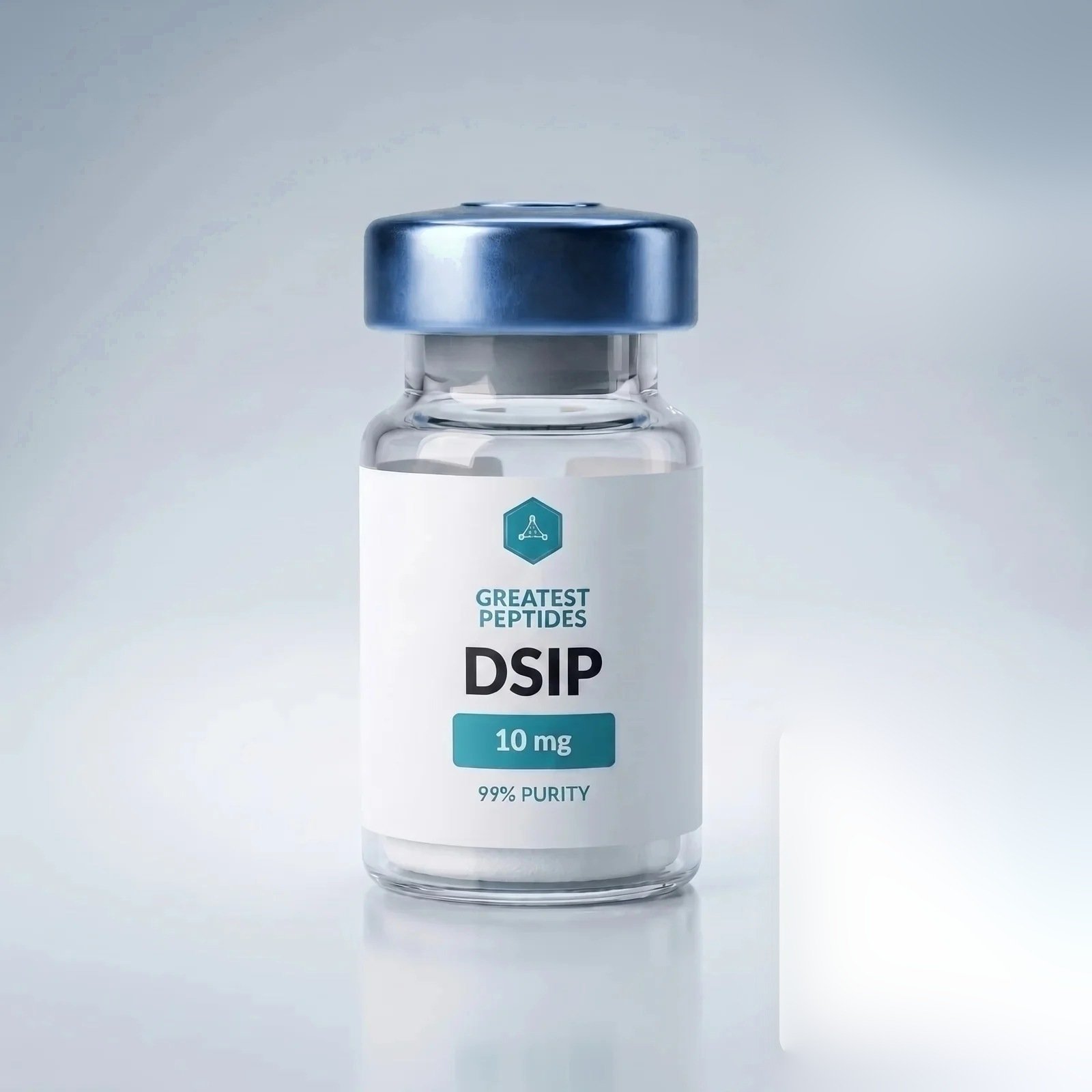
$50.99Original price was: $50.99.$44.99Current price is: $44.99.
In stockShips today if ordered by 3 PM ESTUSA fulfillment
Research Studies
✓Studied as a nonapeptide in sleep-regulation and neuromodulation research.
✓Investigated for effects on circadian and neuroendocrine signaling in vitro.
✓Used in laboratory models of stress-response.
✓Applied in neuropeptide research assays.
DSIP 10 mg is supplied at 99%+ purity for in-vitro laboratory research only. Not for human or veterinary use.
Reconstituting this vial? Our free peptide reconstitution calculator converts vial mass and diluent volume into concentration, draw volume and U-100 syringe graduations. Research use only.
ALL ARTICLES AND PRODUCT INFORMATION PROVIDED ON THIS WEBSITE ARE FOR INFORMATIONAL AND EDUCATIONAL PURPOSES ONLY. The products offered on this website are intended solely for research and laboratory use. These products are not intended for human or animal consumption. They are not medicines or drugs and have not been evaluated or approved by the FDA to diagnose, treat, cure, or prevent any disease or medical condition. Any form of bodily introduction is strictly prohibited by law.
DSIP (Delta Sleep-Inducing Peptide) is a naturally occurring neuropeptide widely studied in sleep-regulation, stress-response, and neuroendocrine research models. Supplied as a lyophilized powder for controlled laboratory research only.
Specifications
Compound: DSIP (Delta Sleep-Inducing Peptide)
Quantity: 10 mg per vial, lyophilized powder
Purity: 99%+ HPLC standard — batch-specific Certificate of Analysis included for your exact lot
Identity: confirmed by LC-MS
Appearance: white lyophilized powder
Documentation: Every vial ships with access to a batch-specific Certificate of Analysis showing HPLC purity, mass-spectrometry identity confirmation, endotoxin, residual solvents, and water content for your exact lot.
Handling & storage: Store lyophilized powder at -20°C. Reconstitute with bacteriostatic water for research handling. Keep out of direct light.
For laboratory and research use only. Not for human or animal consumption.
Shipped at ambient temperature; once received, store at -20°C
Regulatory/Compliance
Manufactured in a facility that adheres to cGMP guidelines
Safety Information
Refer to provided MSDS
Researcher FAQ
How do I reconstitute this peptide?
Use bacteriostatic water (BAC) at a 1–2 mL volume per vial. Add the solvent slowly down the vial wall, swirl gently — never shake. Refrigerate after reconstitution and use within 30 days. For in-vitro laboratory handling only.
How should I store this product?
Lyophilized: 36–46°F (refrigerated) for up to 24 months. Reconstituted: keep refrigerated and protect from light; use within 30 days. Avoid repeated freeze-thaw cycles.
Shipping & tracking?
Orders placed before 3 PM EST ship the same business day from our USA facility. Tracking is emailed within 24 hours. Plain, discreet packaging. Free shipping on orders over $150.
Buy DSIP for Research | RUO COA & Documentation Guide
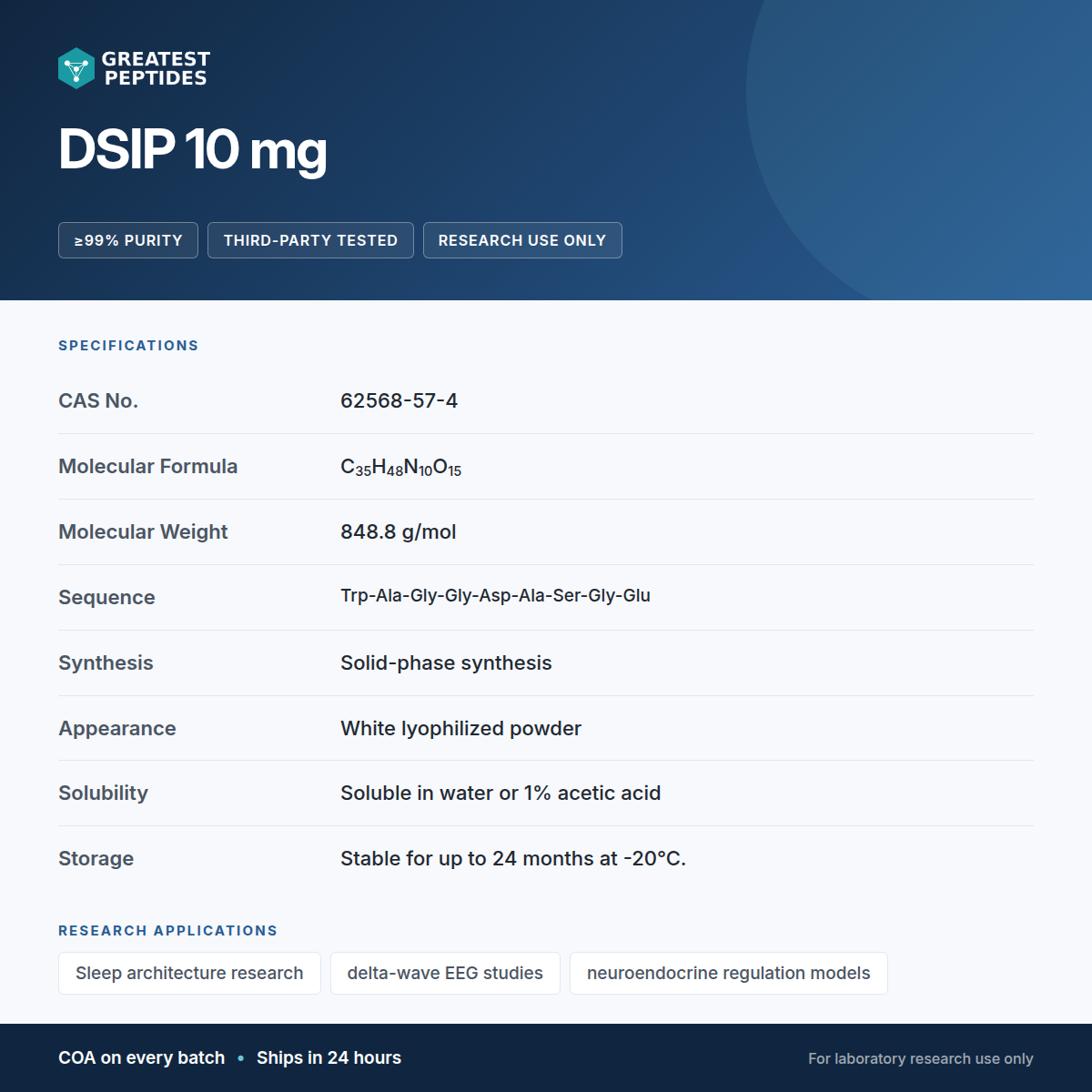
For laboratory teams evaluating where to buy DSIP for research, the priority is documentation, compound identity, and research-use-only (RUO) alignment. DSIP (delta-sleep-inducing peptide) is a nonapeptide (sequence Trp-Ala-Gly-Gly-Asp-Ala-Ser-Gly-Glu) catalogued by PubChem with the molecular formula C35H48N10O15 and a molecular weight of approximately 848.8 g/mol (PubChem CID 68816)[1] (CAS 62568-57-4). It was first described in delta-sleep research by Schoenenberger and Monnier in 1974[2].
Fast Answer
Researchers evaluating where to buy DSIP for research should review RUO labeling, a batch-specific certificate of analysis (COA), HPLC purity data, LC-MS or comparable identity support, sequence/mass consistency, and lot traceability before procurement. Material discussed here is intended for laboratory research use only and is not for human or veterinary use.
What Does “Buy DSIP for Research” Mean?
The phrase is addressed as laboratory research-procurement intent — how qualified researchers, institutions, and technical buyers evaluate a DSIP reference material through documentation, analytical support, and labeling clarity, not personal, clinical, or consumer decision-making.
Compound Identity & Classification
Compound name
DSIP (delta-sleep-inducing peptide)
PubChem CID
68816[1]
CAS number
62568-57-4
Molecular formula
C35H48N10O15[1]
Molecular weight
≈ 848.8 g/mol[1]
Sequence
Trp-Ala-Gly-Gly-Asp-Ala-Ser-Gly-Glu
Format
9-amino-acid synthetic peptide
Product form
Lyophilized powder
Purity target
≥ 99% (see batch-specific COA)
Regulatory status
Research use only — not for human or veterinary use
Published literature discusses DSIP within sleep-modulation and neuroendocrine research, originating from delta-EEG-sleep studies in animal models[2][3]. On a research product page this pathway context should remain academic literature interpretation used to define the research lane — it is not converted into product-performance language.
COA, Purity & Identity Documentation
A DSIP COA should be reviewed as a batch-specific record, not a marketing statement. Look for compound name, lot number, test date, stated purity, analytical method, identity confirmation, and sequence/mass information. Purity, identity, method, and lot number should be evaluated together.
Evaluation area
What to review
Why it matters
RUO labeling
Clear research-use-only language
Separates research procurement from human-use positioning
COA availability
Batch-specific certificate for the received lot
Supports lot-level documentation
Purity data
HPLC area-percent support for stated purity
Helps evaluate material consistency
Identity testing
LC-MS / mass-spec confirmation vs expected mass
Confirms the material matches the listed peptide
Lot traceability
Lot number matching across records
Supports research recordkeeping
HPLC, LC-MS & Analytical Review
HPLC documentation supports purity assessment; LC-MS or mass-spectrometry documentation supports identity confirmation and molecular-mass review[10][11]. For a short nonapeptide, mass data confirming the observed mass against the expected value are especially useful alongside HPLC purity data. ICH Q2(R2) describes validation characteristics used to interpret assay, purity, and identity results[7].
Lot Traceability & Batch Documentation
Lot traceability connects the product listing, COA, label, and receiving record. ISO/IEC 17025 addresses the competence of testing laboratories, and NIST resources describe how certificates and lot identifiers support traceability[8][9].
Claim Boundary for RUO Positioning
Research-safe statement
Non-compliant version to avoid
“DSIP is discussed in published literature on sleep-modulation neuropeptide research.”
“DSIP treats insomnia or improves sleep.”
“Researchers should review COA and identity data before procurement.”
“Buy DSIP for better sleep.”
“Greatest Peptides supplies DSIP as a research-use-only material.”
“Greatest Peptides supplies DSIP for treatment.”
Research Procurement Checklist
Confirm the material is labeled for research use only.
Review the batch-specific certificate of analysis for the received lot.
Confirm purity is supported by HPLC analytical data.
Confirm identity is supported by LC-MS or mass spectrometry.
Compare compound name, sequence, formula, and mass across the page, label, and COA.
Verify the lot number matches across all documentation.
Document storage and handling conditions in the laboratory record.
How Greatest Peptides Presents DSIP
Greatest Peptides supplies DSIP as a research-use-only laboratory material in lyophilized powder form, positioned around a stated ≥99% purity target, batch-specific COA availability, HPLC/LC-MS documentation, lot-level traceability, and transparent RUO labeling. Products are not intended for human or animal consumption, diagnostic, therapeutic, clinical, or veterinary use.
Published Literature Context
Published DSIP literature spans peptide chemistry and preclinical sleep-modulation research models dating to its original characterization[2][3]. Model-specific findings should not be generalized or interpreted as use guidance for research-use-only materials.
Contributing Researchers
Recognized for published work that shaped the scientific context discussed above
Guido Schoenenberger, PhD — co-described the delta-sleep-inducing peptide (DSIP) in foundational sleep research[2].
Marcel Monnier, MD — co-described DSIP through delta-EEG-sleep research in animal models[3].
FAQs About Buying DSIP for Research
What should researchers check before buying DSIP for research?
Review RUO labeling, the batch-specific COA, stated purity with HPLC support, LC-MS identity data, sequence/mass consistency, and lot traceability.
What is DSIP in research documentation?
A nonapeptide (Trp-Ala-Gly-Gly-Asp-Ala-Ser-Gly-Glu) with molecular formula C35H48N10O15 and a molecular weight near 848.8 g/mol.
Why does a COA matter when buying DSIP?
It connects the listing to batch-specific documentation: compound name, lot number, test date, purity, and identity method for the received lot.
Is DSIP intended for human or animal use?
No. Material discussed here is intended strictly for laboratory research use only.
How should published literature be interpreted?
As scientific context only. Model-specific findings should not be generalized or read as use guidance for research-use-only materials.
This page addresses DSIP only as research-use-only laboratory procurement. Boundary-sensitive terms such as sleep, insomnia, stress, and circadian rhythm are referenced here only as research-language examples that must stay separate from RUO product positioning. All product information is for informational and educational purposes only. Products are not intended for human or animal consumption and have not been evaluated by the FDA to diagnose, treat, cure, or prevent any disease.
References
National Center for Biotechnology Information. Delta-sleep-inducing peptide, CID 68816. PubChem Compound record. Accessed 2026.
Schoenenberger GA, Monnier M. Characterization of a delta-electroencephalogram-(sleep)-inducing peptide. Proc Natl Acad Sci USA. 1977. PMID 200938.
Monnier M, Schoenenberger GA. Delta-sleep-inducing peptide in sleep research (review). Sleep/neuroscience literature. 1970s–1980s.
Registry record for DSIP, CAS 62568-57-4. Accessed 2026.
IUPAC-IUB Joint Commission. Nomenclature and symbolism for amino acids and peptides. 1983.
U.S. FDA. Analytical procedures and methods validation for drugs and biologics. 2015.
U.S. FDA. Q2(R2) Validation of Analytical Procedures. 2024.
International Organization for Standardization. ISO/IEC 17025:2017. 2017.
National Institute of Standards and Technology. Reference materials and certificates of analysis. Accessed 2026.
Mant CT, et al. HPLC analysis and purification of peptides. Methods in Molecular Biology. 2007.
Steen H, Mann M. Peptide sequencing. Nature Reviews Molecular Cell Biology. 2004. PMID 15340378.
Compound profile
DSIP: compound profile, literature landscape and handling notes
DSIP in one paragraph
DSIP is a short synthetic peptide, nine residues long, whose name is an abbreviation of delta sleep-inducing peptide. That name is the single most important thing to understand about it, and not for the reason most secondary sources assume. The peptide was named after the experimental setup it was pulled out of in the 1970s, not after a mechanism anyone had demonstrated, and almost fifty years later there is still no cloned receptor for it and no confidently assigned precursor gene. It is also, unusually for this catalog, a strongly acidic peptide rather than a basic or neutral one, which changes how it behaves on an ion-exchange resin, how it ionizes in a mass spectrometer and where it sits on a reversed-phase gradient. Everything below describes the published research record and the bench behavior of the material. Nothing here is a claim about what this vial does, and nothing here is applicable to use in humans or animals.
Where DSIP came from
The origin story is unusually well documented and unusually cautionary, and it deserves to anchor any honest description of this compound. The work came out of Swiss physiology in the late 1960s and 1970s, associated principally with Monnier and with Schoenenberger, working on the then-live question of whether sleep is driven by a circulating humoral factor. The experimental design was a cross-circulation one. Delta-wave electroencephalographic activity was produced in donor rabbits by low-frequency electrical stimulation of the thalamus, blood was collected from the cerebral venous circulation of those animals, a dialysate of that blood was transferred into recipient animals, and the recipients were reported to show increased delta-wave activity on their own recordings. Fractionation of the active dialysate over several years led to a nonapeptide, which was characterized and named for the effect the fraction had been selected on.
That is the whole basis of the name. The peptide was not identified by isolating a receptor and finding its ligand, nor by knocking out a gene, nor by tracing a biosynthetic pathway. It was identified as the smallest thing that survived a purification funnel whose readout was an EEG trace in a recipient rabbit. Naming a molecule after the assay it fell out of is a defensible convention when the assay is specific, and a serious problem when it is not. An EEG delta measure in a recipient animal is a low-specificity endpoint: many manipulations move it, and a fraction that moves it has not been shown to move it for the reason the name implies.
The consequence is a fifty-year record of over-interpretation. Once a molecule is called delta sleep-inducing peptide, every subsequent discussion starts from the assumption that inducing delta sleep is what it does, and the burden of proof quietly inverts. A researcher approaching this material now should hold the name at arm's length and treat it as a hypothesis from 1977 that was never confirmed, rather than as a summary of established pharmacology. The catalog in this category contains at least one other compound named for the tissue fraction it came out of rather than for a mechanism, and the pattern of misreading that follows is nearly identical in both cases.
Reading the structure of DSIP
The exact sequence, molecular formula and molecular weight for this listing are printed in the specification table further down this page, taken from the product record rather than restated here. What is worth doing is reading that sequence for what it implies, because DSIP is compositionally unlike most of the short peptides in this catalog and the differences are not cosmetic.
The first thing to notice is charge. The peptide carries carboxylate-bearing side chains, aspartate and glutamate, and essentially no basic side chains: no arginine, no lysine, and no histidine. At neutral pH the molecule is therefore net negative, and its isoelectric point sits well down in the acidic range rather than near or above neutrality. Nearly every other short peptide on this site is the opposite case, a molecule whose charge at working pH is carried by arginine and lysine side chains. That single compositional fact propagates into solubility behavior, ion-exchange behavior, ion-pairing behavior on a reversed-phase column and ionization polarity in a mass spectrometer, and it is the reason DSIP is worth treating as its own analytical problem rather than as one more short peptide.
The second thing to notice is how little structure the backbone can support. The sequence is small, glycine-rich and conformationally permissive. Glycine has no side chain and the widest accessible backbone torsion space of any residue, so a glycine-rich nonapeptide in aqueous solution is a flexible, largely disordered chain rather than a folded object. There is no helix here, no turn locked in by a disulfide, no hydrophobic core. Circular dichroism on such a peptide returns a random-coil trace and tells you almost nothing about identity or integrity, which is worth knowing before anyone proposes CD as a release check.
The third is that the molecule is short, unmodified and unprotected. The published record describes it without a fatty-acid chain, without C-terminal amidation in its parent form, and without non-proteinogenic substitutions. There is nothing in the structure that would resist exopeptidase trimming, which is consistent with reports that the peptide disappears from plasma on a timescale of minutes rather than hours. Modified forms exist in the literature, and this is exactly where the naming problem returns: amidated, phosphorylated and tyrosine-extended variants have all been studied and all have been referred to loosely as DSIP in secondary discussion, even though a modification at the terminus of a nonapeptide is a substantial fraction of the molecule.
The target and the pathway in more detail
This section is short on pathway detail for an honest reason: there is no confirmed target. No DSIP receptor has been cloned, no high-affinity binding site has been reproducibly characterized and assigned, and no orphan receptor has been convincingly deorphanized with this peptide as its ligand. That is a remarkable statement to be able to make about a molecule isolated in the 1970s, and it should be stated plainly and early rather than buried after three paragraphs of proposed mechanisms.
The situation on the biosynthetic side is, if anything, weaker. A peptide hormone or neuropeptide is normally traceable to a precursor protein encoded by an identifiable gene, processed at recognizable dibasic cleavage sites by known convertases. For DSIP that chain of evidence has never been closed. No precursor gene has been confidently assigned, and the nonapeptide sequence does not sit inside a well-characterized prohormone the way the enkephalins sit inside proenkephalin or the melanocortins sit inside proopiomelanocortin. Given how thoroughly mammalian genomes have been sequenced and annotated in the intervening decades, the continued absence of a precursor is not a gap waiting to be filled by more sequencing. It is a substantive reason to be careful about how firmly one asserts that the endogenous molecule exists in the form the 1970s work described.
What the literature offers instead of a receptor is a collection of proposed indirect mechanisms, each associated with a small number of groups. Reported interactions with the hypothalamic-pituitary-adrenal axis appear repeatedly, framed as modulation of corticotropin and corticosteroid measures rather than as receptor occupancy. There are reported effects on thermoregulatory measures in rodents. There are reports positioning the peptide as an antioxidant or membrane-stabilizing agent, which is mechanistically a very different kind of claim and does not require a receptor at all. There is a scattered literature invoking opioid and monoaminergic systems, generally on the basis that an antagonist blunted an effect rather than on the basis of direct binding.
None of these threads has converged. For experimental design the practical implication is that DSIP cannot be used as a selective pharmacological tool, because there is no established target to be selective for. Any effect observed with it requires its own mechanistic controls, established within the study, because there is no accepted receptor-level framework to inherit.
What the published literature on DSIP actually measures
The published DSIP literature is best understood as a body of work with a distinct center of gravity in the 1980s, thinning sharply thereafter, and it divides into four strands that are usually blurred together.
The first strand is sleep electrophysiology, which is the founding claim and the weakest of the four. The reports here are recordings in rabbits, rats, cats and some human sleep-laboratory work, with delta-power or slow-wave measures as the endpoint. What matters is that the results are inconsistent across groups. Some laboratories reported changes in delta measures; several others, working with comparable preparations, did not reproduce them. Later commentary from investigators who worked directly on the problem has been notably skeptical about whether the founding effect is real at all. A reader who encounters the claim that DSIP induces delta sleep should know that this is the contested strand of the literature, not the settled part of it.
The second strand is stress-axis work. Reported changes in corticotropin, corticosteroid and catecholamine measures in rodents appear across a number of small studies, and this strand is somewhat more internally consistent than the sleep strand, though the endpoints are indirect and the group diversity is limited.
The third strand is thermoregulation and circadian measurement: reported effects on body temperature regulation and on the phase or amplitude of rhythms in rodents. This strand is small, and much of it comes from a narrow set of laboratories.
The fourth strand is measurement of endogenous DSIP-like material in tissue and plasma by radioimmunoassay, usually reported as DSIP-like immunoreactivity. This phrase should be read carefully. It denotes whatever a particular antiserum bound in a particular extract, and it is not the same as demonstrating that the nonapeptide is present. Immunoreactivity studies were a substantial fraction of the 1980s output and are frequently cited in secondary sources as though they had confirmed the peptide's endogenous existence and regulation. They did not; they measured cross-reactive material.
Across all four strands the methodological era is the limiting factor. These are small studies, mostly predating modern standards for statistical power, preregistration and mass-spectrometric confirmation of peptide identity, and very few have been repeated with contemporary methods.
Where the DSIP literature is thin or frequently misread
This is the section that matters most for DSIP, and it can be stated bluntly.
There is no receptor. Fifty years after isolation, no DSIP receptor has been cloned or convincingly identified. Every mechanistic account in circulation is therefore an inference from a downstream measure, not a description of a ligand-target interaction.
There is no confirmed gene. No precursor has been securely mapped, which is extraordinary for a peptide isolated that long ago and is a legitimate reason for skepticism about whether the endogenous molecule exists as originally described. A peptide with no receptor and no precursor is not a characterized signaling molecule; it is a synthetic nonapeptide with an interesting history.
The founding result has not held up cleanly. Several groups failed to reproduce the sleep-EEG findings, and the modern position of investigators closest to the original work has been openly doubtful. Presenting the sleep effect as established, which most secondary writing does, misrepresents the record.
The name is doing argumentative work it has not earned. Assay-context naming creates an expectation in every reader before they have seen any data, and it has driven fifty years of confirmatory reading. This is the same failure mode as compounds named for the tissue fraction they were purified from.
The provenance of circulating claims is shallow. Most of what is asserted about DSIP online traces to a small 1980s literature, to reviews of that literature, or to material with no primary source at all, rather than to modern controlled work. Following a claim back two or three citation steps very often terminates in a 1980s abstract or a review citing a review.
Finally, the label is used loosely. The string DSIP is applied in secondary sources to the parent nonapeptide and to modified analogs, including amidated and tyrosine-extended forms, without distinguishing them. Those are different molecules with different properties, and data generated on one does not characterize another. Establishing which molecule a given lot actually contains is an analytical question, answered by the documentation for that lot rather than by the name on it.
How DSIP behaves in solution
DSIP is supplied as lyophilized material and its solution behavior is governed by its acidic character, which makes it genuinely different from the basic peptides that dominate this catalog.
The important practical fact is that solubility is pH-dependent and passes through a minimum near the isoelectric point, which for this peptide sits low, in the acidic range rather than near neutrality. At the pI the molecule carries no net charge, electrostatic repulsion between molecules is at its weakest, and the tendency to associate and come out of solution is at its greatest. This produces a bench observation that surprises people used to basic peptides: adding acid does not help here. Acidifying a solution of an arginine-rich peptide generally improves solubility by protonating side chains and increasing net positive charge, and that reflex, applied to DSIP, drives the solution toward its worst region. A neutral to slightly alkaline aqueous environment keeps the carboxylates deprotonated and the molecule charged, which is where it is most comfortable. Anyone working near a low-pH buffer should expect haze or a slow-forming precipitate rather than assume the material was defective.
Ionic strength interacts with this. A charged, hydrophilic, low-molecular-weight peptide is generally salted in at modest ionic strength, but high salt near the pI is where aggregation appears fastest.
Beyond pH, the standard short-peptide liabilities apply and one specific chemical liability is worth checking against the printed sequence. Where an aspartate residue is followed by a small residue such as glycine, serine or alanine, the classic degradation route is intramolecular attack forming a succinimide intermediate that opens to give isoaspartate, producing a species with the same nominal mass and a slightly different retention time. Where an asparagine is present in a similar context, deamidation adds a small mass increment. Both are accelerated by alkaline pH and by warm storage in solution, which sets up a genuine tension with the solubility argument above and is a reason to keep working solutions cold and short-lived rather than merely well buffered. If the printed sequence includes an aromatic residue, that position is the oxidation- and light-sensitive one, and amber vials and minimized headspace are reasonable precautions. Freeze-thaw cycling should be minimized as a matter of course; aliquot once rather than returning repeatedly to a stock. The storage statement in the specification table is the product record for this material and should be read as the manufacturer statement it is.
Analytical notes specific to DSIP
The acidic composition changes the analytical approach in ways that are worth spelling out, because advice written for basic peptides transfers badly here.
Start with detection. Quantitative work on short peptides is normally done at 214 nm, where the amide bond absorbs, and that remains the workhorse wavelength for this material. The usual caveat applies with extra force: a purity figure reported as area percent at 214 nm counts only what absorbs at that wavelength, so every peptide-bond-containing fragment is weighed while residual salts, scavengers and counter-ions largely are not, and the number is systematically flattered. Whether a second, longer wavelength is worth configuring depends entirely on whether the printed sequence contains an aromatic residue. If it does, running 214 nm and 280 nm together is a cheap orthogonal check, because the ratio between the two channels across a peak is an identity signal in itself. If it does not, 280 nm is dead space.
Then ionization polarity, the strong recommendation here and an unusual one for a peptide catalog. Positive-mode electrospray works well for basic peptides because arginine and lysine side chains are readily protonated and hand you a clean multiply charged series. A peptide with no basic side chains has only the N-terminal amine available, so positive-mode signal is weak, the charge envelope is shallow, and sodium and potassium adducts compete for what signal there is. Negative-ion mode suits this molecule far better: the carboxylates deprotonate readily and the deprotonated species is usually the stronger and cleaner ion. A disappointing positive-mode spectrum here is a reason to switch polarity, not a conclusion about the sample.
Chromatography differs too. A small, glycine-rich, hydrophilic peptide is poorly retained on C18 and can elute near the void volume on a gradient built for larger hydrophobic analytes, where no impurity separation is possible. Trifluoroacetic acid as an ion-pairing additive works by pairing with positive charges, so its retention-enhancing effect on a peptide with no basic residues is limited compared with what it achieves on an arginine-rich sequence. A polar-endcapped or aqueous-compatible reversed-phase column run from a very low organic starting point, or a hydrophilic interaction separation, is the more productive direction. On ion exchange the polarity inverts as well: this peptide binds an anion exchanger at neutral pH where most peptides in this catalog would bind a cation exchanger, which is useful preparatively and as a quick orthogonal identity argument.
A synthetic heptapeptide built on tuftsin with a proline-glycine-proline stabilizing tail. Grouped with DSIP in secondary sources because both are short peptides studied against central nervous system endpoints without a confirmed receptor, but Selank is basic where DSIP is acidic, has an identifiable parent peptide, and has a defined mechanistic thread in its own literature. Shared absence of a receptor is not a shared mechanism.
An adrenocorticotropic hormone fragment carrying the same glyproline tail as Selank. Like DSIP it is short and centrally studied, but it has a real parent hormone, a traceable gene through proopiomelanocortin, and a literature that connects it to melanocortin and neurotrophic signaling. It is also not acidic, so none of the ion-exchange, ion-pairing or negative-mode reasoning that applies to DSIP carries over to it.
A structural parallel rather than a pharmacological one, and the closest analogy in this catalog to DSIP's core problem. Its parent was named for the tissue fraction it was purified from rather than for a demonstrated function, and the name has propagated an expectation ever since. Different chemistry, different literature, same cautionary lesson about how a purification-derived name becomes a claim.
Melatonin
An indoleamine, not a peptide, with a fully characterized biosynthetic route from tryptophan, cloned high-affinity G-protein-coupled receptors, and a large modern literature. It is frequently mentioned alongside DSIP in circadian and sleep-research discussion, which invites a false equivalence: one has a receptor, a gene and a pathway, and the other has none of the three.
Epitalon (Epithalon)
A synthetic tetrapeptide from a separate Russian research line associated with pineal extract work. It shares with DSIP an acidic character and an association with sleep and circadian framing in secondary sources, but it is shorter, comes from a different tradition, and its reported mechanisms are usually framed around telomerase and gene expression rather than electrophysiology.
DSIP-NH2 and other modified analogs
Amidated, phosphorylated and tyrosine-extended forms appear in the primary literature and are routinely called DSIP without qualification. On a nonapeptide a terminal modification is a substantial structural change: amidation removes a negative charge and shifts the isoelectric point, and a tyrosine extension exists specifically to permit radiolabeling. Data from those molecules should not be attributed to the parent.
Questions specific to DSIP
Does the name mean DSIP was shown to induce delta sleep?
No, and this is the central point about the compound. The name records the assay the peptide was purified against, not a demonstrated mechanism. The 1970s work induced delta-wave activity in donor rabbits by electrical stimulation of the thalamus, collected cerebral venous blood, transferred a dialysate to recipient animals, and followed the fraction that moved a delta-wave measure in those recipients. Naming the isolated nonapeptide after that readout was a convention of the era, but it built a conclusion into the label. Subsequent work did not establish the mechanism the name implies, and the sleep findings themselves proved difficult to reproduce. Treat the name as a 1977 hypothesis rather than as a summary of established pharmacology.
Has a DSIP receptor ever been identified?
No. Nearly fifty years after isolation there is no cloned DSIP receptor, no reproducibly characterized high-affinity binding site assigned to a defined protein, and no deorphanized receptor for which this peptide is the accepted ligand. That absence is not a small gap. It means every mechanistic claim about the peptide is an inference drawn from a downstream physiological or biochemical measure rather than from a ligand-target interaction, and it means the compound cannot serve as a selective pharmacological tool, because there is nothing established to be selective for. Any study using it needs its own internal mechanistic controls, since there is no accepted receptor-level framework to inherit from the literature.
Why is the absence of a precursor gene treated as a serious problem?
Because that is normally how the existence of an endogenous peptide is confirmed. Known neuropeptides sit within precursor proteins encoded by identifiable genes and are released by convertase cleavage at recognizable sites, as the enkephalins are from proenkephalin. For DSIP no precursor has been confidently assigned. Mammalian genomes have been sequenced and annotated exhaustively since the peptide was described, so this is not a gap that more sequencing will close. It is a substantive reason to be careful about asserting that the endogenous molecule circulates in the form the original work described. The synthetic nonapeptide plainly exists; the endogenous entity the name refers to is on much weaker footing.
What does DSIP-like immunoreactivity in a published paper actually mean?
It means that a particular antiserum, raised against the synthetic nonapeptide, bound something in a particular extract at a particular dilution. That is all it means. It does not establish that the material bound was the nonapeptide, because short-peptide antisera cross-react readily with related fragments and with unrelated sequences sharing a short epitope, and because the extraction chemistry itself selects for some species over others. A large fraction of the 1980s output on this compound consists of immunoreactivity measurements in tissue and plasma, and secondary sources routinely cite them as though they confirmed the peptide's endogenous presence and regulation. Confirming identity would require mass-spectrometric characterization of the immunoreactive material, which is rarely what those papers report.
Why is this peptide harder to see by mass spectrometry than the others in this catalog?
Because it lacks basic residues. Positive-mode electrospray relies on protonation, and for most peptides the arginine, lysine and histidine side chains supply readily protonated sites that generate a strong multiply charged envelope. With no basic side chains, only the N-terminal amine is available, so positive-mode signal is weak, the charge envelope is shallow, and alkali metal adducts compete for what signal there is. Negative-ion mode is the better fit: the carboxylate side chains deprotonate easily and typically give a stronger, cleaner ion. A weak positive-mode spectrum from this material is more often a polarity mismatch than evidence about the sample, and switching polarity should come before any conclusion about content.
Why does it elute so early on a standard reversed-phase peptide gradient?
Because it is small, glycine-rich and hydrophilic, with carboxylates rather than hydrophobic or basic side chains. There is very little for a C18 stationary phase to retain. On a gradient designed for larger, more hydrophobic peptides it can appear at or near the void volume, where it coelutes with salts and void-volume artifacts and no meaningful impurity separation is possible. Trifluoroacetic acid does not rescue this the way it does for basic sequences, because ion pairing with that additive works on positive charges the molecule does not have. A polar-endcapped or aqueous-compatible reversed-phase column started from very low organic content, or a hydrophilic interaction separation, is the productive direction.
Are the sleep findings simply unreplicated, or actively contradicted?
Both descriptions appear in the record, which is why the honest phrasing is that the result did not hold up cleanly. Some laboratories reported changes in delta-power measures in animal and human sleep recordings; several others working with comparable preparations reported no such effect, and commentary from investigators who worked closely on the problem has been openly doubtful about whether the founding effect exists. Layered on top of that is the methodological era: these are small studies predating current expectations for statistical power and for mass-spectrometric confirmation of what was actually applied. The correct summary for a methods section is that the sleep claim is the contested part of this literature rather than its settled foundation.
Documentation and handling reference
DSIP: Documentation, Handling and Quality Record for This SKU
The section above covers what DSIP is and what the published literature has looked at. This section is the operational half: what physically arrives when you order this listing, what paperwork comes with it, which fields on that paperwork are worth reading closely, and how to log the material once it is on your bench. It is written for the person who has already decided the compound is relevant and now has to justify the purchase to a supervisor, a grant line or an internal quality process.
Everything below is scoped to this exact listing rather than to research peptides in general. If you want the general version — how to read a certificate of analysis from scratch, what HPLC and mass spectrometry each prove, how to compare two suppliers who both claim 99% — that is on the home page guide, and there is no reason to read it twice.
What ships when you order DSIP
At a glance
One sealed vial of lyophilized material at the listed 10 mg fill, labeled for research use only, dispatched within 24 hours of the order clearing. Batch documentation is available for the lot you receive. Free shipping applies at $150 and above.
This listing is a single fixed presentation, not a size selector. That is deliberate: each presentation gets its own page, its own documentation trail and its own URL, so a citation or a purchase-order line that points at DSIP at 10 mg points at exactly one thing. If you need a different fill of the same compound and it is not listed, it is not currently in stock rather than hidden behind a dropdown.
Field
This listing
Listing
DSIP 10 mg
Labeled fill mass
10 mg
Physical form
Lyophilized powder in a sealed vial
Catalog category
Neuropeptide & CNS-Active Compounds
Compound class
Neuroactive research peptide
Intended use
Research use only. Not for human or veterinary use, not for diagnostic use, not a drug or supplement.
Dispatch
Within 24 hours of the order clearing
Documentation
Batch analytical documentation available for the lot supplied
Free shipping threshold
Orders of $150 and above
Specification summary for DSIP
The table below is the specification the store publishes for this listing. It is reproduced here from the product record itself rather than retyped, which means it cannot drift away from what the attribute table further up the page says. Where a field is absent it is absent because we do not publish it for this SKU, not because it was left out of this summary.
CAS No.
62568-57-4
Purity
≥99%
Sequence
Trp-Ala-Gly-Gly-Asp-Ala-Ser-Gly-Glu
Molecular Formula
C35H48N10O15
Molecular Weight
848.8 g/mol
Synthesis
Solid-phase synthesis
Solubility
Soluble in water or 1% acetic acid
Stability & Storage
Stable for up to 24 months at -20°C. After reconstitution, may be stored at 4°C for up to 4 weeks or at -20°C for up to 6 months.
Shipped at ambient temperature; once received, store at -20°C
Regulatory/Compliance
Manufactured in a facility that adheres to cGMP guidelines
Safety Information
Refer to provided MSDS
A specification table is a claim, and a claim is only worth the record behind it. Every field above is one you can ask us to substantiate against the batch documentation for the lot you were sent. If a field ever fails to match the paperwork, that is a defect on our side and we would rather hear about it than not.
Several materials in this group are close structural relatives of one another, and a couple differ by a single residue. Sequence-level confirmation is the only thing that separates them; a purity percentage does not.
The analytical record behind this lot
A certificate of analysis is not a quality badge. It is a measurement report about one specific batch, produced on a specific date by a specific method, and its value to you is entirely a function of how much of that context it discloses. For DSIP the fields worth checking first are the ones that tie the document to the container in your hand.
Field on the certificate
Why it matters for this SKU
Lot or batch identifier
Ties the document to the vial. A certificate with no lot reference describes some batch, not necessarily yours.
Compound name and, where applicable, sequence
This is the identity claim. For a neuroactive research peptide it is the field that distinguishes the material from its close relatives.
Analytical method and conditions
A purity figure without a method is a number without units. Column, gradient and detection wavelength change what the figure means.
Date of analysis
Establishes how old the measurement is relative to the material. A recent vial with a two-year-old certificate is a documentation gap.
Who performed the analysis
In-house and independent third-party results are both legitimate; they are not the same claim, and the document should say which it is.
The chromatogram or spectrum itself
A summary table can be typed by anyone. A trace can be read, and a reader who knows the compound class can tell whether it is plausible.
What our documentation for DSIP does assert is what the analysis measured on the batch that was tested. What it does not assert — and no certificate from any supplier can assert — is that the material is safe, that it is suitable for any use in humans or animals, or that it will reproduce a result reported in a published paper. Those are different questions and a purity figure is not evidence for any of them.
Our batch documentation policy, including how to request the record for a lot you already have, is on the certificate of analysis page. If you need the record before ordering rather than after, ask us through the contact page and reference this listing by name.
How DSIP is checked before it reaches this catalog
Three questions have to be answered separately before a compound gets a page here, and collapsing them into one percentage is the most common way a supplier listing becomes misleading.
Question
What answers it
What it does not tell you
Identity — is this the right molecule?
Mass determination, and sequence confirmation where the material is a defined chain
Nothing about how much of the vial is that molecule
Purity — what proportion of the detected material is the target?
Chromatographic separation with a stated method
Nothing about what the other fraction actually is, unless the impurities are themselves identified
Content — how much target material is actually in the container?
Quantitative determination against the labeled fill
Nothing about identity or purity; a vial can be accurately filled with the wrong thing
For DSIP, receptor binding panels, neurotrophic factor expression assays and behavioral batteries are the assay formats the published work in this area tends to use, which matters when you are deciding whether the material as supplied is fit for the experiment you have in mind. A compound that is clean enough for a binding assay is not automatically clean enough for a quantitative cell-based readout where a co-eluting impurity could carry activity of its own.
Content is the field most often missing from a supplier listing, and it is the one that changes your arithmetic. A vial labeled 10 mg contains that much total solid, and total solid includes counter-ion, residual water and whatever else survived the process. If you need the peptide mass rather than the vial mass to be exact, that is a specific request to make in advance, not an assumption to carry into a calculation.
Receiving, inspecting and storing DSIP
The most useful five minutes you will spend on this material are the five minutes immediately after the package is opened, because that is the only moment at which you can still distinguish a transit problem from a handling problem of your own.
Confirm the label on the container matches this listing, including the fill mass, and record the lot identifier in your notebook before anything else happens.
Inspect the closure and seal. A compromised closure is a reason to stop, not a reason to proceed carefully.
Look at the cake. Note its appearance and position; a cake that has collapsed, shifted or gone glassy is telling you something about the vial's history in transit.
Let a cold vial reach room temperature before opening it, so that atmospheric moisture condenses outside the vial rather than into the material.
Photograph the label and the container on arrival. It costs nothing and it settles later questions instantly.
Store it in the dark, at the temperature stated for this listing, and write down the date it entered storage.
Decide your aliquot plan before the first opening, not after it.
Small neuroactive sequences are often supplied at low fill masses, which makes weighing error a proportionally larger problem than it is for a 70 mg vial.
The general rule for lyophilized material is that the dry state is the stable state and every transition away from it costs you something. Freeze-thaw cycling is the specific mechanism most likely to degrade DSIP after it reaches you, and it is entirely under your control: a single reconstitution split into pre-planned aliquots exposes the material once, while repeatedly warming and refreezing one container exposes it as many times as you open it. There is a fuller treatment of the mechanism in our guide on freeze-thaw cycles in peptide research materials and on storage and handling.
Preparing aliquots from a 10 mg vial: the measurement arithmetic
This is arithmetic, not guidance. The only thing the table below does is tell you what concentration you are holding after you have added a known volume of diluent to a vial labeled 10 mg, so that the figure in your notebook and the figure in the container are the same figure. It says nothing about how much material any experiment should use, and it is not applicable to any use in humans or animals.
Diluent added
Resulting concentration
Amount in 0.1 mL
Amount in 0.05 mL
Aliquots of 0.25 mL
1 mL
10 mg/mL
1,000 µg
500 µg
4
2 mL
5 mg/mL
500 µg
250 µg
8
3 mL
3.33 mg/mL
333.3 µg
166.7 µg
12
5 mL
2 mg/mL
200 µg
100 µg
20
Every figure above is the same division: the labeled mass of DSIP divided by the volume of diluent added. Nothing in the table is a recommendation about how much material to use in an experiment — it is the arithmetic that tells you what concentration you are holding once you have added a known volume, so that the number you write in the notebook matches what is in the container.
Two things routinely go wrong at this step. The first is treating the labeled mass as the peptide mass; as noted above, the labeled figure is total solid unless the documentation says otherwise, so a concentration derived from it is a nominal concentration. Say so in your methods rather than implying a precision the specification does not support. The second is ignoring the volume the solid itself occupies — small at these masses, but not zero, and it means the final volume is very slightly greater than the volume you added.
If you want to work backwards from a target concentration to a diluent volume, or to check a figure against a different vial size, our peptide reconstitution calculator does the same division in both directions and shows its working.
What to record for DSIP so the work is reproducible
Reproducibility in this area fails at the material-provenance step far more often than at the analysis step. The fields below are the ones that let somebody else — a reviewer, a collaborator, or you in eighteen months — work out whether two sets of results were generated with comparable material.
Supplier and the exact listing name, including the fill size, rather than just the compound name
Lot identifier, and the date the batch documentation was issued
Date received, and the storage conditions and location it went into
Date of reconstitution, the diluent used and its lot, and the volume actually added
Nominal concentration obtained, stated as nominal rather than as measured
Aliquot scheme: how many, what volume, stored where
Freeze-thaw count for each aliquot at the point of use
Any deviation from plan, including deviations that seemed unimportant at the time
Whether the material was research-use-only labeled, which for this listing it is
Comparing suppliers on this exact SKU
Comparing DSIP across suppliers on price alone is comparing two numbers that may not describe the same thing. These are the questions that make the comparison meaningful, with our answers next to them so you can hold us to the same standard you would hold anyone else.
Question to ask any supplier
Our answer for this listing
Is batch documentation available for the specific lot I will receive, not a representative lot?
Is there a published position on what the documentation does not prove?
Yes. It is stated on this page and on every product page.
A supplier who answers all seven honestly is a better bet than a supplier who is ten percent cheaper and answers four. A supplier who cannot answer the first one at all is not selling you documented material; they are selling you a container.
Compliance boundary for DSIP
DSIP is supplied for laboratory research use only. It is not a drug, not a supplement, not a cosmetic and not a medical device. It is not for human or veterinary administration, not for diagnostic use, and not for use in food. That is not a disclaimer bolted onto a sales page — it is the actual scope of what is being sold, and it constrains what can honestly be written about it.
Language that stays inside the boundary
Language that does not
"Supplied for research use only"
Any phrasing that implies a personal or clinical use
"Published work in this area has examined receptor and transporter interaction, neurotrophic marker expression and behavioral endpoints in animal models"
"DSIP does X" stated as an established effect
"Purity determined by the stated method on the tested batch"
"Pharmaceutical grade", "medical grade", "safe"
"Concentration arithmetic for preparing laboratory aliquots"
Anything framed as a dose, a protocol or a schedule
"Not for human or veterinary use"
Silence on the point, which readers correctly interpret as evasion
Naming the model system a finding came from
Reporting an animal or in-vitro finding as though it were a human finding
The reason to be precise about this is not only regulatory. Research literature on this class of material is genuinely interesting and genuinely incomplete, and overstating it makes the real findings harder to see. Where published work is referenced on this site it is referenced as what was measured, in what system, at what scale — not as a property of the vial.
Other Neuropeptide & CNS-Active Compounds listings
These share a catalog category with DSIP, which means the documentation and handling considerations above largely transfer to them. Their compound-specific sections do not — each has its own identity, its own literature and its own analytical profile.
$50.99Original price was: $50.99.$44.99Current price is: $44.99.
The full catalog is on the shop page, and the longer written material is in our research guides.
Questions about ordering DSIP
Is DSIP documentation available before I order?
Yes. Ask through the contact page and reference this listing by name. Our general position on batch documentation is on the certificate of analysis page. If a supplier will not show you the record until after payment has cleared, that is worth noticing.
What does the 10 mg figure on the label actually refer to?
It is the labeled fill for this presentation. For lyophilized material the labeled mass is total solid unless the documentation states otherwise, and total solid includes counter-ion and residual moisture as well as target compound. If your calculation depends on the distinction, resolve it against the batch record rather than assuming.
How fast does DSIP ship?
Within 24 hours of the order clearing. Orders of $150 and above ship free. Transit time after dispatch depends on the service selected at checkout.
Can I buy DSIP for personal use?
No. This material is supplied for laboratory research use only. It is not a drug, supplement or cosmetic, it is not for human or veterinary administration, and nothing on this page should be read as guidance for any such use.
How should DSIP be stored before and after reconstitution?
Store the sealed vial dry, dark and at the temperature stated for this listing, and record the date it entered storage. Once material is in solution the useful discipline is to minimize repeated warming: plan the aliquot scheme before the first reconstitution so the material is exposed once rather than once per experiment. Small neuroactive sequences are often supplied at low fill masses, which makes weighing error a proportionally larger problem than it is for a 70 mg vial.
How much diluent should I add to a 10 mg vial?
That depends entirely on the concentration your protocol calls for, which is your decision and not something a product page can answer. What the table above provides is the arithmetic: labeled mass divided by added volume gives concentration. The reconstitution calculator runs the same division in either direction.
Does a high purity figure mean DSIP is safe?
No, and this is the single most common misreading of a certificate of analysis. Purity describes what proportion of the detected material was the target compound in the batch that was tested, by the method stated. It is not a safety assessment, it says nothing about suitability for any use in humans or animals, and it does not become a safety claim by being a large number.
What is DSIP classified as in your catalog?
It is listed as a short neuroactive sequence, in the Neuropeptide & CNS-Active Compounds category. Published work in this area has looked at receptor and transporter interaction, neurotrophic marker expression and behavioral endpoints in animal models. That is a description of where the literature sits, not a claim about what the material does.
Do you have more general written material on evaluating research peptides?
Yes. The home page guide covers reading a certificate of analysis, what chromatographic and mass-spectrometric methods each prove, and how to compare suppliers. The research guides go deeper on individual topics, and the FAQ covers ordering, shipping and post-shipping questions.
DSIP 10 mg is supplied strictly for laboratory research use. It is not a drug, supplement, cosmetic or medical device; it is not for human or veterinary use, not for diagnostic use and not for use in food. No statement on this page is intended to describe a therapeutic use, benefit or outcome, and references to published work describe what was measured in the reported model system rather than a property of the material supplied. Purchasers are responsible for handling the material in accordance with the requirements applicable to their institution and jurisdiction.
Check the documentation before you check the price