In stockShips today if ordered by 3 PM ESTUSA fulfillment
Research Studies
✓Studied as a dual GLP-1/GIP receptor agonist in metabolic research.
✓Investigated for combined incretin signaling effects in vitro.
✓Used in laboratory models of glucose regulation and lipid metabolism.
✓Applied in comparative receptor-agonism research assays.
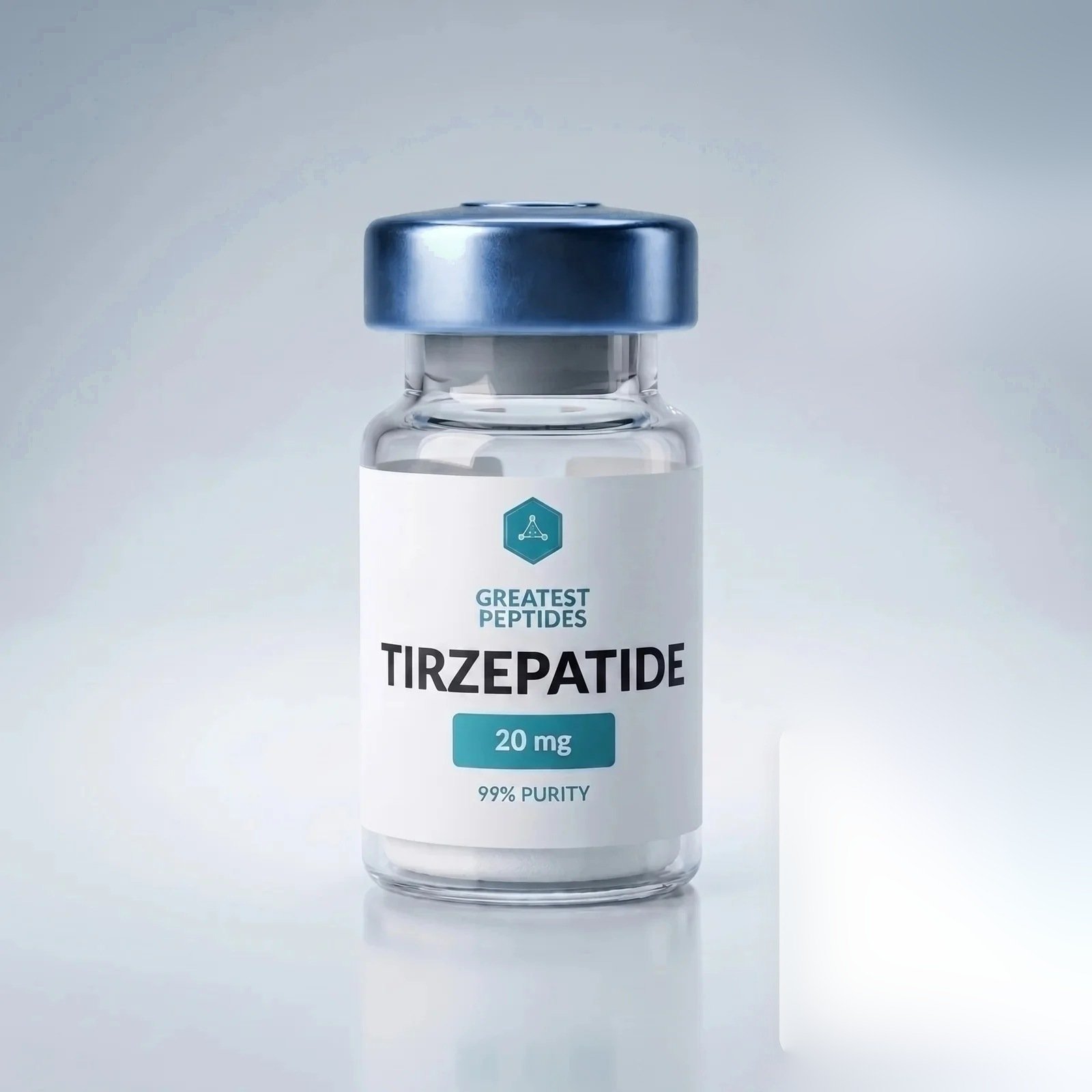
Tirzepatide 20 mg is supplied at 99%+ purity for in-vitro laboratory research only. Not for human or veterinary use.
Reconstituting this vial? Our free peptide reconstitution calculator converts vial mass and diluent volume into concentration, draw volume and U-100 syringe graduations. Research use only.
ALL ARTICLES AND PRODUCT INFORMATION PROVIDED ON THIS WEBSITE ARE FOR INFORMATIONAL AND EDUCATIONAL PURPOSES ONLY. The products offered on this website are intended solely for research and laboratory use. These products are not intended for human or animal consumption. They are not medicines or drugs and have not been evaluated or approved by the FDA to diagnose, treat, cure, or prevent any disease or medical condition. Any form of bodily introduction is strictly prohibited by law.
Tirzepatide is a synthetic research peptide studied in metabolic signaling models and receptor interaction pathways across GLP-1 and GIP receptors. Supplied as a lyophilized powder for controlled laboratory research only. 99%+ purity, third-party tested, Certificate of Analysis included with every order. Not for human or animal consumption.
Stable for up to 24 months at -20°C. After reconstitution, may be stored at 4°C for up to 4 weeks or at -20°C for up to 6 months.
Applications
Dual GIP/GLP-1 receptor research, incretin signaling studies, glucose and energy homeostasis models
Appearance
White lyophilized powder
Shipping Conditions
Shipped at ambient temperature; once received, store at -20°C
Regulatory/Compliance
Produced in compliance with cGMP guidelines
Safety Information
Refer to provided MSDS
Researcher FAQ
How do I reconstitute this peptide?
Use bacteriostatic water (BAC) at a 1–2 mL volume per vial. Add the solvent slowly down the vial wall, swirl gently — never shake. Refrigerate after reconstitution and use within 30 days. For in-vitro laboratory handling only.
How should I store this product?
Lyophilized: 36–46°F (refrigerated) for up to 24 months. Reconstituted: keep refrigerated and protect from light; use within 30 days. Avoid repeated freeze-thaw cycles.
Shipping & tracking?
Orders placed before 3 PM EST ship the same business day from our USA facility. Tracking is emailed within 24 hours. Plain, discreet packaging. Free shipping on orders over $150.
Buy Tirzepatide for Research | RUO COA & Documentation Guide
For laboratory teams evaluating where to buy tirzepatide for research, the priority is documentation, compound identity, and research-use-only (RUO) alignment — not consumer positioning. Tirzepatide (development code LY-3298176) is a synthetic 39‑amino‑acid peptide catalogued by PubChem with the molecular formula C225H348N48O68 and a molecular weight of approximately 4,813 g/mol (PubChem CID 166567236)[1]. It carries a C20 fatty di-acid moiety and is described in the literature as a dual glucose-dependent insulinotropic polypeptide (GIP) and glucagon-like peptide-1 (GLP-1) receptor agonist[2][3]. This product-page guide explains how tirzepatide is framed for controlled research procurement while keeping documentation review separate from non-laboratory intent.
Fast Answer
Researchers evaluating where to buy tirzepatide for research should review RUO labeling, a batch-specific certificate of analysis (COA), HPLC purity data, LC-MS or comparable identity support, sequence/formula consistency, and lot traceability before procurement. Material discussed here is intended for laboratory research use only and is not for human or veterinary use. The safest evaluation lens is documentation-first, not outcome-first.
What Does “Buy Tirzepatide for Research” Mean?
In this context the phrase is addressed as laboratory research-procurement intent. It refers to how qualified researchers, institutions, and technical buyers evaluate a tirzepatide reference material through documentation, analytical support, and labeling clarity — not personal, clinical, or consumer decision-making. The first review layer is compound identity, COA availability, lot-number alignment, and test-method transparency.
Compound Identity & Classification
Tirzepatide should be evaluated at the product and batch level. The identity record on the product page, label, and COA should tell one consistent story across name, sequence notation, molecular formula, and mass.
Research use only — not for human or veterinary use
Receptor Pathway Context (GIP / GLP-1)
Peer-reviewed literature describes tirzepatide within incretin-receptor pharmacology. The discovery and characterization work reported it as a dual GIP and GLP-1 receptor agonist[2], and later receptor-pharmacology analysis described it as an imbalanced, biased agonist with relatively greater activity at the GIP receptor than the GLP-1 receptor[3]. On a research product page this pathway context should remain academic literature interpretation used to define the receptor lane — it is not converted into product-performance language.
COA, Purity & Identity Documentation
A tirzepatide COA should be reviewed as a batch-specific record, not a general marketing statement. Look for compound name, lot number, test date, stated purity, analytical method, identity confirmation, and molecular information. Purity percentage alone does not establish identity; purity, identity, method, and lot number should be evaluated together.
Evaluation area
What to review
Why it matters for RUO procurement
RUO labeling
Clear research-use-only language on page and label
Separates research procurement from human-use positioning
COA availability
Batch-specific certificate for the received lot
Supports lot-level documentation and quality review
Purity data
HPLC area-percent support for the stated purity
Helps evaluate material consistency
Identity testing
LC-MS / mass-spec confirmation vs expected mass
Confirms the material matches the listed peptide
Lot traceability
Lot number matching across records
Supports research recordkeeping
HPLC, LC-MS & Analytical Review
HPLC documentation supports purity assessment and chromatographic separation review; LC-MS or mass-spectrometry documentation supports identity confirmation and molecular-mass review[10][11]. For a 39-residue peptide with a fatty-acid modification, complementary methods are especially useful: HPLC characterizes the purity profile while mass data confirm the observed mass against the expected value. Analytical-procedure frameworks such as ICH Q2(R2) describe validation characteristics used to interpret assay, purity, and identity results[7].
Lot Traceability & Batch Documentation
Lot traceability connects the product listing, COA, label, and receiving record. When the same lot number appears consistently across records, the laboratory file is easier to verify and maintain. ISO/IEC 17025 addresses the competence and consistent operation of testing laboratories, and NIST resources describe how certificates and lot identifiers support traceability in reference-material contexts[8][9].
Claim Boundary for RUO Positioning
Research-safe statement
Non-compliant version to avoid
“Tirzepatide is discussed in published literature on GIP/GLP-1 receptor pharmacology.”
“Tirzepatide helps with weight or blood sugar.”
“Researchers should review COA and identity data before procurement.”
“Buy tirzepatide for results.”
“Greatest Peptides supplies tirzepatide as a research-use-only material.”
“Greatest Peptides supplies tirzepatide for treatment.”
Research Procurement Checklist
Confirm the material is labeled for research use only.
Review the batch-specific certificate of analysis for the received lot.
Confirm purity is supported by HPLC analytical data.
Confirm identity is supported by LC-MS or mass spectrometry.
Compare compound name, molecular formula, and mass across the page, label, and COA.
Verify the lot number matches across all documentation.
Document storage and handling conditions in the laboratory record.
How Greatest Peptides Presents Tirzepatide
Greatest Peptides supplies tirzepatide as a research-use-only laboratory material in lyophilized powder form, positioned around a stated ≥99% purity target, batch-specific COA availability, HPLC/LC-MS documentation, lot-level traceability, and transparent RUO labeling. Products are not intended for human or animal consumption, diagnostic, therapeutic, clinical, or veterinary use. Researchers are responsible for lawful, appropriate handling under applicable regulations and institutional guidelines.
Published Literature Context
Published tirzepatide literature spans discovery chemistry, receptor pharmacology, and clinical study programs[2][3][4][5]. This literature is useful for understanding how the compound is characterized in scientific settings. Published clinical literature is outside the scope of RUO product positioning and should not be interpreted as use guidance for research-use-only materials. Regulated medicines, clinical-study materials, and RUO materials are not interchangeable.
Contributing Researchers
Recognized for published work that shaped the scientific context discussed above
Tamer Coskun, PhD — led the discovery and preclinical characterization of LY3298176 as a dual GIP/GLP-1 receptor agonist (Molecular Metabolism, 2018)[2].
Francis S. Willard, PhD — reported receptor-pharmacology characterization describing tirzepatide as an imbalanced, biased dual agonist (JCI Insight, 2020)[3].
Ania M. Jastreboff, MD, PhD — authored clinical research that informs the broader scientific context around tirzepatide (New England Journal of Medicine, 2022)[5].
FAQs About Buying Tirzepatide for Research
What should researchers check before they buy tirzepatide for research?
Review RUO labeling, the batch-specific COA, stated purity with HPLC support, LC-MS identity data, molecular formula/mass consistency, and lot traceability. The strongest procurement lens is documentation-first rather than claim-first.
What is tirzepatide in research documentation?
Tirzepatide (LY-3298176) is a synthetic 39-amino-acid peptide with molecular formula C225H348N48O68 and a molecular weight near 4,813 g/mol, described in the literature as a dual GIP/GLP-1 receptor agonist.
Why does a COA matter when buying tirzepatide?
A COA connects the product listing to batch-specific documentation. A useful review checks compound name, lot number, test date, purity, and identity method, and confirms the record corresponds to the lot being received.
How does LC-MS support identity review?
LC-MS pairs chromatographic separation with mass detection so reviewers can compare expected molecular identity with observed mass information, read alongside the COA, sequence documentation, and lot records.
Is tirzepatide intended for human or animal use?
No. Material discussed here is intended strictly for laboratory research use only and is not for human or veterinary use, diagnosis, or treatment.
How should published clinical literature be interpreted?
As scientific context only. Clinical literature does not convert a research-use-only material into a consumer, clinical, or veterinary product, and should not be read as use guidance for RUO materials.
This page addresses tirzepatide only as research-use-only laboratory procurement. Boundary-sensitive terms such as weight loss, blood glucose, diabetes, obesity, dosing, and administration are referenced here only as research-language examples that must stay separate from RUO product positioning. The focus remains on compound identity, COA review, analytical testing, purity, lot traceability, RUO labeling, and published-literature boundaries. All product information is for informational and educational purposes only. Products are not intended for human or animal consumption and have not been evaluated by the FDA to diagnose, treat, cure, or prevent any disease.
References
National Center for Biotechnology Information. Tirzepatide, CID 166567236. PubChem Compound record. Accessed 2026.
Coskun T, et al. LY3298176, a novel dual GIP and GLP-1 receptor agonist for the treatment of type 2 diabetes: from discovery to clinical proof of concept. Molecular Metabolism. 2018. PMID 30473097.
Willard FS, et al. Tirzepatide is an imbalanced and biased dual GIP and GLP-1 receptor agonist. JCI Insight. 2020;5(17):e140532. PMID 32730231.
Frías JP, et al. Tirzepatide versus semaglutide once weekly in patients with type 2 diabetes (SURPASS-2). N Engl J Med. 2021. PMID 34170647.
Jastreboff AM, et al. Tirzepatide once weekly for the treatment of obesity (SURMOUNT-1). N Engl J Med. 2022. PMID 35658024.
U.S. National Library of Medicine. Tirzepatide official label record. DailyMed. Updated 2025.
U.S. FDA. Q2(R2) Validation of Analytical Procedures. Guidance Document. 2024.
International Organization for Standardization. ISO/IEC 17025:2017 — testing and calibration laboratories. 2017.
National Institute of Standards and Technology. Reference materials and certificates of analysis. NIST. Accessed 2026.
Mant CT, et al. HPLC analysis and purification of peptides. Methods in Molecular Biology. 2007.
Steen H, Mann M. The ABC’s (and XYZ’s) of peptide sequencing. Nature Reviews Molecular Cell Biology. 2004. PMID 15340378.
IUPAC-IUB Joint Commission. Nomenclature and symbolism for amino acids and peptides. 1983.
Compound profile
Tirzepatide: compound profile, literature landscape and handling notes
Tirzepatide in one paragraph
Tirzepatide is a synthetic 39-residue peptide that acts as an agonist at both the glucose-dependent insulinotropic polypeptide receptor and the glucagon-like peptide-1 receptor. Structurally it is built on the GIP backbone rather than the GLP-1 backbone, which is the single fact that explains most of its pharmacology and most of the confusion about it. It is the best-characterized dual incretin agonist in the published record, which makes it the natural reference compound when a multi-receptor effect needs to be separated from a single-receptor one. Everything below describes the research literature. It is not guidance, and it is not applicable to any use in humans or animals.
Where Tirzepatide came from
The design history of tirzepatide begins with a negative result. Through the 1990s and 2000s the GIP receptor was widely regarded as a poor drug target in metabolic disease, partly because GIP secretion is preserved or elevated in type 2 diabetes while its insulinotropic effect is blunted, and partly because GIP-receptor knockout animals were resistant to diet-induced obesity, which pointed the wrong way. The prevailing conclusion was that GIP-receptor agonism would be unhelpful and possibly counterproductive.
What changed the picture was a series of reports that GIP-receptor and GLP-1-receptor agonism given together produced effects that neither produced alone, and that the blunted GIP response in diabetes could be restored once glycemia improved. That reframed GIP-receptor agonism as something that might work in combination even though it did not work in isolation. The molecule that came out of that reframing, from Eli Lilly, was described in the literature as LY3298176 before it received the name tirzepatide.
The engineering decision that distinguishes it is the choice of backbone. Rather than modifying GLP-1 to pick up GIP-receptor affinity, the program modified GIP to pick up GLP-1-receptor affinity. GIP and GLP-1 share meaningful sequence homology in the region that engages the receptor extracellular domain, so this was feasible, and it produced a molecule with an unbalanced rather than a balanced activity profile: closer to native GIP in potency at the GIP receptor, and weaker than native GLP-1 at the GLP-1 receptor.
Reading the structure of Tirzepatide
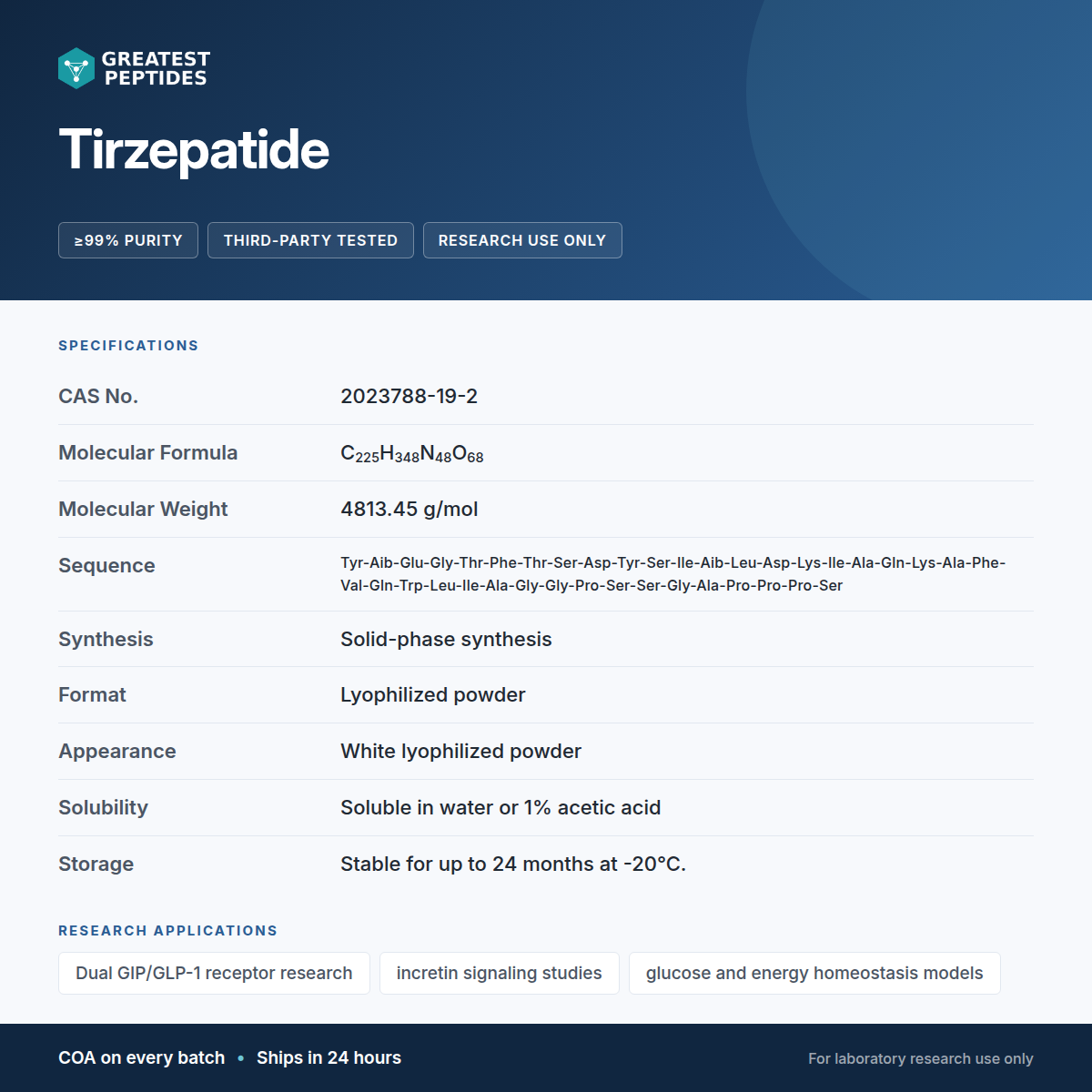
The specification table on this page carries the sequence, molecular formula and molecular weight recorded for this listing. What that string encodes, read structurally, is four deliberate departures from the native GIP sequence.
Two positions near the N-terminus carry alpha-aminoisobutyric acid in place of the native residues. The substitution at the second position is the one that blocks dipeptidyl peptidase-4, which would otherwise remove the first two residues and destroy activity within minutes. The second such substitution, further along, stabilizes the helical conformation the peptide adopts when bound.
A lysine side chain in the mid-sequence region carries a C20 fatty diacid, attached not directly but through a linker built from glutamic acid and two units of a short polyethylene-glycol-like spacer. The diacid binds albumin; the spacer holds it far enough from the backbone that it does not interfere with receptor engagement. This is the module that converts a peptide with a half-life of minutes into one with a half-life measured in days, and it is also what makes the molecule surface-active on the bench.
The C-terminus is amidated rather than carrying a free carboxylate. And a small number of mid-sequence substitutions relative to native GIP are what create the GLP-1-receptor affinity, since native GIP has essentially none.
One further property is reported for this molecule that is not visible in the sequence at all. At the GLP-1 receptor, tirzepatide has been described as a biased agonist, producing cyclic AMP accumulation while recruiting beta-arrestin less efficiently than a balanced agonist would, which reduces receptor internalization. Whether that bias is functionally important is one of the live questions in the field.
The target and the pathway in more detail
The GIP receptor and the GLP-1 receptor are both class B G-protein-coupled receptors that couple to Gs and raise cyclic AMP, and both are expressed on pancreatic beta cells, which is where their shared insulinotropic effect originates. Beyond that overlap their distributions diverge in ways that matter.
The GLP-1 receptor is densely expressed in the hindbrain, in the area postrema and the nucleus tractus solitarius, and in the hypothalamic arcuate nucleus, and this central expression is where most of the food-intake literature localizes its effect. It is also present in the gastrointestinal tract, where its activation slows gastric emptying, and in the heart and kidney.
The GIP receptor is expressed on beta cells, on adipocytes, and centrally in the hypothalamus, and its role in adipose tissue is the most genuinely unresolved question in this area of the literature. Agonism and antagonism at the GIP receptor have both been reported to reduce body weight in animal models, which is not a contradiction anyone has cleanly resolved. Candidate explanations include receptor desensitization under sustained agonism producing a functional antagonism, tissue-specific differences between central and peripheral GIP receptors, and genuine differences between acute and chronic signaling. Any paper you read on tirzepatide's adipose effects sits somewhere in that dispute, and it is worth identifying where.
Because the molecule's activity is unbalanced, favoring the GIP receptor, its composite pharmacology is not what you would predict from a balanced co-agonist. This is the reason the correct comparators in a tirzepatide experiment are a GLP-1-selective agonist and, where available, a GIP-selective agonist, run in the same system.
What the published literature on Tirzepatide actually measures
Tirzepatide has the deepest literature of any multi-receptor incretin agonist, and it is unusually well stratified.
The foundational pharmacology papers characterize cyclic AMP accumulation and beta-arrestin recruitment at both human receptors in recombinant cell systems, establish the imbalance in favor of the GIP receptor, and report the signaling-bias observation at the GLP-1 receptor. These are the papers to cite for potency and selectivity, and they are also where the assay-condition caveats are stated most carefully.
A second body of work uses the compound in rodent models with a comparator set, addressing food intake, energy expenditure by indirect calorimetry, insulin secretion in isolated islets, adipose tissue gene expression and lipid handling, and receptor-knockout designs that attempt to assign each observed effect to one receptor or the other. The knockout studies are the most informative single category for mechanism and the least often cited in secondary discussion.
A third body is clinical, spanning the diabetes and obesity trial programs reported from 2018 onward. These are human-outcome papers. They establish nothing about the molecule as a reagent and should not be used as bench references, however frequently they are quoted on retail pages.
A fourth and growing body uses tirzepatide as the reference dual agonist against which newer multi-agonists are measured. If you are reading a paper about a triple agonist, tirzepatide is very likely the comparator, and the comparison is only interpretable if both were run in the same assay.
Where the Tirzepatide literature is thin or frequently misread
Four specific misreadings account for most of the wrong statements made about this compound.
The first is describing it as a GLP-1 agonist, or worse as a semaglutide variant. It is built on GIP, it is more potent at the GIP receptor than at the GLP-1 receptor, and its pharmacology is not a stronger version of a GLP-1 agonist's. The description matters in a methods section because a reader who takes it as a GLP-1 tool compound will misinterpret the controls.
The second is treating the GIP-receptor question as settled. It is not. The coexistence of reports that both GIP-receptor agonism and GIP-receptor antagonism reduce adiposity in animal models is an open problem, and secondary sources routinely present one side of it as established fact.
The third is over-reading the signaling-bias observation. Reduced beta-arrestin recruitment relative to a comparator is a measurement made in a specific recombinant system with a specific readout. Whether it explains anything about the compound's behavior in tissue is an active question, not a conclusion, and bias metrics are notoriously sensitive to the choice of reference ligand and to receptor expression level.
The fourth is comparing potency figures across papers. The same caution applies here as to every class B receptor agonist: half-maximal effective concentrations for these molecules shift by an order of magnitude with expression level, incubation time and whether phosphodiesterase inhibition is present. Numbers from different laboratories are not comparable, and constructing a potency ranking from a literature survey is not a valid procedure.
How Tirzepatide behaves in solution
Tirzepatide's bench behavior is governed by its fatty diacid, which makes it amphiphilic and therefore surface-active. Three consequences dominate.
Surface adsorption is substantial. A dilute solution stored or handled in ordinary plastic loses peptide to the container wall, and the fractional loss rises as concentration falls because the amount adsorbed depends on surface area rather than on how much is in solution. Low-binding labware, minimal transfer steps and preparing working dilutions immediately before use all reduce this. Where a carrier protein is acceptable in the assay matrix it reduces it further, at the cost of changing the matrix.
Self-association means nominal concentration and monomer concentration are different quantities. Acylated incretin analogs form oligomeric species whose distribution depends on pH, ionic strength, temperature and the presence of phenolic compounds. Whether that matters depends entirely on what your assay reads.
Interface stress during freezing and thawing is the most common avoidable cause of loss, and repeated freeze-thaw of a stock is worse than any other single handling decision. Aliquot once into the volumes you will actually consume.
Solubility of the free peptide is pH-dependent and is poorest near its isoelectric point. The solubility and storage statements printed in the specification table above come from the product record for this listing; verify them against the documentation supplied with the lot rather than treating a catalog row as an independent measurement.
Analytical notes specific to Tirzepatide
The analytical profile of tirzepatide is dominated by the fatty-acid chain. On a reversed-phase column the molecule is strongly retained and elutes late, requiring a high organic proportion, and its peak is intrinsically broader than a short unmodified peptide's because oligomeric species interconvert during the separation. Interpreting that breadth as impurity is a routine error.
The impurities that are analytically hardest, and therefore the ones documentation should speak to, are those that are structurally close to the target: deamidation products, oxidation products, sequence variants from incomplete coupling, and species in which the fatty diacid is absent, truncated, or conjugated at the wrong lysine. The unconjugated peptide is much less retained and is usually resolvable; a wrongly positioned conjugate may not be, and it has the same mass as the correct molecule, which means mass spectrometry alone does not exclude it.
That last point is worth being explicit about, because it is the main reason a purity number and an identity confirmation are not interchangeable. A mass spectrum tells you the molecule has the expected composition. A chromatogram tells you how much of the sample runs as a single species. Neither tells you the isomer is correct, and a certificate that reports only the two of them is silent about a class of defect specific to acylated peptides.
For quantitation, note that content and purity are different measurements. Purity is a relative area figure; content is the fraction of the weighed mass that is peptide rather than trifluoroacetate or acetate counter-ion, residual water and salt. For an acylated peptide the gap between the two can be substantial, and it is content, not purity, that determines what a given weighed mass actually delivers.
Built on the GLP-1 backbone and selective for the GLP-1 receptor. It is the correct control for isolating the GLP-1 component of a tirzepatide effect, and it is a different molecule with a different receptor profile, not a weaker version of the same thing.
Adds glucagon-receptor agonism to the same structural design language. Useful as the next comparator up when asking whether an effect requires a third receptor, but with a much thinner independent literature.
Native GIP
The endogenous 42-residue hormone. It is cleaved by dipeptidyl peptidase-4 within minutes, carries no fatty acid, and has essentially no GLP-1 receptor affinity. Data generated with native GIP does not transfer.
GIP receptor antagonists
A separate and actively pursued approach that also reduces adiposity in animal models. Their existence is the clearest sign that the GIP arm of this pharmacology is not a settled question, and they are sometimes cited as though they supported the agonist rationale.
Questions specific to Tirzepatide
Is tirzepatide a GLP-1 analog?
No, and this is the most consequential misdescription in circulation. It is a GIP analog that has been modified to also engage the GLP-1 receptor. Its potency at the GIP receptor is closer to native GIP than its potency at the GLP-1 receptor is to native GLP-1, so the imbalance runs toward GIP. Describing it as a GLP-1 analog will lead a reader to expect the wrong comparators.
What does biased agonism mean for this compound?
In recombinant assays tirzepatide has been reported to drive cyclic AMP accumulation at the GLP-1 receptor while recruiting beta-arrestin less efficiently than a balanced agonist, which is associated with less receptor internalization. That is a measurement in a defined system, not an established mechanism of action, and bias calculations depend heavily on the reference ligand and receptor expression level.
Why does the GIP-receptor literature seem contradictory?
Because it genuinely is unresolved. Both agonism and antagonism at the GIP receptor have been reported to reduce adiposity in animal models. Proposed reconciliations include desensitization under sustained agonism amounting to functional antagonism, differences between central and peripheral receptor populations, and differences between acute and chronic signaling. No single explanation has consensus.
Can I compare its potency numbers with figures from another paper?
Not reliably. Class B receptor potency figures move by an order of magnitude with assay conditions, and cross-paper comparison is a well-known source of error for these molecules. If the comparison is load-bearing for your conclusion, the compounds need to be run side by side in one assay.
Which analytical documentation is most informative for an acylated peptide like this?
Identity by mass spectrometry and purity by reversed-phase HPLC are the baseline, but for an acylated peptide neither addresses conjugation position, since a misplaced fatty acid has the correct mass and may co-elute. Documentation that speaks to the conjugation specifically, or a method resolved enough to separate positional isomers, tells you more here than it would for an unmodified peptide. Content, as distinct from purity, is the other figure most often missing.
Documentation and handling reference
Tirzepatide: Documentation, Handling and Quality Record for This SKU
The section above covers what Tirzepatide is and what the published literature has looked at. This section is the operational half: what physically arrives when you order this listing, what paperwork comes with it, which fields on that paperwork are worth reading closely, and how to log the material once it is on your bench. It is written for the person who has already decided the compound is relevant and now has to justify the purchase to a supervisor, a grant line or an internal quality process.
Everything below is scoped to this exact listing rather than to research peptides in general. If you want the general version — how to read a certificate of analysis from scratch, what HPLC and mass spectrometry each prove, how to compare two suppliers who both claim 99% — that is on the home page guide, and there is no reason to read it twice.
What ships when you order Tirzepatide
At a glance
One sealed vial of lyophilized material at the listed 20 mg fill, labeled for research use only, dispatched within 24 hours of the order clearing. Batch documentation is available for the lot you receive. Free shipping applies at $150 and above.
This listing is a single fixed presentation, not a size selector. That is deliberate: each presentation gets its own page, its own documentation trail and its own URL, so a citation or a purchase-order line that points at Tirzepatide at 20 mg points at exactly one thing. If you need a different fill of the same compound and it is not listed, it is not currently in stock rather than hidden behind a dropdown.
Field
This listing
Listing
Tirzepatide
Labeled fill mass
20 mg
Physical form
Lyophilized powder in a sealed vial
Catalog category
GLP-1 / Incretin Class Analogs
Compound class
Incretin-class analog
Intended use
Research use only. Not for human or veterinary use, not for diagnostic use, not a drug or supplement.
Dispatch
Within 24 hours of the order clearing
Documentation
Batch analytical documentation available for the lot supplied
Free shipping threshold
Orders of $150 and above
Specification summary for Tirzepatide
The table below is the specification the store publishes for this listing. It is reproduced here from the product record itself rather than retyped, which means it cannot drift away from what the attribute table further up the page says. Where a field is absent it is absent because we do not publish it for this SKU, not because it was left out of this summary.
Stable for up to 24 months at -20°C. After reconstitution, may be stored at 4°C for up to 4 weeks or at -20°C for up to 6 months.
Applications
Dual GIP/GLP-1 receptor research, incretin signaling studies, glucose and energy homeostasis models
Appearance
White lyophilized powder
Shipping Conditions
Shipped at ambient temperature; once received, store at -20°C
Regulatory/Compliance
Produced in compliance with cGMP guidelines
Safety Information
Refer to provided MSDS
A specification table is a claim, and a claim is only worth the record behind it. Every field above is one you can ask us to substantiate against the batch documentation for the lot you were sent. If a field ever fails to match the paperwork, that is a defect on our side and we would rather hear about it than not.
Incretin-class analogs are long-chain sequences with modifications that are easy to get almost right and hard to get exactly right. A mass that lands a few hundred daltons away from the expected value usually means a truncated or incorrectly modified chain rather than a weighing error, which is why the mass-spectrometry trace matters more here than on a short peptide.
The analytical record behind this lot
A certificate of analysis is not a quality badge. It is a measurement report about one specific batch, produced on a specific date by a specific method, and its value to you is entirely a function of how much of that context it discloses. For Tirzepatide the fields worth checking first are the ones that tie the document to the container in your hand.
Field on the certificate
Why it matters for this SKU
Lot or batch identifier
Ties the document to the vial. A certificate with no lot reference describes some batch, not necessarily yours.
Compound name and, where applicable, sequence
This is the identity claim. For a incretin-class analog it is the field that distinguishes the material from its close relatives.
Analytical method and conditions
A purity figure without a method is a number without units. Column, gradient and detection wavelength change what the figure means.
Date of analysis
Establishes how old the measurement is relative to the material. A recent vial with a two-year-old certificate is a documentation gap.
Who performed the analysis
In-house and independent third-party results are both legitimate; they are not the same claim, and the document should say which it is.
The chromatogram or spectrum itself
A summary table can be typed by anyone. A trace can be read, and a reader who knows the compound class can tell whether it is plausible.
What our documentation for Tirzepatide does assert is what the analysis measured on the batch that was tested. What it does not assert — and no certificate from any supplier can assert — is that the material is safe, that it is suitable for any use in humans or animals, or that it will reproduce a result reported in a published paper. Those are different questions and a purity figure is not evidence for any of them.
Our batch documentation policy, including how to request the record for a lot you already have, is on the certificate of analysis page. If you need the record before ordering rather than after, ask us through the contact page and reference this listing by name.
How Tirzepatide is checked before it reaches this catalog
Three questions have to be answered separately before a compound gets a page here, and collapsing them into one percentage is the most common way a supplier listing becomes misleading.
Question
What answers it
What it does not tell you
Identity — is this the right molecule?
Mass determination, and sequence confirmation where the material is a defined chain
Nothing about how much of the vial is that molecule
Purity — what proportion of the detected material is the target?
Chromatographic separation with a stated method
Nothing about what the other fraction actually is, unless the impurities are themselves identified
Content — how much target material is actually in the container?
Quantitative determination against the labeled fill
Nothing about identity or purity; a vial can be accurately filled with the wrong thing
For Tirzepatide, receptor activation assays, cell-based cAMP or beta-arrestin readouts, and metabolic endpoint work in animal models are the assay formats the published work in this area tends to use, which matters when you are deciding whether the material as supplied is fit for the experiment you have in mind. A compound that is clean enough for a binding assay is not automatically clean enough for a quantitative cell-based readout where a co-eluting impurity could carry activity of its own.
Content is the field most often missing from a supplier listing, and it is the one that changes your arithmetic. A vial labeled 20 mg contains that much total solid, and total solid includes counter-ion, residual water and whatever else survived the process. If you need the peptide mass rather than the vial mass to be exact, that is a specific request to make in advance, not an assumption to carry into a calculation.
Receiving, inspecting and storing Tirzepatide
The most useful five minutes you will spend on this material are the five minutes immediately after the package is opened, because that is the only moment at which you can still distinguish a transit problem from a handling problem of your own.
Confirm the label on the container matches this listing, including the fill mass, and record the lot identifier in your notebook before anything else happens.
Inspect the closure and seal. A compromised closure is a reason to stop, not a reason to proceed carefully.
Look at the cake. Note its appearance and position; a cake that has collapsed, shifted or gone glassy is telling you something about the vial's history in transit.
Let a cold vial reach room temperature before opening it, so that atmospheric moisture condenses outside the vial rather than into the material.
Photograph the label and the container on arrival. It costs nothing and it settles later questions instantly.
Store it in the dark, at the temperature stated for this listing, and write down the date it entered storage.
Decide your aliquot plan before the first opening, not after it.
Longer modified chains in this class are typically the least tolerant of repeated warming in the catalog, so aliquot planning before the first reconstitution is worth more here than almost anywhere else.
The general rule for lyophilized material is that the dry state is the stable state and every transition away from it costs you something. Freeze-thaw cycling is the specific mechanism most likely to degrade Tirzepatide after it reaches you, and it is entirely under your control: a single reconstitution split into pre-planned aliquots exposes the material once, while repeatedly warming and refreezing one container exposes it as many times as you open it. There is a fuller treatment of the mechanism in our guide on freeze-thaw cycles in peptide research materials and on storage and handling.
Preparing aliquots from a 20 mg vial: the measurement arithmetic
This is arithmetic, not guidance. The only thing the table below does is tell you what concentration you are holding after you have added a known volume of diluent to a vial labeled 20 mg, so that the figure in your notebook and the figure in the container are the same figure. It says nothing about how much material any experiment should use, and it is not applicable to any use in humans or animals.
Diluent added
Resulting concentration
Amount in 0.1 mL
Amount in 0.05 mL
Aliquots of 0.25 mL
1 mL
20 mg/mL
2,000 µg
1,000 µg
4
2 mL
10 mg/mL
1,000 µg
500 µg
8
3 mL
6.67 mg/mL
666.7 µg
333.3 µg
12
5 mL
4 mg/mL
400 µg
200 µg
20
Every figure above is the same division: the labeled mass of Tirzepatide divided by the volume of diluent added. Nothing in the table is a recommendation about how much material to use in an experiment — it is the arithmetic that tells you what concentration you are holding once you have added a known volume, so that the number you write in the notebook matches what is in the container.
Two things routinely go wrong at this step. The first is treating the labeled mass as the peptide mass; as noted above, the labeled figure is total solid unless the documentation says otherwise, so a concentration derived from it is a nominal concentration. Say so in your methods rather than implying a precision the specification does not support. The second is ignoring the volume the solid itself occupies — small at these masses, but not zero, and it means the final volume is very slightly greater than the volume you added.
If you want to work backwards from a target concentration to a diluent volume, or to check a figure against a different vial size, our peptide reconstitution calculator does the same division in both directions and shows its working.
What to record for Tirzepatide so the work is reproducible
Reproducibility in this area fails at the material-provenance step far more often than at the analysis step. The fields below are the ones that let somebody else — a reviewer, a collaborator, or you in eighteen months — work out whether two sets of results were generated with comparable material.
Supplier and the exact listing name, including the fill size, rather than just the compound name
Lot identifier, and the date the batch documentation was issued
Date received, and the storage conditions and location it went into
Date of reconstitution, the diluent used and its lot, and the volume actually added
Nominal concentration obtained, stated as nominal rather than as measured
Aliquot scheme: how many, what volume, stored where
Freeze-thaw count for each aliquot at the point of use
Any deviation from plan, including deviations that seemed unimportant at the time
Whether the material was research-use-only labeled, which for this listing it is
Comparing suppliers on this exact SKU
Comparing Tirzepatide across suppliers on price alone is comparing two numbers that may not describe the same thing. These are the questions that make the comparison meaningful, with our answers next to them so you can hold us to the same standard you would hold anyone else.
Question to ask any supplier
Our answer for this listing
Is batch documentation available for the specific lot I will receive, not a representative lot?
Is there a published position on what the documentation does not prove?
Yes. It is stated on this page and on every product page.
A supplier who answers all seven honestly is a better bet than a supplier who is ten percent cheaper and answers four. A supplier who cannot answer the first one at all is not selling you documented material; they are selling you a container.
Compliance boundary for Tirzepatide
Tirzepatide is supplied for laboratory research use only. It is not a drug, not a supplement, not a cosmetic and not a medical device. It is not for human or veterinary administration, not for diagnostic use, and not for use in food. That is not a disclaimer bolted onto a sales page — it is the actual scope of what is being sold, and it constrains what can honestly be written about it.
Language that stays inside the boundary
Language that does not
"Supplied for research use only"
Any phrasing that implies a personal or clinical use
"Published work in this area has examined receptor binding, signaling selectivity and metabolic endpoints in incretin-pathway models"
"Tirzepatide does X" stated as an established effect
"Purity determined by the stated method on the tested batch"
"Pharmaceutical grade", "medical grade", "safe"
"Concentration arithmetic for preparing laboratory aliquots"
Anything framed as a dose, a protocol or a schedule
"Not for human or veterinary use"
Silence on the point, which readers correctly interpret as evasion
Naming the model system a finding came from
Reporting an animal or in-vitro finding as though it were a human finding
The reason to be precise about this is not only regulatory. Research literature on this class of material is genuinely interesting and genuinely incomplete, and overstating it makes the real findings harder to see. Where published work is referenced on this site it is referenced as what was measured, in what system, at what scale — not as a property of the vial.
Other GLP-1 / Incretin Class Analogs listings
These share a catalog category with Tirzepatide, which means the documentation and handling considerations above largely transfer to them. Their compound-specific sections do not — each has its own identity, its own literature and its own analytical profile.
The full catalog is on the shop page, and the longer written material is in our research guides.
Questions about ordering Tirzepatide
Is Tirzepatide documentation available before I order?
Yes. Ask through the contact page and reference this listing by name. Our general position on batch documentation is on the certificate of analysis page. If a supplier will not show you the record until after payment has cleared, that is worth noticing.
What does the 20 mg figure on the label actually refer to?
It is the labeled fill for this presentation. For lyophilized material the labeled mass is total solid unless the documentation states otherwise, and total solid includes counter-ion and residual moisture as well as target compound. If your calculation depends on the distinction, resolve it against the batch record rather than assuming.
How fast does Tirzepatide ship?
Within 24 hours of the order clearing. Orders of $150 and above ship free. Transit time after dispatch depends on the service selected at checkout.
Can I buy Tirzepatide for personal use?
No. This material is supplied for laboratory research use only. It is not a drug, supplement or cosmetic, it is not for human or veterinary administration, and nothing on this page should be read as guidance for any such use.
How should Tirzepatide be stored before and after reconstitution?
Store the sealed vial dry, dark and at the temperature stated for this listing, and record the date it entered storage. Once material is in solution the useful discipline is to minimize repeated warming: plan the aliquot scheme before the first reconstitution so the material is exposed once rather than once per experiment. Longer modified chains in this class are typically the least tolerant of repeated warming in the catalog, so aliquot planning before the first reconstitution is worth more here than almost anywhere else.
How much diluent should I add to a 20 mg vial?
That depends entirely on the concentration your protocol calls for, which is your decision and not something a product page can answer. What the table above provides is the arithmetic: labeled mass divided by added volume gives concentration. The reconstitution calculator runs the same division in either direction.
Does a high purity figure mean Tirzepatide is safe?
No, and this is the single most common misreading of a certificate of analysis. Purity describes what proportion of the detected material was the target compound in the batch that was tested, by the method stated. It is not a safety assessment, it says nothing about suitability for any use in humans or animals, and it does not become a safety claim by being a large number.
What is Tirzepatide classified as in your catalog?
It is listed as a long modified chain with an acylated or otherwise conjugated residue, in the GLP-1 / Incretin Class Analogs category. Published work in this area has looked at receptor binding, signaling selectivity and metabolic endpoints in incretin-pathway models. That is a description of where the literature sits, not a claim about what the material does.
Do you have more general written material on evaluating research peptides?
Yes. The home page guide covers reading a certificate of analysis, what chromatographic and mass-spectrometric methods each prove, and how to compare suppliers. The research guides go deeper on individual topics, and the FAQ covers ordering, shipping and post-shipping questions.
Tirzepatide is supplied strictly for laboratory research use. It is not a drug, supplement, cosmetic or medical device; it is not for human or veterinary use, not for diagnostic use and not for use in food. No statement on this page is intended to describe a therapeutic use, benefit or outcome, and references to published work describe what was measured in the reported model system rather than a property of the material supplied. Purchasers are responsible for handling the material in accordance with the requirements applicable to their institution and jurisdiction.
Check the documentation before you check the price