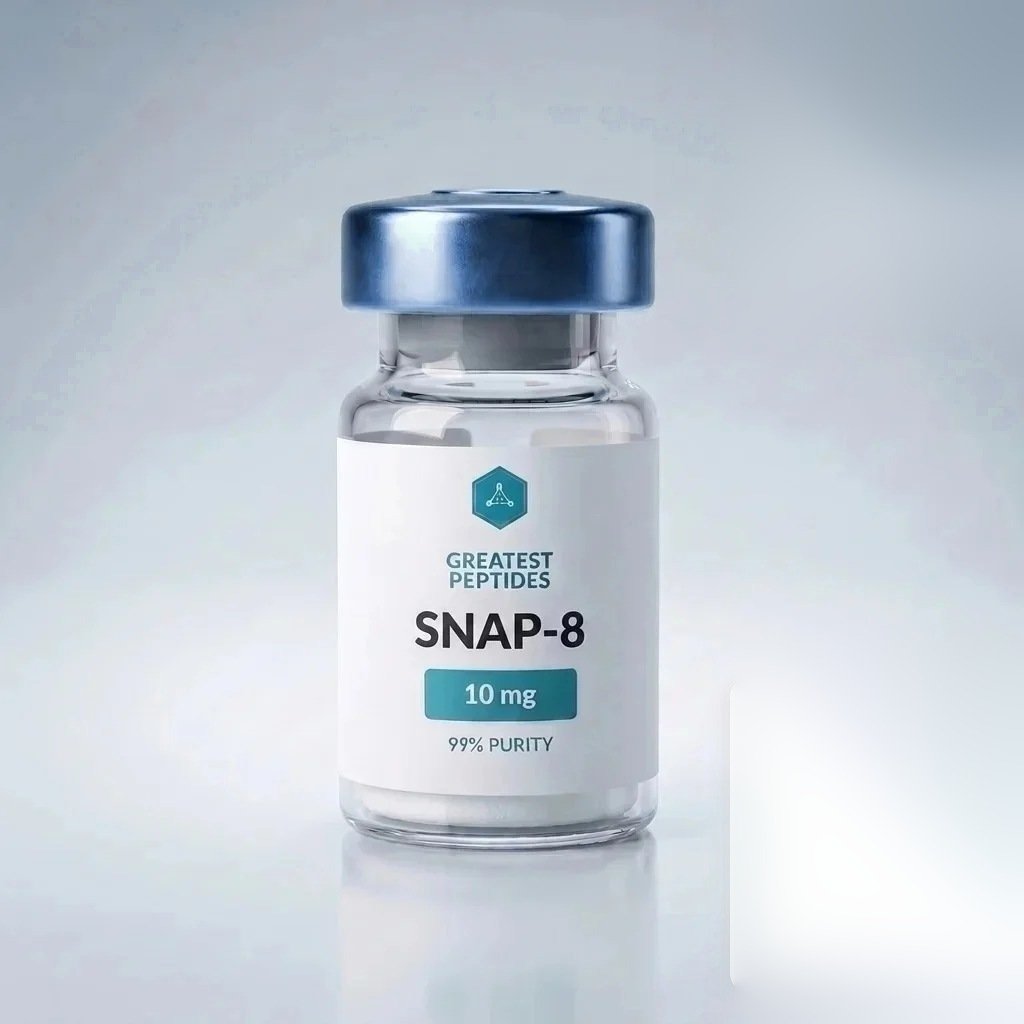
$35.99Original price was: $35.99.$31.99Current price is: $31.99.
In stockShips today if ordered by 3 PM ESTUSA fulfillment
Research Studies
✓Studied as an acetyl octapeptide in neuromuscular-signaling research.
✓Investigated for SNARE-complex and catecholamine-release pathways in vitro.
✓Used in laboratory models of dermal-cell signaling.
✓Applied in peptide-cosmetic research assays.
Snap-8 10 mg is supplied at 99%+ purity for in-vitro laboratory research only. Not for human or veterinary use.
Reconstituting this vial? Our free peptide reconstitution calculator converts vial mass and diluent volume into concentration, draw volume and U-100 syringe graduations. Research use only.
ALL ARTICLES AND PRODUCT INFORMATION PROVIDED ON THIS WEBSITE ARE FOR INFORMATIONAL AND EDUCATIONAL PURPOSES ONLY. The products offered on this website are intended solely for research and laboratory use. These products are not intended for human or animal consumption. They are not medicines or drugs and have not been evaluated or approved by the FDA to diagnose, treat, cure, or prevent any disease or medical condition. Any form of bodily introduction is strictly prohibited by law.
SNAP-8 (acetyl octapeptide-3) is a synthetic peptide studied in cosmetic and skin research as a topical research compound. It is an elongation of the Argireline sequence and is investigated for its interaction with the SNARE complex involved in neurotransmitter vesicle docking. Greatest Peptides supplies SNAP-8 as a >99% pure powder for laboratory research use only.
Snap-8, an acetyl octapeptide studied in cosmetic/formulation research (lyophilized). For research use only.
Purity: ≥98% HPLC (see batch COA); identity confirmed by LC-MS. A batch-specific Certificate of Analysis (COA) is available for each lot. For laboratory and research use only. Not for human or animal consumption.
SNAP-8 Research Overview
In published cosmetic-research literature, SNAP-8 has been studied for its proposed competition with SNAP-25 within the SNARE complex, a mechanism examined in expression-line and topical skin research models. It is frequently used as a model compound alongside acetyl hexapeptide-3 (Argireline) in comparative cosmetic-peptide studies.
These observations describe outcomes reported in laboratory and animal research models only. SNAP-8 is a research chemical — it is not a dietary supplement, drug, or therapeutic product, and nothing here describes effects in humans.
Related Research Topics
SNAP-8 vs. Argireline in cosmetic research
SNARE-complex peptides in skin research
Acetyl octapeptide research overview
Frequently Asked Questions
What is SNAP-8 used for in research?
SNAP-8 is used strictly as a tool compound in laboratory research, as described in the overview above. It is studied in controlled models only.
Is SNAP-8 research use only?
Yes. All compounds from Greatest Peptides are supplied strictly for laboratory and research use only. They are not intended for human or veterinary use.
What purity is your SNAP-8?
Supplied at 99%+ HPLC purity with a batch-specific Certificate of Analysis (COA) confirming purity by HPLC and identity by mass spectrometry for your exact lot.
How should SNAP-8 be stored?
Lyophilized SNAP-8 is typically kept refrigerated and protected from light for short-term handling, and frozen (-20°C) for longer-term storage.
How is SNAP-8 supplied?
SNAP-8 ships as a lyophilized powder, 10 mg per vial, requiring reconstitution with a suitable solvent prior to research use.
Additional information
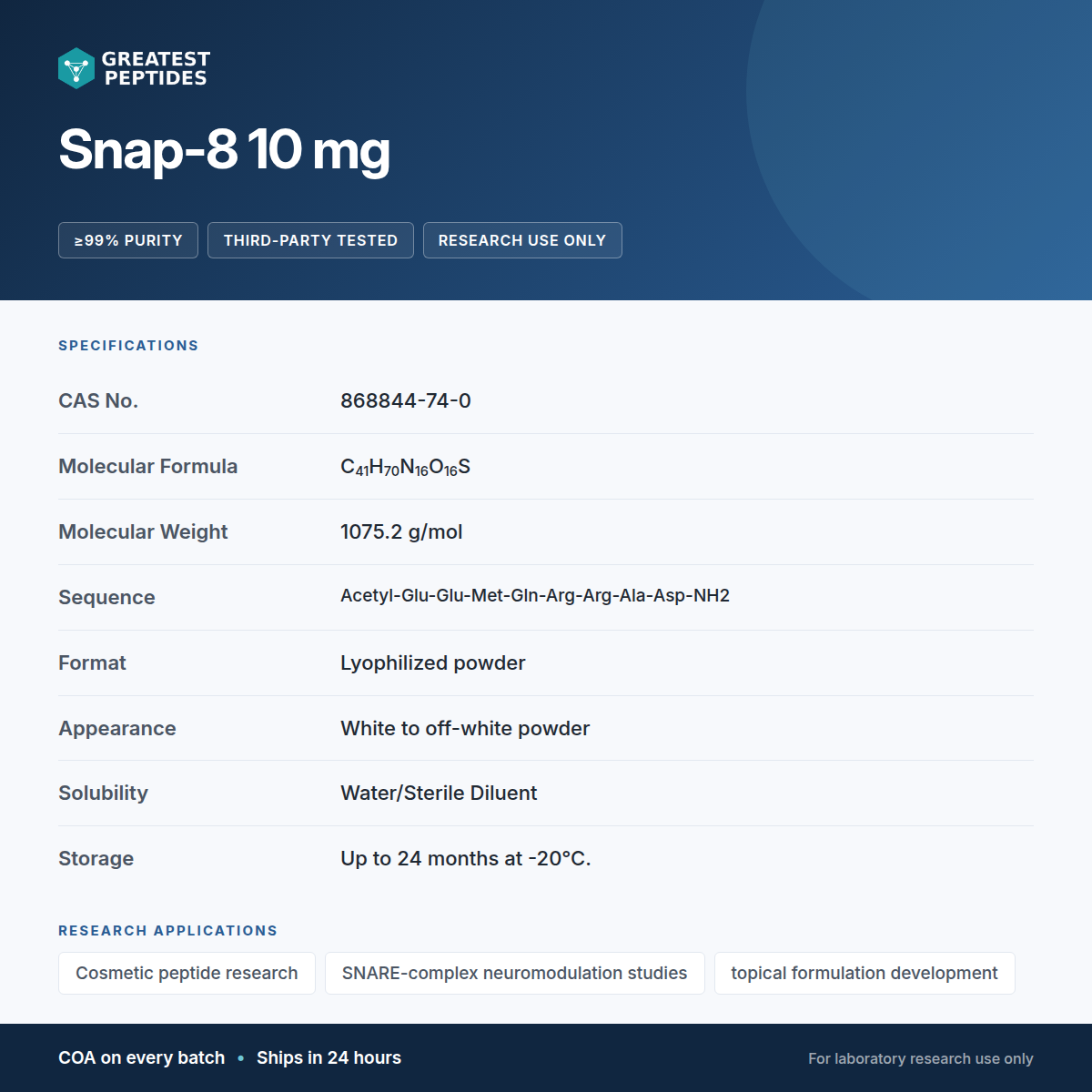
CAS No.
868844-74-0
Purity
≥99%
Sequence
Acetyl-Glu-Glu-Met-Gln-Arg-Arg-Ala-Asp-NH2
Molecular Formula
C41H70N16O16S
Molecular Weight
1075.2 g/mol
Format
Lyophilized powder
Solubility
Water/Sterile Diluent
Stability & Storage
Up to 24 months at -20°C. Avoid repeated freeze-thaw cycles.
Applications
Cosmetic peptide research, SNARE-complex neuromodulation studies, topical formulation development
Appearance
White to off-white powder
Regulatory/Compliance
Not for human consumption. For research use only.
Safety Information
MSDS available upon request
Shipping Conditions
Shipped at ambient temperature in protective packaging. Lyophilized powder is stable in transit; on arrival, transfer to −20 °C storage as noted above.
Researcher FAQ
How do I reconstitute this peptide?
Use bacteriostatic water (BAC) at a 1–2 mL volume per vial. Add the solvent slowly down the vial wall, swirl gently — never shake. Refrigerate after reconstitution and use within 30 days. For in-vitro laboratory handling only.
How should I store this product?
Lyophilized: 36–46°F (refrigerated) for up to 24 months. Reconstituted: keep refrigerated and protect from light; use within 30 days. Avoid repeated freeze-thaw cycles.
Shipping & tracking?
Orders placed before 3 PM EST ship the same business day from our USA facility. Tracking is emailed within 24 hours. Plain, discreet packaging. Free shipping on orders over $150.
For Research Use Only · Not for human consumption
Research Procurement Information
Buy Snap-8 for Research | RUO COA & Documentation Guide
For laboratory teams evaluating where to buy Snap-8 for research, the priority is documentation, compound identity, and research-use-only (RUO) alignment. Snap-8 (acetyl octapeptide-3) is a synthetic eight-amino-acid peptide (sequence Ac-Glu-Glu-Met-Gln-Arg-Arg-Ala-Asp-NH2) with reported molecular formula C41H70N16O16S and a molecular weight of approximately 1,075–1,111 Da depending on source/salt form (CAS 868844-74-0)[1]; identity should be confirmed against the batch-specific COA. It is described in the literature as a peptide modeled on the SNAP-25 N-terminus in cosmetic-science research[2].
Fast Answer
Researchers evaluating where to buy Snap-8 for research should review RUO labeling, a batch-specific certificate of analysis (COA), HPLC purity data, LC-MS or comparable identity support, sequence/mass consistency, and lot traceability before procurement. Material discussed here is intended for laboratory research use only and is not for human or veterinary use.
What Does “Buy Snap-8 for Research” Mean?
The phrase is addressed as laboratory research-procurement intent — how qualified researchers evaluate a Snap-8 reference material through documentation, analytical support, and labeling clarity, not personal, clinical, or consumer decision-making.
Published literature discusses Snap-8 within cosmetic-science research as a peptide modeled on the SNAP-25 N-terminus (part of the SNARE complex) in cell and in-vitro models[2][3]. On a research product page this pathway context should remain academic literature interpretation used to define the research lane — it is not converted into product-performance language.
COA, Purity & Identity Documentation
A Snap-8 COA should be reviewed as a batch-specific record, not a marketing statement. Look for compound name, lot number, test date, stated purity, analytical method, identity confirmation, and sequence/mass information. Purity, identity, method, and lot number should be evaluated together.
Evaluation area
What to review
Why it matters
RUO labeling
Clear research-use-only language
Separates research procurement from human-use positioning
COA availability
Batch-specific certificate for the received lot
Supports lot-level documentation
Purity data
HPLC area-percent support for stated purity
Helps evaluate material consistency
Identity testing
LC-MS / mass-spec confirmation vs expected mass
Confirms the material matches the listed peptide
Lot traceability
Lot number matching across records
Supports research recordkeeping
HPLC, LC-MS & Analytical Review
HPLC documentation supports purity assessment; LC-MS or mass-spectrometry documentation supports identity confirmation and molecular-mass review[10][11]. Because reported descriptors vary by source, mass data confirming the observed mass against the expected value are especially useful. ICH Q2(R2) describes validation characteristics used to interpret assay, purity, and identity results[7].
Lot Traceability & Batch Documentation
Lot traceability connects the product listing, COA, label, and receiving record. ISO/IEC 17025 addresses the competence of testing laboratories, and NIST resources describe how certificates and lot identifiers support traceability[8][9].
Claim Boundary for RUO Positioning
Research-safe statement
Non-compliant version to avoid
“Snap-8 is discussed in cosmetic-science literature as a SNAP-25-modeled peptide.”
“Snap-8 removes wrinkles or expression lines.”
“Researchers should review COA and identity data before procurement.”
“Buy Snap-8 for anti-wrinkle.”
“Greatest Peptides supplies Snap-8 as a research-use-only material.”
“Greatest Peptides supplies Snap-8 for treatment.”
Research Procurement Checklist
Confirm the material is labeled for research use only.
Review the batch-specific certificate of analysis for the received lot.
Confirm purity is supported by HPLC analytical data.
Confirm identity is supported by LC-MS or mass spectrometry.
Compare compound name, sequence, formula, and mass across the page, label, and COA.
Verify the lot number matches across all documentation.
Document storage and handling conditions in the laboratory record.
How Greatest Peptides Presents Snap-8
Greatest Peptides supplies Snap-8 as a research-use-only laboratory material in lyophilized powder form, positioned around a stated ≥99% purity target, batch-specific COA availability, HPLC/LC-MS documentation, lot-level traceability, and transparent RUO labeling. Products are not intended for human or animal consumption, diagnostic, therapeutic, clinical, or veterinary use.
Published Literature Context
Published Snap-8 literature spans peptide chemistry and cosmetic-science research models[2][3]. Model-specific findings should not be generalized or interpreted as use guidance for research-use-only materials.
Contributing Researchers
Recognized for published work that shaped the scientific context discussed above
M. J. Blanes-Mira, PhD — authored research on SNAP-25-derived peptides in cosmetic-science research relevant to Snap-8[2].
Cosmetic peptide research group — characterized SNARE-modeled octapeptides in in-vitro research[3].
FAQs About Buying Snap-8 for Research
What should researchers check before buying Snap-8 for research?
Review RUO labeling, the batch-specific COA, stated purity with HPLC support, LC-MS identity data, sequence/mass consistency, and lot traceability.
What is Snap-8 in research documentation?
A synthetic acetylated octapeptide (Ac-EEMQRRAD-NH2) modeled on the SNAP-25 N-terminus, with reported formula C41H70N16O16S; confirm descriptors against the COA.
Why does a COA matter when buying Snap-8?
It connects the listing to batch-specific documentation: compound name, lot number, test date, purity, and identity method for the received lot.
Is Snap-8 intended for human or animal use?
No. Material discussed here is intended strictly for laboratory research use only.
How should published literature be interpreted?
As scientific context only. Model-specific findings should not be generalized or read as use guidance for research-use-only materials.
This page addresses Snap-8 only as research-use-only laboratory procurement. Boundary-sensitive terms such as wrinkles, expression lines, skin, and cosmetic use are referenced here only as research-language examples that must stay separate from RUO product positioning. All product information is for informational and educational purposes only. Products are not intended for human or animal consumption and have not been evaluated by the FDA to diagnose, treat, cure, or prevent any disease.
References
Registry record for Snap-8 (acetyl octapeptide-3), CAS 868844-74-0 (reported formula C41H70N16O16S; confirm against COA). Accessed 2026.
Blanes-Mira MJ, et al. A synthetic peptide modeled on the SNAP-25 protein (SNARE-competing) in cosmetic-science research. International Journal of Cosmetic Science. 2002.
Cosmetic peptide research literature on SNARE-modeled octapeptides. 2000s.
Registry record for acetyl octapeptide-3, CAS 868844-74-0. Accessed 2026.
IUPAC-IUB Joint Commission. Nomenclature and symbolism for amino acids and peptides. 1983.
U.S. FDA. Analytical procedures and methods validation for drugs and biologics. 2015.
U.S. FDA. Q2(R2) Validation of Analytical Procedures. 2024.
International Organization for Standardization. ISO/IEC 17025:2017. 2017.
National Institute of Standards and Technology. Reference materials and certificates of analysis. Accessed 2026.
Mant CT, et al. HPLC analysis and purification of peptides. Methods in Molecular Biology. 2007.
Steen H, Mann M. Peptide sequencing. Nature Reviews Molecular Cell Biology. 2004. PMID 15340378.
Compound profile
SNAP-8: compound profile, literature landscape and handling notes
SNAP-8 in one paragraph
SNAP-8 is a synthetic octapeptide, blocked at both ends, whose name is also its mechanistic premise: it is patterned on a segment of SNAP-25, the synaptosomal-associated protein that contributes two of the four helices to the neuronal SNARE complex. That makes it the one compound in this catalog whose proposed mode of action is not receptor binding but competition for a position in a protein-protein assembly, which changes what a potency figure means, what an assay can measure, and what an orthogonal experiment would have to look like. Structurally it is a two-residue extension of the earlier hexapeptide marketed as Argireline, from the same design lineage and the same ingredient program. It is also the compound here whose evidence base is the most heavily industry-generated, and that is the single most important thing to establish before citing anything about it. Everything below describes the published research record and the behavior of the material on a bench. Nothing here is a claim about what this vial does, and nothing here is applicable to use in humans or animals.
Where SNAP-8 came from
SNAP-8 comes from a cosmetic ingredients program rather than a pharmacology program, and recognizing that is the key to reading everything written about it. The design question was posed in reverse from a toxin. Botulinum neurotoxin type A had been characterized well enough by the 1990s that its molecular target was no longer in dispute: it is a protease, and the protein it destroys is SNAP-25. Once that was known, an obvious question followed for anyone working on small synthetic molecules. If the toxin acts by removing SNAP-25 from the assembly that drives vesicle fusion, could some entirely non-toxic molecule interfere with the same assembly by a different and much gentler route?
The answer proposed by a Spanish specialty-ingredients developer in the late 1990s was to take a short stretch of SNAP-25 itself, synthesize it as a free peptide, and rely on it competing with the intact protein for a place in the complex. The first product of that reasoning was a hexapeptide, given the trade name Argireline and the INCI designation acetyl hexapeptide-3, later renumbered to acetyl hexapeptide-8. SNAP-8 is the follow-on: the same peptide extended by two residues, carrying the INCI name acetyl octapeptide-3, and named directly after the protein it is modeled on with the residue count appended.
The INCI numbering deserves a sentence because it causes more confusion than anything else in the naming. Those numbers are positions in a registry index. They are assigned sequentially as ingredients are listed and they encode nothing at all about sequence, length, chemistry or relatedness. Acetyl hexapeptide-3 and acetyl hexapeptide-8 are the same compound under two index entries; acetyl octapeptide-3 and acetyl hexapeptide-3 share a number and are different molecules. Anyone reconciling a vendor label against a paper should ignore the number and work from the sequence in the specification table further down this page.
The practical consequence of this origin is that SNAP-8 has no academic tool-compound tradition behind it. There was no target validation phase, no receptor deorphanization, no medicinal chemistry series published in the open literature. The compound arrived as an ingredient with a mechanistic story attached, and the story has been repeated far more often than it has been tested.
Reading the structure of SNAP-8
The exact sequence string, formula and mass for this listing are printed in the specification table further down this page, taken from the product record rather than restated here. What is worth doing is reading what the eight residues and two blocked termini are for, because in a peptide this short every feature is deliberate.
The core is the hexapeptide sequence shared with Argireline: a pair of acidic residues at the N-terminal end, a methionine, a glutamine and two adjacent arginines. SNAP-8 continues two residues further along the parent protein sequence, adding a small neutral residue and one more acidic side chain. The stated design rationale for the extension is more contact surface for the competitive interaction, on the reasoning that a longer stretch of the mimicked segment presents more of the interface the intact protein would present. Whether the extension actually improves competition is a developer claim supported by developer data rather than an independently established structure-activity finding.
Both termini are blocked. N-terminal acetylation replaces the hydrogen on the free alpha-amino group with an acetyl group. That does three things simultaneously: it removes a positive charge that the segment does not carry in the intact protein, where this stretch is internal rather than terminal; it denies aminopeptidases the free alpha-amino group they require to begin trimming from that end; and it adds a fixed 42-unit increment to the mass, which is useful as an identity check. C-terminal amidation removes the corresponding negative charge and blunts carboxypeptidase attack.
With the termini neutralized, the charge state is set entirely by side chains: three carboxylates against two guanidinium groups, giving a small net negative charge at neutral pH distributed as distinct acidic and basic patches rather than as a uniform polarity. There is no aromatic residue, no cysteine, no hydrophobic face and nothing to nucleate secondary structure. The methionine is the only chemically labile residue in the molecule and it accounts for most of what can go wrong in solution.
The more instructive point is what the fragment lacks relative to the protein it imitates. SNAP-25 is a protein of a little over two hundred residues carrying two separate SNARE motifs joined by a linker that is palmitoylated on a cluster of cysteines, and that lipid modification is how the protein is held at the membrane, since it has no transmembrane segment of its own. An eight-residue peptide has no membrane anchor, no second motif and no capacity to form a four-helix bundle. It is therefore not a functional substitute for SNAP-25. The design intent is occupancy and obstruction, not replacement, and secondary writing that describes SNAP-8 as taking the place of SNAP-25 has misstated the premise.
The target and the pathway in more detail
The target here is not a receptor. It is a protein assembly, and the whole entry turns on understanding what that assembly is and what interfering with it would mean.
Membrane fusion is thermodynamically difficult. Two lipid bilayers approaching each other must shed ordered water and overcome strong repulsion before their leaflets can merge, and nothing about that happens spontaneously at a useful rate. The SNARE proteins are the machinery that supplies the mechanical energy. In the neuronal case the participants are three: synaptobrevin, also called VAMP, which sits in the vesicle membrane; syntaxin-1, which sits in the plasma membrane; and SNAP-25, which is also at the plasma membrane but held there by lipid modification rather than by a membrane-spanning helix. Synaptobrevin contributes one helical SNARE motif, syntaxin contributes one, and SNAP-25 contributes two. Together they assemble into a parallel four-helix bundle.
The assembly is directional. It begins at the membrane-distal ends of the motifs and zippers toward the membrane-proximal ends, and because the two membranes are attached to opposite ends of the forming bundle, zippering physically drags them together. The core of the finished bundle is hydrophobic except for one central layer containing three glutamines and one arginine, which is the basis of the standard Q-SNARE and R-SNARE classification. The completed complex is remarkably stable, resistant to detergent and to considerable heat, and taking it apart afterward requires a dedicated ATP-driven machine, the AAA+ ATPase NSF acting with its adaptor proteins. Calcium sensing and timing are layered on top by synaptotagmin, complexin and the Munc proteins, which regulate assembly rather than perform it.
The premise behind SNAP-8 is that a free peptide corresponding to part of one of SNAP-25's motifs can insert itself into the space that motif would occupy, forming a non-productive arrangement and lowering the rate or the extent of productive four-helix assembly. Several properties follow directly from that premise and they are what make this compound analytically unusual.
There is no saturable high-affinity binding site, so there is no meaningful dissociation constant of the kind quoted for a receptor ligand. The interaction is stoichiometric rather than catalytic, which means useful competition requires the peptide to be present at molar amounts comparable to the protein it competes with, not at trace amounts. It is reversible and occupancy-driven, so removing the peptide removes the effect. And because the assembled bundle is so stable, competition can only act on complexes that are unassembled or partly assembled, which makes the effect kinetic and window-dependent rather than a simple on-off switch. Every one of those properties is the opposite of how a receptor agonist behaves, and importing receptor intuitions here produces wrong expectations.
What the published literature on SNAP-8 actually measures
The published record on SNAP-8 sorts into four categories that differ enormously in rigor, and almost every dispute about this compound comes from citations that cross between them without saying so.
The first category is biochemical SNARE work, and this is the strongest material, though most of it concerns the mechanism rather than the compound. Cell-free assays reconstitute the complex from purified recombinant proteins and read assembly by detergent-resistant complex formation on a gel, by fluorescence resonance energy transfer between labeled motifs, or by lipid mixing between reconstituted proteoliposomes. In this format a competing peptide is added and the reduction in assembly is measured. What such an assay establishes is narrow and real: that a peptide at a stated concentration reduces complex formation between purified proteins in a defined buffer.
The second category is neurosecretory cell work. Chromaffin cells from adrenal medulla are the classical preparation for regulated exocytosis, and catecholamine release from them can be measured by amperometry at single-cell resolution or by bulk assay after stimulation. The founding reports for this peptide family, published in the cosmetic science literature in the early 2000s, used preparations of this kind and described interference with stimulated release. Synaptosome and neuronal culture preparations appear in the same role. These experiments measure secretion from excitable cells in a dish, which is a much more specific claim than the phrasing usually attached to it.
The third category is the applied cosmetic literature, and it is by volume the largest. It consists predominantly of studies commissioned by or performed at ingredient developers, reported in trade journals, technical dossiers and conference material, using instrumental surface-topography endpoints such as silicone replica profilometry or image analysis on small panels of volunteers. Blinding, vehicle controls, randomization, pre-registration and independent replication are variably present and frequently absent. A large fraction of this material was never peer reviewed in any conventional sense.
The fourth category is permeation and formulation science, and it is the most interesting recent work. It consists of Franz diffusion cell experiments on excised skin, tape-stripping studies, quantification of peptide recovered from separated tissue layers, and comparisons of encapsulation strategies including liposomes, ethosomes and various nanocarriers. This literature exists precisely because the permeation question is unresolved, and it is generally more careful than the efficacy literature it is meant to support. It is also the part a bench researcher can most usefully read, because its methods are transferable and its endpoints are analytical rather than perceptual.
Where the SNAP-8 literature is thin or frequently misread
This is the section that matters most for SNAP-8, and it has to be blunt. The evidence base is weak in three independent ways, none usually acknowledged.
The first is provenance. Essentially the entire body of work supporting the applied claims was generated by the cosmetic industry, much of it by the ingredient developers themselves, and much of it exists as technical white papers, marketing dossiers and conference posters rather than peer-reviewed controlled studies. Small unblinded panels without vehicle comparison are common. A claim repeated across thousands of pages can still trace back to a single internal document, and here that is frequently the case. Tracing an assertion back to its primary source is unusually rewarding, because the trail is short and often ends somewhere unexpected.
The second is access, the central unresolved objection. The SNARE complex assembles in the cytoplasm, on the inner face of a plasma membrane, inside a cell. For the competitive premise to operate in intact tissue the peptide must cross the stratum corneum, traverse viable epidermis and reach the cytosol of a specific cell type. An octapeptide of roughly a kilodalton, carrying multiple charged side chains and no hydrophobic character, is far outside the informal 500-dalton guideline for passive permeation through intact stratum corneum, and being charged and hydrophilic makes the subsequent bilayer crossing harder still. This objection is neither obscure nor new. What is remarkable is how often it is simply not addressed: writing about this compound routinely moves from an in vitro competition figure to an applied claim without mentioning that the two are separated by two membranes and a barrier the peptide is not built to cross.
The third is context transfer. The SNARE competition data comes from cell-free reconstitutions and neurosecretory cell preparations with no relation to the tissue context in which the compound is marketed. Chromaffin cells are an excellent model of regulated exocytosis and a poor model of anything else. Reporting that a peptide reduces catecholamine release from adrenal medullary cells in a dish is a statement about adrenal medullary cells in a dish.
A fourth problem is arithmetic. Because the mechanism is stoichiometric rather than catalytic, the concentrations at which competition is demonstrable in vitro are high in molar terms. Anyone asking whether such concentrations could be reached at an intracellular target after transit across a barrier should carry that number through, and most published discussion does not.
How SNAP-8 behaves in solution
SNAP-8 is one of the easier peptides in this catalog to keep in solution and one of the harder ones to tell by eye whether it is still intact.
Solubility is not a problem. With three carboxylates, two guanidinium groups, several polar amide side chains and no hydrophobic face, the peptide dissolves readily in water and in ordinary buffers. The aggregation and surfactant behavior that dominates acylated and amphiphilic peptides is absent: there is nothing to bury and no fold to nucleate on.
Adsorption is more subtle than the low hydrophobicity suggests. Untreated polypropylene is a modest problem here, but glass is another matter. Silanol groups on a glass surface are negatively charged at neutral pH, and the guanidinium groups of the two arginines interact with them in an ion-exchange-like fashion. Arginine-containing peptides can be lost to glass at low concentration in low-ionic-strength buffer, worst at high surface-to-volume ratio. Raising ionic strength suppresses it, as do low-binding plasticware and fewer transfer steps.
Chemical stability in solution is good relative to most peptides but not unconditional, and two reactions account for nearly all of it. The methionine oxidizes to the sulfoxide and, more slowly, to the sulfone, accelerated by dissolved oxygen, trace transition metals, light and peroxide impurities in excipients. Glutamine deamidation is the other, converting an amide side chain to a carboxylate at a rate rising sharply with pH above neutral; the C-terminal amide hydrolyzes by the same chemistry. Both are slow at low temperature and near-neutral pH, and both are cumulative.
Freeze-thaw cycling is less destructive than for a structured peptide, since there is no fold to disrupt, but it is not free. The ice interface concentrates solutes, and in sodium phosphate buffers the two salt forms crystallize at different rates as freezing proceeds, driving the pH of the unfrozen fraction down by more than a unit. Aliquoting once at a working concentration is the answer.
The uncomfortable point is what degraded material looks like: exactly like intact material. Oxidation and deamidation shift mass by 16 and by 1 and precipitate nothing, so there is no turbidity, no color change and no visible signal. Visual inspection has almost no diagnostic value here, and turbidity is more likely to indicate microbial growth than peptide degradation. The storage statement in the specification table is the product record for this material and should be checked against the documentation supplied with the lot.
Analytical notes specific to SNAP-8
Three analytical features are specific to this molecule, and together they explain why a conventional certificate tells you less than its simple structure suggests.
The first is the absence of any aromatic residue: no tryptophan, no tyrosine, no cystine, and therefore essentially no absorbance at 280 nanometers. Detection has to be at around 214 nanometers, where the peptide bond absorbs. That works chromatographically but carries the familiar caveat with unusual force: the 214 nanometer response scales roughly with the number of peptide bonds a species contains, so among short peptides an area-percent figure is not proportional to composition. Shorter impurities are under-represented, longer ones over-represented, and anything co-eluting is invisible entirely. Concentration should come from weighed mass, amino acid analysis, or a chromatographic method calibrated against a reference material.
The second is the acetyl group, the most useful identity handle the molecule offers. Acetylation shifts the mass by a fixed 42 units relative to the free-amine peptide, so an unacetylated batch is immediately distinguishable by mass spectrometry. Incomplete acetylation is a realistic synthesis outcome and an unacetylated batch a realistic substitution, and the free-amine form is a different molecule: it carries an extra positive charge at neutral pH and presents an alpha-amino group that aminopeptidases will act on. Chromatographic separation is possible, but the retention difference under a short gradient may be smaller than expected, so mass is the reliable discriminator.
The third is the oxidation and deamidation family. Methionine sulfoxide is 16 units heavier and generally elutes earlier on a reversed-phase column because it is markedly more polar; the sulfone adds 32. Deamidation of the glutamine side chain and hydrolysis of the C-terminal amide each add roughly 1 unit, which demands enough mass resolution to separate them from the natural isotope pattern of the intact species. That is the realistic impurity profile, and none of it announces itself in the vial.
The relationship to the hexapeptide is analytically trivial and administratively treacherous. SNAP-8 and Argireline differ by two residues, a large mass difference and a clear retention difference, so any competent method separates them. The exposure is at the labeling level: two compounds from one lineage sharing six of eight residues, both sold under index names carrying no structural information, are easy to swap and impossible to tell apart by eye. Identity by mass spectrometry against the sequence in the specification table, not the name, is what settles it.
Compounds researchers confuse with SNAP-8
Often mistaken for
How it actually differs from SNAP-8
Argireline (acetyl hexapeptide-3, also indexed as acetyl hexapeptide-8)
The parent hexapeptide from the same design program, identical in its acetylated and amidated termini and in six of the eight residues, and lacking the two-residue extension. It is the direct comparator for any structure-activity reasoning about SNAP-8, and it carries almost all of the older literature that gets cited for the octapeptide. Two INCI index numbers for one compound add to the confusion; the index number encodes nothing structural.
Botulinum neurotoxin type A
Not a peptide in any comparable sense but a bacterial protein toxin of roughly 150 kilodaltons whose light chain is a zinc-dependent endopeptidase. It cleaves SNAP-25 catalytically and irreversibly, one enzyme molecule destroying substrate after substrate. SNAP-8 has no catalytic activity whatever and can only occupy an interface reversibly and in stoichiometric proportion. Shared target protein, categorically different kind of interaction.
Leuphasyl (pentapeptide-18) and Matrixyl (palmitoyl pentapeptide-4)
Two other short peptides from the same commercial category, routinely grouped with SNAP-8 and mechanistically unrelated to it. Pentapeptide-18 is enkephalin-derived and its proposed action is at opioid receptors, an actual receptor mechanism. Palmitoyl pentapeptide-4 is a lipidated matrix-derived fragment whose published premise concerns extracellular matrix signaling, not neurosecretion. Nothing about SNARE competition transfers to either.
A copper coordination complex rather than a peptide acting alone, and the other compound in this catalog with a substantial dermatological research literature. Its proposed activity depends on the metal it carries and on transcriptional and matrix-remodeling readouts, an entirely different route from a protein-protein assembly competition. The two are grouped commercially and share no mechanistic ground.
The C-terminal tripeptide of alpha-melanocyte-stimulating hormone, with a preclinical anti-inflammatory literature centered on NF-kappaB signaling and on oligopeptide transporter uptake. It shares with SNAP-8 only the fact of being a very short synthetic peptide studied in surface-tissue contexts. Different parent protein, different proposed target, and its access problem has a candidate answer that SNAP-8 does not have.
Tissue-repair compounds with large rodent injury-model literatures, bundled with SNAP-8 in catalog groupings and in secondary writing because both are short synthetic peptides. Neither has any connection to SNARE proteins, vesicle fusion or neurosecretion, and neither shares a precursor, a sequence motif or a proposed target with it. The grouping is commercial, not pharmacological.
Questions specific to SNAP-8
What does the "SNAP" in SNAP-8 actually refer to?
It refers to SNAP-25, the synaptosomal-associated protein of 25 kilodaltons, and the 8 is the residue count of the peptide. SNAP-25 is one of the three proteins that build the neuronal SNARE complex, contributing two of the four helices in the bundle. The peptide is designed as a mimetic of a segment of that protein. There is a naming coincidence worth knowing about: the SNAP in SNARE stands for soluble NSF attachment protein, which is a different family of proteins entirely from the synaptosomal- associated proteins that SNAP-25 belongs to. Two unrelated abbreviations converged, and the resulting ambiguity produces a fair amount of confused secondary writing about what this compound is modeled on.
If botulinum toxin type A also acts on SNAP-25, is SNAP-8 a milder version of it?
No, and the comparison is worth taking apart because it is the most common claim made about this compound. Botulinum neurotoxin type A is a protein toxin whose light chain is a zinc-dependent protease. It cleaves SNAP-25, removing a short segment from the C-terminal end, and it does so catalytically: a single toxin molecule cleaves substrate after substrate, and each cleavage is a covalent bond broken and not restored. The truncated protein that remains also interferes with the complex, so the consequence compounds. SNAP-8 has no catalytic activity of any kind. Its proposed action is stoichiometric occupancy of an interface, meaning one peptide molecule can obstruct at most one interaction at a time and only while it is present. It breaks nothing and it is reversible. Same complex, opposite kind of interaction: one enzymatic and effectively permanent per molecule, one occupancy-driven and transient. They are not points on a spectrum.
Is SNAP-8 just Argireline with two extra residues?
Structurally that is close to accurate: they share the acetylated N-terminus, the amidated C-terminus and six of the eight residues, and SNAP-8 continues two residues further along the mimicked segment of the parent protein. Functionally the honest answer is that they are two different molecules and data from one does not transfer to the other without argument. The developer rationale for the extension is additional contact surface for the competitive interaction, which is a reasonable hypothesis rather than an independently established structure-activity finding. Much of the literature cited for SNAP-8 was actually generated with the hexapeptide, so when a claim about the octapeptide is traced back it frequently lands on a study of its shorter predecessor. Checking which molecule a given report used is worth doing every time.
Why is the N-terminus acetylated, and what does it mean for identity checking?
Acetylation caps the free alpha-amino group with an acetyl group, and it does three things at once. It removes a positive charge that the segment does not carry in the intact protein, where this stretch is internal rather than at a terminus, so the capped peptide better reproduces the native electrostatic context. It denies aminopeptidases the free alpha-amino group they need in order to start trimming from that end. And it adds a fixed 42-unit increment to the molecular mass. That last point is the practically useful one: an unacetylated batch differs from the correct material by exactly 42 units and is immediately visible by mass spectrometry. Incomplete acetylation during synthesis is a realistic failure mode and an unacetylated peptide is a realistic substitution, so confirming the acetyl group rather than assuming it is a cheap and worthwhile check.
Why is there no binding affinity number quoted for this peptide?
Because there is no receptor and therefore no saturable binding site to measure affinity at. Every other compound in this catalog engages a defined protein target with a binding pocket, which is what makes a dissociation constant or a half-maximal effective concentration meaningful. SNAP-8 is proposed to work by competing for a position in a protein-protein assembly, and what such an experiment can report is the reduction in complex formation at a stated peptide concentration in a stated assay format. That number is not an affinity constant and it moves with the concentrations of all the participating proteins, with buffer composition and ionic strength, with whether the assay reads assembly biochemically or reads a downstream secretion event, and with how much time the assembly is given. Figures from two different formats should not be compared, and neither should be described as a potency in the receptor-pharmacology sense.
What is the strongest published objection to the SNARE-competition premise?
Access to the target. SNARE assembly happens in the cytoplasm on the inner face of a plasma membrane, so for the competitive premise to operate in an intact tissue preparation the peptide must first cross the stratum corneum, then move through viable tissue, then cross a plasma membrane into a cytosolic compartment. An octapeptide of roughly a kilodalton with several charged side chains and no lipophilic character is poorly suited to every one of those steps; it sits well above the informal 500-dalton guideline for passive permeation through intact stratum corneum, and its charge works against the bilayer crossing that would follow. This objection is straightforward, well known and usually unaddressed. It is also why the permeation and formulation arm of the literature, which uses diffusion cells and tape stripping to measure how much peptide actually reaches separated tissue layers, is the most informative part of the record for a bench researcher.
What would an orthogonal assay add to a reported SNARE-competition finding?
A great deal, because the standard biochemical readouts are all vulnerable to the same class of artifact. Detergent-resistant complex formation on a gel reports on the stability of an assembled bundle under a specific denaturing condition, not on assembly kinetics, and a peptide that changes ionic strength or interacts with the gel system can perturb it without competing at the interface. Useful orthogonal work would pair a biochemical assembly readout with a functional one, such as lipid mixing between reconstituted proteoliposomes or a secretion measurement in a cell, run a scrambled-sequence peptide of matched composition and charge as a control rather than a buffer blank, and confirm that competition scales with the concentration of the competing protein in the way a stoichiometric mechanism requires. Concentration-response behavior that does not track protein stoichiometry is evidence against the proposed mechanism rather than for it.
Documentation and handling reference
Snap-8: Documentation, Handling and Quality Record for This SKU
The section above covers what Snap-8 is and what the published literature has looked at. This section is the operational half: what physically arrives when you order this listing, what paperwork comes with it, which fields on that paperwork are worth reading closely, and how to log the material once it is on your bench. It is written for the person who has already decided the compound is relevant and now has to justify the purchase to a supervisor, a grant line or an internal quality process.
Everything below is scoped to this exact listing rather than to research peptides in general. If you want the general version — how to read a certificate of analysis from scratch, what HPLC and mass spectrometry each prove, how to compare two suppliers who both claim 99% — that is on the home page guide, and there is no reason to read it twice.
What ships when you order Snap-8
At a glance
One sealed vial of lyophilized material at the listed 10 mg fill, labeled for research use only, dispatched within 24 hours of the order clearing. Batch documentation is available for the lot you receive. Free shipping applies at $150 and above.
This listing is a single fixed presentation, not a size selector. That is deliberate: each presentation gets its own page, its own documentation trail and its own URL, so a citation or a purchase-order line that points at Snap-8 at 10 mg points at exactly one thing. If you need a different fill of the same compound and it is not listed, it is not currently in stock rather than hidden behind a dropdown.
Field
This listing
Listing
Snap-8 10 mg
Labeled fill mass
10 mg
Physical form
Lyophilized powder in a sealed vial
Catalog category
Dermatological & Cosmetic Research Reagents
Compound class
Cosmetic-science research peptide
Intended use
Research use only. Not for human or veterinary use, not for diagnostic use, not a drug or supplement.
Dispatch
Within 24 hours of the order clearing
Documentation
Batch analytical documentation available for the lot supplied
Free shipping threshold
Orders of $150 and above
Specification summary for Snap-8
The table below is the specification the store publishes for this listing. It is reproduced here from the product record itself rather than retyped, which means it cannot drift away from what the attribute table further up the page says. Where a field is absent it is absent because we do not publish it for this SKU, not because it was left out of this summary.
CAS No.
868844-74-0
Purity
≥99%
Sequence
Acetyl-Glu-Glu-Met-Gln-Arg-Arg-Ala-Asp-NH2
Molecular Formula
C41H70N16O16S
Molecular Weight
1075.2 g/mol
Format
Lyophilized powder
Solubility
Water/Sterile Diluent
Stability & Storage
Up to 24 months at -20°C. Avoid repeated freeze-thaw cycles.
Applications
Cosmetic peptide research, SNARE-complex neuromodulation studies, topical formulation development
Appearance
White to off-white powder
Regulatory/Compliance
Not for human consumption. For research use only.
Safety Information
MSDS available upon request
A specification table is a claim, and a claim is only worth the record behind it. Every field above is one you can ask us to substantiate against the batch documentation for the lot you were sent. If a field ever fails to match the paperwork, that is a defect on our side and we would rather hear about it than not.
Copper-complexed and acetylated materials in this group carry a coordinated metal or a blocking group that the analytical record has to account for. A trace that ignores the complex is measuring the wrong molecule.
The analytical record behind this lot
A certificate of analysis is not a quality badge. It is a measurement report about one specific batch, produced on a specific date by a specific method, and its value to you is entirely a function of how much of that context it discloses. For Snap-8 the fields worth checking first are the ones that tie the document to the container in your hand.
Field on the certificate
Why it matters for this SKU
Lot or batch identifier
Ties the document to the vial. A certificate with no lot reference describes some batch, not necessarily yours.
Compound name and, where applicable, sequence
This is the identity claim. For a cosmetic-science research peptide it is the field that distinguishes the material from its close relatives.
Analytical method and conditions
A purity figure without a method is a number without units. Column, gradient and detection wavelength change what the figure means.
Date of analysis
Establishes how old the measurement is relative to the material. A recent vial with a two-year-old certificate is a documentation gap.
Who performed the analysis
In-house and independent third-party results are both legitimate; they are not the same claim, and the document should say which it is.
The chromatogram or spectrum itself
A summary table can be typed by anyone. A trace can be read, and a reader who knows the compound class can tell whether it is plausible.
What our documentation for Snap-8 does assert is what the analysis measured on the batch that was tested. What it does not assert — and no certificate from any supplier can assert — is that the material is safe, that it is suitable for any use in humans or animals, or that it will reproduce a result reported in a published paper. Those are different questions and a purity figure is not evidence for any of them.
Our batch documentation policy, including how to request the record for a lot you already have, is on the certificate of analysis page. If you need the record before ordering rather than after, ask us through the contact page and reference this listing by name.
How Snap-8 is checked before it reaches this catalog
Three questions have to be answered separately before a compound gets a page here, and collapsing them into one percentage is the most common way a supplier listing becomes misleading.
Question
What answers it
What it does not tell you
Identity — is this the right molecule?
Mass determination, and sequence confirmation where the material is a defined chain
Nothing about how much of the vial is that molecule
Purity — what proportion of the detected material is the target?
Chromatographic separation with a stated method
Nothing about what the other fraction actually is, unless the impurities are themselves identified
Content — how much target material is actually in the container?
Quantitative determination against the labeled fill
Nothing about identity or purity; a vial can be accurately filled with the wrong thing
For Snap-8, fibroblast culture work, collagen and elastin expression assays and reconstructed-epidermis models are the assay formats the published work in this area tends to use, which matters when you are deciding whether the material as supplied is fit for the experiment you have in mind. A compound that is clean enough for a binding assay is not automatically clean enough for a quantitative cell-based readout where a co-eluting impurity could carry activity of its own.
Content is the field most often missing from a supplier listing, and it is the one that changes your arithmetic. A vial labeled 10 mg contains that much total solid, and total solid includes counter-ion, residual water and whatever else survived the process. If you need the peptide mass rather than the vial mass to be exact, that is a specific request to make in advance, not an assumption to carry into a calculation.
Receiving, inspecting and storing Snap-8
The most useful five minutes you will spend on this material are the five minutes immediately after the package is opened, because that is the only moment at which you can still distinguish a transit problem from a handling problem of your own.
Confirm the label on the container matches this listing, including the fill mass, and record the lot identifier in your notebook before anything else happens.
Inspect the closure and seal. A compromised closure is a reason to stop, not a reason to proceed carefully.
Look at the cake. Note its appearance and position; a cake that has collapsed, shifted or gone glassy is telling you something about the vial's history in transit.
Let a cold vial reach room temperature before opening it, so that atmospheric moisture condenses outside the vial rather than into the material.
Photograph the label and the container on arrival. It costs nothing and it settles later questions instantly.
Store it in the dark, at the temperature stated for this listing, and write down the date it entered storage.
Decide your aliquot plan before the first opening, not after it.
Copper-complexed material is light-sensitive in a way most of the catalog is not, and a visible color shift is a handling signal worth recording.
The general rule for lyophilized material is that the dry state is the stable state and every transition away from it costs you something. Freeze-thaw cycling is the specific mechanism most likely to degrade Snap-8 after it reaches you, and it is entirely under your control: a single reconstitution split into pre-planned aliquots exposes the material once, while repeatedly warming and refreezing one container exposes it as many times as you open it. There is a fuller treatment of the mechanism in our guide on freeze-thaw cycles in peptide research materials and on storage and handling.
Preparing aliquots from a 10 mg vial: the measurement arithmetic
This is arithmetic, not guidance. The only thing the table below does is tell you what concentration you are holding after you have added a known volume of diluent to a vial labeled 10 mg, so that the figure in your notebook and the figure in the container are the same figure. It says nothing about how much material any experiment should use, and it is not applicable to any use in humans or animals.
Diluent added
Resulting concentration
Amount in 0.1 mL
Amount in 0.05 mL
Aliquots of 0.25 mL
1 mL
10 mg/mL
1,000 µg
500 µg
4
2 mL
5 mg/mL
500 µg
250 µg
8
3 mL
3.33 mg/mL
333.3 µg
166.7 µg
12
5 mL
2 mg/mL
200 µg
100 µg
20
Every figure above is the same division: the labeled mass of Snap-8 divided by the volume of diluent added. Nothing in the table is a recommendation about how much material to use in an experiment — it is the arithmetic that tells you what concentration you are holding once you have added a known volume, so that the number you write in the notebook matches what is in the container.
Two things routinely go wrong at this step. The first is treating the labeled mass as the peptide mass; as noted above, the labeled figure is total solid unless the documentation says otherwise, so a concentration derived from it is a nominal concentration. Say so in your methods rather than implying a precision the specification does not support. The second is ignoring the volume the solid itself occupies — small at these masses, but not zero, and it means the final volume is very slightly greater than the volume you added.
If you want to work backwards from a target concentration to a diluent volume, or to check a figure against a different vial size, our peptide reconstitution calculator does the same division in both directions and shows its working.
What to record for Snap-8 so the work is reproducible
Reproducibility in this area fails at the material-provenance step far more often than at the analysis step. The fields below are the ones that let somebody else — a reviewer, a collaborator, or you in eighteen months — work out whether two sets of results were generated with comparable material.
Supplier and the exact listing name, including the fill size, rather than just the compound name
Lot identifier, and the date the batch documentation was issued
Date received, and the storage conditions and location it went into
Date of reconstitution, the diluent used and its lot, and the volume actually added
Nominal concentration obtained, stated as nominal rather than as measured
Aliquot scheme: how many, what volume, stored where
Freeze-thaw count for each aliquot at the point of use
Any deviation from plan, including deviations that seemed unimportant at the time
Whether the material was research-use-only labeled, which for this listing it is
Comparing suppliers on this exact SKU
Comparing Snap-8 across suppliers on price alone is comparing two numbers that may not describe the same thing. These are the questions that make the comparison meaningful, with our answers next to them so you can hold us to the same standard you would hold anyone else.
Question to ask any supplier
Our answer for this listing
Is batch documentation available for the specific lot I will receive, not a representative lot?
Is there a published position on what the documentation does not prove?
Yes. It is stated on this page and on every product page.
A supplier who answers all seven honestly is a better bet than a supplier who is ten percent cheaper and answers four. A supplier who cannot answer the first one at all is not selling you documented material; they are selling you a container.
Compliance boundary for Snap-8
Snap-8 is supplied for laboratory research use only. It is not a drug, not a supplement, not a cosmetic and not a medical device. It is not for human or veterinary administration, not for diagnostic use, and not for use in food. That is not a disclaimer bolted onto a sales page — it is the actual scope of what is being sold, and it constrains what can honestly be written about it.
Language that stays inside the boundary
Language that does not
"Supplied for research use only"
Any phrasing that implies a personal or clinical use
"Published work in this area has examined matrix protein expression, fibroblast response and barrier-function markers in skin models"
"Snap-8 does X" stated as an established effect
"Purity determined by the stated method on the tested batch"
"Pharmaceutical grade", "medical grade", "safe"
"Concentration arithmetic for preparing laboratory aliquots"
Anything framed as a dose, a protocol or a schedule
"Not for human or veterinary use"
Silence on the point, which readers correctly interpret as evasion
Naming the model system a finding came from
Reporting an animal or in-vitro finding as though it were a human finding
The reason to be precise about this is not only regulatory. Research literature on this class of material is genuinely interesting and genuinely incomplete, and overstating it makes the real findings harder to see. Where published work is referenced on this site it is referenced as what was measured, in what system, at what scale — not as a property of the vial.
Questions about ordering Snap-8
Is Snap-8 documentation available before I order?
Yes. Ask through the contact page and reference this listing by name. Our general position on batch documentation is on the certificate of analysis page. If a supplier will not show you the record until after payment has cleared, that is worth noticing.
What does the 10 mg figure on the label actually refer to?
It is the labeled fill for this presentation. For lyophilized material the labeled mass is total solid unless the documentation states otherwise, and total solid includes counter-ion and residual moisture as well as target compound. If your calculation depends on the distinction, resolve it against the batch record rather than assuming.
How fast does Snap-8 ship?
Within 24 hours of the order clearing. Orders of $150 and above ship free. Transit time after dispatch depends on the service selected at checkout.
Can I buy Snap-8 for personal use?
No. This material is supplied for laboratory research use only. It is not a drug, supplement or cosmetic, it is not for human or veterinary administration, and nothing on this page should be read as guidance for any such use.
How should Snap-8 be stored before and after reconstitution?
Store the sealed vial dry, dark and at the temperature stated for this listing, and record the date it entered storage. Once material is in solution the useful discipline is to minimize repeated warming: plan the aliquot scheme before the first reconstitution so the material is exposed once rather than once per experiment. Copper-complexed material is light-sensitive in a way most of the catalog is not, and a visible color shift is a handling signal worth recording.
How much diluent should I add to a 10 mg vial?
That depends entirely on the concentration your protocol calls for, which is your decision and not something a product page can answer. What the table above provides is the arithmetic: labeled mass divided by added volume gives concentration. The reconstitution calculator runs the same division in either direction.
Does a high purity figure mean Snap-8 is safe?
No, and this is the single most common misreading of a certificate of analysis. Purity describes what proportion of the detected material was the target compound in the batch that was tested, by the method stated. It is not a safety assessment, it says nothing about suitability for any use in humans or animals, and it does not become a safety claim by being a large number.
What is Snap-8 classified as in your catalog?
It is listed as a complexed or end-modified short sequence, in the Dermatological & Cosmetic Research Reagents category. Published work in this area has looked at matrix protein expression, fibroblast response and barrier-function markers in skin models. That is a description of where the literature sits, not a claim about what the material does.
Do you have more general written material on evaluating research peptides?
Yes. The home page guide covers reading a certificate of analysis, what chromatographic and mass-spectrometric methods each prove, and how to compare suppliers. The research guides go deeper on individual topics, and the FAQ covers ordering, shipping and post-shipping questions.
Snap-8 10 mg is supplied strictly for laboratory research use. It is not a drug, supplement, cosmetic or medical device; it is not for human or veterinary use, not for diagnostic use and not for use in food. No statement on this page is intended to describe a therapeutic use, benefit or outcome, and references to published work describe what was measured in the reported model system rather than a property of the material supplied. Purchasers are responsible for handling the material in accordance with the requirements applicable to their institution and jurisdiction.
Check the documentation before you check the price